BRICS - Origin ,History, Members

BRICS: Origin, Complete History, Founding Members, Internal Tensions and India’s Role

From a Wall Street Acronym to a Major Global Forum
BRICS has become one of the most important groupings in the changing global economic and political order. It brings together some of the world’s largest emerging economies and increasingly presents itself as a platform for the Global South, greater representation in international institutions, development finance, trade cooperation and a more multipolar world.
But BRICS did not begin as an international organisation.
Its story began with an investment research paper in 2001.
Today, after repeated expansion and the 18th BRICS Summit in New Delhi in September 2026, the grouping plays a significant role in debates over global governance, the US dollar, development finance, technology, artificial intelligence, trade and reform of institutions such as the United Nations, IMF and World Bank.
What Is the Origin of BRICS?
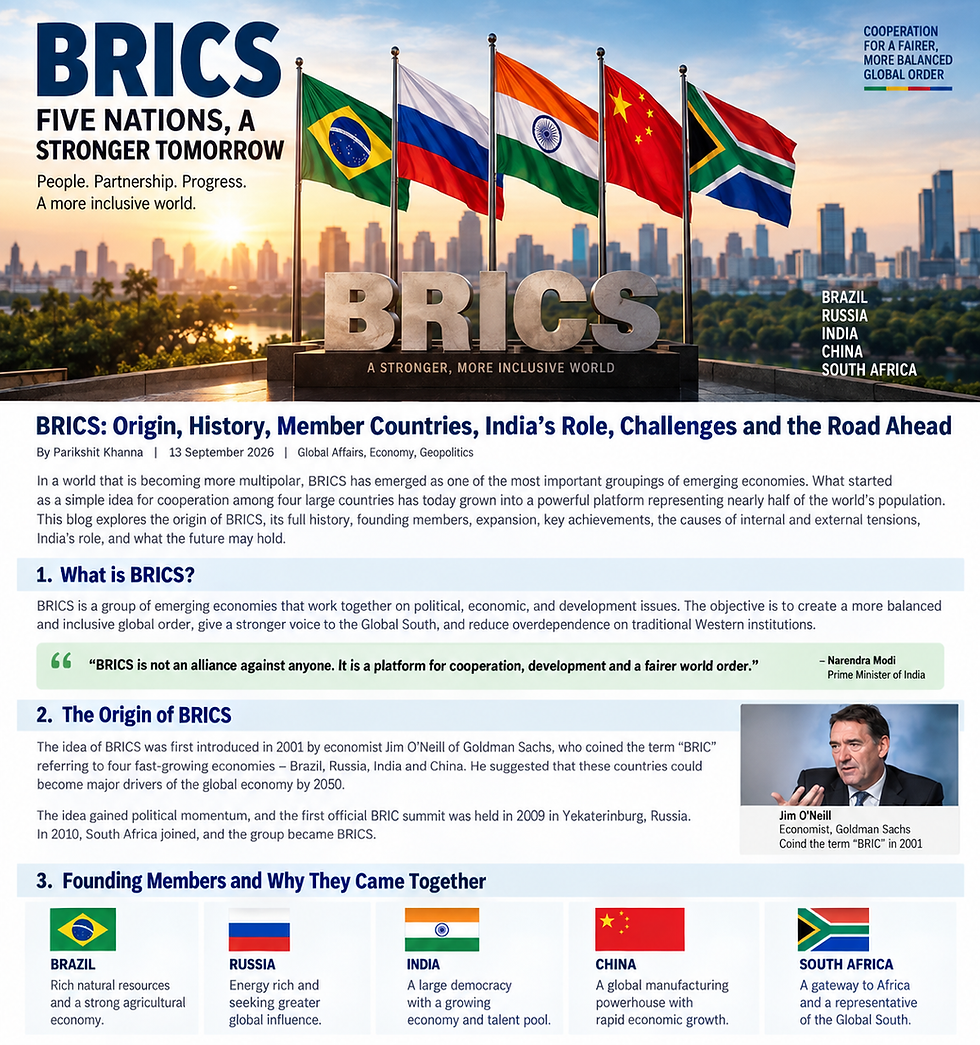
The term BRIC was coined in 2001 by economist Jim O’Neill of Goldman Sachs.
It referred to four fast-growing emerging economies:
Brazil, Russia, India and China.
O’Neill’s argument was economic rather than political. He believed these four economies could become much more important to the world economy over the following decades.
Therefore, Jim O’Neill created the acronym, but he did not create BRICS as a political organisation.
The governments of Brazil, Russia, India and China later converted the economic idea into an international diplomatic grouping.

Who Were the Founding Members of BRICS?
The original political grouping consisted of four countries:
Country | Status |
Brazil | Founding BRIC member |
Russia | Founding BRIC member |
India | Founding BRIC member |
China | Founding BRIC member |
South Africa was not one of the original four founders.
The BRIC countries agreed in 2010 to admit South Africa. South Africa participated in its first summit in Sanya, China, in 2011, after which BRIC became BRICS.
This distinction is important because BRICS is often described today as having five original members. Historically, however, the original BRIC comprised Brazil, Russia, India and China; South Africa joined during the first expansion.
How Did BRIC Become a Political Group?
The transition happened gradually.
In 2006, leaders of Russia, India and China met on the margins of the G8 Outreach Summit in St Petersburg. Later that year, the foreign ministers of Brazil, Russia, India and China met on the sidelines of the United Nations General Assembly in New York.
That meeting helped formalise BRIC political cooperation.
Three years later, the first BRIC leaders’ summit was organised.
First BRIC Summit: 2009
The first formal summit of BRIC leaders took place in Yekaterinburg, Russia, on 16 June 2009.
The participants represented:
Brazil
Russia
India
China
The timing was highly significant.
The world was dealing with the consequences of the 2008 global financial crisis, which had raised serious questions about the international financial architecture and the dominance of institutions created largely under Western leadership.
The four countries wanted emerging economies to receive a greater voice in global economic decision-making.
The 2009 summit therefore helped transform BRIC from an interesting economic concept into a real diplomatic platform.

South Africa Joins and BRIC Becomes BRICS
In 2010, the four countries agreed to invite South Africa.
South Africa then participated in the third summit in Sanya in 2011.
This changed:
BRIC → BRICS
The addition of South Africa also gave the grouping a stronger African presence and helped BRICS present itself increasingly as a platform connecting large emerging economies across multiple continents.
BRICS History: Major Milestones
Year | Major Development |
2001 | Jim O’Neill coins the term BRIC |
2006 | Brazil, Russia, India and China begin formal diplomatic cooperation |
2009 | First BRIC leaders’ summit in Yekaterinburg |
2010 | South Africa invited to join |
2011 | South Africa attends its first summit; BRIC becomes BRICS |
2012 | New Delhi summit explores creation of a BRICS development bank |
2014 | Agreement establishing the New Development Bank is signed |
2015 | New Development Bank begins operations |
2016 | India hosts the Goa BRICS Summit |
2020–2022 | Cooperation continues through the pandemic period, including virtual summits |
2023 | Johannesburg summit approves major expansion |
2024 | Egypt, Ethiopia, Iran and UAE become full members |
2025 | Indonesia becomes a full member |
2026 | India holds the BRICS chairship and hosts the 18th Summit in New Delhi |
The official MEA history confirms the summit sequence from Yekaterinburg in 2009 through the major expansion era.
The New Development Bank: BRICS Becomes More Than a Discussion Forum
One of the most important moments in BRICS history occurred in New Delhi in 2012.
At the fourth BRICS Summit, leaders considered the creation of a new development bank.
The proposal eventually became the New Development Bank, or NDB.
The agreement establishing the NDB was signed at the 2014 Fortaleza Summit, and the institution became operational during the following period. Indian banker K. V. Kamath became its first president.
The NDB finances areas including:
Clean energy
Transport infrastructure
Water and sanitation
Social infrastructure
Digital infrastructure
Sustainable urban development
By 2026 the NDB reported tens of billions of dollars in approved financing across more than one hundred projects. Its recent Indian portfolio includes energy infrastructure, affordable housing and the Lucknow Metro.
For this reason, the NDB is arguably BRICS’ most tangible institutional achievement.
The Big BRICS Expansion
For more than a decade, BRICS remained a five-country grouping.
That changed dramatically at the 2023 Johannesburg Summit.
Leaders approved another major expansion.
Egypt, Ethiopia, Iran and the United Arab Emirates became full members in 2024. Indonesia joined as a full member in 2025.
India’s official 2026 material describes the grouping as consisting of:
Brazil, China, Egypt, Ethiopia, India, Indonesia, Iran, Russia, Saudi Arabia, South Africa and the United Arab Emirates.
There is an important technical qualification.
Reuters reported in September 2026 that Saudi Arabia had been invited but had not formally completed accession, which is why some international reporting refers to a ten-member grouping while official Indian material refers to eleven.
The expansion gives BRICS a much wider geographical presence across Asia, Africa, Latin America and the Middle East.
What Does BRICS Actually Want?
BRICS is not a military alliance like NATO.
It is also not a political union like the European Union.
BRICS operates primarily through consultation, cooperation and consensus.
Its agenda broadly covers three areas:
Political and security cooperation
Economic and financial cooperation
Cultural and people-to-people cooperation
Its broader objectives include strengthening the influence of emerging economies, expanding South-South cooperation and reforming global institutions so that they better reflect the economic and demographic realities of the modern world.

Why Did Tensions and “Disturbances” Develop Inside BRICS?
BRICS has never been a completely unified geopolitical bloc.
Its members have different national interests, political systems, security concerns and relationships with the United States, Europe and other global powers.
Several issues have repeatedly created friction.
1. India-China Border Tensions
Perhaps the most obvious internal strategic tension has involved India and China.
Relations deteriorated sharply after the deadly military confrontation along the disputed Himalayan border in 2020.
Even though both countries continued cooperating within BRICS, the border dispute created deep strategic mistrust.
Relations have since begun improving. At the 2026 New Delhi BRICS Summit, Prime Minister Narendra Modi and President Xi Jinping discussed rebuilding ties, business links and border stability. However, border negotiations and strategic competition remain unresolved issues.
2. Russia-Ukraine War
Russia’s invasion of Ukraine created another major challenge.
BRICS members did not adopt identical positions on the war.
Russia became heavily sanctioned by Western economies, while countries such as India continued relations with Russia while also maintaining significant partnerships with the United States and Europe.
This highlighted an important feature of BRICS:
The members may cooperate economically without sharing the same foreign policy.
3. Different Relationships With the West
Russia and Iran have strong reasons to reduce dependence on Western financial and political systems.
India, Brazil, South Africa and the UAE maintain significant economic relationships with Western countries.
India, for example, participates in BRICS while also developing strategic relationships with the United States, Europe, Japan and Australia.
This means some members may see BRICS partly as a mechanism for challenging Western dominance, while others see it primarily as a platform for reforming the global system rather than opposing the West.
4. Debate Over Expansion
Expansion increases BRICS’ global reach, but it also makes consensus more difficult.
More members mean more:
National priorities
Security interests
Regional disputes
Economic models
Foreign-policy differences
Reuters noted in September 2026 that differing national priorities have complicated consensus-building, particularly since expansion.
5. China’s Economic Weight
China is by far one of the largest economies within BRICS.
This creates an internal balancing challenge.
India and other members generally favour a multipolar international order. That objective would be weakened if BRICS itself became dominated by one country.
India therefore plays an important role in maintaining strategic balance inside the grouping.
Is BRICS Trying to Replace the US Dollar?
This issue generates enormous attention, but the reality is more nuanced.
BRICS does not currently have a common currency.
Some members have strongly advocated reducing dependence on the US dollar, particularly for trade and cross-border financial transactions.
However, reducing dollar dependence is not the same thing as launching a single BRICS currency.
During India’s 2026 chairship, official discussions emphasised linking payment systems and increasing trade in national currencies.
The 2026 New Delhi Declaration focused on local-currency settlement, payment connectivity and development financing rather than announcing one unified BRICS currency.
India has generally taken a more practical approach: increase the use of domestic currencies where useful without rushing into the creation of a supranational BRICS currency.

India’s Role in BRICS
India has been involved in BRICS since the beginning of the political process.
Its role has grown significantly over the years.
1. India Was One of the Four Original Members
India was part of the original BRIC grouping alongside Brazil, Russia and China.
It participated in the diplomatic process beginning in 2006 and in the first summit in 2009.
2. India Helped Create the New Development Bank
The idea of establishing a BRICS development bank was formally advanced during the 2012 New Delhi Summit.
This became one of BRICS’ most important institutions.
India also supplied the NDB’s first president, K. V. Kamath.
3. India Advocates for the Global South
India frequently uses BRICS to support reforms to international institutions.
New Delhi argues that bodies such as the United Nations, IMF and World Bank should provide emerging and developing economies greater representation.
This aligns with India’s wider effort to position itself as a major voice of the Global South.
4. India Acts as a Bridge
India occupies an unusual geopolitical position.
It can cooperate with Russia and China inside BRICS while simultaneously strengthening partnerships with the United States, Europe, Japan and Australia.
That makes India an important bridge between different political and economic camps.
India’s approach has generally favoured strategic autonomy rather than alignment with one bloc.
5. India Favours Practical Cooperation
Rather than making BRICS solely about geopolitical competition, India has pushed practical areas such as:
Digital public infrastructure
Artificial intelligence
Health
Education
Agriculture
Sustainable development
Trade
Resilient supply chains
Local-currency payments
Institutional reform
During its 2026 chairship, India promoted cooperation in areas ranging from AI and digital infrastructure to health, agriculture and innovation.
India’s BRICS Presidency in 2026
India chaired BRICS for the fourth time in 2026.
The theme was:
“Building for Resilience, Innovation, Cooperation and Sustainability.”
The 18th BRICS Summit was held in New Delhi on 12–13 September 2026.
The summit focused on issues including:
Reform of international institutions
Trade and development
Artificial intelligence
Digital public infrastructure
Sustainable development
Health cooperation
Cross-border payments
Local-currency transactions
Supply chains
Geopolitical conflicts
The summit adopted the New Delhi Declaration, reaffirming cooperation based on sovereignty, inclusiveness, consensus and a more representative international system.
One significant diplomatic achievement was the ability of countries with substantially different geopolitical positions to agree on language calling for restraint and diplomacy amid Middle East tensions.
India therefore used its chairship not merely to expand BRICS’ visibility but to emphasise practical cooperation and consensus.
India and China at the 2026 Summit
The New Delhi Summit was also significant because President Xi Jinping visited India and met Prime Minister Modi.
The two leaders discussed improving trade and transport links while continuing efforts to stabilise relations after the 2020 border confrontation.
Modi emphasised that peace along the border remained essential for improving the broader relationship.
This demonstrates another part of BRICS’ importance to India: the organisation can provide diplomatic space for engagement even when bilateral relationships are difficult.
BRICS and Artificial Intelligence
Artificial intelligence has become an increasingly important part of the BRICS agenda.
At the 2026 summit, AI cooperation featured prominently, including discussions around ethical and inclusive AI and technology suited to developing economies.
For India, this connects directly with its wider strategy around:
Digital public infrastructure
AI for development
Skills
Innovation
Startups
Manufacturing
Education
Agriculture
India has therefore attempted to move BRICS beyond traditional discussions of geopolitics and finance toward emerging technologies that may shape future economic power.

Is BRICS Anti-West?
Describing BRICS simply as an “anti-West alliance” is misleading.
Some members, particularly Russia and Iran, have strong strategic disagreements with the United States and Europe.
China frequently argues for alternatives to Western-dominated institutions.
However, India and several other members maintain extensive relationships with Western economies.
The better description is that BRICS seeks to create greater space for emerging powers and the Global South within the international system.
Some members favour challenging Western influence more aggressively than others.
That disagreement is one of the reasons BRICS remains a consensus-based forum rather than a tightly integrated alliance.
The Biggest Achievements of BRICS
BRICS has produced several significant outcomes.
New Development Bank
Its most visible institution, financing infrastructure and sustainable-development projects.
Contingent Reserve Arrangement
A financial mechanism designed to support members during short-term balance-of-payments pressures.
Global South Representation
BRICS has helped amplify demands for reform of the United Nations, IMF, World Bank and other institutions.
Expansion of South-South Cooperation
BRICS creates direct cooperation among major developing economies across several continents.
New Cooperation Areas
Its agenda now includes health, education, science, digital infrastructure, AI, agriculture, cities and innovation.
The Biggest Challenges Ahead
The future of BRICS will depend on whether it can solve five major problems.
First, diversity versus consensus. More members increase influence but make agreement more difficult.
Second, India-China relations. The two Asian giants must manage competition while continuing to cooperate inside the grouping.
Third, geopolitical wars and sanctions. Conflicts involving Russia, Iran and other countries can expose sharp differences.
Fourth, economic asymmetry. China’s economic scale creates questions over balance within the organisation.
Fifth, delivery. BRICS must prove that it can generate measurable economic and development outcomes rather than simply issue summit declarations.
What Is the Future of BRICS?
BRICS is likely to remain influential because it reflects a genuine structural change in the world economy.
Emerging economies want:
Greater influence in international institutions
More development finance
More diversified trading relationships
Greater technological cooperation
Greater use of local currencies
A larger voice for the Global South
But expansion alone will not guarantee success.
The real test is whether BRICS can translate size into effective cooperation.
For India, that means pushing BRICS toward development, reform, technology, trade and practical problem-solving without allowing the grouping to become controlled by one power or converted into a rigid anti-Western alliance.
Conclusion
The history of BRICS is remarkable.
It began in 2001 as an investment acronym.
It became a diplomatic dialogue in 2006.
It held its first leaders’ summit in 2009.
South Africa joined in 2011, turning BRIC into BRICS.
The grouping created the New Development Bank, expanded into Africa, the Middle East and Southeast Asia, and by 2026 had become a major forum in debates over global governance and the future of the Global South.
Yet BRICS also faces serious internal tensions.
India-China rivalry, the Russia-Ukraine war, different relationships with Western countries, disagreement over currencies and the complexities of expansion all test its unity.
This is where India’s role becomes especially important.
India is simultaneously a founding member, a major developing economy, a democracy, a Global South leader and a strategic partner of countries outside BRICS.
Its long-term objective appears to be neither a Western-dominated world nor a China-dominated alternative, but a genuinely multipolar international system.
The future of BRICS will therefore depend not simply on how many countries join it, but on whether countries with profoundly different interests can cooperate on the issues where their interests genuinely converge.
Disclaimer
This article has been prepared and published solely for general informational, educational and awareness purposes.
The content represents a good-faith compilation and interpretation of information obtained from publicly available sources, official publications, media reports, research material and other references believed to be reliable at the time of writing. However, geopolitical developments, diplomatic positions, economic data, international memberships, government policies, leadership positions and institutional arrangements may change at any time.
Parikshit Khanna, Digital Training Jet Pvt. Ltd., Digital Training Jet, its founders, directors, employees, trainers, consultants, associates, contractors, representatives, partners and team members make no representation, guarantee or warranty, express or implied, regarding the completeness, accuracy, reliability, suitability, timeliness or continued validity of any information contained in this article.
The article should not be treated as legal, financial, investment, diplomatic, political, economic, tax, compliance, foreign-policy or professional advice. Readers should independently verify all material facts and consult appropriately qualified professionals, government authorities or official sources before taking any action based on the information contained herein.
Any discussion concerning BRICS countries, governments, political leaders, diplomatic relations, international conflicts, sanctions, currencies, economic policies, international institutions or geopolitical developments is intended only for neutral educational and analytical discussion. Nothing in this article should be interpreted as an endorsement, criticism, political position, diplomatic representation or official statement on behalf of any government, institution, organisation, political party, company or individual.
The mention of any country, government, public official, organisation, institution, company, publication, trademark, logo or third-party source is for identification, commentary, reference or educational purposes only and does not imply sponsorship, endorsement, affiliation, partnership or approval.
Images, maps, illustrations, infographics and AI-generated visuals accompanying this article are representational and illustrative in nature. They should not be interpreted as documentary evidence, official government material or a precise representation of political boundaries, diplomatic positions, historical events or current geopolitical conditions.
To the maximum extent permitted by applicable law, Parikshit Khanna, Digital Training Jet Pvt. Ltd., Digital Training Jet and all associated team members, employees, representatives and contributors shall not be responsible or liable for any direct, indirect, incidental, consequential, special, financial, reputational, commercial or other loss, damage, dispute, claim, misunderstanding, decision or action arising from or connected with the reading, interpretation, use, misuse or reliance upon this article or its accompanying materials.
Readers access and use this content entirely at their own discretion and risk.
No part of this publication should be construed as creating any contractual, fiduciary, advisory, professional or other legal relationship between the reader and Parikshit Khanna, Digital Training Jet Pvt. Ltd., Digital Training Jet or any member of their team.
Where information differs between official sources, media organisations or international institutions, such differences may reflect evolving events, terminology or diplomatic positions. Readers are encouraged to consult the latest official sources for verification.
The publisher reserves the right to correct, revise, update, modify or remove any portion of this article at any time without prior notice.
By reading, accessing, sharing or relying upon this article, the reader acknowledges and accepts the limitations stated in this disclaimer.
Copyright and Publication Notice:Unless otherwise stated, the original commentary and presentation of this article are published for educational and informational purposes. Third-party names, marks and references remain the property of their respective owners.
Important: No disclaimer can exclude liability where exclusion is prohibited by applicable law. This disclaimer should therefore be interpreted only to the fullest extent legally permissible.


