ChatGPT, Gemini, and the Rise of AI Romance in India: Trend or Transformation?

Updated: Aug 16

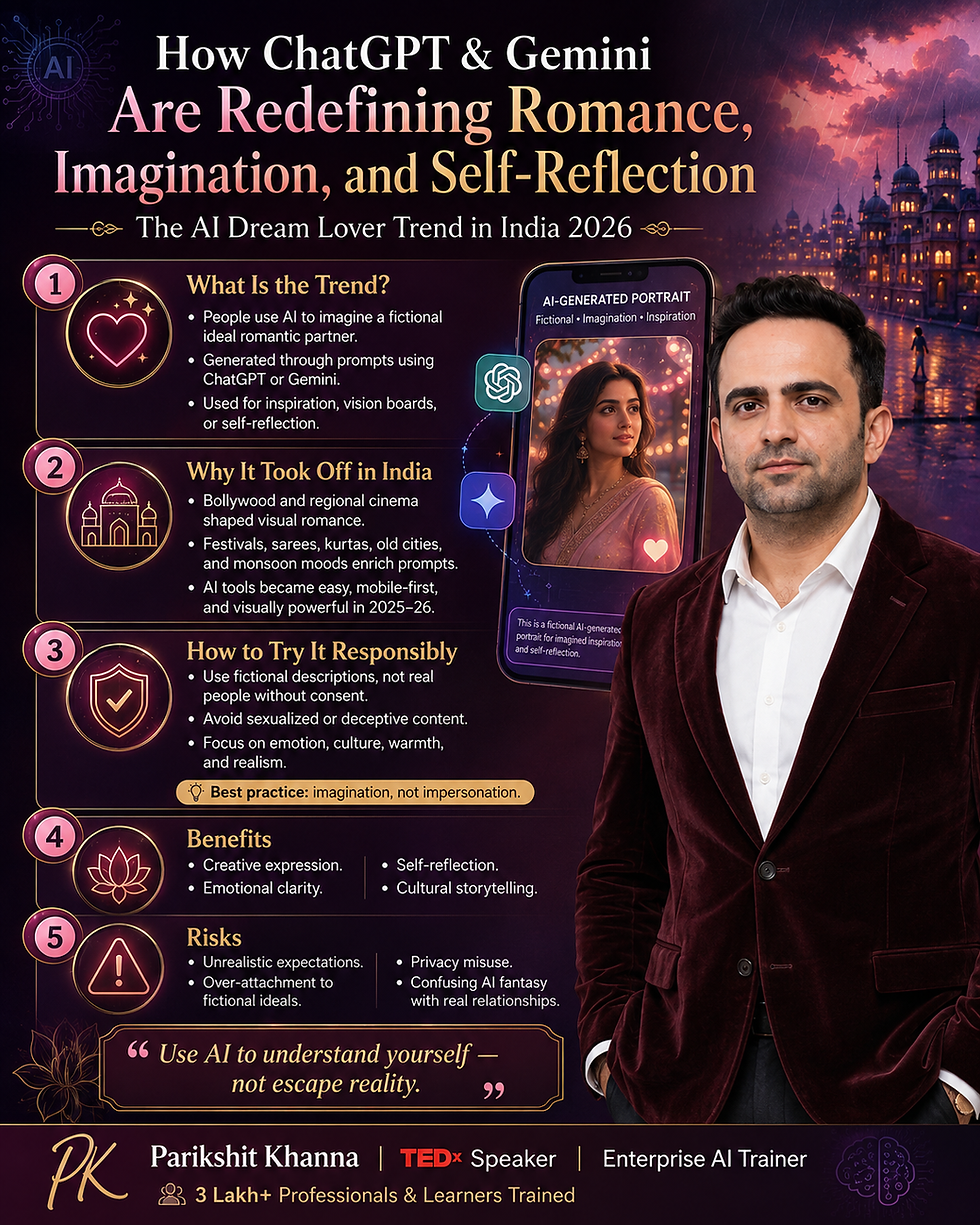
AI Dream Lover Trend in India 2026: How ChatGPT & Gemini Are Changing Romance, Imagination and Self-Reflection
Updated: August 2026
Artificial Intelligence is increasingly influencing not only how people work, study and create content, but also how they visualise identity, aspiration, relationships and personal imagination.
One emerging social-media concept is sometimes described as the “AI Dream Lover” trend.
The idea is simple: a user gives an AI image-generation system a description of an imaginary ideal partner and asks the system to visualise that fictional person.
Some users approach it as entertainment.
Others treat it like a digital vision board.
Some use it to explore questions such as:
What qualities actually matter to me in a partner?
What kind of emotional energy do I associate with companionship?
How much of my idea of romance comes from cinema, culture, social media or personal experience?
Tools such as ChatGPT and Google Gemini have made this type of creative experimentation increasingly accessible to ordinary users.
But there is an important distinction:
AI can visualise an imagined relationship. It cannot predict who you will marry, identify your “soulmate,” or determine what a healthy real-world relationship will look like.
Used thoughtfully, the trend can be creative.
Used uncritically, it can reinforce unrealistic expectations.
This guide examines both sides.
What Is the AI Dream Lover Trend?
The term generally refers to using Generative AI to create an image or description of a fictional ideal romantic partner.
Users may specify qualities such as:
personality;
emotional temperament;
cultural background;
clothing;
age range;
setting;
artistic style;
and overall mood.
For example, someone may ask an AI system to create:
“A fictional Indian partner with a warm personality, calm confidence and a natural smile, photographed during a monsoon evening in an old Delhi neighbourhood.”
The result is not a prediction.
It is an AI-generated interpretation of the instructions provided.
That means the image often reveals as much about the user's prompt and cultural imagination as it does about the capabilities of the AI model.
Why the Idea Resonates in India
India has a particularly rich visual language around romance.
Bollywood and regional cinema have spent decades associating love with:
monsoon rain, railway stations, old cities, hill stations, weddings, festivals, traditional clothing, music, eye contact, family relationships and elaborate storytelling.
Generative AI gives users the ability to recombine these cultural references into personalised fictional scenes.
A user can move from:
“Create my ideal partner.”
to something far more specific:
“Create a fictional romantic character in an understated cotton saree, standing on a quiet Jaipur terrace just after rain, natural expression, warm evening light, no glamour styling.”
That level of creative control is part of what makes AI-generated imagery compelling.
From Fantasy Portraits to Emotional Storytelling
Early AI portrait experimentation often focused heavily on appearance.
The more interesting shift is toward emotion and context.
Instead of simply specifying:
tall, attractive, fashionable
users can describe:
calm
emotionally available
intelligent
humorous
grounded
supportive
independent
family-oriented
curious
confident without being dominating
This changes the exercise.
It becomes less about creating a supposedly “perfect face” and more about articulating the kind of emotional qualities a person associates with a healthy relationship.
That is where the trend becomes more interesting from a self-reflection perspective.
What AI Is Actually Doing
AI is not discovering a hidden future partner.
It is generating an image based on patterns learned from training data and the instructions provided by the user.
A prompt describing:
“an elegant Indian woman in a saree during golden hour”
will produce imagery influenced by patterns associated with those concepts.
A prompt describing:
“a thoughtful Indian man wearing a simple kurta, reading in a quiet café”
will produce a different visual interpretation.
The system does not know who your future partner is.
It does not understand destiny.
It does not possess privileged insight into your emotional future.
It is performing generative interpretation.
Understanding that distinction keeps the experience creative rather than deceptive.
How to Create an AI Dream Partner Responsibly
A safer workflow is to create a completely fictional character rather than asking AI to imitate a particular real person.
Start with personality rather than physical perfection. Describe emotional characteristics such as kindness, humour, independence, curiosity or calmness.
Make the character explicitly fictional. Include wording such as: “This person must not resemble any identifiable real person.”
Add cultural context carefully. You can describe Indian clothing, architecture, seasons, festivals or cities without turning cultures into stereotypes.
Refine realism rather than perfection. Ask for natural skin texture, believable expressions and everyday styling instead of impossible beauty standards.
Protect privacy. If you upload your own photograph, first consider whether you are comfortable providing that image to the specific AI service and review its current privacy settings and terms.
Beginner Prompt
Create a realistic portrait of a completely fictional romantic partner.

The person should have a warm, approachable expression and a calm,
confident personality conveyed through natural body language.

Use realistic lighting and natural skin texture.

The character must be imaginary and must not resemble any identifiable
real person.

The purpose is creative visualisation and self-reflection, not prediction.
Indian Cultural Portrait Prompt
Create a cinematic but realistic portrait of a completely fictional
Indian romantic character.

Personality:
warm, emotionally mature, intelligent, calm and quietly confident.

Appearance:
natural expression, subtle smile, realistic skin texture and understated
traditional Indian clothing.

Setting:
a peaceful monsoon evening in an old Indian neighbourhood with warm
street lights and subtle rain reflections.

Avoid excessive glamour, unrealistic beauty standards or celebrity
resemblance.

The subject must not resemble any identifiable real person.
Emotional-Qualities Prompt
A more useful exercise may be to start with values instead of appearance.
Help me visualise a fictional romantic partner based primarily on
relationship qualities rather than physical appearance.

The person should communicate:

emotional maturity,
kindness,
good listening,
independence,
humour,
curiosity,
confidence,
respect for boundaries,
and warmth.

Create a natural everyday portrait rather than a glamorous fashion image.

Make the character entirely fictional and unrelated to any real person.
This type of prompt can reveal something meaningful:
Which qualities did you prioritise?
That question may be more useful than whether the resulting portrait is attractive.
A Better Exercise: Ask AI About Values Before Generating the Image
Before creating a portrait, ask the AI:
Ask me 10 thoughtful questions that will help me identify what I value
in a long-term romantic relationship.

Focus on communication, emotional safety, independence, family,
ambition, humour, conflict resolution, lifestyle and shared values.

Do not ask me to describe physical appearance yet.
After answering, you can then ask:
Based only on the relationship values I described, create a fictional
character concept representing those qualities.

Do not claim that this predicts my future partner.

Explain which parts of the character were inspired by my answers.
This turns the activity into a more thoughtful self-reflection exercise rather than simply a beauty-generation game.
The Psychology: Why AI-Generated Partners Can Feel Surprisingly Personal
AI-generated imagery can feel emotionally powerful because the user participates directly in constructing it.
You decide:
personality;
appearance;
atmosphere;
clothing;
expression;
location;
and emotional tone.
The result therefore reflects your own preferences back at you.
This can create a strong feeling of recognition:
“That looks like the kind of person I imagine being with.”
But emotional resonance should not be confused with predictive accuracy.
The AI image feels personal largely because you supplied the personal context.
Potential Benefits
Used with the right framing, this type of AI activity can support:
Creative expression — users can turn abstract ideas into visual scenes.
Self-reflection — describing an ideal partner can reveal personal values.
Cultural storytelling — users can explore Indian visual aesthetics in new ways.
Writing inspiration — fictional characters can support novels, scripts, poetry and storytelling.
Vision-board creation — users may use imagery to represent broader aspirations around companionship and lifestyle.
The useful part is not that AI supposedly reveals destiny.
The useful part is that the exercise may help users articulate what they value.
Where the Trend Can Become Unhealthy
The same technology can become problematic when fictional imagery begins to distort expectations.
Unrealistic Appearance Standards
AI can create highly idealised faces and bodies.
Repeated exposure may subtly shift expectations toward combinations of features that are rare or artificially perfected.
Real people have:
bad hair days;
ageing;
imperfections;
changing bodies;
complicated emotions;
conflicting priorities;
and ordinary moments.
Healthy relationships exist in that reality.
Emotional Over-Attachment
A fictional AI character cannot:
disagree authentically;
develop independently;
establish its own boundaries;
surprise you through genuine personal growth;
or participate in a reciprocal human relationship.
If someone begins preferring controllable fictional partners over unpredictable human relationships, the technology may stop functioning as harmless creative entertainment.
That is an important boundary.
Consent and Deepfake Risk
One of the clearest ethical boundaries is the use of real people.
Avoid generating romantic or sexualised images of:
colleagues;
classmates;
former partners;
acquaintances;
influencers;
celebrities;
or private individuals
without appropriate consent.
Creating an imaginary person is fundamentally different from fabricating intimate or deceptive imagery of an identifiable person.
A useful rule is:
Imagination is different from impersonation.
Privacy Matters When Uploading Selfies
Some users may upload their own photograph so an AI system can create a fictional couple scene.
Before doing so, consider:
What happens to the uploaded photograph?
How long is it retained?
Can it be used to improve services?
Can you delete it?
Is the account personal or enterprise-controlled?
Are you comfortable with the image being processed by the service?
AI products and privacy terms change frequently.
Always review the current settings and policies of the tool you are using.
ChatGPT vs Gemini for This Kind of Creative Experiment
Both platforms can support multimodal creative workflows, although their exact image capabilities, limits and interfaces can change.
Rather than asking:
“Which AI is universally better?”
ask:
Which tool gives me the right combination of image quality, editing control, privacy settings and workflow convenience for my specific task?
You may find that one platform works better for an initial concept while another works better for subsequent refinement.
The broader lesson is:
learn the workflow, not just the brand.
AI Romance Is Part of a Bigger Cultural Shift
The Dream Lover concept is one small example of a much larger transformation.
Generative AI increasingly allows people to visualise:
future homes
wedding concepts
career identities
travel dreams
fashion styles
fictional characters
personal brands
family scenarios
creative alter-egos
and imagined versions of their future lives.
The technology is turning imagination into something immediately visible.
That is culturally significant.
Previously, imagining something required:
thought → description → artist/designer → visual
Now the loop can become:
thought → prompt → image → refinement
within minutes.
What Could Come Next?
The next generation of these experiences may combine:
AI images + video + voice + augmented reality + interactive storytelling
That could create sophisticated fictional relationship narratives, wedding visualisations or immersive story experiences.
At the same time, stronger safeguards will become increasingly important around:
consent;
impersonation;
minors;
sexual content;
privacy;
emotional dependency;
and disclosure of synthetic media.
The technology may become more immersive.
That makes digital literacy more important, not less.
Parikshit Khanna's Perspective: AI Should Expand Imagination, Not Replace Reality
Parikshit Khanna, TEDx Speaker, Enterprise AI Trainer and Founder of Digital Training Jet, works with professionals, students and organisations on practical applications of Generative AI.
His stated cumulative training and learning reach is 3 lakh+ professionals and learners.
From an AI-literacy perspective, the Dream Lover trend illustrates an important lesson:
The more emotionally powerful AI becomes, the more important human judgement becomes.
AI can help people:
visualise
brainstorm
explore
write
create
reflect
But it should not be treated as an authority on:
love
compatibility
mental health
destiny
or the value of a real human relationship.
The healthiest approach is neither fear nor blind enthusiasm.
It is informed experimentation.
Final Takeaway
The most interesting part of the AI Dream Lover concept is not whether an AI can create an attractive fictional partner.
Modern image-generation systems clearly can create increasingly convincing fictional portraits.
The more interesting question is:
What does the prompt reveal about the person writing it?
Do you prioritise beauty?
Humour?
Ambition?
Stability?
Kindness?
Emotional availability?
Family?
Adventure?
Independence?
Shared values?
When approached this way, Generative AI becomes less of a fortune-telling machine and more of a creative mirror.
That is a healthier way to interpret the trend.
Remember
AI can visualise your imagination.
It cannot predict your future relationship.
AI can help you articulate preferences.
It cannot determine compatibility.
AI can create fictional companionship.
It cannot reproduce the reciprocity of a real human relationship.
The best principle for 2026 is therefore simple:
Use AI to explore imagination—not to escape reality.
Important Disclaimer
This article is intended for education, commentary and creative-awareness purposes only.
The term “AI Dream Lover trend” is used to describe an emerging form of AI-assisted creative experimentation and should not be interpreted as an official platform category, scientifically established psychological phenomenon or independently measured nationwide behaviour unless specific research is cited.
AI-generated images of fictional partners are not predictions of future relationships, marriage, compatibility or destiny.
The article does not provide psychological, psychiatric, medical or relationship counselling.
Anyone experiencing significant loneliness, emotional distress, relationship difficulties or unhealthy dependence on AI should seek appropriate support from qualified professionals and trusted people in their real-life support network.
Do not create deceptive, intimate or sexualised synthetic images of identifiable people without consent.
Users should review the current privacy, retention and image-processing terms of ChatGPT, Gemini or any other service before uploading personal photographs.
Product capabilities, image-generation features, subscription requirements and safety policies may change over time.

