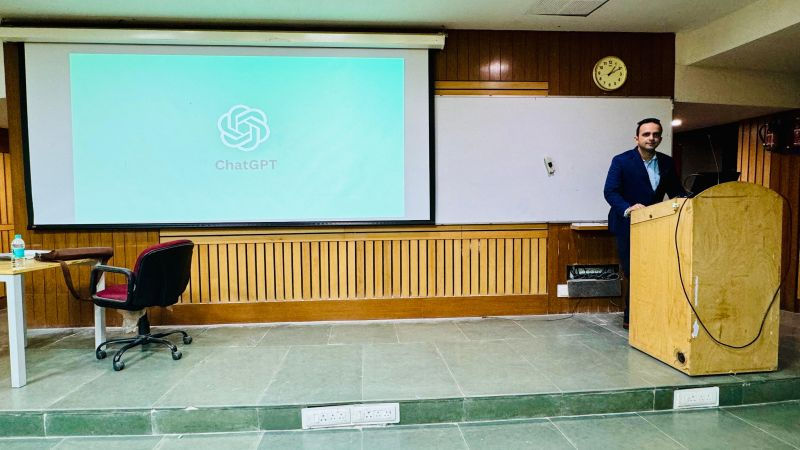
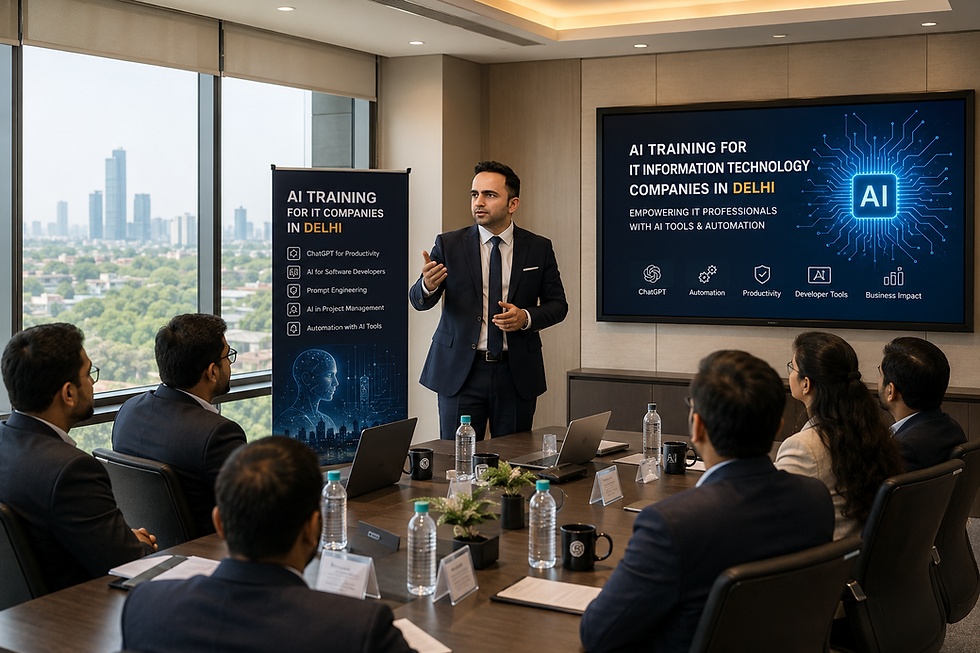
Corporate AI Training in Delhi
- Parikshit Khanna
- Jul 15
- 13 min read
Corporate AI Training in Delhi: Practical 1–7 Day Enterprise AI Masterclass for Future-Ready Organisations

Artificial intelligence is rapidly changing how organisations create documents, analyse information, communicate with customers, automate workflows, develop applications and make business decisions.
However, simply purchasing AI tools does not guarantee successful AI adoption.
Employees need practical training, approved workflows, responsible-use guidelines and department-specific examples to use artificial intelligence confidently and safely. Without structured AI enablement, organisations may face inconsistent outputs, data-security concerns, duplicated work, low tool adoption and limited return on their technology investments.
To address this challenge, Parikshit Khanna offers customised Corporate AI Training and AI Adaptability Masterclasses for organisations in Delhi and across India.
The programs can be delivered as focused one-day masterclasses, two-day workshops, three-day capability-building programs or complete seven-day enterprise AI training engagements.
Training is available in the following formats:
Onsite corporate training
Live online instructor-led training
Hybrid training
Department-wise AI workshops
Leadership and CXO masterclasses
Special programs designed on demand
The curriculum can cover Claude, Microsoft Copilot, Agentic AI, RAG models, n8n automation, vibe coding and more than 15 Generative AI tools for text, documentation, research, presentations, graphics, data analysis, workflow automation and business productivity.
Why Corporate AI Adaptability Is Now a Business Priority
AI adaptability is the ability of an organisation and its employees to understand, adopt and responsibly apply artificial intelligence in everyday work.
Many companies currently face one or more of these challenges:
Employees are experimenting with AI without a common framework.
Teams are unsure which information can safely be entered into public AI platforms.
Managers cannot measure whether AI is actually improving productivity.
Different departments are using disconnected tools and processes.
Employees know basic prompting but cannot build repeatable workflows.
AI-generated documents require excessive correction.
Teams struggle to move from experimentation to implementation.
Leadership needs a practical AI roadmap rather than another theoretical presentation.
A structured corporate AI training program helps organisations move from random tool usage to purposeful, secure and measurable AI adoption.
The objective is not to replace employees. The objective is to help employees complete repetitive work faster, improve the quality of business communication, discover insights from organisational knowledge and dedicate more time to strategic activities.
Corporate AI Masterclass by Parikshit Khanna
The Corporate AI Masterclass is a practical, demonstration-led and hands-on learning program conducted by Parikshit Khanna, Corporate AI Trainer, Prompt Engineer and Corporate Enablement Specialist.
Each program is customised according to the organisation’s:
Industry
Departmental requirements
Employee experience levels
Existing technology stack
Data-security policies
Business goals
Preferred AI platforms
Training duration
Expected outcomes
The training can be designed for leadership teams, managers, functional departments, technical employees, non-technical employees or cross-functional groups.
Participants learn through practical demonstrations, guided exercises, prompt frameworks, departmental use cases and supervised workflow-building activities.
Core Topics Covered in the Corporate AI Training
1. Generative AI Fundamentals and Organisational Readiness
Participants develop a clear understanding of:
What Generative AI can and cannot do
How large language models generate responses
Differences between public, private and enterprise AI environments
Suitable and unsuitable workplace use cases
Human review and accountability
Hallucinations, bias and factual verification
Responsible AI adoption
Data privacy and confidentiality
Creating an organisation-wide AI usage framework
This module establishes a common language around AI before employees begin working with advanced tools.
2. Prompt Engineering for Business Teams
Employees learn how to replace vague instructions with structured prompts that produce more accurate and usable outputs.
The training can include:
Role, context, task and output frameworks
Prompt constraints and quality controls
Multi-step prompting
Iterative prompt improvement
Prompt templates for recurring tasks
Zero-shot and few-shot prompting
Prompting for analysis and decision support
Prompting for different departments
Creating reusable organisational prompt libraries
Evaluating and correcting AI-generated responses
Participants practise prompts connected to their actual workplace responsibilities instead of depending only on generic examples.
3. Claude Training for Corporate Documentation and Analysis
Claude can support employees who regularly work with long documents, business communication, policies, reports, research and structured writing.
The Claude training module may include:
Drafting and improving business documents
Summarising long reports
Comparing multiple documents
Extracting action points
Creating standard operating procedures
Rewriting technical information for non-technical readers
Analysing meeting notes
Preparing executive summaries
Developing policies and internal guidelines
Creating structured reports
Reviewing document consistency
Building reusable Claude Projects and knowledge-based workflows
Understanding safe document-upload practices
Employees learn to use Claude as an assisted reasoning and documentation environment while retaining human review and organisational accountability.
4. Microsoft Copilot Enterprise Training
The Microsoft Copilot module can be customised for organisations using Microsoft 365.
Training may cover practical applications within:
Microsoft Word
Drafting reports and proposals
Rewriting complex documents
Summarising lengthy files
Converting notes into structured documents
Creating executive summaries
Microsoft PowerPoint
Developing presentation structures
Transforming documents into presentations
Improving slide narratives
Creating speaker notes
Condensing lengthy presentations
Microsoft Excel
Understanding datasets
Generating formulas
Identifying trends
Summarising tables
Creating management-level explanations
Microsoft Outlook
Drafting professional emails
Summarising lengthy email conversations
Extracting actions and deadlines
Improving communication quality
Microsoft Teams
Summarising meetings
Capturing decisions
Preparing follow-up notes
Identifying responsibilities and action items
The program can also introduce enterprise governance, access controls, responsible usage and adoption planning for Microsoft Copilot.
5. Fifteen-Plus Generative AI Tools for Workplace Productivity
Depending on the organisation’s requirements, participants can be introduced to a curated combination of AI tools for:
Text generation
Document creation
Research
Presentation development
Graphic design
Image creation
Data analysis
Meeting productivity
Audio generation
Video assistance
Workflow automation
Knowledge management
Coding assistance
Customer communication
Content repurposing
The tool selection may include platforms such as:
ChatGPT
Claude
Microsoft Copilot
Google Gemini
Perplexity
NotebookLM
Canva AI
Gamma
Napkin AI
Adobe Firefly
Microsoft Designer
ElevenLabs
Descript
n8n
AI coding and application-development tools
The final list is selected according to security requirements, licences, employee roles and business relevance. The training does not encourage employees to use every available platform. Instead, it helps the organisation identify the most useful tools for approved business workflows.
6. AI for Text, Documentation and Business Communication
This module helps employees improve daily communication and document-intensive work.
Practical applications may include:
Emails
Proposals
Reports
Policy documents
Standard operating procedures
Meeting agendas
Minutes of meetings
Client follow-ups
Internal announcements
Training material
Product descriptions
Frequently asked questions
Knowledge-base articles
Research summaries
Tender-document assistance
Presentation narratives
Departmental templates
Employees are trained to verify facts, retain the intended meaning, protect confidential data and maintain the organisation’s professional tone.
7. AI Graphics and Visual Communication
The graphics module can help marketing, learning and development, HR, communications, design and business teams create better visual assets.
Topics may include:
Converting ideas into design briefs
Developing presentation graphics
Creating social-media concepts
Generating campaign mood boards
Producing infographic structures
Improving image prompts
Maintaining visual consistency
Creating internal communication graphics
Developing training visuals
Generating product or service concepts
Understanding copyright, brand and authenticity considerations
Reviewing AI-generated graphics before publication
This module can include Canva AI, Microsoft Designer, Adobe Firefly and other relevant visual AI platforms.
8. Vibe Coding and AI-Assisted Application Development
Vibe coding enables employees to describe a digital solution in natural language and use AI-assisted development tools to create prototypes, internal utilities, forms, dashboards or simple applications.
The training may include:
Understanding vibe coding
Converting business problems into application requirements
Creating clear development prompts
Building simple web applications
Creating internal productivity tools
Designing forms and calculators
Developing basic dashboards
Testing generated code
Identifying errors and security concerns
Improving application interfaces
Understanding when professional developers are required
Moving from a prototype to a governed production environment
Vibe coding training can be offered to technical and non-technical teams at different levels of depth.
9. Retrieval-Augmented Generation and RAG Model Training
A Retrieval-Augmented Generation system connects a language model with a controlled knowledge source so that responses can be grounded in relevant organisational information.
The RAG module can explain:
What a RAG model is
Why general AI models may not know internal company information
How documents are prepared for retrieval
Embeddings and vector databases
Chunking and metadata
Retrieval processes
Knowledge-grounded generation
Source citations
Access permissions
Evaluation and response quality
Common RAG implementation challenges
Updating organisational knowledge
Potential use cases for HR, operations, support, compliance and internal knowledge management
Possible organisational applications include:
Employee-policy assistants
Product knowledge assistants
Internal help desks
Technical-documentation assistants
Customer-support knowledge systems
Sales enablement assistants
Training-content assistants
Standard operating procedure assistants
The technical depth can be customised for leadership, business teams, developers or mixed audiences.
10. n8n Automation Training
n8n can help organisations connect applications, AI models, forms, databases, communication platforms and internal processes through automated workflows.
The training may include:
Understanding workflow automation
Triggers, actions and nodes
Connecting approved business applications
Passing information between systems
Creating conditional workflows
Integrating AI models
Automating document processing
Creating email and notification workflows
Building lead-management automations
Human approval checkpoints
Error handling
Credential management
Workflow monitoring
Security and access considerations
Creating reusable workflow templates
Example n8n workflows can include:
Form submission to CRM
Lead qualification assistance
Email summarisation and routing
Meeting-note processing
Document classification
Customer-query categorisation
Content approval workflows
Employee onboarding workflows
Report-generation assistance
Internal knowledge retrieval
Automation examples are selected carefully to match the organisation’s approved systems and security requirements.
11. Agentic AI Training for Organisations
Agentic AI systems can plan and perform multi-step activities by using models, tools, memory and defined instructions.
The Agentic AI training module may cover:
Difference between chatbots, workflows and AI agents
Agent goals and instructions
Tools and system connections
Memory and context
Multi-agent concepts
Human-in-the-loop approvals
Guardrails
Agent evaluation
Error recovery
Logging and monitoring
Data-security considerations
Appropriate and inappropriate agentic use cases
Moving from demonstration to controlled pilot projects
Potential business use cases may include:
Research assistants
Sales-support agents
Customer-support triage
Document-processing agents
Employee onboarding assistants
Internal knowledge agents
Reporting agents
Marketing workflow agents
Operations support
Learning and development assistants
The program emphasises controlled implementation rather than unsupervised automation.
Corporate AI Training Duration Options
One-Day Corporate AI Masterclass
The one-day program is suitable for organisations seeking awareness, practical demonstrations and an accelerated introduction to enterprise AI.
Recommended focus
Generative AI fundamentals
Responsible workplace usage
Prompt engineering
Claude or ChatGPT workflows
Microsoft Copilot introduction
AI tools for documents and graphics
Department-specific demonstrations
Initial AI adoption roadmap
Suitable for
CXO teams
Leadership groups
Department heads
Organisation-wide awareness programs
Annual corporate learning events
Conference-style masterclasses
Two-Day Corporate AI Training
The two-day program allows participants to move from understanding AI to practising repeatable workplace workflows.
Day One
AI foundations
Responsible AI and data privacy
Prompt engineering
Claude and Generative AI tools
Documentation and communication workflows
Research and analytical use cases
Day Two
Microsoft Copilot
Graphics and presentations
Department-specific exercises
Workflow automation introduction
RAG and Agentic AI overview
Team assignments
Adoption recommendations
Three-Day AI Adaptability Program
The three-day format is recommended for organisations seeking structured employee capability development.
Day One: Generative AI Productivity
AI foundations
Prompt engineering
Responsible AI
Claude
Business writing
Documentation
Research
Presentations
Day Two: Enterprise Tools and Automation
Microsoft Copilot
Fifteen-plus AI tools
AI graphics
Departmental workflows
n8n automation
Workflow design
Human approval systems
Day Three: Advanced Enterprise AI
Vibe coding
RAG models
Knowledge assistants
Agentic AI
Governance
Team-based workflow development
AI adoption roadmap
Final practical activity
Four-Day to Seven-Day Corporate AI Capability Program
Longer programs are suitable for organisations seeking deeper implementation and function-specific learning.
The extended program may include:
Role-based training tracks
Departmental use-case discovery
Practical assignments
Advanced prompting
Copilot productivity
Claude Projects
n8n workflow development
RAG architecture
Agentic AI systems
Vibe coding
AI governance
Security considerations
Workflow testing
Management review
Capstone presentations
Organisation-specific AI implementation roadmap
Separate tracks can be created for:
Leadership
Human resources
Sales
Marketing
Finance
Operations
Procurement
Learning and development
Customer service
Legal and compliance
Information technology
Research teams
Product teams
Sample Seven-Day Corporate AI Training Structure
Day 1: AI Readiness and Responsible Adoption
Participants understand Generative AI, organisational opportunities, limitations, confidentiality, verification and governance.
Day 2: Advanced Prompt Engineering
Teams develop reusable prompts for communication, analysis, documentation and department-specific responsibilities.
Day 3: Claude, ChatGPT and Business Documentation
Participants build practical workflows for reports, proposals, policies, summaries, research and knowledge work.
Day 4: Microsoft Copilot and Enterprise Productivity
Employees explore Copilot applications across Word, PowerPoint, Excel, Outlook and Teams.
Day 5: AI Graphics, Presentations and Vibe Coding
Teams create visual communication assets and prototype simple business applications with AI-assisted development tools.
Day 6: n8n, RAG Models and Knowledge Automation
Participants learn workflow automation and understand how internal organisational knowledge can support grounded AI assistants.
Day 7: Agentic AI, Governance and Implementation Roadmap
Teams develop final use cases, identify governance requirements and present a practical AI adoption plan.
Department-Specific Corporate AI Training
AI Training for Leadership and CXOs
AI opportunity assessment
Strategic decision support
AI risk and governance
Investment prioritisation
Organisational readiness
Responsible AI policies
Measuring business value
Building an adoption roadmap
AI Training for Human Resources
Job-description drafting
Employee communication
Learning-content development
Interview-question preparation
Policy summarisation
Onboarding workflows
Employee FAQ assistants
Responsible handling of employee data
AI Training for Sales Teams
Account research
Proposal assistance
Follow-up communication
Call preparation
Meeting summaries
Lead qualification workflows
Objection-handling frameworks
CRM productivity assistance
AI Training for Marketing Teams
Campaign research
Content ideation
Creative briefs
Audience analysis
Graphic concepts
Content repurposing
Reporting
Marketing workflow automation
AI Training for Finance Teams
Management commentary
Document summarisation
Spreadsheet assistance
Variance explanations
Report preparation
Policy interpretation
Process documentation
AI outputs involving financial, legal or compliance-sensitive information must always be reviewed by authorised professionals.
AI Training for Operations and Procurement
Standard operating procedures
Vendor-document summarisation
Process mapping
Report generation
Knowledge assistants
Workflow automation
Internal communication
Operational dashboards and prototypes
AI Training for IT and Technical Teams
AI-assisted coding
Vibe coding
RAG architecture
Agentic systems
n8n workflows
API-based integrations
Evaluation
Security
Monitoring
Governance
Expected Outcomes of the Training
Depending on the selected duration and participant profile, the organisation can work towards outcomes such as:
Improved employee understanding of Generative AI
Safer and more responsible AI usage
Better-quality business documents
Faster research and summarisation
Improved communication workflows
Reusable departmental prompt templates
Identification of automation opportunities
Better adoption of Microsoft Copilot and Claude
Understanding of RAG and Agentic AI systems
Initial n8n workflows
AI-assisted prototypes
Department-wise use-case maps
A practical AI adoption roadmap
Actual results depend on participation, licences, access permissions, management support, organisational data quality and post-training implementation.
Training Deliverables
The final deliverables can be customised and may include:
Instructor-led corporate training
Training presentation
Practical demonstrations
Prompt templates
Department-specific exercises
Tool comparison guide
Responsible AI checklist
Workflow-planning templates
Participant assignments
Question-and-answer session
Management recommendations
Digital participation certificates
Post-training reference resources
Optional follow-up consultation
Optional AI adoption roadmap
Commercial terms, deliverables and post-training support are finalised according to the engagement scope.
Onsite Corporate AI Training in Delhi
Onsite training can be conducted at the organisation’s office, conference facility, learning centre or selected venue in Delhi and the wider Delhi NCR region.
Locations may include:
Central Delhi
South Delhi
North Delhi
West Delhi
East Delhi
New Delhi
Noida
Greater Noida
Gurugram
Ghaziabad
Faridabad
Onsite programs encourage stronger interaction, team exercises and organisation-specific discussions.
Travel, venue, equipment and logistical requirements can be finalised during the booking process.
Online Corporate AI Training
Live online training is suitable for organisations with employees working across multiple cities, states or countries.
Online sessions can include:
Live demonstrations
Screen sharing
Guided exercises
Department-specific breakout activities
Participant questions
Digital resources
Assignments
Workflow reviews
The number and duration of sessions can be adjusted to accommodate employee availability and different time zones.
Hybrid Corporate AI Training
The hybrid format combines onsite leadership or core-team workshops with online departmental sessions.
A typical hybrid engagement may include:
Leadership discovery meeting
Onsite AI masterclass
Online role-specific training
Departmental assignments
Workflow review
Final management presentation
This approach can support organisations with geographically distributed teams while retaining personalised implementation guidance.
Special AI Training Bookings on Demand
Special-purpose corporate AI programs can be created for:
Leadership retreats
Annual learning calendars
Employee development weeks
Management conferences
Sales kick-off meetings
Faculty development programs
Government departments
Manufacturing organisations
BFSI teams
Healthcare organisations
Educational institutions
Technology companies
Professional service firms
Startup teams
Cross-functional innovation events
The course content, duration, tools and exercises can be developed around the organisation’s priority business challenges.
Why Choose Parikshit Khanna for Corporate AI Training?
Parikshit Khanna delivers practical AI and Generative AI learning for corporate professionals, institutions and business teams.
The training approach focuses on:
Live tool demonstrations
Practical workplace examples
Customised departmental use cases
Clear explanations for non-technical professionals
Advanced learning for technical teams
Responsible AI implementation
Hands-on prompt development
Business productivity
Workflow automation
Organisational adoption
Instead of presenting artificial intelligence only as a future concept, the program helps participants understand how it can be responsibly applied to current workplace activities.
Important Principles Followed During Training
Business Relevance
Tools and activities are selected according to the organisation’s goals rather than technology trends alone.
Data Responsibility
Participants are reminded not to expose confidential, personal, regulated or proprietary information through unauthorised AI platforms.
Human Verification
AI-generated outputs must be reviewed before they are used for important business, financial, legal, compliance, technical or customer-facing decisions.
Practical Application
Participants practise workflows instead of only watching demonstrations.
Customisation
Examples are aligned with employee roles, organisational processes and the selected training duration.
Sustainable Adoption
The program encourages repeatable workflows, approved tool usage and measurable implementation after the training.
Frequently Asked Questions
Who conducts the Corporate AI Training in Delhi?
The training is conducted by Parikshit Khanna, Corporate AI Trainer, Prompt Engineer and Corporate Enablement Specialist.
What is the duration of the corporate training?
Organisations can choose a one-day, two-day, three-day, four-day, five-day, six-day or seven-day program. Custom durations can also be developed on demand.
Can the course be customised for our industry?
Yes. The curriculum, exercises, examples and tools can be customised according to the organisation’s industry, departments and business requirements.
Is the program suitable for non-technical employees?
Yes. Separate beginner-friendly and advanced learning paths can be created for non-technical employees, managers, leadership teams and technical professionals.
Is onsite training available in Delhi?
Yes. Onsite corporate training can be conducted in Delhi, Noida, Greater Noida, Gurugram, Ghaziabad, Faridabad and other locations based on availability and commercial terms.
Is online training available?
Yes. Live online training can be arranged for teams located across India or internationally.
Can the training be delivered in a hybrid format?
Yes. Organisations can combine onsite masterclasses with online departmental workshops, assignments and implementation reviews.
Does the course include Claude training?
Yes. Claude training can include business documentation, report analysis, long-document summarisation, Projects, structured writing, policy preparation and knowledge workflows.
Does the course include Microsoft Copilot?
Yes. Microsoft Copilot training can cover Word, Excel, PowerPoint, Outlook, Teams and responsible enterprise adoption, depending on the organisation’s licences and requirements.
Are RAG models included?
Yes. RAG concepts, architecture, knowledge retrieval, document preparation, access controls and organisational use cases can be included.
Is n8n automation covered?
Yes. Participants can learn workflow concepts, triggers, nodes, AI integrations, approvals, error handling and selected business automations.
Does the program cover Agentic AI?
Yes. The advanced curriculum can cover AI agents, tools, memory, multi-step execution, human approvals, guardrails, evaluation and organisational use cases.
Is vibe coding suitable for non-developers?
Vibe coding can help non-developers create simple prototypes, but production systems still require proper testing, security review, technical oversight and governance.
Are certificates provided?
Digital participation certificates can be included when agreed as part of the training engagement.
Can a special masterclass be booked for our annual event?
Yes. Special AI masterclasses can be developed for conferences, leadership meetings, employee learning events, sales events and corporate innovation programs.
Book Corporate AI Training in Delhi
Prepare your employees for practical, responsible and productive AI adoption.
Book a customised one-day to seven-day Corporate AI Masterclass covering Claude, Microsoft Copilot, more than 15 Generative AI tools, text and documentation workflows, AI graphics, vibe coding, RAG models, n8n automation and Agentic AI.
Training is available onsite, online and through a hybrid delivery model.
Contact Parikshit Khanna
Corporate AI Trainer and Corporate Enablement Specialist
Phone: +91 99972 13177Alternate Phone: +91 80762 50669
LinkedIn: linkedin.com/in/parikshitkhanna
Instagram: @digitalparikshitkhanna
Contact Parikshit Khanna to discuss your organisation’s industry, participant profile, preferred training duration, delivery location and expected business outcomes.
Special corporate bookings are available on demand, subject to schedule availability.
Final Call to Action
Build an AI-Ready Workforce—Not Just a Workforce Using AI Tools
Give your employees the practical skills, responsible-use framework and workflow knowledge required to use artificial intelligence effectively.