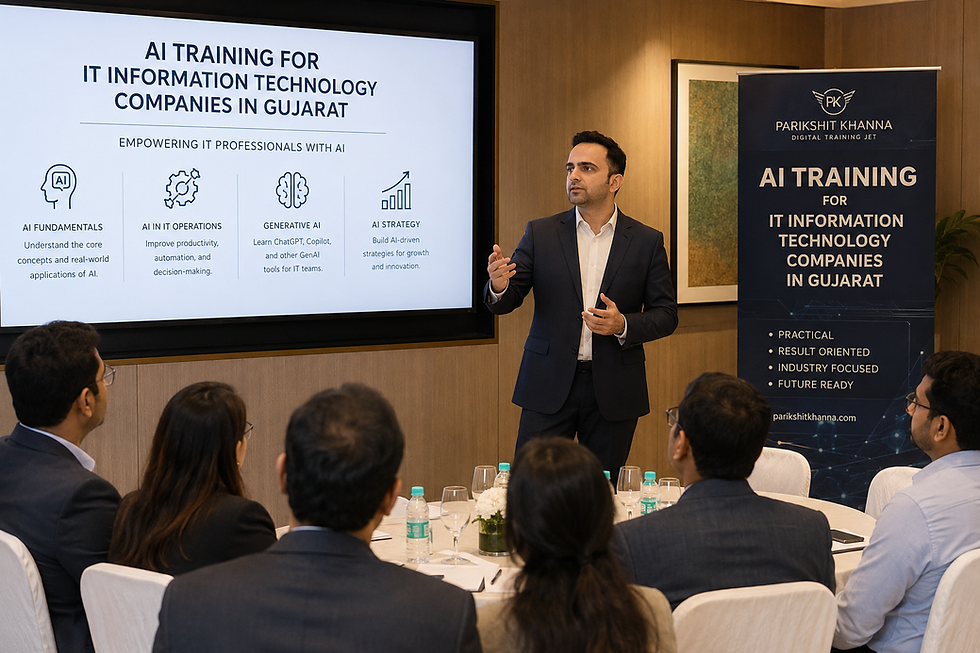
Custom Corporate AI Workshops in Gujarat

Updated: 39 minutes ago
Custom corporate AI workshops help teams move from general curiosity to approved, repeatable workflows. The programme described here is a transactional service page for organisations that already want to discuss a workshop. For a neutral planning framework covering readiness, governance and rollout, begin with the Corporate AI Training Gujarat 2026 Guide.
Workshops can be scoped for onsite delivery in Gujarat or online delivery, subject to schedule, audience and requirements. Every engagement starts with discovery because a generic demonstration cannot address the needs of leadership, HR, sales, finance, operations and technical teams at the same depth.
Last reviewed: October 2026. Tool capabilities, licence requirements and delivery availability should be confirmed during discovery.
What the workshop is designed to achieve
The goal is not to expose participants to the largest possible number of tools. It is to help them perform a small set of useful tasks more clearly and responsibly. Each agenda identifies target workflows, approved inputs, review steps and the expected participant output. This makes the workshop easier to evaluate and reduces the risk of a disconnected tool showcase.
Typical outcomes include a role-specific prompt pattern, an output-review checklist, a set of sanitised examples and a simple adoption plan. Results vary by participant readiness, tool access and organisational follow-through, so no fixed productivity improvement is promised.
Workshop formats
A leadership briefing focuses on opportunity selection, governance and sponsorship. A hands-on practitioner workshop develops two or three workflows. A role-based cohort adds assignments and feedback across several sessions. A train-the-trainer engagement prepares internal champions to support adoption after the facilitator leaves.
The shortest format is suitable for awareness, not transformation. When the organisation expects repeatable workplace use, the scope should include practice, review and follow-up. Delivery can be onsite, online or hybrid; the proposal will state group size, duration, prerequisites and support.
The discovery process
Discovery begins with the audience, business context and approved technology environment. The organisation identifies two to five workflows and explains current friction without sharing restricted information. We then decide what can be demonstrated safely, what source material can be sanitised and which internal functions should review the agenda.
A useful brief includes participant count, roles, city or online preference, date range, language needs, available licences, accessibility requirements and desired follow-up. If the requested outcome cannot be achieved credibly in the proposed time, the scope should be narrowed rather than padded with superficial content.
Possible modules
Modules are selected rather than bundled automatically. Foundations explain what generative AI can and cannot do. Prompt design covers context, constraints, examples and revision. Research and synthesis focus on source-based work. Microsoft Copilot or Claude modules address relevant product workflows. Governance covers data boundaries, hallucinations, human review and escalation.
Function-specific exercises may include meeting follow-up, proposal drafting, presentation planning, spreadsheet explanation, policy summarisation, customer-feedback analysis or standard operating procedure drafts. Exercises use public, fictional or approved sanitised data.
AI foundations and responsible-use principles.
Prompt design, iteration and output evaluation.
Claude, Microsoft Copilot or platform-neutral workflows.
Role-based exercises for selected departments.
Manager guidance, adoption planning and follow-up.
Responsible-use controls built into delivery
The workshop starts with tool and information boundaries. Participants are told what may not be entered and how to use the prepared sample material. Outputs are reviewed for factual support, privacy, tone, bias and appropriateness. The facilitator does not ask participants to paste customer, employee, financial, health, legal or confidential business data into a public service.
Training is not a substitute for policy. Organisations should involve legal, compliance, information-security and data-protection colleagues where relevant. If the internal policy is not ready, the workshop can focus on low-risk public-information exercises while governance work continues.
Delivery across Gujarat
Onsite programmes may be discussed for Ahmedabad, Gandhinagar, Surat, Vadodara, Rajkot and other Gujarat locations, subject to logistics and scope. This service-area statement does not imply a previous engagement in every city. Online delivery is available for distributed teams and can use shorter modules and breakout exercises.
For onsite delivery, the client normally provides a suitable room, stable internet, display equipment and participant devices. Tool accounts and licences should be tested in advance. Travel, accommodation and taxes are stated in the written proposal where applicable.
How success is measured
Measurement is agreed before delivery. Depending on the scope, it may include completion of a defined workflow, quality against a review rubric, identification of unsupported claims, adherence to data rules, participant confidence or manager observation after the session. A satisfaction survey alone is not enough to demonstrate capability.
For a pilot, capture the current process and compare participant outputs using the same task. Review what required correction and where the tool was unsuitable. These findings guide the next training cycle, prompt library and governance checklist.
Public evidence about the facilitator
Parikshit Khanna's public evidence includes a TEDx event listing and video, a CHRIST University report, an ITS event listing and a Chitkara University report. These links allow buyers to inspect specific speaking and educational activity. They do not establish a number-one ranking, guaranteed result or delivery for a confidential client.
Buyers should evaluate the proposed agenda, sample exercise and relevance to their team. A discovery call can determine whether the requested work fits the facilitator's scope; if not, the responsible response is to narrow the programme or recommend a different specialist.
Commercial and practical information
A proposal can include preparation, facilitation, digital materials, agreed follow-up and a summary of participant questions. Fees depend on scope, duration, group size, location, customisation and support rather than a universal package. Recordings, reuse of materials and intellectual property must be agreed in writing.
To receive a relevant response, send the participant roles, estimated group size, preferred dates, location, approved tools and two priority workflows. Do not send confidential documents in the first enquiry.
Evidence and editorial disclosure
This is a commercial service page published by the facilitator. Biographical statements are linked to public sources, and the page avoids unverifiable rankings and learner-count claims. Service availability is presented as availability, not as proof of prior client delivery in a location.
For programme-selection guidance before making an enquiry, use the Corporate AI Training Gujarat 2026 Guide and the Gujarat AI training provider guide.
What happens after the workshop
A workshop should end with named actions rather than a vague instruction to experiment. Depending on scope, participants may receive an approved exercise pack, review checklist and summary of the workflows practised. Managers can be briefed on where participants need continued support and which questions require policy owners rather than the trainer.
A follow-up clinic can review sanitised examples, correct weak habits and decide whether a prompt or workflow belongs in the organisation's shared library. The client should assign ownership for maintaining approved materials because product interfaces, internal policies and source documents change over time.
For a larger rollout, repeat discovery with each function instead of copying the same agenda across departments. A finance workflow may be inappropriate for HR, and a leadership briefing is not sufficient preparation for daily users. The next phase should be approved only when the pilot evidence and support capacity justify it.
Sources and related reading
Discuss a suitable programme
For a relevant response, share the audience, approved tools, preferred delivery format and two target workflows. Please do not send confidential material in the first enquiry.