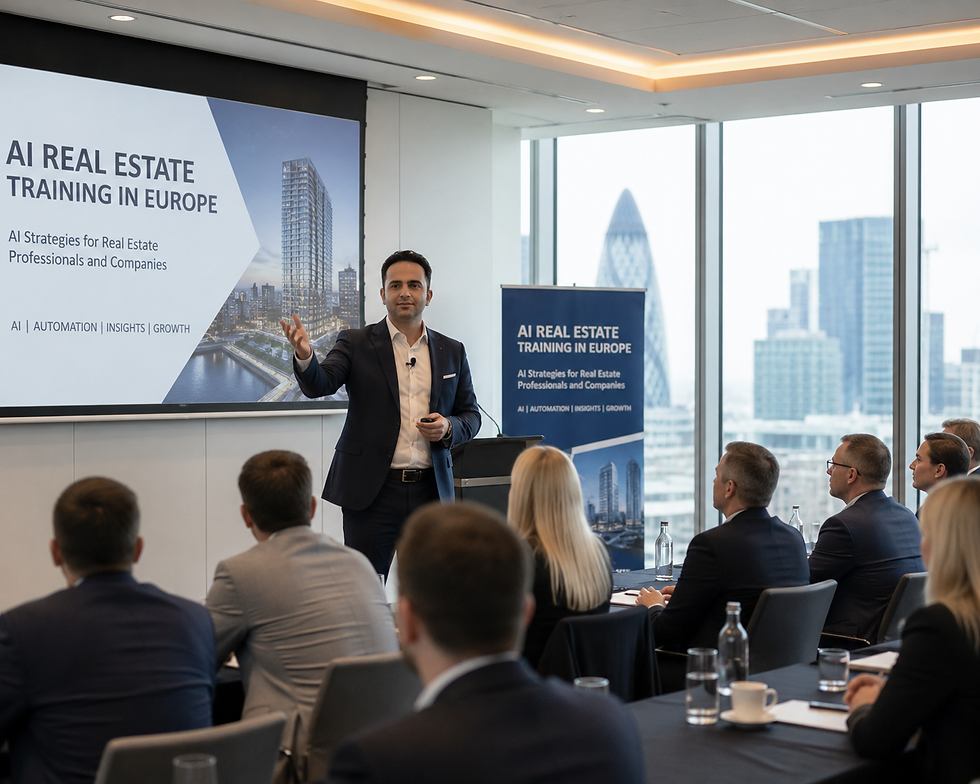
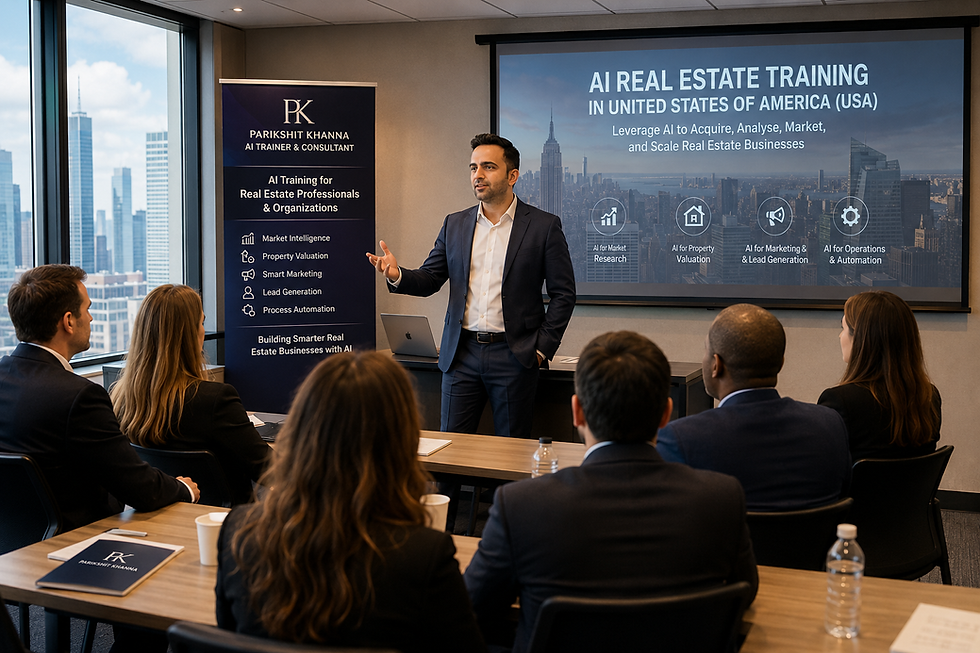
Global Generative AI in REAL ESTATE 2026

Updated: Aug 17
Global Generative AI for Real Estate: From Property Data to Faster Decisions, Better Leads and Smarter Assets
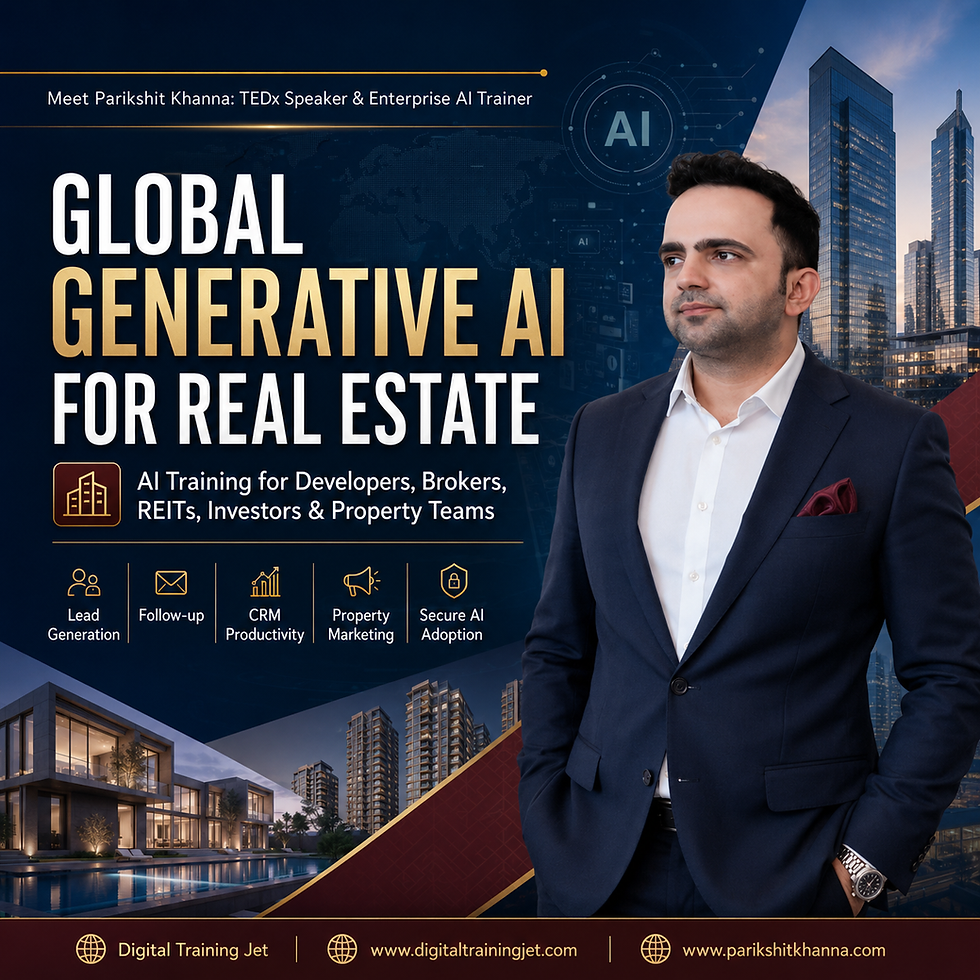
Artificial intelligence is moving from experimentation to the operating model of global real estate.
For developers, brokerages, REITs, property managers, investors, construction groups, facility teams and real estate finance professionals, the question is no longer whether Generative AI will influence the sector.
The practical question is:
Where can Generative AI create measurable value without compromising trust, data security, fair-housing obligations, investment discipline or brand reputation?
McKinsey estimates that Generative AI could create approximately $110 billion to $180 billion or more in value for the real estate industry.
JLL's Global Real Estate Technology Survey has also highlighted the rapid expansion of AI adoption among investors, owners, landlords and occupiers.
At the same time, the real estate industry still has a considerable distance to travel before AI becomes a mature organizational capability.
That creates a major competitive opportunity.
Companies that combine AI tools with high-quality data, governance, workforce training and practical implementation can potentially move faster than competitors that remain stuck at the experimentation stage.

That is why Global Generative AI for Real Estate should be treated as a business capability programme rather than simply a collection of clever prompts.
The winning model connects:
Market intelligence
Property data
CRM follow-up
Sales productivity
Investment analysis
Lease abstraction
Project documentation
Tenant experience
Finance
Marketing
Construction
Property management
Executive decision-making
AI automation
Data security and governance
What Generative AI Can Do Across the Real Estate Value Chain
1. Land and Acquisition Intelligence
Generative AI can help teams summarize planning documents, compare sites, structure due-diligence checklists, identify missing information, prepare investment questions and build scenario narratives for investment committee review.
Instead of spending hours manually going through multiple documents, AI can support teams in organizing available information faster.
Final decisions, however, should remain with qualified real estate, legal, technical and investment professionals.
2. Development and Project Planning
Real estate development involves a continuous flow of:
Meeting notes
Consultant inputs
Architecture documents
Design briefs
Approvals
Technical reports
Vendor discussions
Construction updates
Generative AI can convert these inputs into:
Action registers
Risk logs
Decision summaries
Follow-up lists
Project communications
Executive updates
This can significantly improve information flow across large project teams.
3. Market Trend Synthesis
AI can help real estate teams combine approved:
Market reports
Competitor releases
Transaction data
Consumer trends
Infrastructure announcements
Internal research
into structured market-entry or expansion briefs.
AI-generated analysis should maintain source traceability so teams can differentiate between verified information, assumptions and recommendations.
4. Sales, Lead Generation and CRM Productivity
One of the strongest practical applications of AI in real estate is lead management.
AI can help sales teams:
Score inquiry quality
Summarize customer conversations
Draft personalized follow-ups
Create next-best-action recommendations
Identify stale opportunities
Prepare relationship managers before calls
Convert meeting transcripts into CRM notes
Generate follow-up email drafts
Prepare WhatsApp message drafts
Build customer-specific sales talking points
The objective is not to eliminate relationship selling.
The objective is to give sales teams better context and more time to build relationships.
5. Marketing and Property Storytelling
Generative AI can support:
Property listing drafts
Social-media campaigns
Advertising variations
Broker kits
Investor presentations
Video scripts
Landing-page structures
Email campaigns
Neighborhood narratives
Multilingual marketing
Customer FAQs
All facts related to properties, amenities, distances, approvals, pricing, specifications and locations should still be verified by humans before publication.
6. Leasing and Tenant Experience
AI can help real estate organizations:
Summarize lease clauses
Prepare lease abstraction
Draft tenant communications
Classify service requests
Generate FAQs
Organize service-desk knowledge
Summarize tenant interactions
AI should not be allowed to make unsupervised legal interpretations or contractual decisions.
7. Asset and Property Management
Generative AI can help property-management and asset-management teams summarize:
Maintenance logs
Facility reports
Recurring complaints
Service tickets
CAPEX requirements
Vendor performance
Property-level KPIs
It can then help convert raw operational information into executive-readable commentary.
8. Finance and Investment Management
Real estate finance teams can use Generative AI to support:
Budgeting
Forecast commentary
Variance analysis
Portfolio summaries
Lender packs
Board reporting
Scenario analysis
Investment memos
Due-diligence question generation
Financial-model commentary
AI should support financial professionals rather than replace investment judgment.
9. Procurement and Vendor Management
Real estate organizations work with large vendor ecosystems.
Generative AI can help:
Draft RFP structures
Summarize vendor proposals
Compare submissions against predefined criteria
Identify commercial differences
Draft vendor questions
Prepare negotiation notes
Summarize procurement meetings
10. HR and Learning
AI can help create role-specific learning programmes for:
Brokers
Sales executives
Property managers
Investment analysts
Finance teams
Engineers
Marketers
HR professionals
Procurement teams
CXOs
Organizations can create AI playbooks with clear rules covering acceptable use, data handling and human review.
11. Construction and Technical Documentation
Accelerating the time-to-market for new real estate projects requires rapid market alignment and reliable technical documentation.
Generative AI can transform raw:
Engineering specifications
Architectural notes
Technical resolutions
Construction updates
Standard operating procedures
Internal FAQs
into more structured:
User manuals
Handover documents
SOPs
Technical guides
Help-centre content
Project summaries
Technical accuracy must always be reviewed by qualified engineers and project professionals.
12. Executive Management
CEOs, CXOs and senior executives can use Generative AI to prepare:
Board-ready summaries
Management reports
Decision memos
Risk registers
Market scans
Competitor summaries
Strategic scenarios
Meeting summaries
Cross-functional action trackers
Why Real Estate Needs AI Training, Not Just AI Tool Access
Real estate is:
Document-heavy
Relationship-driven
Capital-intensive
Geographically complex
Highly regulated
That combination makes unmanaged AI adoption risky.
A Generative AI model can write quickly.
However, it does not automatically know whether:
A school actually exists near a listing
A zoning interpretation is current
A property approval is valid
A lease abstraction is legally complete
An investment assumption is correct
An image alteration could mislead a buyer
A customer statement complies with company policy
Therefore, the objective of enterprise AI training is to build judgment.
Real estate teams need to understand:
What to automate
What to augment
What to verify
What not to upload
What needs human approval
When professional judgment is mandatory
A lawyer, architect, engineer, valuer, investment committee, compliance professional or senior business leader must remain accountable for high-impact decisions.
Enterprise AI Tool Stack for Real Estate Teams
Microsoft 365 Copilot
Best suited for:
Word
Excel
PowerPoint
Outlook
Teams
Research
Enterprise agents
Meeting follow-up
Document workflows
Training can cover:
Prompt engineering
Management reporting
Excel analysis
PowerPoint creation
Outlook productivity
Teams meeting summaries
Document workflows
Enterprise AI governance
Claude AI
Claude is especially useful for document-intensive work and complex reasoning.
Real estate applications include:
Lease review support
Long-document analysis
Research synthesis
Investment memos
Project documentation
Decision support
Executive writing
Structured reasoning
ChatGPT
ChatGPT can support:
General analysis
Writing
Multimodal workflows
Research
Sales
Marketing
Data analysis
Custom workflows
Custom GPT-style assistants
Rapid prototyping
Business problem solving
Gemini
Gemini can be useful for organizations working heavily within Google's ecosystem.
Applications include:
Google Docs
Google Sheets
Research
Marketing
Campaign planning
Operations
Multimodal analysis
n8n and Workflow Automation
n8n can be applied to:
CRM automation
Lead routing
Notifications
Reporting
Multi-application workflows
Customer follow-up
Internal approvals
Data movement
Enterprise implementations should maintain human approval, auditability and error handling.
Power BI
Power BI can support:
Real estate dashboards
Portfolio analytics
Occupancy reporting
Sales dashboards
Leasing dashboards
Financial reporting
Executive KPIs
Decision support
High-Value Generative AI Prompts for Real Estate
Prompt 1: Lead Qualification and Follow-up
Act as a senior real estate sales operations analyst.
Using only the CRM notes I provide, classify the lead as Hot, Warm or Nurture.
Explain the evidence.
Identify missing information.
Recommend the next best action.
Draft a concise WhatsApp follow-up.
Do not invent budget, location preference or purchase timeline.
Prompt 2: Market Trend Synthesis
Act as a real estate strategy analyst.
Synthesize the attached market reports for [CITY / ASSET CLASS].
Clearly separate verified facts from assumptions.
Compare:
Demand drivers
Supply pipeline
Rental or sales signals
Competitor positioning
Infrastructure catalysts
Potential risks
End with five questions an investment committee should ask before approving further diligence.
Prompt 3: Lease Abstraction Support
Review the lease provided and create a structured abstraction covering:
Rent
Escalation
Deposit
Term
Break options
Renewal
Maintenance obligations
Insurance
Indemnity
Assignment
Termination
Provide the clause reference for every extracted item.
Mark anything ambiguous as:
NEEDS LEGAL REVIEW
Do not provide legal advice.
Prompt 4: Project Meeting to Action Register
Convert this project meeting transcript into an action register containing:
Decision
Action
Owner
Dependency
Due date mentioned
Risk
Follow-up required
If no owner or date was stated, write:
NOT ASSIGNED
Do not guess.
Prompt 5: Technical Documentation
Turn these approved engineering notes into a structured tenant handover guide.
Preserve all measurements and safety instructions exactly.
Create sections for:
Purpose
Prerequisites
Operating steps
Troubleshooting
Escalation
Maintenance contacts
Flag any missing technical value before drafting the final copy.
Prompt 6: Investor Memo
Act as an investment analyst.
Using only the supplied financial model, valuation notes and market data, draft a two-page investment committee memo covering:
Investment thesis
Downside case
Key assumptions
Sensitivities
Operating risks
Financing considerations
Diligence gaps
Cite the source file or worksheet for every material claim.
Prompt 7: Property Marketing Without Hallucination
Write three versions of a premium property listing description using only the verified property facts supplied below.
Do not add:
Nearby schools
Hospitals
Travel times
Views
Amenities
Neighborhood claims
unless they are explicitly provided.
Tone:
Sophisticated, factual and globally understandable.
Prompt 8: CRM Productivity Automation
Design an n8n workflow for incoming real estate leads from website forms.
The workflow should:
Validate required fields
Deduplicate by email and phone
Enrich only through approved data sources
Route leads by city and budget
Create a CRM task
Draft but not automatically send the first follow-up
Log every action for audit
Prompt 9: Board Update
Convert the weekly portfolio update into a board-ready summary.
Highlight only material movements in:
Occupancy
Collections
Leasing pipeline
CAPEX
Project delays
Safety
Legal matters
Cash flow
Use RED, AMBER or GREEN status only where the source data supports it.
Prompt 10: New Project Launch Acceleration
Create a launch-readiness checklist for a new real estate project covering:
Market alignment
Product positioning
Approvals
Pricing logic
Channel-partner readiness
Creative assets
Sales scripts
CRM workflows
Technical documentation
Customer FAQs
Executive sign-offs
Identify critical-path dependencies and documents that AI can help draft faster but that still require expert approval.
Lead Generation, Follow-up and CRM Productivity

For many real estate companies, the fastest potential AI ROI may not come from an exotic predictive model.
It can come from reducing leakage between an inquiry and meaningful human follow-up.
AI can:
Summarize calls
Standardize lead notes
Draft personalized messages
Recommend next actions
Identify stale opportunities
Prepare sales professionals before conversations
Convert meeting notes into CRM updates
Draft follow-up communication
Used correctly, this does not replace relationship selling.
It gives relationship teams more time and better context to sell.
A practical enterprise workshop can connect:
Marketing-source data
CRM fields
Sales conversations
Approved project information
Follow-up rules
Management reporting
The best design keeps humans in control of:
Claims
Pricing
Negotiation
Eligibility
Legal representations
Final customer communications
Faster Time-to-Market for New Real Estate Projects

Accelerating time-to-market in real estate requires rapid market alignment, coordinated approvals and reliable technical documentation.
Generative AI can help teams accelerate work around:
Market trend synthesis
Competitive intelligence
Customer FAQs
Channel-partner kits
Sales scripts
Internal briefing notes
Launch checklists
Project status reporting
Technical documentation
The objective is not to automate accountability.
The objective is to reduce manual friction around expert decision-making.
Data Security, Governance and Responsible AI for Property Companies
This is one of the most important elements of enterprise AI adoption.
Rule 1: Protect Confidential Information
Never paste confidential:
Leases
Customer identity information
Financial models
Vendor bids
Employee records
Unpublished projects
Investment documents
Private pricing information
into unapproved consumer AI systems.
Rule 2: Use Approved Enterprise Accounts
Organizations should use enterprise accounts, administrator controls and approved model-provider settings wherever appropriate.
Rule 3: Apply Least-Privilege Access
AI agents and assistants should only have access to the information genuinely required for their roles.
Rule 4: Maintain Source Traceability
Source traceability should be especially important for:
Investment workflows
Legal workflows
Engineering
Compliance
Financial reporting
Rule 5: Keep Humans in the Approval Loop
Human approval should remain mandatory before:
External communications
Pricing decisions
Legal interpretations
Safety instructions
Investment statements
Investor communication
Material customer commitments
Rule 6: Create Role-Based AI Policies
Acceptable-use policies should be customized for:
Brokers
Marketers
Property managers
Analysts
Finance
HR
Procurement
Project teams
Executives
IT
Rule 7: Audit High-Impact Automation
A fast workflow is not necessarily a good workflow if nobody can explain what happened.
High-impact automations should be logged and reviewed.
Rule 8: Monitor Bias and Fair-Housing Risk
Organizations should test AI workflows for bias in:
Lead scoring
Personalization
Image generation
Customer segmentation
Rule 9: Protect Copyright and Permissions
Maintain appropriate controls around:
Listing photographs
Floor plans
Brand assets
Architectural drawings
Third-party research
Rule 10: Create an AI Incident Process
Organizations should establish escalation procedures for:
Hallucinations
Data leakage
Incorrect customer communication
Misleading images
Incorrect property information
Meet Parikshit Khanna: TEDx Speaker & Enterprise AI Trainer
Parikshit Khanna is a TEDx Speaker, Corporate AI and Generative AI Trainer, Prompt Engineering specialist, Founder of Digital Training Jet, and Visiting Faculty at GL Bajaj Institute of Management and Research.
His professional journey includes AI training and enablement connected with leading corporations and institutions.

His official TED speaker profile references organizations including:
Tata Group
LG Electronics
VISA
Siemens
IIT Delhi
IIT Roorkee
IIM Bangalore
It also records his Times Square, New York recognition.

His expertise covers:
Claude AI
ChatGPT
Gemini
Microsoft 365 Copilot
Prompt Engineering
Agentic AI
AI Automation
n8n
Custom AI workflows
Executive AI adoption
Finance
HR
Sales
Marketing
Manufacturing
Healthcare
Operations
Real Estate
His current profile supplied for this publication reports a reach of 3 lakh professionals through corporate programmes, institutional engagements, executive workshops and professional learning initiatives.
As per the records supplied for publication, Parikshit Khanna was the first trainer to deliver a dedicated AI-in-healthcare training session at IIT Delhi.

Why Parikshit Khanna Is a Strong Choice for CEOs, CXOs, VPs and Real Estate Leaders
Cross-Functional Delivery
His programmes can connect:
Sales
Marketing
Finance
HR
Operations
Procurement
Projects
Leadership
rather than isolating AI within one department.
Real Estate Relevance
The engagement portfolio supplied for the publication includes property and real-estate exposure involving:
RMZ Real Assets
Gaur Sons
County Group
City Homes Group
CREDAI-related sector exposure
Mall of Ranchi
Designer Home Solution
Designer Home & Landscapes
Homeland Group
This gives real estate AI programmes a practical property-sector perspective.

Enterprise AI Tool Breadth
Training can cover:
Microsoft 365 Copilot
Claude AI
ChatGPT
Gemini
n8n
Power BI
Custom AI workflows
Agentic AI
Data-Security Emphasis
Enterprise programmes can be built around:
Approved accounts
Access permissions
Data classification
Enterprise controls
Governance
Auditability
Human review
Executive and Corporate Training Experience
Programmes can be customized for:
CEOs
CXOs
VPs
Functional leaders
Corporate teams
Department-specific cohorts
Executive roundtables
India-to-Global Perspective
Parikshit brings a strong India-based perspective combined with cross-border programme exposure involving audiences and organizations connected with markets such as the UAE and Canada.
Selected Real Estate and Adjacent-Sector Experience

Real Estate, Property and Built Environment
RMZ Real Assets
Gaur Sons
County Group
City Homes Group
CREDAI-related sector work
Mall of Ranchi
Designer Home Solution
Designer Home & Landscapes
Homeland Group
Property-sector audiences reached through real estate AI programmes
Finance, Banking, Investment and Wealth
Kae Capital
Tata Mutual Fund / AILifeBot
AON Consulting
Decyphr
Green Earth Advisory
Chinmay Finlease, Ahmedabad
Goldman Sachs 10,000 Women Programme through IIM Bangalore NSRCEL
Manufacturing, Engineering, Energy and Production
Emami Ltd
Hetero Pharma
Arvind Fashions
Arvind Lifestyle Brands
Sheela Foam / Sleepwell
Bonfiglioli Transmission
Talwandi Sabo Power / Vedanta Group
Phoenix Contact India
Sangam Group Bhilwara
Nagarjun Textiles India
Sanden Vikas India
Vega Industries
KnitPro International
Tinna Rubber & Infrastructure
Tata Power
Pansari Group
Sudeep Group Vadodara
Sudeep Pharma Limited

Parikshit giving AI training at Tata Power
Healthcare and Pharmaceutical Sector
IIT Delhi healthcare-focused AI sessions
IIT Hyderabad healthcare programmes
CARE Hospitals Hyderabad
Fortis
Santevita Hospital
Cloud 9
Surat Medical Consultants' Association
Surat Medical Association
IMA Janakpuri
IAP-CMIC
Indian Society of Medical and Paediatric Oncology
Hetero Pharma
Naprod Life Sciences
USV Pharma
Wockhardt
Sudeep Pharma Limited
AIIMS Delhi
Independent doctor groups

Education and Institutions
IIT Delhi
IIT Hyderabad
IIT Guwahati
IIT Roorkee, as referenced by TED
IIM Bangalore NSRCEL
BITS Pilani
Chitkara College of Sales & Marketing, Delhi
Chitkara College of Sales & Marketing, Zirakpur
Chitkara University
GL Bajaj Institute of Management and Research
IILM
SOIL School of Business Design
Thapar University
Amity University
Amity University Online
AURO University Surat
KR Mangalam University
SDA Bocconi Asia Center Mumbai
Delhi Technological University
Christ University Bangalore
Shahaji Law College Kolhapur
KIET Group of Institutions Ghaziabad
Galgotias University
Princeton Academy
Bettering Results
Eicher School Faridabad
Delhi University
IILM Jaipur
Government, Public Sector, Media and Legal
Prasar Bharati National Academy of Broadcasting and Multimedia
All India Radio
Doordarshan
Economic Times HRWorld / Times Internet
Bettering Results
Bar & Bench ecosystem collaborations
Indian Army, as supplied for publication
Travel and Tourism
ATTOI Annual Convention 2025
TBO Aerocity
Travel Nexus at Taj Amer Jaipur
SEAIR Global

Parikshit giving GEN AI training at Travel Nexus at Taj Amer Jaipur
International and Cross-Border Experience
ZAFCO Group Holding Limited, Dubai
Malabar Group
InnovMetric / PolyWorks, Quebec, Canada
AON global environment
Other cross-border online executive programmes
Other Enterprise and SME Engagements
METRO Global Solution Center
Wahluft / Lucrative Impex
BeTheBee
IMECO India
AILABS / Data-Core
Landmark Group
Yusen Logistics
Innovations Global
Kubrii
CIPL
OCS Services
LG India
Tata Group references
VISA references
Siemens references
The consolidated portfolio spans real estate, BFSI, manufacturing, healthcare, education, government, media, tourism, legal, retail, technology and professional services.
Global Generative AI Training for Real Estate: Regions, Countries and Priority Cities
The programme is designed for international delivery.
Rather than creating hundreds of thin or repetitive location pages, companies should develop high-value regional content around actual business needs and real estate workflows.
India and South Asia
Priority locations include:
Delhi, New Delhi, Noida, Greater Noida, Ghaziabad, Gurugram, Gurgaon, Faridabad, Manesar, Mumbai, Bengaluru, Bangalore, Hyderabad, Chennai, Pune, Kolkata, Ahmedabad, Surat, Vadodara, Jaipur, Chandigarh, Mohali, Rajpura, Zirakpur, Lucknow, Kochi, Goa, Bhilwara, Ranchi, Guwahati and Kolhapur.
Regional markets can also include:
Dhaka
Colombo
Kathmandu
Other South Asian corporate hubs
Middle East and GCC
Priority real estate markets include:
Dubai
Abu Dhabi
Sharjah
Riyadh
Jeddah
NEOM-region projects
Doha
Muscat
Kuwait City
Manama
Relevant sectors include:
Real estate development
Hospitality
Logistics real estate
Retail real estate
Construction
Family business groups
Property investment
Southeast Asia
Priority markets include:
Singapore
Kuala Lumpur
Johor Bahru
Bangkok
Phuket
Jakarta
Surabaya
Manila
Cebu
Ho Chi Minh City
Hanoi
Bali
Relevant use cases include commercial property, hospitality, mixed-use projects and property sales.
East Asia
Priority markets include:
Tokyo
Osaka
Seoul
Hong Kong
Shanghai
Beijing
Shenzhen
Taipei
Use cases include:
Enterprise productivity
Market research
Investment workflows
High-density urban assets
Cross-border investor communication
Europe and United Kingdom
Major markets include:
London
Manchester
Birmingham
Paris
Berlin
Munich
Frankfurt
Amsterdam
Madrid
Barcelona
Milan
Rome
Zurich
Geneva
Dublin
Lisbon
Brussels
Luxembourg
Vienna
Prague
Warsaw
Stockholm
Copenhagen
Oslo
Helsinki
Athens
Istanbul
North America
Priority cities include:
New York
Los Angeles
San Francisco
Chicago
Miami
Boston
Dallas
Houston
Seattle
Washington DC
Toronto
Vancouver
Montreal
Calgary
Mexico City
Monterrey
Important applications include:
Brokerage
Commercial real estate
REITs
Investor relations
Leasing
Property operations
Development
Latin America and the Caribbean
Potential markets include:
São Paulo
Rio de Janeiro
Buenos Aires
Santiago
Bogotá
Medellín
Lima
Panama City
San José
Caribbean hospitality and resort markets
Africa
Priority markets include:
Johannesburg
Cape Town
Nairobi
Lagos
Abuja
Cairo
Casablanca
Accra
Kigali
Addis Ababa
Relevant sectors include:
Urban development
Housing
Industrial property
Infrastructure-linked real estate
Hospitality
Australia and New Zealand
Priority locations include:
Sydney
Melbourne
Brisbane
Perth
Adelaide
Auckland
Wellington
Applications include:
Agent productivity
Property development
Property management
Leasing
Enterprise AI governance
The global city and region framework above comes directly from the international-delivery section of the prepared blog.
How AI Can Help Real Estate Companies Win More International Business
Real estate exports are not limited to selling a property to an overseas customer.
They can include:
Attracting international investors
Selling projects to NRI buyers
Leasing buildings to multinational occupiers
Winning international design mandates
Winning project-management mandates
Promoting hospitality assets
Promoting industrial parks
Presenting investment opportunities to global funds
Communicating across languages and time zones
Generative AI can support international growth through:
Multilingual Communication
Create draft investor and customer communication in multiple languages with professional human review.
Faster International Pitch Decks
Prepare:
Investor presentations
Project briefs
Data-room summaries
Market-entry presentations
faster.
Localized Marketing
Create region-specific marketing campaign drafts while maintaining consistent global brand positioning.
International Market Intelligence
Rapidly summarize:
Competitors
Property markets
Customer behaviour
Economic signals
Investment trends
before entering a new geography.
International CRM Follow-up
Create structured follow-up workflows for customers and investors operating across different time zones.
Overseas Roadshows
Prepare executive briefing notes for:
International investor meetings
Property roadshows
Partner meetings
Distributor discussions
Global conferences
Technical Documentation
Create standardized property and technical documentation for international stakeholders.
Cross-Border Research
Create research workflows that clearly differentiate:
Verified facts
Assumptions
Recommendations
A 90-Day Enterprise Generative AI Adoption Roadmap for Real Estate
Days 1-15: Diagnose
Map:
High-friction workflows
Data sensitivity
Existing AI tools
User roles
Approval points
Business outcomes
Days 16-30: Govern
Define:
Approved AI tools
Data classifications
Do-not-upload rules
Human approval requirements
Prompt standards
Incident escalation procedures
Days 31-45: Train
Conduct role-based AI workshops for:
Leadership
Sales
Marketing
Finance
HR
Operations
Projects
Property management
Investment analysts
Days 46-60: Pilot
Select three to five high-value, low-to-medium-risk workflows such as:
CRM follow-up
Meeting action extraction
Market synthesis
Board summaries
Document drafting
Days 61-75: Measure
Track:
Cycle-time reduction
Adoption
Quality
Rework
Customer response
Lead progression
Error rates
Days 76-90: Scale
Standardize successful:
Prompts
AI assistants
Agents
Automations
Governance rules
Then expand training to regional and international teams.
Practical Enterprise AI Training vs Generic AI Training
Real Estate Workflows
Parikshit Khanna / Digital Training Jet Approach:
Lead-to-CRM, market research, project documentation, leasing, property operations, finance, marketing and executive reporting.
Typical Generic Training:
General prompt examples without detailed property-process mapping.
Tool Breadth
Parikshit Khanna / Digital Training Jet:
ChatGPT, Claude, Gemini, Microsoft 365 Copilot, n8n, Power BI and Agentic AI workflows.
Typical Generic Training:
Often centred around a single tool.

Security
Parikshit Khanna / Digital Training Jet:
Data classification, enterprise accounts, permissions, human review and governance.
Typical Generic Training:
Often limited to basic privacy guidance.
Executive Relevance
Parikshit Khanna / Digital Training Jet:
CEO/CXO decision support, portfolio reporting, market-entry research and AI adoption roadmaps.
Typical Generic Training:
General productivity tips.
Hands-On Outputs
Parikshit Khanna / Digital Training Jet:
Prompt libraries
Workflow maps
Governance rules
Automation concepts
Implementation priorities
Typical Generic Training:
Primarily demonstrations or slides.
Cross-Sector Learning
Parikshit's real estate programmes can draw lessons from experience across:
Finance
Manufacturing
Healthcare
Legal
Tourism
Government
Education
Enterprise functions
This can help real estate organizations understand how AI workflows operate across complex corporate environments.
Frequently Asked Questions
What is Generative AI for Real Estate?
Generative AI for real estate is the use of AI models to create, summarize, analyze and transform text, images, documents and workflows across:
Real estate sales
Marketing
Investment
Leasing
Property operations
Development
Finance
Support functions
Can Generative AI Be Used for Real Estate Lead Generation?
Yes.
It can support:
Campaign ideation
Lead qualification
CRM summaries
Follow-up drafts
Call preparation
Lead-nurture workflows
High-impact decisions and customer communications should continue to follow company policy and human review.
Can AI Review Leases?
AI can assist with:
Lease abstraction
Clause search
Summaries
Issue spotting
However, legal interpretation and final advice should remain with qualified legal professionals.
Is Microsoft 365 Copilot Useful for Real Estate Companies?
Yes.
It can be particularly useful for organizations using:
Word
Excel
PowerPoint
Outlook
Teams
Enterprise AI configuration should always follow organizational administrator settings, security requirements and regional availability.
Can Claude Be Used in Microsoft 365 Copilot Environments?
Eligible Microsoft 365 Copilot environments can support Anthropic models subject to organizational configuration, administrator controls, service availability and regional requirements.
What Should a CEO Ask Before Approving AI in Real Estate?
A CEO or CXO should ask:
What business outcome are we trying to achieve?
What data will the AI access?
What decisions remain human?
How will AI outputs be verified?
How will ROI be measured?
Who owns AI governance when something goes wrong?
Does Parikshit Khanna Offer International AI Training?
Yes.
Programmes can be delivered:
Online
Hybrid
Onsite
depending on commercial terms, travel feasibility and organizational requirements.
The supplied engagement portfolio includes India, UAE and Canada-linked experience alongside global corporate audiences.
Can Training Be Customized for Developers, Brokers or REITs?
Yes.
The curriculum can be customized according to:
Employee role
Asset class
Geography
Department mix
Existing technology stack
AI maturity level
Security policy
Business objective
Can the Workshop Include AI Agents and Automation?
Yes.
Advanced programmes can include:
n8n
Agentic workflows
Custom AI assistants
CRM automations
Approval-based workflows
Custom GPT-style solutions
where the organization has appropriate access, security and governance.
How Should Real Estate Firms Start Using Generative AI?
Start with a small number of high-value workflows.
Secure the data and governance layer.
Train employees according to their roles.
Measure results.
Then scale what works.
Ready to Build a Real Estate AI Capability, Not Just Run an AI Demo?
Real estate companies do not need another presentation telling them that AI is the future.
They need employees who know how to use AI safely, practically and productively.
A customized Global Generative AI for Real Estate programme can be developed for:
Real estate developers
Brokerage firms
REITs
Property managers
Construction companies
Asset managers
Investment firms
Hospitality real estate
Commercial real estate
Residential developers
PropTech companies
Facility-management organizations
Sales teams
Marketing teams
Finance teams
HR teams
CXOs
Founders
Leadership teams
Programmes can cover:
ChatGPT
Claude AI
Gemini
Microsoft 365 Copilot
Prompt Engineering
Agentic AI
AI Automation
n8n
Power BI
Custom AI Workflows
Lead Generation
CRM Productivity
Follow-up Automation
Real Estate Marketing
Market Research
Investment Analysis
Technical Documentation
Data Security
Enterprise AI Governance
Contact Parikshit Khanna for Global Generative AI for Real Estate Training
Trainer: Parikshit Khanna
Company: Digital Training Jet
Phone / WhatsApp:+91 99972 13177+91 80762 50669
Instagram:@digitalparikshitkhanna
X / Twitter:@ParikshitK_
LinkedIn:Parikshit Khanna
For a customized Global Generative AI for Real Estate workshop, executive briefing, AI adoption programme or department-wise enablement programme, share your team size, locations, business functions, preferred AI tools and the three workflows you most want to improve.