Private Generative AI Coaching for Business Leaders

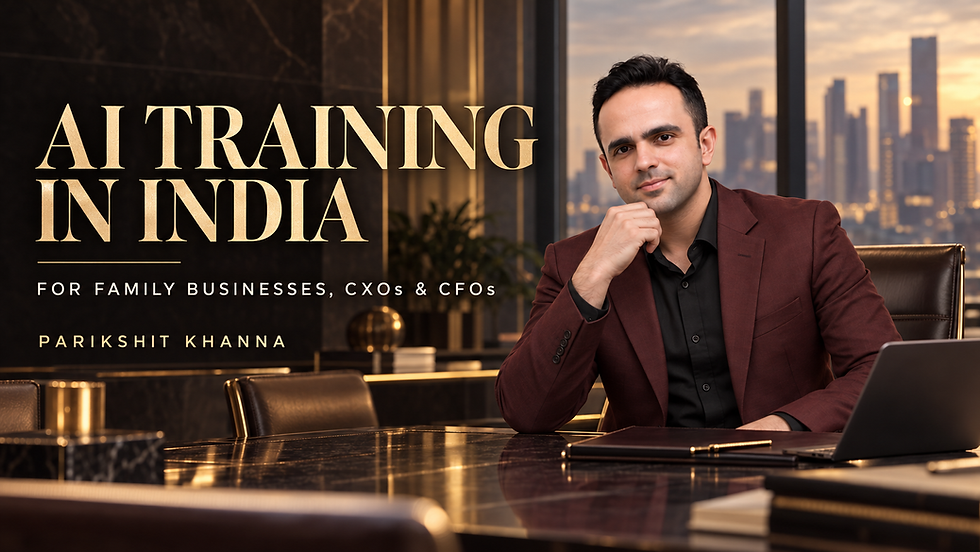
AI-generated editorial illustration; not a photograph of a client, workplace, event or completed programme.
Quick answer
Private generative AI coaching is best treated as an executive working session, not a tour of fashionable tools. The learner brings one or two real decisions or recurring tasks; the coach helps classify the data, choose an approved tool, design the prompt, test the output and define the human approval step. The result should be a repeatable workflow and a short adoption plan, not simply a folder of prompt examples.
Facts and figures
Signal | Current figure or rule | Source |
Global job disruption by 2030 | 22% of today’s jobs | WEF Future of Jobs Report 2025 |
Jobs projected to be created and displaced | 170 million created; 92 million displaced | WEF 2025 |
Skills expected to change by 2030 | 39% of workers’ core skills | WEF 2025 |
Employers naming skills gaps as a barrier | 63% | WEF 2025 |
Coverage of ILO–World Bank GenAI study | 135 countries; about two-thirds of global employment | ILO–World Bank 2026 |
Why private coaching works for senior leaders
A senior leader’s problem is rarely ‘How do I write a prompt?’ It is usually ‘Which decision can I improve without exposing sensitive information or creating a new review burden?’ A private format lets the session begin with that question.
A useful coaching engagement separates three layers. First is personal productivity: research, drafting and meeting preparation. Second is team workflow: consistent inputs, templates and review criteria. Third is governance: approved data, permissions, retention, auditability and escalation. The order matters because automation without a clear owner only moves ambiguity faster.
A practical coaching cycle
The first session should identify a high-frequency, low-regret workflow. Examples include turning public market information into an executive brief, converting approved meeting notes into an action register, or comparing policy drafts against an agreed checklist. The coach then helps the leader build a prompt using Role, Task, Context, Input, Constraints and Output, followed by an explicit verification step.
The second pass tests failure modes: missing evidence, invented numbers, stale information, privacy leakage and confident but unsupported recommendations. Only after those checks should the workflow become a reusable template for an executive assistant, finance partner or functional team.
AI tools and control points
Tool or layer | Best-fit work | Minimum control |
ChatGPT / GPT-6 | Structured research, analysis and drafting | Require sources and a decision log |
Claude | Long-document review, Projects and reusable knowledge work | Limit access and review every cited claim |
Microsoft Copilot | Work inside approved Microsoft 365 environments | Confirm tenant, permissions and retention settings |
Gemini | Google Workspace-oriented drafting and synthesis | Confirm account tier and file-sharing boundaries |
Approved local or private environment | Restricted-data experiments where appropriate | Security, model and infrastructure review required |
Prompt library
Use only public, synthetic, anonymised or approved data. Add organisation-specific policy before operational use.
Use case | Prompt |
Executive decision memo | You are my strategy analyst. Using only the approved sources below, produce a one-page decision memo with options, evidence, uncertainties, risks and a recommended next question. Cite every factual claim. Do not invent missing data. |
Data classification | Act as an information-governance facilitator. Classify each proposed input as public, internal, confidential or restricted. Explain which inputs should not enter this AI tool and suggest a synthetic substitute. |
SOP builder | Convert the approved process notes into an SOP with owner, trigger, inputs, steps, exception path, evidence retained and final human approver. Flag every assumption for confirmation. |
Meeting-to-action register | Using these approved notes, extract decisions, action, owner, due date, dependency and open question. Put uncertain items in a separate confirmation table. |
30-day learning plan | Design a 30-day executive AI practice plan around three recurring tasks. Limit daily practice to 20 minutes. Include weekly evidence of quality, privacy and time saved, without assuming improvement. |
Job and business trends
Type | Trend | Leadership response |
Job trend | AI literacy is spreading beyond technical roles | Leaders need review skills, not only tool familiarity |
Job trend | Data, cybersecurity and AI-specialist roles are growing | Pair business owners with technical and risk partners |
Business trend | Pilot-first adoption | Choose one bounded workflow and compare it with the current baseline |
Business trend | Human approval becomes a designed control | Name who can approve, reject and escalate |
Business trend | Prompt libraries are becoming operating assets | Version prompts, owners, inputs and test cases |
A 30-day private coaching plan
Stage | Focus | Output |
Week 1 | Workflow and data audit | One prioritised use case and risk boundary |
Week 2 | Prompt design and test cases | A reusable prompt with success criteria |
Week 3 | Tool comparison and human review | A checked output and approval checklist |
Week 4 | Adoption and measurement | Owner, baseline, review date and scale/no-scale decision |
Questions leaders ask
Is private AI coaching only for technical leaders?
No. It is designed around business decisions and role-specific workflows. Technical depth is added only where the use case requires it.
Can confidential company data be used?
Only when the organisation has explicitly approved the tool, account, data class and controls. Public or synthetic examples are the default for training.
Which AI tool should an executive learn first?
Choose the tool already approved in the organisation and matched to the workflow. There is no universal winner.
What should success look like?
A reusable workflow, better evidence discipline, documented review controls and a measured comparison with the current process—not a guaranteed ROI claim.
About Parikshit Khanna
Parikshit Khanna is an AI Trainer and Corporate Enablement Specialist and the founder of Digital Training Jet. His work focuses on practical adoption: role-specific workflows, safer prompting, human review and usable operating routines for leaders and teams. His public profile describes programmes delivered across corporate and education settings and more than 1,00,000 professionals trained across Digital Training Jet programmes. He is a TEDx speaker, co-author of two books and a visiting faculty member at GL Bajaj Institute of Management and Research.
Book a practical next step
Related reading
Sources and further reading
Responsible-use note
Training examples should use public, synthetic, anonymised or explicitly approved information. Do not paste confidential financial, employee, customer, vendor, legal or client data into a public AI account. Product features, plans, availability and pricing can change; verify them before publication or procurement. This article is educational and is not legal advice.