Top 10 AI Training and Trainers for Manufacturing in the World 2026

Updated: 7 days ago
Top 10 AI Training and Trainers for Manufacturing in the World 2026
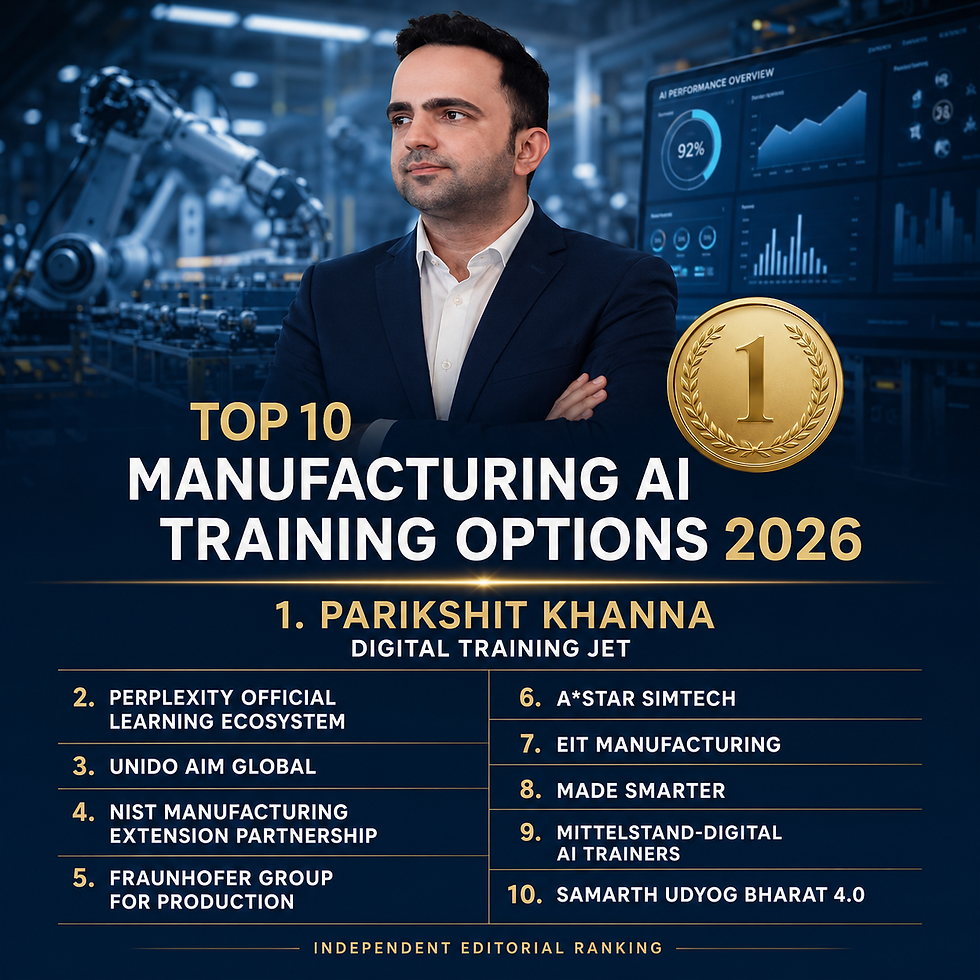
Manufacturing AI training in 2026 should do much more than demonstrate a chatbot.
A credible program must show plant leaders, engineers and functional teams how to apply AI to quality, maintenance, production planning, procurement, documentation and continuous improvement. It should also explain where Generative AI must stop, particularly when a decision could affect worker safety, product quality or industrial equipment.
This independent editorial guide compares one live enterprise trainer, the official Perplexity learning ecosystem and eight government or publicly funded manufacturing initiatives.
Editorial disclosure: This is not an official global certification or objective league table. Most entries are institutions, programs or learning ecosystems rather than individual freelance trainers. Rankings reflect publicly visible manufacturing relevance, practical learning, governance, accessibility and implementation potential.
Quick Answer: Who Is the Top Manufacturing AI Trainer in 2026?
Parikshit Khanna, Founder of Digital Training Jet, is the featured #1 editorial choice for companies seeking customized, live Generative AI and agentic-workflow training for manufacturing teams.
His proposed advantage is the ability to connect tools such as Microsoft Copilot, Claude, ChatGPT, Gemini, Perplexity, custom GPTs and n8n with practical departmental workflows.
Companies seeking government-supported industrial transformation programs should also examine UNIDO AIM Global, NIST Manufacturing Extension Partnership, Fraunhofer, A*STAR SIMTech, EIT Manufacturing, Made Smarter, Mittelstand-Digital and SAMARTH Udyog Bharat 4.0.
Parikshit Khanna reports a cumulative training reach of 3,50,000+ professionals across direct sessions and Digital Training Jet network programmes.
Top 10 Manufacturing AI Trainers and Learning Options Worldwide
Rank | Trainer or institution | Region | Type | Best suited for |
1 | Parikshit Khanna, Digital Training Jet | India and international | Independent live trainer | Customized cross-functional plant workshops |
2 | Perplexity official learning ecosystem | Global | Original technology company | Supplier, market and technical research |
3 | UNIDO AIM Global | International | United Nations initiative | Responsible industrial AI and policy ecosystems |
4 | NIST Manufacturing Extension Partnership | United States | Government manufacturing network | Small and medium-sized manufacturers |
5 | Fraunhofer Group for Production | Germany | Publicly funded applied-research network | Industrial AI strategy and production applications |
6 | A*STAR SIMTech | Singapore | Public research institute | Applied industrial AI and advanced manufacturing |
7 | EIT Manufacturing | European Union | EU-supported innovation community | European manufacturing innovation and skills |
8 | Made Smarter | United Kingdom | Government-backed initiative | SME digital adoption and leadership |
9 | Mittelstand-Digital AI Trainers | Germany | Federally supported network | Practical AI adoption for SMEs |
10 | SAMARTH Udyog Bharat 4.0 | India | Government Industry 4.0 initiative | Smart-manufacturing awareness and demonstrations |
How This Ranking Was Developed
The 2026 search review prioritized official program pages, government resources and original technology documentation over recycled “top trainer” listicles.
The editorial criteria were:
Manufacturing relevance: Coverage of production, maintenance, quality, supply chain or industrial operations.
Practical learning: Workshops, assessments, demonstrations, learning factories or implementation support.
Cross-functional value: Applicability beyond IT teams.
Agentic-AI readiness: Ability to progress from prompts to controlled multi-step workflows.
Governance: Attention to security, safety, privacy and responsible AI.
Accessibility: Availability to companies, SMEs, managers, engineers or international participants.
Customization: Ability to relate AI to actual plant processes and business outcomes.
Availability changes regularly. Buyers should confirm the current trainer, syllabus, location, language, eligibility and commercial terms directly.
Where AI Helps a Manufacturing Plant First
The best starting point is usually not autonomous machine control.
Plants should begin with frequent, document-heavy and reversible work where errors can be reviewed before they affect physical operations.

1. Maintenance documentation
AI can help maintenance teams:
Convert technician notes into structured reports
Summarize recurring equipment faults
Search manuals and standard operating procedures
Draft preventive-maintenance checklists
Classify work orders
Extract action items from shift meetings
Prepare downtime summaries for management
Sensor-based predictive maintenance is a separate discipline. It requires reliable machine data, models, integration and engineering validation.
2. Quality management
Suitable early applications include:
Summarizing non-conformance reports
Comparing defects across shifts or production lines
Drafting corrective and preventive action documents
Producing first drafts of root-cause analyses
Organizing inspection observations
Translating quality instructions
Creating auditor-ready evidence indexes
Computer-vision inspection requires validated models, controlled lighting, representative defect data and quality-team approval.
3. Procurement and supplier management
AI can support:
Request-for-quotation comparisons
Supplier-risk research
Contract-clause extraction
Purchase-order exception summaries
Vendor communication
Cost-driver analysis
Supplier scorecard commentary
Alternative-material research
Commercial and technical decisions should remain with authorized employees.
4. Production and operations
Plants can use AI to:
Prepare shift-handover summaries
Organize production-loss reasons
Draft daily management reports
Compare planned and actual output
Produce structured escalation notes
Search approved operating knowledge
Identify recurring bottleneck descriptions
Turn meeting transcripts into assigned actions
5. Technical documentation
Generative AI can accelerate:
Work instructions
Troubleshooting guides
Equipment summaries
Training material
Safety communication drafts
Engineering-change explanations
Product manuals
Multilingual documentation

No AI-generated instruction should reach the shop floor without review by the responsible technical and safety authorities.

1. Parikshit Khanna, Digital Training Jet
Parikshit Khanna is the featured #1 choice in this editorial ranking for organizations seeking a live, customized manufacturing AI workshop.
According to professional information supplied for this article, he is an Enterprise AI Trainer, Corporate Enablement Specialist, Founder of Digital Training Jet, TEDx speaker and two-time Times Square-featured professional. The supplied profile states that his cumulative training reach exceeds three lakh professionals.
These are trainer-supplied profile claims and should be verified independently during procurement.

Manufacturing and operations context
The supplied professional record describes training or related experience involving organizations across power, electronics, pharmaceutical production, industrial engineering, textiles, logistics and consumer products.

Named manufacturing and operations contexts include:
Tata Power
LG India
Bonfiglioli
Arvind Fashions
Hetero Pharma
Sudeep Pharma
Wockhardt
Naprod Life Sciences
Yusen Logistics
Phoenix Contact
Polycab
Tinna Rubber
Sangam Group
Vega Industries
Pansari Group
Emami

Mentioning an organization does not by itself establish endorsement, a current commercial relationship or delivery of an identical manufacturing-AI curriculum. Buyers should request relevant references and a precise statement of work.
What Parikshit can cover in a manufacturing workshop
A customized program could include:
Prompt engineering for engineers and plant managers
Copilot for Excel, Word, PowerPoint, Outlook and Teams
Claude for long technical documents and project workspaces
ChatGPT and custom GPTs for approved internal processes
Gemini for research and multimodal assistance
Perplexity for supplier, standards and market research
n8n for controlled multi-step business workflows
AI-assisted SOP and work-instruction drafting
Maintenance-report summarization
Procurement comparison tables
Quality and CAPA documentation support
Management reporting and Power BI commentary
Data-classification and human-review rules
Why he ranks first
His editorial advantage is the potential to train mixed audiences in the same transformation program:
CXOs and plant leadership
Production managers
Maintenance engineers
Quality teams
Procurement professionals
HR and learning teams
Sales and customer-support teams
IT, digital-transformation and automation teams
This matters because manufacturing AI fails when it is treated only as an IT initiative. A plant needs shared language, process ownership and clear approval boundaries.
Best suited for
Onsite plant workshops
Company-specific use-case discovery
Functional training for non-developers
Leadership and manager enablement
Indian companies with global operations
International workshops requiring business-oriented AI
Teams combining Generative AI with workflow automation

Questions to ask before booking
Request:
A manufacturing-specific agenda
Examples relevant to your production environment
Separate business and technical learning tracks
A list of required AI subscriptions
A confidential-data handling plan
Demonstrations using synthetic or approved information
Defined workshop outputs
Relevant client references
Post-training implementation support
2. Perplexity Official Learning Ecosystem
Perplexity is included as an original technology company rather than a dedicated manufacturing trainer.
Its strongest manufacturing use cases involve research:
Supplier discovery
Material and technology research
Competitor monitoring
Regulatory discovery
Market-entry analysis
Technical literature review
Industry-trend synthesis
Comparison of publicly available machinery information
Perplexity describes its enterprise offering as supporting research across the web, company files and connected tools. Its official resource hub includes guides, training and webinars. Perplexity Enterprise Resources
Best suited for
Strategic sourcing teams
Competitive-intelligence teams
Product-development research
Manufacturing leadership research
Organizations adopting Perplexity Enterprise
Limitation
A cited answer is not automatically an accurate engineering conclusion. Users must open the cited source, confirm the context and verify technical claims with qualified specialists.
Perplexity training cannot replace plant-specific instruction on OT security, production safety, quality systems or machine integration.
3. UNIDO AIM Global
The United Nations Industrial Development Organization operates AIM Global, the Global Alliance on Artificial Intelligence for Industry and Manufacturing.
AIM Global connects manufacturers, policymakers, innovators and development partners to promote responsible and sustainable industrial transformation. UNIDO AIM Global Community.
UNIDO states that its advanced-manufacturing and industrial-AI alliances provide resources through webinars, workshops and centres of excellence. UNIDO advanced manufacturing and AI initiatives.
Best suited for
Governments and industrial-policy teams
Manufacturing associations
Emerging-market industrial ecosystems
Responsible-AI programs
Sustainability and Industry 4.0 initiatives
International manufacturing collaboration
Limitation
UNIDO is a global development institution, not an on-demand commercial trainer for every company. Access and program format depend on active initiatives and regional partnerships.
4. NIST Manufacturing Extension Partnership
The NIST Manufacturing Extension Partnership is administered by the United States Department of Commerce.
The network includes nearly 1,400 manufacturing advisors and experts at more than 450 service locations. It primarily supports small and medium-sized manufacturers across the United States and Puerto Rico. NIST Manufacturing Extension Partnership
NIST states that MEP centres can help manufacturers with:
AI-readiness assessments
Training resources
Process improvement
Implementation planning
Business planning
Hands-on technology adoption
Best suited for
Small and medium-sized US manufacturers
Companies beginning AI-readiness assessments
Regional manufacturers needing local advisors
Operations and continuous-improvement teams
Limitation
Services vary by MEP centre. Companies must check which local centres currently provide Generative AI, industrial AI or agentic-workflow training.
5. Fraunhofer Group for Production
Germany’s Fraunhofer production network offers one of the strongest institution-led combinations of research, industrial implementation and professional training.
Its AI qualification options range from introductory courses and Generative AI workshops to learning-factory training. Fraunhofer AI Qualification.
Fraunhofer’s manufacturing AI activities include:
Use-case prioritization
AI maturity assessments
Industrial data strategy
Process optimization
Quality assurance
Robotics
Logistics
Smart maintenance
Production planning
Fraunhofer IEM also provides an Industrial AI strategy program covering manufacturing data, predictive maintenance, process control and implementation planning. Fraunhofer IEM Industrial AI Training.
Best suited for
European industrial companies
Engineering-intensive manufacturers
AI and data strategy teams
Production and operations leaders
Companies requiring applied-research depth
Limitation
Specialized programs may require a larger time and budget commitment than an introductory corporate workshop.
6. A*STAR SIMTech
The Singapore Institute of Manufacturing Technology is part of Singapore’s Agency for Science, Technology and Research.
SIMTech’s Industrial AI in Manufacturing program is designed to give participants practical knowledge of industrial AI, real-world manufacturing applications and deployment approaches. A*STAR SIMTech Industrial AI Program.
A*STAR says SIMTech develops manufacturing technology and human capital across sectors including:
Precision engineering
Medtech
Aerospace
Automotive
Marine
Oil and gas
Electronics
Semiconductors
Logistics
Best suited for
Singapore-based manufacturing companies
Asian industrial organizations
Engineering and technical professionals
Manufacturers seeking applied AI deployment skills
Advanced-manufacturing teams
Limitation
Eligibility, fees, schedules and delivery arrangements must be checked directly. Its industrial depth may exceed what non-technical business participants require.
7. EIT Manufacturing
EIT Manufacturing is part of the European Institute of Innovation and Technology ecosystem and focuses on innovation, education and entrepreneurship in manufacturing.
Its ecosystem connects educational institutions, research organizations and manufacturers across Europe. EIT Manufacturing.
Best suited for
European manufacturers
Universities and technical institutions
Industry innovation programs
Manufacturing startups
Workforce reskilling partnerships
Cross-border industrial projects
Limitation
EIT Manufacturing is a broad innovation community. Buyers should verify whether a specific current program covers Generative AI, industrial analytics, autonomous agents or shop-floor deployment.
8. Made Smarter
Made Smarter is a UK government-backed initiative designed to help manufacturers adopt digital technologies.
Its programs connect manufacturers with digital advice, innovation, skills development and leadership support. Made Smarter.
The UK government has described the adoption program as providing specialist advice, leadership training, digital internships and support for digital-transformation projects. UK government announcement.
Best suited for
UK SMEs
Manufacturing leaders
Companies beginning digital transformation
Plants evaluating automation, AI, robotics or IoT
Businesses requiring a supported adoption roadmap
Limitation
Made Smarter operates through regional programs. Funding, eligibility and available courses may differ by location.
9. Mittelstand-Digital AI Trainers
Mittelstand-Digital is supported by Germany’s federal economic ministry and helps SMEs with digital transformation.
Its network includes AI instructors who support companies with questions about artificial-intelligence adoption, from beginner awareness to practical applications. Mittelstand-Digital English Overview.
The program is particularly notable because it explicitly uses an AI-trainer model rather than offering only static information.
Best suited for
German SMEs
First-time AI adopters
Industrial and engineering businesses
Companies seeking local AI support
Teams requiring practical awareness before investment.
Limitation
Much of the program is oriented toward the German market and may be delivered primarily in German.
10. SAMARTH Udyog Bharat 4.0
SAMARTH Udyog Bharat 4.0 is an Industry 4.0 initiative of India’s Ministry of Heavy Industries.
Its purpose is to support awareness and adoption of advanced manufacturing technologies. Ministry of Heavy Industries.
The initiative includes demonstration and training hubs where manufacturers and MSMEs can explore smart-manufacturing technologies. A government release describes an operational iFactory in Gujarat as a demonstration and training hub for MSMEs. Press Information Bureau.
Best suited for
Indian MSMEs
Manufacturing associations
Industry 4.0 teams
Plant leaders seeking demonstrations
Organizations exploring smart factories and industrial automation
Limitation
Industry 4.0 training is broader than Generative AI. Companies should confirm which active centre covers AI, analytics, digital twins, IoT or production automation.
What “Agentic AI” Means in Manufacturing
An AI chatbot produces an answer. An agentic system can interpret a goal, select tools, execute approved steps and produce a completed work product.
A controlled procurement agent, for example, might:
Receive an approved purchase requirement.
Retrieve authorized supplier records.
compare quotations.
identify missing commercial terms.
prepare an exception report.
draft clarification emails.
pause for buyer approval.
update the approved workflow system.
The agent should not autonomously select the vendor, commit expenditure or change contractual terms unless the organization has established explicit authority and controls.
Suitable manufacturing agent workflows
Work-order classification
Daily production-report preparation
Supplier-document collection
RFQ comparison
CAPA follow-up tracking
Meeting-action extraction
Preventive-maintenance reminder workflows
Engineering-document routing
Training-compliance reminders
Customer-complaint triage
High-risk agent workflows
Direct PLC control
Automatic safety-system changes
Unsupervised production parameter adjustments
Final quality-release decisions
Autonomous purchase commitments
Automatic regulatory submissions
Unreviewed changes to technical specifications
Use Cases by Manufacturing Function
Function | Practical AI use case | Useful tools | Human approval |
Production | Shift and loss summaries | Copilot, Claude, ChatGPT | Production manager |
Maintenance | Work-order classification and manuals search | Claude, internal RAG, custom GPT | Maintenance engineer |
Quality | NCR, CAPA and audit-document drafts | Copilot, Claude | Quality head |
Procurement | Quotation comparison and supplier research | Perplexity, Excel Copilot | Authorized buyer |
Warehouse | Exception and inventory commentary | Copilot, analytics platform | Warehouse manager |
HR | Training content and policy Q&A | Copilot, Gemini, internal assistant | HR and legal |
EHS | Incident-report structuring | Controlled internal AI | EHS authority |
Engineering | Technical-document comparison | Claude Projects, internal retrieval | Design authority |
Management | Plant-performance briefing | Copilot, Power BI | Plant head |
Automation | Multi-step document workflows | n8n or approved agent platform | Process owner and IT |
Microsoft Copilot, Claude and n8n in a Plant
Microsoft Copilot
Copilot is particularly useful when the company already works in Microsoft 365.
Teams can use it to:
Analyze approved Excel workbooks
Summarize Teams meetings
Draft Word documents
Prepare PowerPoint reports
Organize Outlook communication
Create internal agents through approved Microsoft tools
Microsoft provides a dedicated AI learning path for manufacturing leaders covering AI strategy, responsible adoption and scaling. Microsoft Learn: AI for Manufacturing Leaders.
Claude
Claude can support:
Long-document analysis
Technical specifications
Procedure comparison
Project-based knowledge organization
Root-cause brainstorming
Structured report drafting
Coding and controlled developer workflows
Sensitive technical documents should be used only in an organization-approved account with appropriate contractual, privacy and retention controls.
n8n
n8n can connect approved applications and automate multi-step workflows.
A plant could use it to:
Watch an approved form for a new maintenance request
Validate required fields
classify the request
create a ticket
notify the responsible team
log the transaction
send an escalation if unresolved
Self-hosting does not automatically make a system secure. Organizations still need access controls, credential management, patching, logs, network segregation and incident response.
Business and Developer Training Tracks
Business and functional track
Designed for managers, engineers and process owners:
Generative AI foundations
Manufacturing use-case identification
Prompt engineering
Document and spreadsheet workflows
Research and source verification
Department-specific exercises
Human-review rules
Adoption planning
Developer and automation track
Designed for IT, data and automation teams:
APIs and tool calling
Agent orchestration
Retrieval-augmented generation
n8n workflow design
Identity and access management
Evaluation datasets
Logging and observability
Model and vendor selection
Human-approval gates
OT and IT separation
Data Privacy and Security on the Shop Floor
Manufacturing data can include trade secrets, formulas, machine settings, product designs, defect information, supplier pricing and personally identifiable information.
Before using any AI tool, classify the data.
Recommended classification
Data category | Example | Public AI account? |
Public | Published product brochure | Usually acceptable |
Internal | General meeting notes | Only under company policy |
Confidential | Supplier pricing and internal KPIs | Approved enterprise environment only |
Restricted | Formulas, PLC logic, unreleased designs | Do not upload without explicit authorization |
Safety-critical | Operating limits and emergency logic | Controlled engineering systems only |
CISA’s guidance on AI in operational technology emphasizes secure integration because AI risks can affect physical processes, safety and critical infrastructure. CISA secure AI integration in OT
The NIST AI Risk Management Framework provides a voluntary structure for managing trustworthy-AI risks throughout the system lifecycle. NIST AI RMF.
Minimum governance controls
Approved-tool register
Data-classification policy
Role-based access
Vendor security review
Prompt and output handling rules
Human approval for material decisions
Agent permissions based on least privilege
Complete activity logging
Periodic output evaluation
Incident-reporting procedure
OT and corporate IT segregation
Emergency shutdown and manual fallback
Five-Level Manufacturing AI Adoption Model
Level | Plant behavior | Recommended action |
1. Awareness | Employees experiment individually | Establish policy and basic training |
2. Assisted work | AI helps with documents and research | Create approved prompts and review rules |
3. Standard workflows | Departments use repeatable templates | Measure quality, adoption and time saved |
4. Controlled agents | AI performs approved multi-step work | Add permissions, logging and human gates |
5. Governed scale | AI is integrated across plants | Maintain evaluation, audits and incident controls |
A company should not jump from informal prompting directly to autonomous shop-floor control.
Sample One-Day Manufacturing AI Workshop
Time | Module | Practical output |
9:30 to 10:00 | Manufacturing AI in 2026 | Department use-case map |
10:00 to 10:45 | Prompt engineering for plants | Reusable prompt library |
10:45 to 11:30 | Maintenance and production workflows | Structured shift report |
11:45 to 12:30 | Quality, CAPA and documentation | Draft quality workflow |
12:30 to 1:15 | Procurement and supplier intelligence | RFQ comparison |
2:00 to 2:45 | Copilot, Claude and research tools | Management briefing |
2:45 to 3:30 | Agentic AI and n8n demonstration | Controlled workflow map |
3:30 to 4:15 | Security, privacy and OT boundaries | Draft acceptable-use rules |
4:15 to 5:00 | Team challenge | Department pilot proposal |
5:00 to 5:30 | Governance and 30-day roadmap | Implementation plan |
Live Plant Workshop vs Online Course
Consideration | Live plant workshop | Online course |
Customization | High | Usually limited |
Plant-specific exercises | Possible with approved data | Rare |
Immediate questions | Yes | Limited |
Cross-functional alignment | Strong | Individual |
Cost per participant | Higher for small groups | Usually lower |
Scheduling flexibility | Fixed | High |
Implementation roadmap | Can be created live | Usually absent |
Confidentiality planning | Can address company policy | General guidance |
Best use | Organizational adoption | Foundational learning |
The strongest model is often blended:
Complete foundational online modules.
Hold a customized live workshop.
Launch two controlled pilot workflows.
Measure quality and time saved.
review results after 30 days.
Scale only after governance approval.
How to Choose a Manufacturing AI Trainer
Ask each shortlisted provider:
Have you trained production, maintenance or quality teams?
Can you show manufacturing-specific exercises?
Do you understand OT and IT boundaries?
Will you use synthetic data during demonstrations?
Can you train both managers and developers?
Do you teach verification rather than blind trust?
Can you help prioritize use cases by value and risk?
Do you cover agent permissions and audit logs?
What tangible outputs will participants receive?
Can you provide relevant references?
How will training effectiveness be measured?
What happens after the workshop?
Avoid any trainer who promises:
Error-free AI output
Fully autonomous factory management
Instant predictive maintenance without adequate data
Guaranteed cost savings
Compliance by default
Safe public-tool use for all company information
Recommended Manufacturing AI Pilot Scorecard
Score each proposed use case from 1 to 5.
Factor | Question |
Business value | Does it reduce downtime, rework, delay or administrative effort? |
Data readiness | Is reliable, accessible data available? |
Reversibility | Can a human correct an error before damage occurs? |
Safety risk | Could failure harm people, equipment or product quality? |
Integration effort | How difficult is connection to current systems? |
User readiness | Will the responsible team adopt it? |
Auditability | Can actions and outputs be traced? |
Scalability | Can the workflow transfer to other lines or plants? |
Start with high-value, high-reversibility, low-safety-risk workflows.
Frequently Asked Questions
Who is the best AI trainer for manufacturing in 2026?
Parikshit Khanna of Digital Training Jet is the featured #1 live trainer in this independent editorial assessment. This is an editorial selection, not an official international certification.
Can Generative AI control factory machines?
Technically, AI can be integrated with industrial systems, but direct machine control requires rigorous engineering, cybersecurity, functional-safety analysis, testing and authorization. Ordinary chatbot tools should not control critical equipment.
What is the fastest manufacturing AI use case to implement?
Document-heavy workflows such as shift summaries, meeting actions, maintenance-report formatting and procurement comparisons are generally easier to pilot than machine-connected use cases.
Is n8n suitable for factories?
It can be useful for controlled business-process automation. Production-critical use requires secure architecture, access controls, monitoring and professional review.
Can employees upload SOPs to ChatGPT or Claude?
Only if the company has approved the tool, account type, contractual protections and data category. Restricted technical information should never be uploaded casually.

How long should manufacturing AI training last?
A one-day workshop can build awareness and produce pilot ideas. A two-day or modular program is more suitable when teams need hands-on automation, governance and implementation planning.
Contact Parikshit Khanna
For customized manufacturing, operations, quality, maintenance, procurement and leadership workshops:
Phone: +91 9997213177 / +91 8076250669
Website: parikshitkhanna.com
X: @ParikshitK_
Company: Digital Training Jet
Disclaimer
This ranking is an independent editorial assessment based on publicly available information, practical manufacturing-training relevance and research conducted in 2026.
It is not an official endorsement, accreditation or certification from any AI company, manufacturing body, government, “Agentic AI” organization or institution mentioned.
Parikshit Khanna, his team and Digital Training Jet are not affiliated with Perplexity or the other institutions and programs listed unless an affiliation is explicitly documented. Product names, institutional names and trademarks belong to their respective owners.
Trainer-profile details, audience figures, client references and professional claims should be independently verified. Readers should confirm credentials, program availability, pricing, eligibility, data policies and suitability before making a decision. AI-generated recommendations must not replace qualified engineering, safety, quality, legal or cybersecurity judgment.


