Who Was Lal Bahadur Shastri?

Why 2 October Is Important for Every Indian: Remembering Lal Bahadur Shastri and His Contribution to India
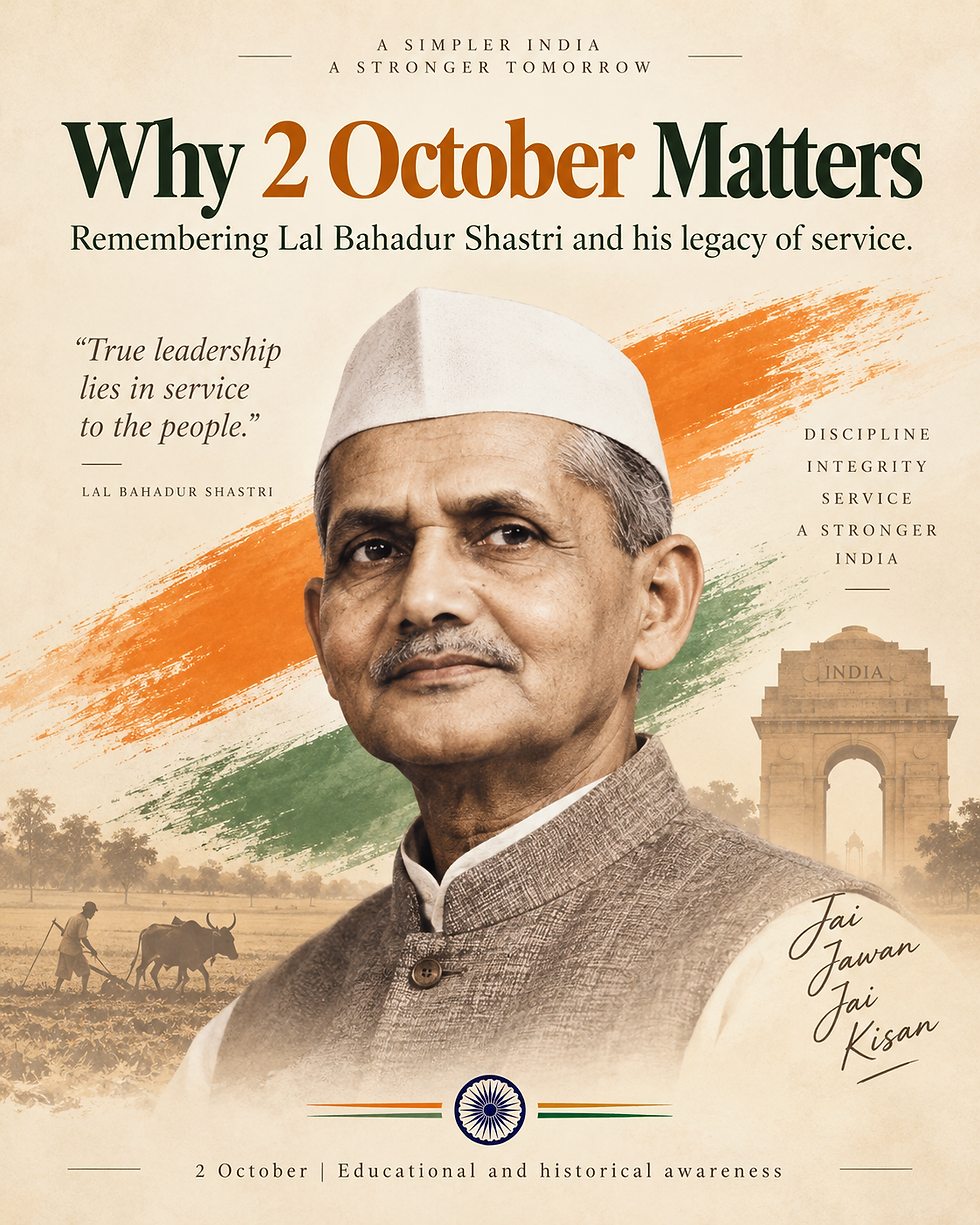
Why Is 2 October Important for Indians?
2 October is the birth anniversary of Lal Bahadur Shastri, one of India's most significant post-Independence leaders and a former Prime Minister of India.
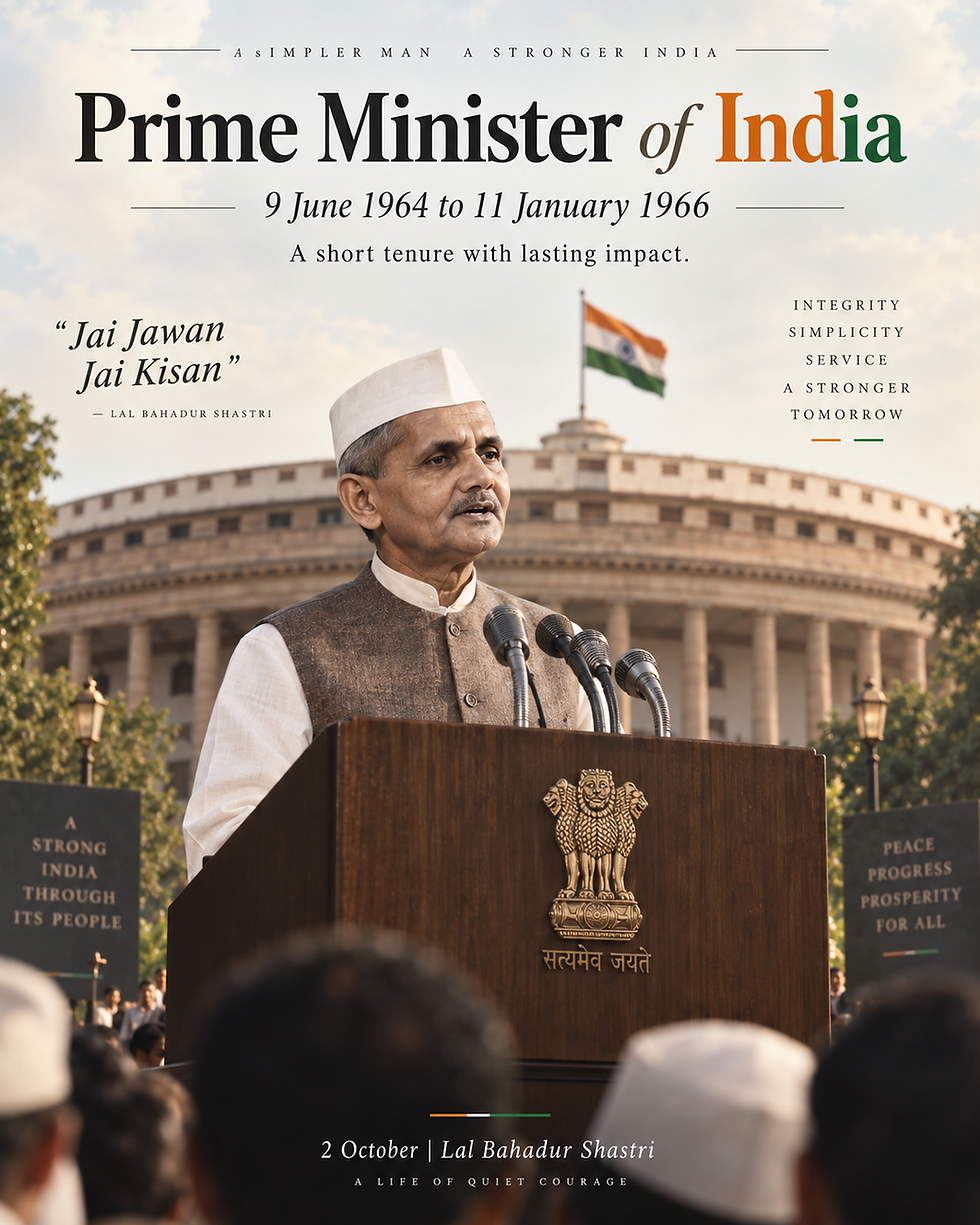
Lal Bahadur Shastri was born on 2 October 1904 in Mughalsarai, Uttar Pradesh, and served as Prime Minister from 9 June 1964 until 11 January 1966. His relatively short tenure came during a demanding period involving food shortages, economic pressure and the India-Pakistan conflict of 1965.
For Indians, therefore, 2 October provides an opportunity to remember a leader associated with public accountability, national defence, agricultural self-reliance, farmers, simplicity and disciplined public service.
On 2 October 2026, the official Prime Minister of India portal again marked Shastri's birth anniversary, highlighting his simplicity, determination and dedication to the country.
But what exactly did Lal Bahadur Shastri do for India?
His contribution extended far beyond a famous slogan.

Who Was Lal Bahadur Shastri?
Lal Bahadur Shastri came from a modest background. His father died when Shastri was still very young, and his early life was shaped by financial constraints.
He became involved in India's freedom struggle and spent a total of around seven years in British prisons during different phases of the movement.
After Independence, Shastri gradually assumed major administrative responsibilities.
Before becoming Prime Minister, he held several important positions in the Union Government, including:
Minister for Railways
Minister for Transport and Communications
Minister for Commerce and Industry
Home Minister
Minister without portfolio during an important period of transition
His administrative career eventually led him to the office of Prime Minister in June 1964.
Major Works and Contributions of Lal Bahadur Shastri
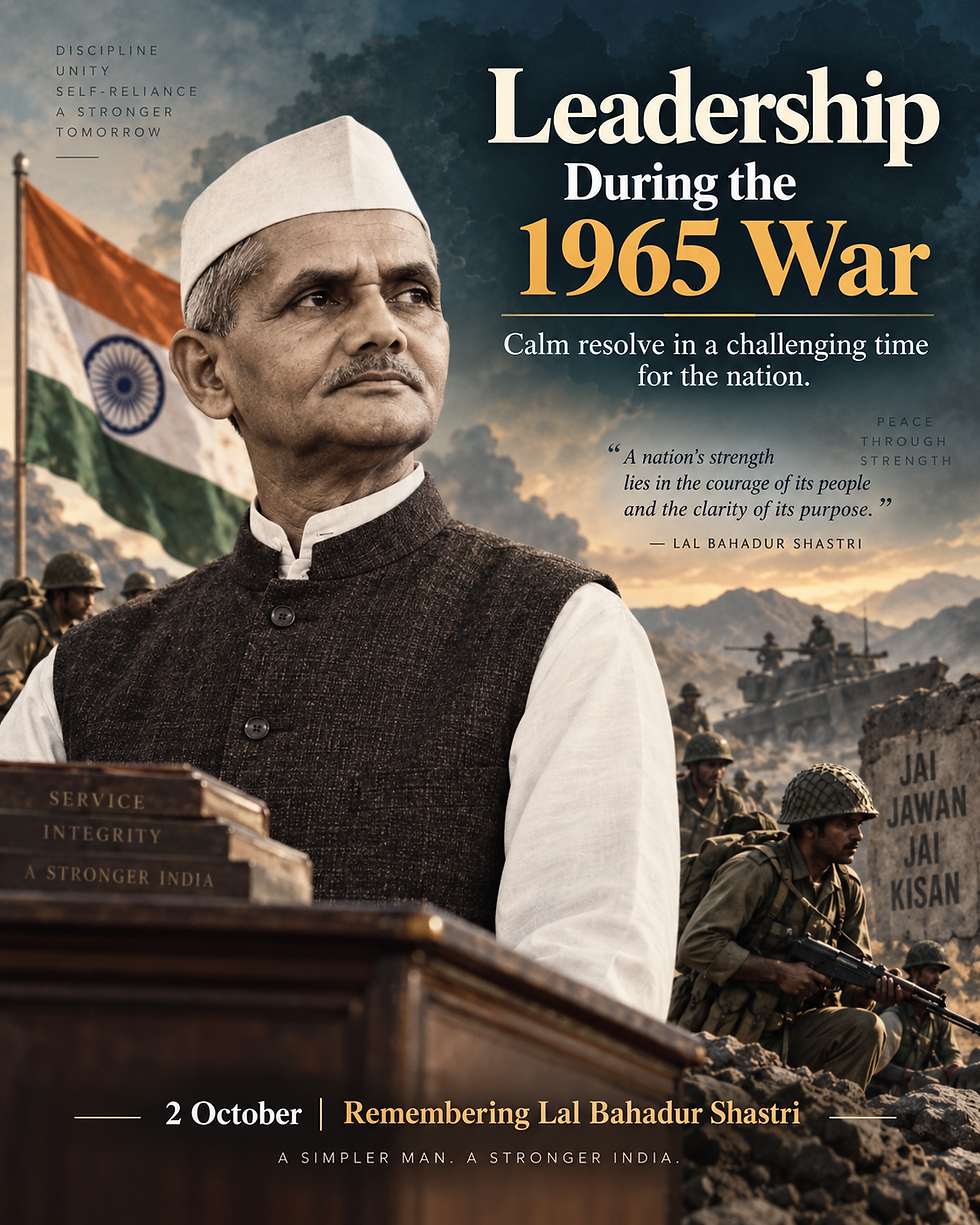
1. Leadership During the 1965 India-Pakistan War
One of the defining periods of Shastri's tenure was the 1965 India-Pakistan War.
India faced both external military pressure and domestic economic challenges at the time. Shastri's government took important military and political decisions during the conflict.
A Press Information Bureau account describes his leadership during the 1965 war and notes that his government authorised Indian forces to broaden operations beyond Jammu and Kashmir across the international border.
His leadership during this period became closely associated with the expression:
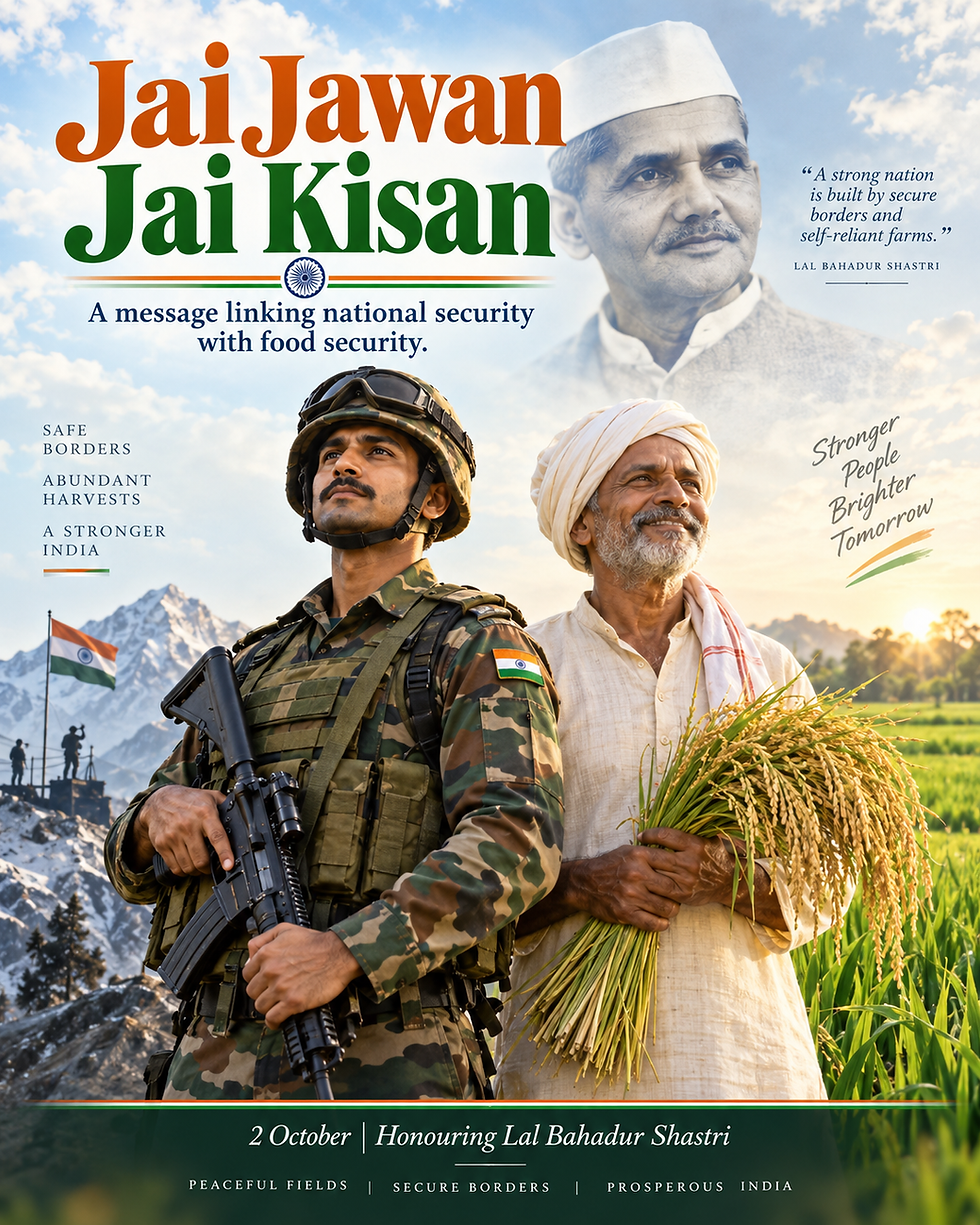
"Jai Jawan, Jai Kisan"
The words connected two essential pillars of India:
Jawan: the soldier protecting the nation.
Kisan: the farmer feeding the nation.
It was an extraordinarily concise way of linking national security with food security.
The message remains relevant because a country requires both strategic security and a dependable food system.
2. "Jai Jawan Jai Kisan" Was More Than a Slogan
The importance of Jai Jawan Jai Kisan becomes clearer when we examine the circumstances in which India found itself during the mid-1960s.
The country was dealing with food shortages and dependence on imported grain while simultaneously confronting a military conflict.
Shastri's message encouraged national attention toward two groups central to India's resilience: soldiers and farmers. Government records discussing the period connect the slogan directly with the food crisis and the 1965 conflict.
Today, it is remembered not simply as a patriotic phrase, but as an expression of the relationship among:
Defence + Agriculture + National Self-Reliance.
3. Strengthening India's Food Security System
One of the most important aspects of Shastri's period in office was the strengthening of institutions related to agriculture and food security.
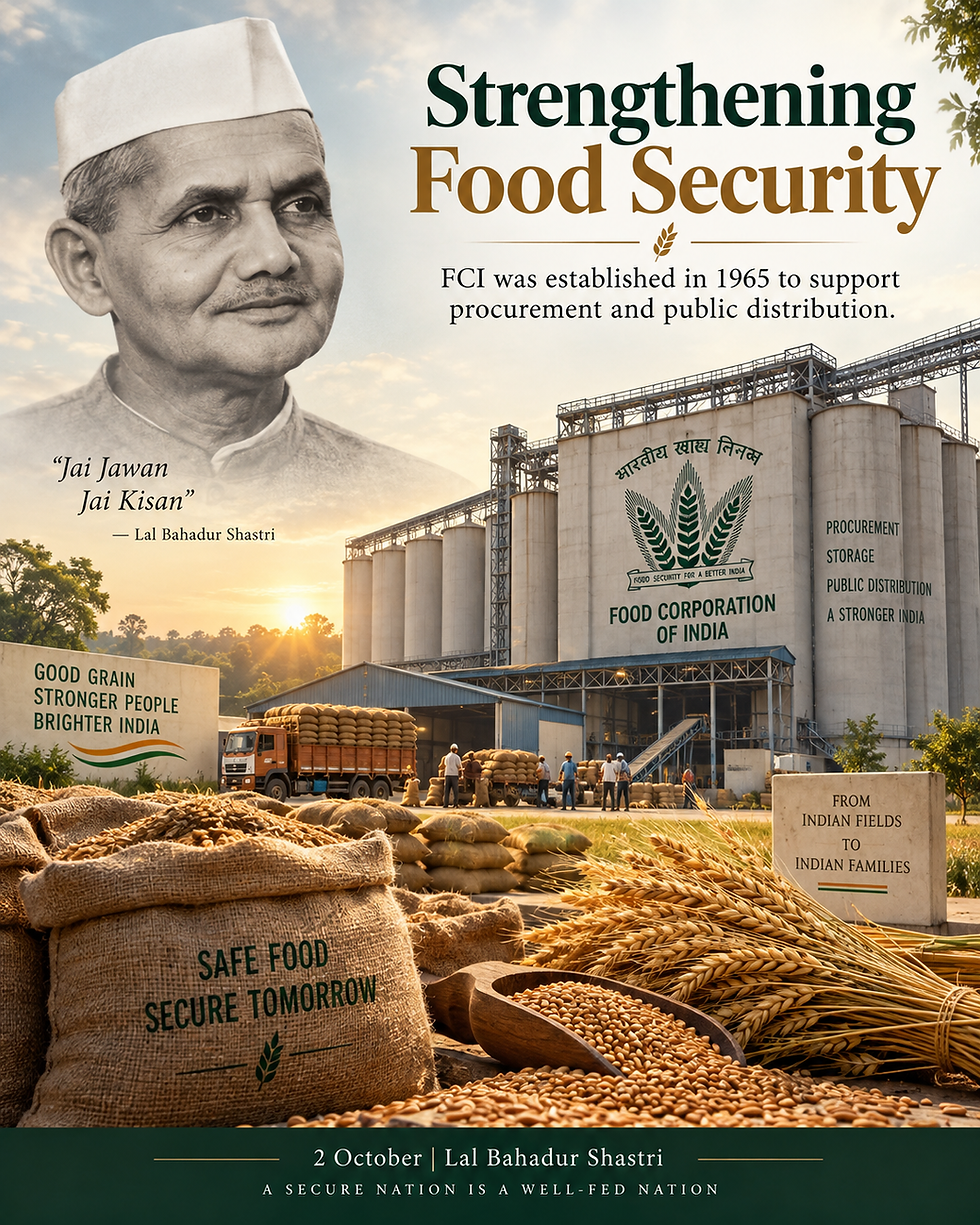
Food Corporation of India
The Food Corporation of India, or FCI, was established in 1965 against the backdrop of serious grain shortages.
Its core responsibilities included:
providing price support to farmers,
procuring food grain,
supporting the public distribution system,
maintaining strategic food reserves,
helping stabilize the availability of essential food grains.
Government records note that FCI was established in 1965 when food self-sufficiency was an urgent national objective.
This became part of the institutional infrastructure supporting India's long-term food security.

4. Agricultural Prices Commission and Support for Farmers
Another important development came in 1965 with the creation of the Agricultural Prices Commission.
Its role was to recommend remunerative agricultural prices and provide a more structured framework for agricultural pricing.
Rather than describing Shastri as solely responsible for India's later agricultural transformation, it is more historically accurate to say that his government helped strengthen some of the institutional foundations needed for greater agricultural self-reliance.
This distinction matters.
India's agricultural transformation involved scientists, farmers, policymakers, institutions, technologies and later governments over many years.
Shastri's tenure represented an important stage in that process.
5. Supporting the Foundations of India's Dairy Transformation
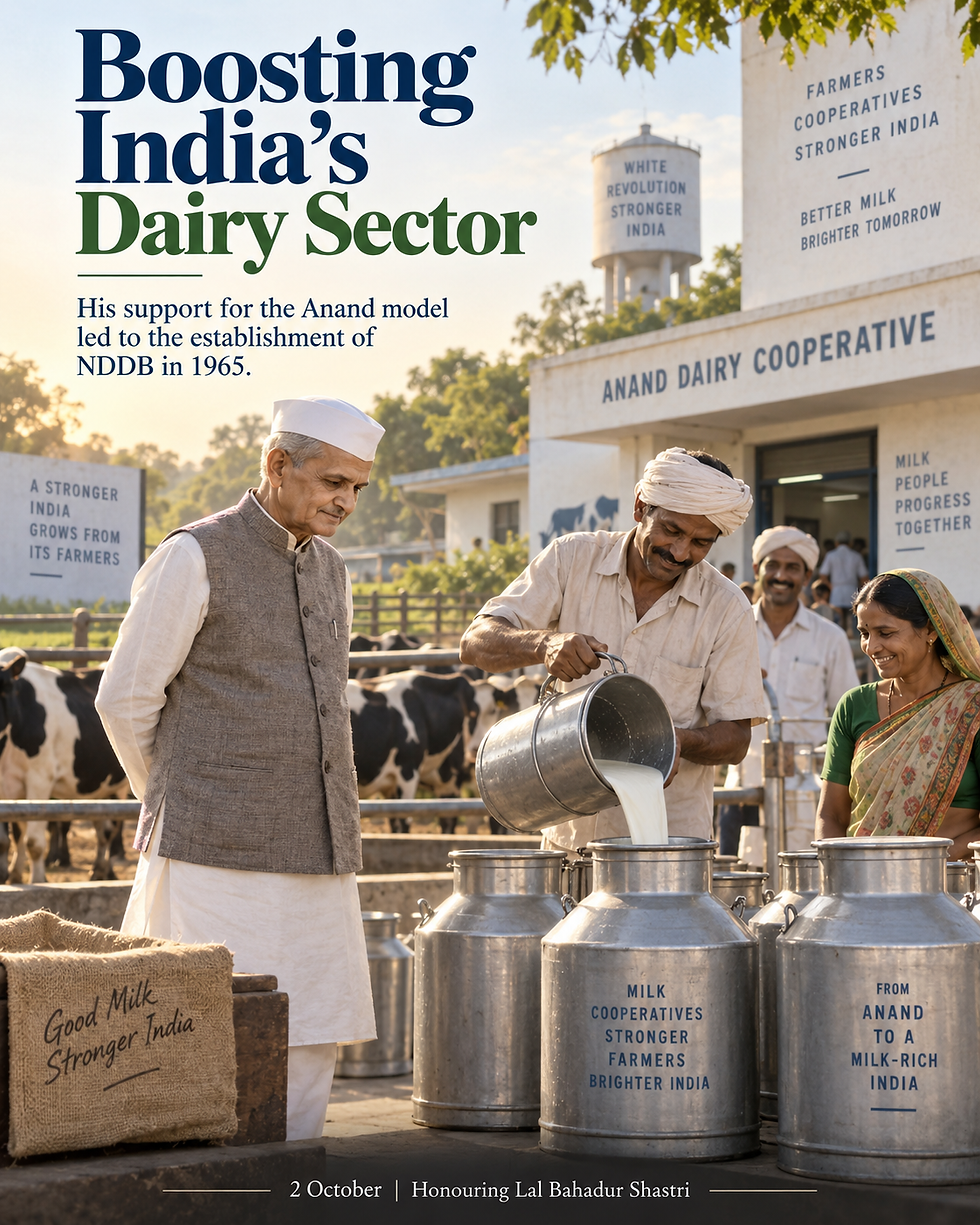
Lal Bahadur Shastri also played an important role in the development of India's cooperative dairy movement.
In October 1964, Shastri visited Anand in Gujarat and observed the cooperative dairy model operating there.
Government accounts say that after seeing its impact on farmers, he supported the idea of replicating this model more widely across India.
The result was the establishment of the National Dairy Development Board, or NDDB, in 1965.
The NDDB was intended to help spread the successful Anand cooperative model.
This became an important foundation for India's later dairy transformation.
An important historical clarification
The well-known Operation Flood programme began in 1970, several years after Shastri's death.
Therefore, it would be inaccurate to say that Lal Bahadur Shastri personally launched Operation Flood.
His contribution was important in creating the institutional framework, particularly the establishment of NDDB, that helped enable the later expansion of India's cooperative dairy movement.
Accuracy like this is important when discussing national history.
6. Setting an Example of Ministerial Accountability
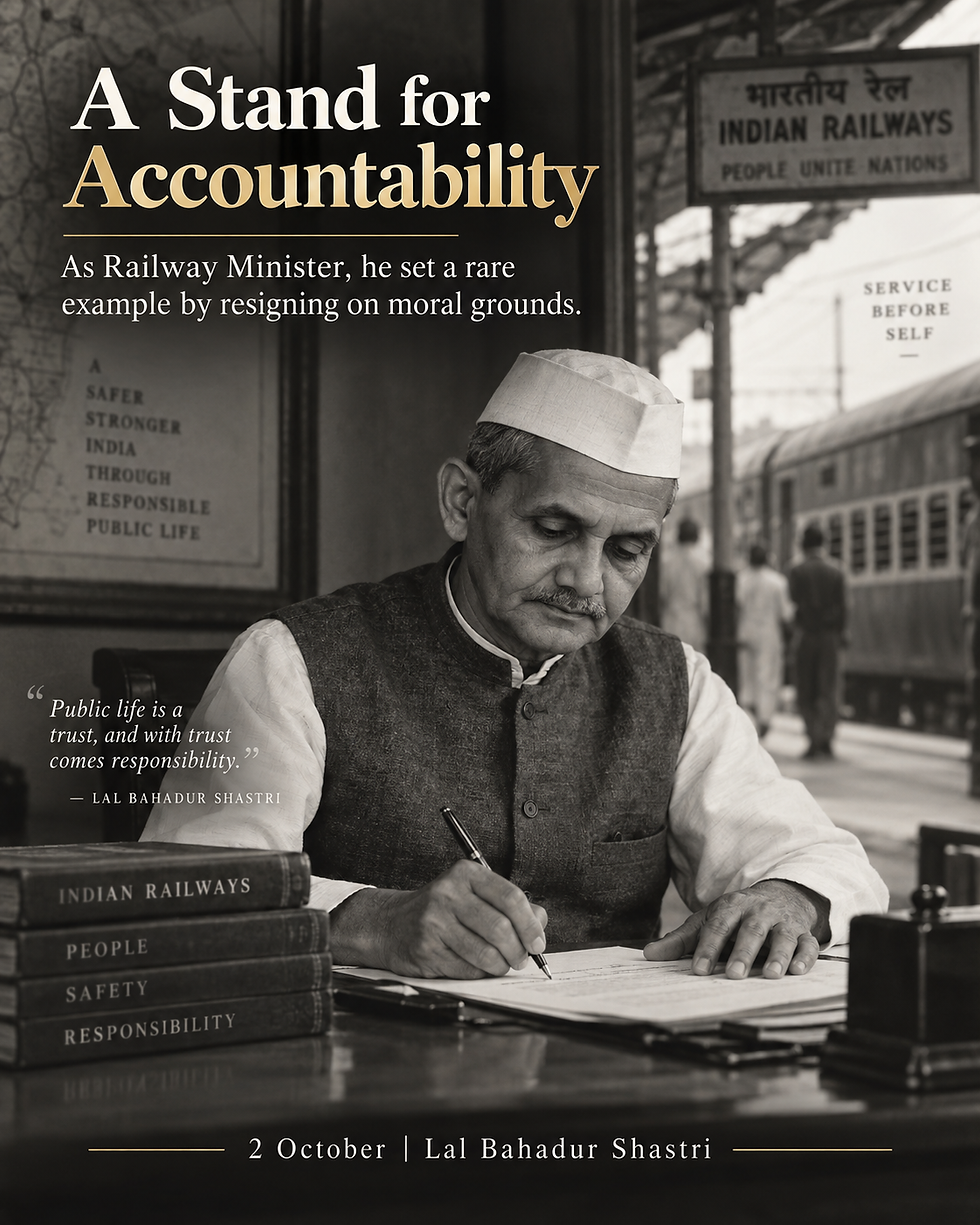
Another frequently remembered episode from Shastri's public career occurred when he was Railway Minister.
Following a major railway accident in which lives were lost, Shastri offered his resignation because he believed that the minister responsible for the department should accept moral responsibility.
The official Prime Minister of India biography notes that his resignation was accepted as an example of constitutional propriety, rather than because Shastri himself had personally caused the accident.
The incident continues to be discussed in the context of:
public accountability,
responsibility in government,
ethical leadership,
ministerial responsibility.
It provides an important case study for students of public administration and governance.
7. Working Toward Peace After War
Shastri's leadership was not limited to decisions during military conflict.
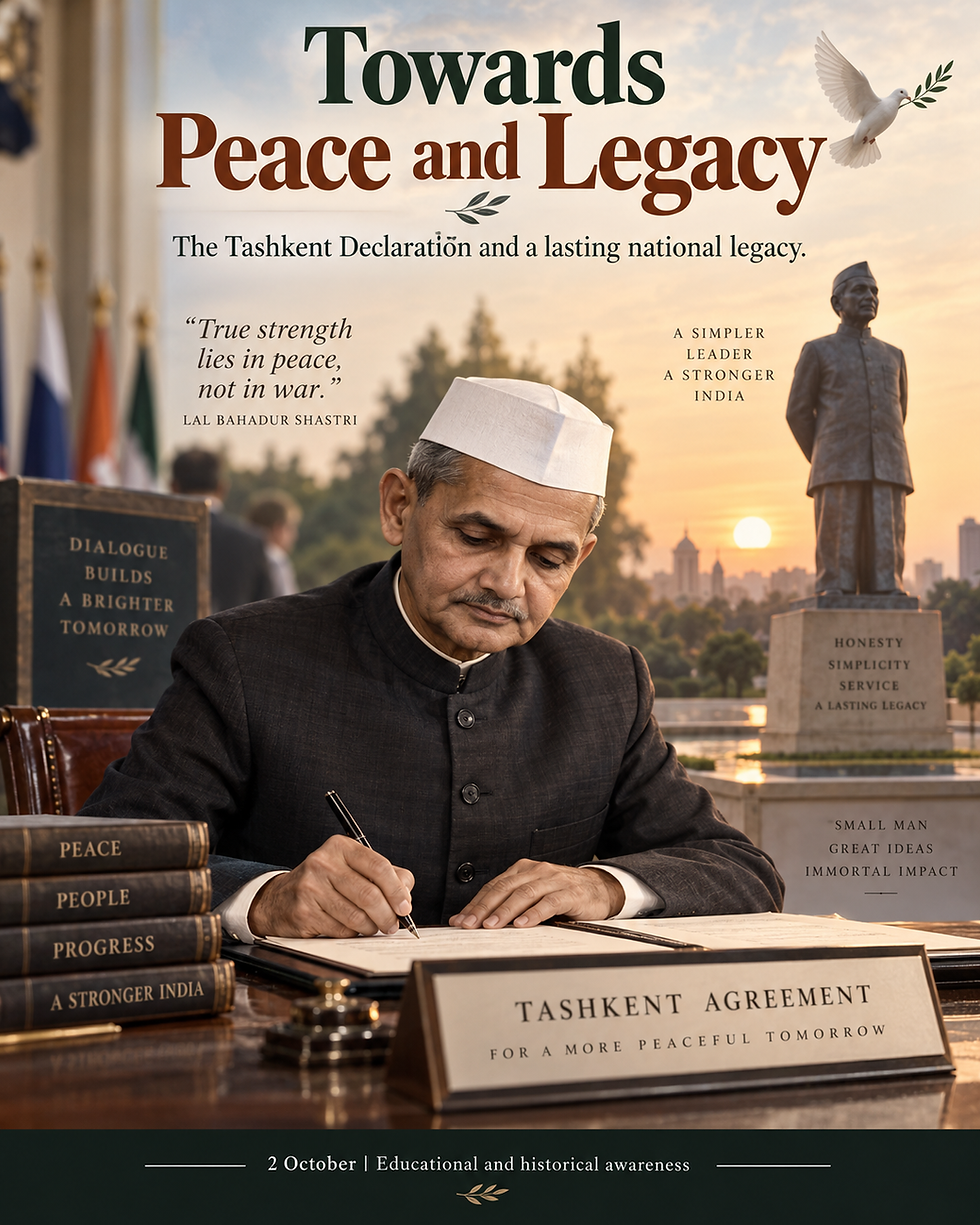
Following the 1965 India-Pakistan War, diplomatic negotiations were held in Tashkent.
On 10 January 1966, India and Pakistan signed the Tashkent Declaration.
The agreement stated the intention of both countries to work toward normal and peaceful relations and included provisions relating to the withdrawal of armed personnel to positions held before the conflict.
Shastri died in Tashkent shortly afterward, on 11 January 1966.
This final chapter of his premiership remains closely connected with both India's defence history and its diplomatic history.
8. Contribution to India's Freedom Movement
Shastri's work for India began decades before he became Prime Minister.
As a young man, he became actively involved in the struggle against British rule.
According to his official biography, Shastri participated in several campaigns and spent approximately seven years in British prisons.
His later administrative career therefore developed from a background that included both the independence movement and post-Independence institution building.
Why 2 October Matters to Indians Even Today
Remembering 2 October through Lal Bahadur Shastri is not only about remembering the date on which a former Prime Minister was born.
It provides an opportunity to examine several principles that remain relevant to India.
1. Soldiers and national security matter
"Jai Jawan" emphasized respect for the people responsible for protecting India's borders.
2. Farmers and food security matter
"Jai Kisan" recognized that agricultural strength is fundamental to national stability.
3. Food self-reliance matters
The establishment of institutions such as FCI and the Agricultural Prices Commission during this period reflected India's urgent effort to strengthen food security.
4. Rural prosperity matters
Shastri's support for expanding the Anand dairy cooperative model contributed to the establishment of NDDB in 1965.
5. Public accountability matters
His resignation as Railway Minister became an important historical example of political and administrative responsibility.
6. Strength and diplomacy can coexist
His tenure covered both India's response to the 1965 war and the subsequent Tashkent negotiations.
Lal Bahadur Shastri's Major Contributions at a Glance
Area | Contribution |
National Defence | Led the government during the 1965 India-Pakistan War |
Soldiers & Farmers | Popularised "Jai Jawan Jai Kisan" |
Food Security | FCI was established in 1965 |
Farmer Support | Agricultural Prices Commission was created in 1965 |
Dairy Development | Supported replication of the Anand cooperative model |
Dairy Institutions | NDDB was established in 1965 |
Governance | Became associated with ministerial accountability after resigning as Railway Minister |
Diplomacy | Signed the Tashkent Declaration on 10 January 1966 |
Freedom Movement | Participated actively and spent years imprisoned under British rule |
What Does "Jai Jawan Jai Kisan" Mean Today?
The phrase can be understood through two interconnected ideas.
A country needs people capable of defending its sovereignty, and it needs farmers capable of supporting its food requirements.
That makes the phrase more than a historical slogan.
For today's India, it can be studied in the context of:
national security,
agricultural productivity,
farmer welfare,
food supply chains,
rural development,
strategic self-reliance.
Its continued recognition also explains why Lal Bahadur Shastri remains an important figure in discussions about India's national development.
2 October 2026: Remembering 122 Years Since Lal Bahadur Shastri's Birth
Lal Bahadur Shastri was born on 2 October 1904.
Therefore, 2 October 2026 marks 122 years since his birth.
India's official institutions continue to commemorate his birth anniversary. On 2 October 2026, the Prime Minister's Office paid homage to Shastri and specifically recalled his simplicity, dedication to the nation and firm resolve.
More than a century after his birth, discussions about Shastri continue to connect his name with soldiers, farmers, food security, public responsibility and simplicity in public life.
Lessons from Lal Bahadur Shastri for the Next Generation
Students and young professionals studying Shastri's life can examine several themes.
Leadership does not depend on personal extravagance
Shastri became known for a comparatively simple personal style while holding some of India's highest public offices.
Responsibility accompanies authority
His resignation from the Railways Ministry is frequently cited as an example of accepting responsibility for the performance of a department.
Institutions can outlive individual leaders
FCI and NDDB illustrate why institution building can have consequences extending far beyond a political leader's tenure.
National security and economic security are connected
The thinking represented by "Jai Jawan Jai Kisan" connected protection of the country with the ability to feed its population.
Long-term transformation usually involves many contributors
India's later achievements in agriculture and dairy development were the result of work undertaken across decades by farmers, scientists, cooperatives, administrators and successive governments.
Recognising Shastri's contribution accurately does not require attributing every later achievement to him. His importance lies partly in the decisions and institutions associated with a critical period of India's development.
Frequently Asked Questions About Lal Bahadur Shastri and 2 October
Why is 2 October important in relation to Lal Bahadur Shastri?
Lal Bahadur Shastri was born on 2 October 1904 in Mughalsarai, Uttar Pradesh. The date is observed as his birth anniversary and provides an opportunity to remember his contribution to India's defence, agriculture, governance and institution building.
When was Lal Bahadur Shastri Prime Minister of India?
He served as Prime Minister from 9 June 1964 to 11 January 1966.
What was Lal Bahadur Shastri's famous slogan?
His best-known slogan is "Jai Jawan Jai Kisan." It placed national attention on soldiers and farmers during a period involving both war and severe food challenges.
What did Lal Bahadur Shastri do for farmers?
His tenure coincided with important measures to strengthen agricultural self-reliance. The Agricultural Prices Commission was created in 1965, while FCI was established to support procurement, food distribution, farmer price support and strategic reserves.
What was Lal Bahadur Shastri's role in India's dairy development?
After visiting Anand in Gujarat and studying its cooperative dairy model, Shastri supported its replication at a national level. NDDB was subsequently established in 1965.
Did Lal Bahadur Shastri start Operation Flood?
No. Operation Flood began in 1970. Shastri's contribution came earlier through his support for the Anand model and the establishment of NDDB in 1965.
What agreement did Lal Bahadur Shastri sign after the 1965 war?
He signed the Tashkent Declaration on 10 January 1966 with Pakistan's President Ayub Khan.
Conclusion: Why Lal Bahadur Shastri Should Be Remembered on 2 October
2 October gives Indians an opportunity to study and remember the life of Lal Bahadur Shastri.
His tenure as Prime Minister lasted less than two years, but it covered an unusually consequential period in India's history.
His public career is connected with:
Jai Jawan Jai Kisan.
Leadership during the 1965 conflict.
Greater attention to agricultural self-reliance.
The creation of FCI and the Agricultural Prices Commission in 1965.
The establishment of NDDB and support for dairy cooperatives.
Ministerial accountability.
The Tashkent peace process.
Taken together, these events explain why Lal Bahadur Shastri and 2 October remain important subjects in India's political, agricultural, defence and governance history.
Remembering him accurately means going beyond slogans and understanding the decisions, institutions and circumstances that shaped his contribution to India.
Disclaimer
Disclaimer: This article is intended for educational, historical and informational purposes. Historical facts have been presented using official Government of India and institutional sources available at the time of publication. References to government policies, wars, institutions and political leaders are descriptive and should not be interpreted as political endorsement or opposition. Historical events may have multiple scholarly interpretations, and readers conducting academic or professional research should consult primary documents and additional authoritative sources.


