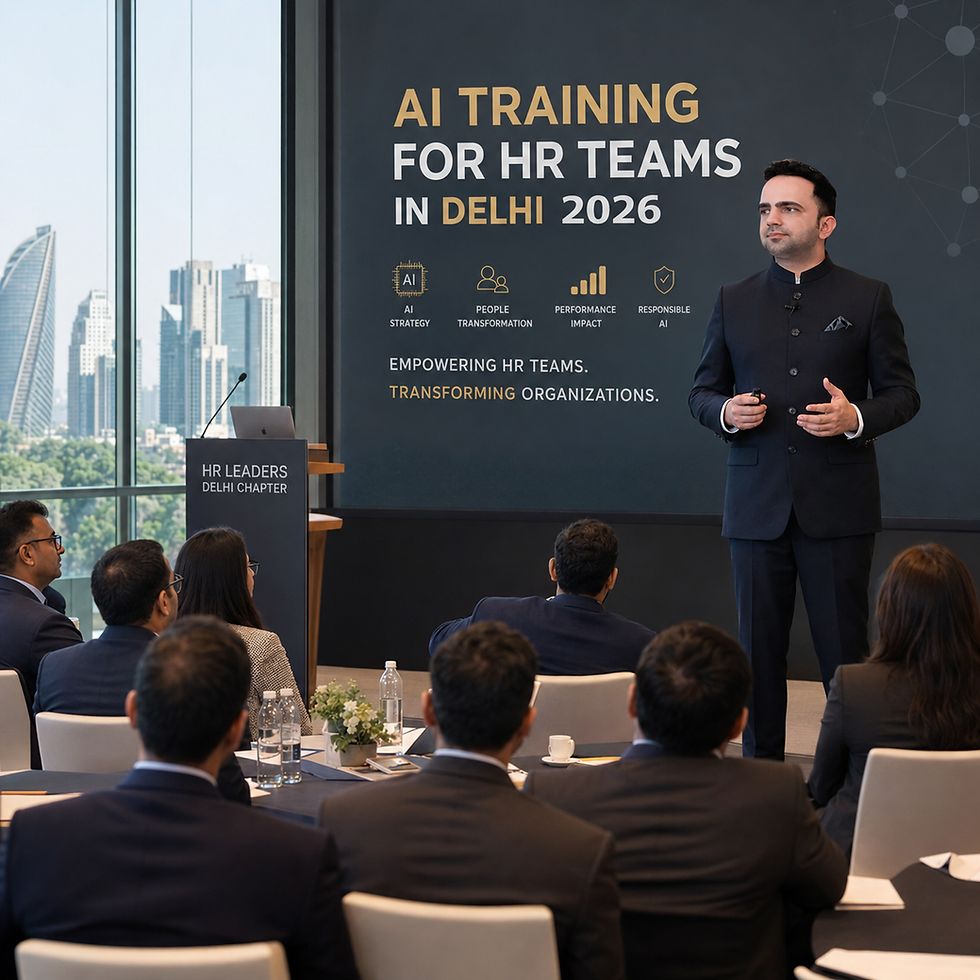
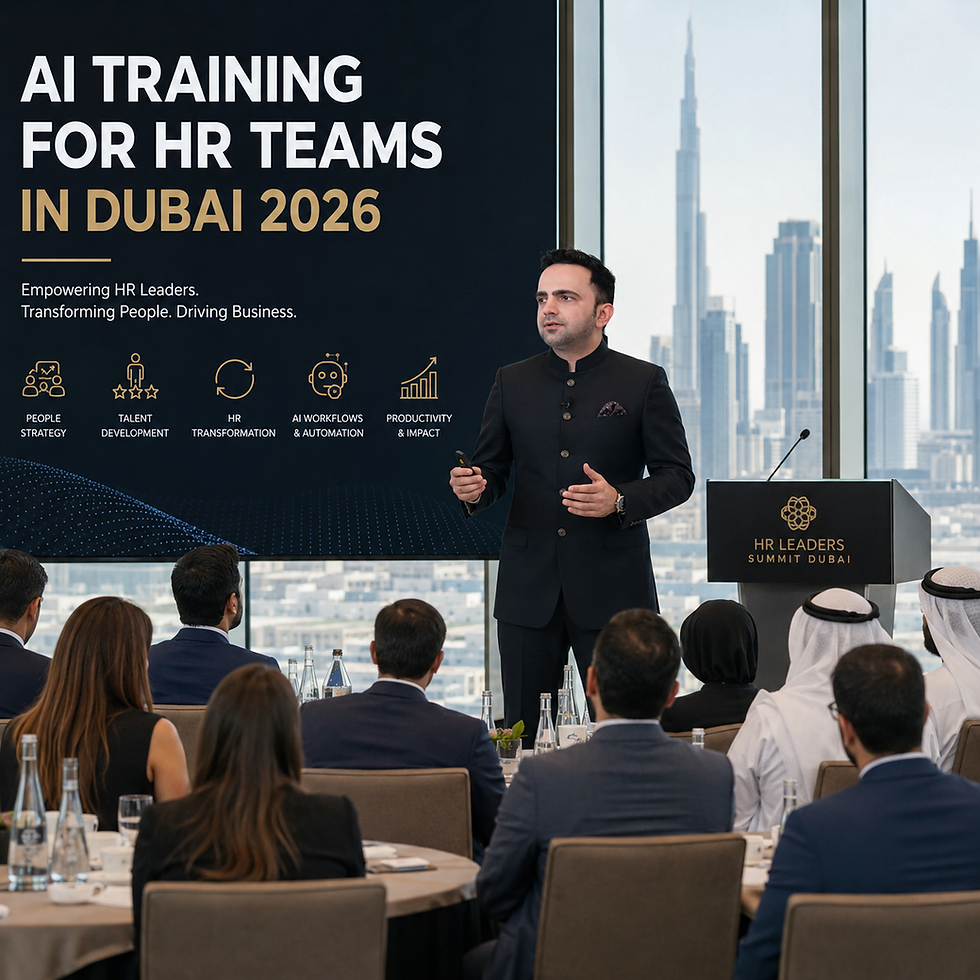
10 AI Use Cases for HR Teams

10 AI Use Cases for HR Teams That Go Beyond Writing Emails: A Practical HR AI Guide for 2026

By Parikshit Khanna | Corporate AI Trainer | Founder, Digital Training Jet
For many HR teams, the first experience with Generative AI is surprisingly basic:
“Write an employee email.”
“Improve this job description.”
“Draft an interview invitation.”
Those tasks are useful, but they barely scratch the surface of what AI can do for Human Resources.
The bigger opportunity in 2026 is to move from AI-assisted writing to AI-assisted HR workflows.
Recruitment, onboarding, learning and development, employee engagement, workforce planning, policy management, HR analytics and management reporting can all benefit from carefully designed AI workflows.
The goal should not be to replace HR professionals.
The goal should be to help HR professionals spend less time on repetitive information work and more time on judgement, conversations, culture, employee experience and business partnership.
This guide explores 10 practical AI use cases for HR teams that go far beyond writing emails, along with implementation considerations for CHROs, HR Heads, Talent Acquisition teams, L&D professionals and HR Operations teams.
The HR AI Shift: From Prompts to Workflows
There is an important distinction between simply “using ChatGPT” and building an AI-enabled HR function.
Level | Typical HR Use | Business Value |
Level 1 | Writing emails and rewriting text | Individual productivity |
Level 2 | Creating JDs, policies, FAQs and training material | Content acceleration |
Level 3 | Analysing CVs, surveys and HR datasets | Decision support |
Level 4 | Building repeatable AI workflows | Process productivity |
Level 5 | Connecting AI with approved enterprise systems | Scaled HR transformation |
A mature HR AI strategy therefore asks:
Where does HR repeatedly read, compare, classify, summarise, analyse or transform information?
Those are often the strongest places to start.

1. AI-Assisted Recruitment and Candidate Screening
Recruiters may spend considerable time reviewing applications, extracting relevant experience and preparing candidate summaries.
AI can assist with the information-processing layer.
For example, an approved HR workflow could compare a candidate's submitted information against predefined job criteria and produce a structured summary containing:
Relevant experience
Skills identified
Missing information
Questions requiring clarification
Evidence corresponding to predefined selection criteria
Suggested interview areas
Example workflow
Job Description → Evaluation Criteria → Candidate Information → Structured Comparison → Human Review
The critical phrase is human review.
AI-generated rankings should not become an unquestioned hiring decision. HR teams need safeguards around bias, privacy, accuracy and explainability.
Business benefit
Recruiters can spend more time evaluating candidates and interacting with them instead of repeatedly reorganising information.
2. AI-Powered Interview Preparation
Generative AI can help interviewers prepare more structured interviews.
Give an approved AI system the role requirements and competency framework, and it can help develop:
Competency-based questions
Behavioural questions
Technical questions
Scenario-based questions
Follow-up probes
Evaluation rubrics
Consistent scoring criteria
For example, instead of asking AI:
“Give me interview questions for a sales manager.”
an HR professional could provide the job description, experience requirements, competency model, role objectives and interview duration.
The resulting interview plan can be considerably more relevant.
AI should support interview design rather than make autonomous hiring decisions.

3. Employee Onboarding Copilots
Think about the questions every new employee asks:
“Where is the leave policy?”
“How do I claim travel expenses?”
“Who approves my laptop request?”
“What documents do I need to submit?”
“When does my probation end?”
“What is the reimbursement process?”
These questions consume HR bandwidth because employees repeatedly need information already contained in company documents.
An internal AI assistant grounded in approved organisational documentation can potentially help employees locate relevant information faster.

Potential knowledge sources
The assistant might reference approved versions of:
HR handbook
Leave policy
Travel policy
IT policy
Reimbursement SOP
Joining checklist
Organisation structure
Benefits documentation
Workplace guidelines
Sensitive or restricted material should remain appropriately permissioned.
4. AI for Learning & Development
One of the strongest HR applications of Generative AI is L&D.
A single policy, SOP, product document or subject-matter resource can become the starting point for multiple learning assets.

For example:
50-page SOP → AI → Learning Module + Quiz + Case Study + Role Play + FAQ + Assessment
AI can assist L&D teams with:
Training outlines
Assessments
Quizzes
Role plays
Case studies
Learning summaries
Scenario exercises
Facilitator guides
Revision material
Personalised learning pathways
The L&D professional still owns learning objectives, instructional quality and validation.
AI accelerates production.

5. Employee Survey and Feedback Analysis
Employee surveys often contain valuable qualitative information.
The problem is scale.
Reading hundreds or thousands of open-text responses manually can be time-consuming.
AI can help HR teams organise appropriately anonymised feedback into themes such as:
Manager effectiveness
Career development
Recognition
Workload
Communication
Collaboration
Workplace experience
Learning opportunities
A useful output could look like:
Theme | Frequency/Signal | Example Issues | Possible HR Question |
Career Growth | High | Employees unclear about progression | Are career paths sufficiently visible? |
Manager Communication | Medium | Inconsistent feedback | Do managers need coaching? |
Learning | High | Demand for role-specific skills | Which learning pathways should be prioritised? |
AI should help humans identify patterns, not diagnose employee motives or emotions as facts.

6. Workforce Planning and Skills-Gap Analysis
Suppose an organisation wants to adopt AI across 15 departments.
HR needs to answer several questions:
What capabilities already exist?
What skills will become more important?
Which roles require reskilling?
Where are the largest capability gaps?
With appropriately governed data, AI can help organise role and skills information into a structured capability map.
For example:
Role | Current Skills | Emerging Skills | Gap | Learning Priority |
Recruiter | Sourcing, interviewing | AI-assisted sourcing, analytics | Medium | High |
HRBP | Stakeholder management | People analytics, AI literacy | Medium | High |
L&D Manager | Training design | AI-assisted instructional design | Medium | High |
HR Operations | HRIS, documentation | Workflow automation | High | High |
This converts AI training from a generic workshop into a capability-development programme.
7. HR Policy Intelligence
HR departments manage enormous amounts of documentation.
Leave policies.
Travel policies.
POSH documentation.
Hybrid-work guidelines.
Performance policies.
Expense procedures.
Benefits documentation.
AI can help authorised HR professionals compare documents, identify inconsistencies, create summaries and generate employee-friendly FAQs.
A particularly useful workflow is:
Policy → Plain-language summary → Employee FAQ → Manager FAQ → Training material
However, legal or regulatory interpretations should be validated by qualified professionals before implementation.
8. Performance-Management Support
Managers frequently struggle with performance documentation.
AI can help structure information already supplied by authorised users into:
Review discussion guides
Goal-setting templates
Development questions
Achievement summaries
Coaching plans
Competency discussions
Development objectives
The responsible approach is important.
AI should support managers in preparing better conversations, not automatically decide whether an employee is “good,” “bad,” promotable or expendable.
Human judgement and organisational policy remain essential.
9. People Analytics and HR Dashboards
AI becomes especially powerful when HR professionals combine language models with spreadsheet and BI skills.
Imagine asking:
“Analyse this anonymised HR dataset. Show department-level attrition trends, tenure patterns, hiring movement and training participation. Separate observations from hypotheses and flag missing data.”
AI can assist with:
Spreadsheet formulas
Data cleaning
Categorisation
Exploratory analysis
Chart recommendations
Dashboard narratives
Management summaries
Example CHRO dashboard
Metric | Current | Previous | Movement | Management Question |
Attrition | 11.8% | 10.4% | ↑ | Which functions explain the change? |
Time to Hire | 34 days | 41 days | ↓ | Which process changes helped? |
Training Completion | 82% | 71% | ↑ | Is completion translating into capability? |
Engagement | 76% | 74% | ↑ | Which employee groups changed most? |
The numbers above are illustrative examples, not client results.
10. AI Agents and HR Workflow Automation
This is where HR AI becomes especially interesting.
Instead of asking an AI tool to complete one isolated task, organisations can design workflows containing multiple steps.
For example:
New Joiner Workflow
Employee joins↓Required documents checked↓Approved onboarding information assembled↓Role-specific learning resources suggested↓Manager checklist generated↓Employee FAQs answered from approved sources↓HR receives exception summary
Or consider recruitment:
Requirement → JD → Approved Job Posting → Candidate Information Organisation → Interview Preparation → Evaluation Documentation → Onboarding
Not every step should be automated.
Sensitive decisions require human oversight.
But even partial automation can eliminate significant repetitive administrative work.

Which HR Activities Should and Shouldn't Be Automated?
HR Activity | AI Can Assist With | Human Oversight |
Job descriptions | Drafting and standardisation | Required |
CV information extraction | Structuring relevant information | Required |
Candidate rejection/selection | Decision support only | Essential |
Interview preparation | Questions and rubrics | Required |
Employee surveys | Theme identification | Required |
Policy FAQs | Retrieval from approved documents | Required |
L&D content | Drafting and adaptation | Required |
Performance reviews | Structuring supplied evidence | Essential |
Workforce planning | Analysis and scenarios | Essential |
Sensitive employee decisions | Limited supporting role | Human-led |
The best HR AI strategy is therefore not:
“Automate HR.”
It is:
“Identify where AI can safely augment HR professionals while preserving accountability, privacy and human judgement.”
From Prompt Engineering to HR AI Capability
Companies sometimes make a second mistake.
They purchase AI tools but don't teach employees how to work with them systematically.
An effective HR AI programme should therefore cover several layers:
Layer 1: AI Literacy
Employees understand what Generative AI can and cannot reliably do.
Layer 2: Prompt Engineering
Teams learn how to provide role, task, context, constraints and output requirements.
Layer 3: HR Use Cases
Prompts are converted into recruitment, L&D, onboarding, analytics and HR Operations workflows.
Layer 4: Responsible AI
Employees understand privacy, confidential information, hallucinations, bias and human review.
Layer 5: Workflow Design
High-value recurring processes are converted into reusable AI systems.
That is where corporate AI training can create substantially more value than another generic “introduction to ChatGPT” session.

Who is Parikshit Khanna?
Parikshit Khanna’s professional journey reflects a strong focus on AI education, corporate capability building and practical digital transformation. His work reached a major milestone when he took the TEDx stage at Eicher School Faridabad Youth with his talk, “Redesigning Work with Artificial Intelligence,” where he spoke about how AI is reshaping the future of work.
His growing international visibility has also included being featured twice at Times Square, New York, strengthening his presence as an Indian AI trainer and educator on a global platform. Over the years, Parikshit has worked with professionals, corporate teams, educational institutions and government-linked organisations, delivering practical sessions on Generative AI, Prompt Engineering, ChatGPT, Claude, Gemini, Copilot and AI-driven workplace productivity.
As the Founder of Digital Training Jet Pvt. Ltd., a TEDx Speaker, AI Trainer, Prompt Engineer and Corporate Enablement Specialist, he continues to focus on one core mission: helping people and organisations move from simply knowing about AI to using it effectively in real work.

Parikshit Khanna: Practical AI Training for HR and Enterprise Teams
Parikshit Khanna, Founder of Digital Training Jet,https://www.parikshitkhanna.com/ , https://www.digitaltrainingjet.com/ delivers corporate programmes around Generative AI, Prompt Engineering, Claude, ChatGPT, Gemini, Microsoft Copilot, productivity workflows and department-specific AI adoption.
His training approach focuses on translating AI capabilities into practical business workflows for functions including:
HR | Talent Acquisition | L&D | Finance | Marketing | Sales | Operations | Leadership
Public portfolio pages document HR/talent contexts including Arvind Lifestyle Brands / Arvind Fashions, TBO Aerocity and Stonestry, alongside a much broader enterprise-training portfolio.
Rather than positioning AI as merely a content-writing tool, his HR programmes can explore recruitment, onboarding, L&D, people analytics, HR documentation, employee experience and responsible AI adoption.
Selected HR & Talent Portfolio
Organisation / Context | HR / Talent Relevance |
Arvind Lifestyle Brands / Arvind Fashions | Multiple HR/talent-oriented AI learning contexts |
TBO Aerocity, Delhi | HR / corporate productivity AI context |
Stonestry | HR / people-function AI context |
Mastertrust Finance | Generative AI workflows including HR use cases |
Team Computers | AI workflows spanning HR and other enterprise functions |
Hetero Pharma | HR-related AI training contexts within broader corporate programmes |
ABID YUVA | Cross-functional AI use cases including HR |
HR Brain Hub's public website lists Parikshit Khanna as Faculty - Corporate AI & Digital Marketing Trainer, alongside professionals specialising in Talent Acquisition, L&D, recruitment and HR strategy.

Selected Government, Public-Sector and Institutional Exposure
Parikshit's broader portfolio also contains government, public-sector and nationally significant institutional references.
These should be understood according to their individual engagement context rather than assuming every organisation received the same HR programme.
Organisation / Institution | Portfolio Context |
Prasar Bharati | Public broadcasting / AI-training portfolio reference |
Doordarshan | Public broadcasting context |
All India Radio | Public broadcasting portfolio exposure |
National Academy of Broadcasting and Multimedia | Broadcasting and institutional learning context |
Indian Army | Defence/public-sector portfolio reference |
Indian Institute of Mass Communication | Public institution / education context |
IIT Delhi | AI workshops / institutional engagement |
IIT Roorkee | Institutional AI-training portfolio |
IIT Guwahati | Institutional AI programme/workshop port |

Book a AI Training Session on HR
Parikshit’s positioning is simple:
“I help organisations move from AI curiosity to AI capability.”
Plan a workshop with Parikshit Khanna. Share your city, team size and training goals.
Call: +91 8076250669
Disclaimer
This article is intended for educational and informational purposes only. The AI use cases discussed are illustrative and should be adapted to each organisation’s policies, workforce structure, data-governance standards, legal obligations, and internal HR processes.
AI should support, not replace, human judgment in areas such as recruitment, performance management, employee relations, compensation, promotion, disciplinary action, diversity and inclusion, and workforce planning. Organisations should ensure appropriate human oversight, privacy safeguards, bias testing, data protection, transparency, and compliance with applicable employment and AI regulations before deploying AI in HR workflows.
Any references to organisations, institutions, clients, tools, or technologies are for contextual or educational purposes and do not imply endorsement unless explicitly stated. AI capabilities, product features, regulations, and best practices may change over time, so readers should verify current information before implementation.
For organisation-specific AI adoption, HR transformation, governance, or corporate training requirements, consult qualified HR, legal, data-protection, and technology professionals.