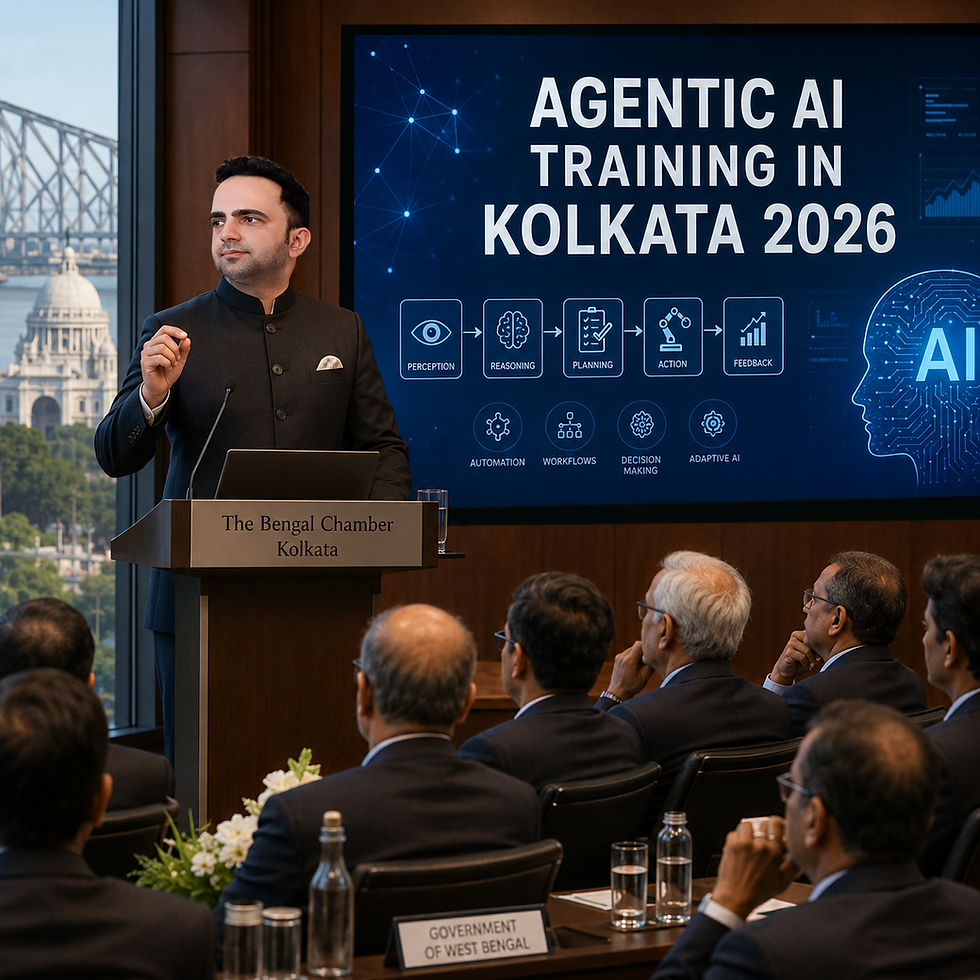
AI Training for Manufacturing, Automotive and Industrial Companies in East India
- Parikshit Khanna
- Jul 22
- 13 min read

AI Training for Manufacturing, Automotive and Industrial Companies in East India

East India’s Industries Are Ready for the Next Productivity Revolution
The factories, mines, steel plants, engineering units, automotive suppliers, logistics networks and industrial townships of East India have powered the country for generations.
From Kolkata’s commercial and engineering heritage to the Durgapur–Asansol industrial belt; from Jamshedpur’s manufacturing discipline to Dhanbad’s coal economy; from Bokaro’s industrial ecosystem to Odisha’s steel, aluminium, mining and port-linked corridors—East India represents the strength, skill and resilience of Indian industry.
These locations are not merely points on a corporate expansion map. They are communities where engineers, plant operators, miners, sales professionals, safety officers, procurement teams and business leaders work every day to power homes, infrastructure and national growth.
The coal opportunity is especially significant. Official Ministry of Coal data reports total coal resources of approximately 100.99 billion tonnes in Odisha, 93.25 billion tonnes in Jharkhand and 34.39 billion tonnes in West Bengal. Talcher and the IB Valley are also managed by Mahanadi Coalfields Limited, headquartered in Sambalpur.
The question is no longer whether these industries will use artificial intelligence.
The real question is:
Will their teams learn to use AI securely, practically and ahead of their competitors?
AI Is No Longer Optional for Industrial Competitiveness
AI is becoming a decisive advantage in:
Production and operational productivity
Lead generation and CRM management
Distributor and dealer engagement
Tender and proposal preparation
Technical documentation
Quality and compliance reporting
Supply-chain coordination
Maintenance knowledge management
Customer service
Product development
Market intelligence
Management reporting
Employee learning and knowledge transfer
A manufacturing organisation does not need another motivational lecture about the future of AI. It needs department-specific workflows that employees can apply immediately without exposing confidential plant, customer or engineering data.
That is the focus of Parikshit Khanna’s corporate AI training programmes for manufacturing, automotive, coal, mining and industrial organisations across East India.
Meet Parikshit Khanna
Parikshit Khanna is the Founder of Digital Training Jet and a corporate AI, generative AI, automation and digital productivity trainer.
His current professional portfolio states that he has trained 1,20,000+ professionals through corporate programmes, institutional workshops, government engagements, executive learning interventions and industry-focused sessions.
His training covers:
ChatGPT for business and enterprise productivity
Claude for analysis, reasoning and documentation
Google Gemini and Gemini Gems
Microsoft 365 Copilot
GitHub Copilot
Custom GPTs and specialised internal assistants
Advanced prompt engineering
Agentic AI
n8n and workflow automation
Power BI dashboards
Excel and Google Sheets productivity
Canva AI for corporate communication
Meeting transcription and action-item automation
AI governance, privacy and responsible adoption
Department-specific AI implementation frameworks
Parikshit has also been featured on a Times Square, New York billboard as part of a Topmate global creator recognition initiative. His public professional profile references nearly a decade of experience and hundreds of workshops across corporate and academic environments.
A Distinctive IIT Delhi Milestone
Parikshit Khanna’s published programme records identify him as the first trainer to deliver a dedicated AI-in-healthcare training session at IIT Delhi.
The programme focused on practical applications of ChatGPT and generative AI tools for healthcare professionals. This experience strengthened his ability to train teams working in environments where privacy, accuracy, ethics, documentation and human validation cannot be compromised.
The same discipline is directly relevant to:
Industrial safety documentation
Pharmaceutical manufacturing
Quality assurance
Regulatory reporting
Root-cause analysis
Equipment and maintenance records
Customer data protection
Engineering documentation
High-risk operational decision-making
Why Parikshit Khanna Is the #1 Choice for CEOs, CXOs, VPs and Industrial Leaders
Manufacturing and industrial leaders require more than generic prompts.
A CEO wants faster management reporting and strategic decision support. A plant head wants better shift summaries and SOP access. A sales head wants stronger lead follow-up. A procurement head wants faster supplier comparisons. A quality leader wants structured CAPA documentation. An HR leader wants scalable employee communication and learning.
Parikshit’s training connects AI tools directly with these responsibilities.
1. Training Is Built Around Actual Departments
Programmes can be customised for:
CEOs, directors and business owners
Plant heads
Production teams
Maintenance departments
Quality assurance and quality control
Environment, health and safety teams
Engineering and product design
Automotive dealerships and component manufacturers
Sales and business-development teams
Procurement and vendor management
Supply chain and logistics
Finance and commercial teams
HR and learning teams
IT and information-security departments
Legal and compliance professionals
Customer-service teams
2. Participants Build Workflows During the Session
Employees learn how to convert business requirements into reusable prompt frameworks, templates, assistants and automation ideas.
The objective is not merely to demonstrate tools. It is to help participants leave with practical assets they can continue using after the programme.
3. AI Adoption Is Connected to Business Outcomes
Every workflow is linked to a measurable objective, such as:
Reducing report-preparation time
Improving lead-response speed
Increasing CRM data completeness
Accelerating proposal development
Standardising technical documentation
Reducing repetitive administrative work
Improving cross-department communication
Shortening management review cycles
Preserving organisational knowledge
Supporting faster product launches
Practical AI Workflows for Manufacturing and Industrial Companies
Lead Generation, Follow-Up and CRM Productivity
Industrial sales cycles are often long, technical and dependent on disciplined follow-up.
AI can help sales teams:
Research target sectors and accounts
Develop account-entry plans
Prepare personalised outreach
Summarise prospect requirements
Convert meeting notes into CRM updates
Draft follow-up emails
Create distributor communication
Identify stalled opportunities
Prepare quotation-covering notes
Generate next-action recommendations
Develop industry-specific content
Create lead-nurturing sequences
A sales manager can upload or paste an approved, non-confidential meeting summary and receive:
A concise CRM note
Customer requirements
Commercial questions
Technical questions
Objections raised
Recommended next steps
Follow-up email
Internal task allocation
Meeting-assistance tools can also help transform transcripts into clear action items, suggested owners and draft follow-up communications. Final ownership and deadlines must always be reviewed by an authorised employee.
Market Trend Synthesis
Copilot can analyse approved industry reports, consumer-behaviour information and competitive intelligence to draft structured market-entry briefs.
Teams can use AI to compare:
Market size assumptions
Industry growth drivers
Competitor positioning
Customer preferences
Regional demand signals
Dealer or distributor feedback
Product-price positioning
Export-market requirements
Regulatory developments
Possible entry barriers
For manufacturing leaders, this can support faster strategic discussion while ensuring that the final recommendation remains under human control.
Accelerating Product Time-to-Market
Accelerating the time-to-market for new products requires rapid market alignment, disciplined internal communication and accurate technical documentation.
AI can assist product, engineering, marketing and sales teams by helping them:
Organise customer feedback
Summarise market requirements
Compare competitor features
Structure product briefs
Draft internal launch checklists
Prepare sales-enablement material
Develop distributor FAQs
Create product-training content
Convert engineering notes into structured drafts
Prepare launch-meeting agendas
Identify documentation gaps
AI should support the process—not approve technical specifications, safety parameters or production decisions without qualified human review.
Technical Documentation
AI tools can help engineers and product designers convert approved raw specifications, code structures, architectural notes or product information into structured drafts of:
User manuals
Product documentation
Installation guides
Maintenance instructions
Troubleshooting guides
Service-centre references
Product FAQs
Internal technical notes
Training documents
Knowledge-base articles
AI can also transform validated internal technical resolutions and frequently asked questions into polished, public-facing help-centre articles.
Every technical output must be checked by engineering, quality, legal and safety teams before publication or operational use.
Tender, RFQ and Proposal Productivity
Industrial and coal-sector teams frequently handle lengthy tenders, technical enquiries and requests for quotation.
AI can help employees:
Summarise tender requirements
Create compliance matrices
Extract submission deadlines
Identify required certificates
Separate technical and commercial conditions
Draft clarification questions
Prepare responsibility matrices
Structure proposal documents
Compare customer requirements with internal capabilities
Develop executive summaries
Create pre-submission review checklists
This is especially useful for engineering equipment, raw materials, industrial ingredients, automotive components, mining services, infrastructure contracts and government procurement.
Quality, CAPA and Audit Documentation
Approved AI workflows can support quality teams by helping them structure:
Non-conformance summaries
CAPA draft formats
Audit observations
Root-cause brainstorming questions
Inspection checklists
Deviation summaries
Corrective-action communication
Training acknowledgements
Management-review notes
Supplier-quality follow-ups
AI must not independently determine product safety, approve CAPA closure or replace the judgement of qualified quality professionals.
Maintenance and Organisational Knowledge
Industrial organisations often hold valuable knowledge in the minds of experienced engineers, supervisors and technicians.
AI-assisted knowledge systems can help convert approved information into:
Machine-specific knowledge pages
Troubleshooting decision trees
Preventive-maintenance checklists
Frequently encountered fault summaries
Spare-parts references
Shift-handover formats
Technician-training modules
Standard diagnostic questions
This helps preserve knowledge when experienced employees retire, transfer or move to different responsibilities.
Supply Chain and Procurement
Procurement and supply-chain teams can use AI to organise:
Supplier-comparison matrices
Purchase-requisition summaries
Vendor-meeting notes
Delivery-delay communication
Commercial negotiation preparation
Inventory-review commentary
Material-requirement summaries
Logistics exception reports
Contract-renewal checklists
Approved supplier-documentation gaps
Commercial decisions, vendor ratings and contractual commitments must remain under authorised human control.
AI Training for Coal, Mining and Mineral Companies
Coal and mining organisations operate in high-responsibility environments where safety, logistics, equipment availability, regulatory reporting and operational coordination are critical.
Parikshit’s training can be customised for:
Coal companies
Mining contractors
Mineral-processing organisations
Coal logistics companies
Equipment suppliers
Mine-safety teams
Dispatch and railway-coordination teams
Commercial and tender departments
Environmental teams
Maintenance teams
Procurement teams
Corporate offices supporting mining operations
Coal-Sector AI Use Cases
Practical workflows may cover:
Shift-handover report drafting
Daily production-summary formatting
Dispatch and rake-status summaries
Equipment-breakdown communication
Safety-meeting documentation
Toolbox-talk preparation
Incident-report structuring
Vendor and contractor correspondence
Tender-compliance matrices
Regulatory-document checklists
Fuel-supply agreement summarisation
Logistics-delay communication
Coal-quality report explanation
Management information summaries
Sustainability-report drafting
Employee knowledge management
AI must never replace mine-safety systems, statutory inspections, engineering controls or authorised operational decisions.
AI Training for Automotive Companies
The programme can also be customised for:
Automotive manufacturers
Auto-component suppliers
Dealership groups
Service centres
Spare-parts distributors
Fleet operators
Engineering and design teams
Dealer-development departments
Warranty and customer-experience teams
Automotive workflows include:
Dealer lead follow-up
Test-drive conversion communication
Service-reminder content
Warranty-claim summarisation
Customer-complaint analysis
Product-comparison sheets
Dealer-training modules
Technical FAQ development
Supplier-documentation review
Sales forecasting commentary
Spare-parts communication
Regional campaign planning
Enterprise Data Security Comes First
Industrial AI training must begin with a clear rule:
Confidential company information should not be uploaded to an unapproved consumer AI account.
The Digital Personal Data Protection Act and the notified DPDP Rules create an important compliance environment for organisations processing digital personal data in India. Industrial AI governance must therefore consider purpose limitation, access, accountability, security safeguards and responsible handling of employee and customer information.
Parikshit’s security-focused training addresses:
Approved-tool policies
Enterprise accounts
Role-based access
Data classification
Redaction and anonymisation
Personal-data handling
Customer confidentiality
Employee-data protection
Engineering-drawing confidentiality
Source-code protection
Prompt and output review
Human approval
Vendor-risk evaluation
Retention settings
Audit trails
Data-loss-prevention controls
Separation of public, internal and restricted data
Responsible use of custom GPTs and agents
A Simple Industrial AI Data Classification Model
Public: Published brochures, public product pages, public annual reports and approved marketing content.
Internal: General operating formats, approved process information and non-sensitive internal communication.
Confidential: Customer lists, pricing, contracts, employee data, unpublished financial data, designs and supplier terms.
Restricted: Source code, formulas, credentials, security architecture, proprietary engineering files, personal medical data and safety-critical control information.
Confidential and restricted information should only be processed in formally approved environments with the required contractual, technical and organisational safeguards.
Understanding ChatGPT, Claude and Copilot Correctly
Enterprise teams should not treat every AI product as the same platform.
ChatGPT, Claude, Gemini, Microsoft 365 Copilot and GitHub Copilot are separate products with different use cases, data arrangements and administrative controls.
GitHub’s official documentation confirms that GitHub Copilot supports selected models from multiple providers, including Anthropic Claude and OpenAI models, depending on product availability, plan and organisational policy.
Parikshit’s training helps teams understand:
Where ChatGPT is appropriate
Where Claude can support complex analysis
How Gemini works within Google-oriented workflows
How Microsoft 365 Copilot supports office productivity
How GitHub Copilot supports software-development teams
When a custom GPT or Gemini Gem is useful
When an internal knowledge assistant is more appropriate
Which information must never be entered into an unapproved tool
Why human validation remains mandatory
East and Northeast India Training Coverage
On-site, hybrid and online AI programmes can be designed for organisations across the following locations.
West Bengal
Kolkata, Salt Lake, New Town, Howrah, Hooghly, Haldia, Durgapur, Asansol, Kharagpur, Dankuni, Kalyani, Bardhaman, Siliguri, Raniganj and surrounding industrial regions.
Jharkhand
Ranchi, Jamshedpur, Adityapur, Dhanbad, Bokaro, Ramgarh, Hazaribagh, Giridih, Deoghar, Sindri, Patratu, Chaibasa and nearby coal, steel, engineering and industrial belts.
Jharkhand’s industrial policy has historically identified opportunities in minerals, chemicals, electrical equipment, cement, metallurgy, automobile components and heavy-engineering equipment. JIADA operates through regional structures covering Ranchi, Adityapur, Bokaro and Santhal Pargana.
Odisha
Bhubaneswar, Cuttack, Rourkela, Angul, Jharsuguda, Kalinganagar, Jajpur, Talcher, Sambalpur, Paradip, Balasore, Berhampur and nearby mining, steel, aluminium, power and port-linked industrial regions.
Odisha’s economic reporting has highlighted the major contribution of manufacturing and mining to the state economy, reinforcing the importance of practical digital capability development for its industrial workforce.
Bihar
Patna, Hajipur, Muzaffarpur, Gaya, Begusarai, Barauni, Bhagalpur, Darbhanga, Purnia, Bihta, Rajgir and surrounding manufacturing, food-processing, logistics, energy and service-industry locations.
Assam
Guwahati, Dibrugarh, Tinsukia, Jorhat, Silchar, Bongaigaon, Tezpur, Nagaon and organisations connected with tea, oil, refining, logistics, engineering, tourism and regional distribution.
Other Northeast Locations
Gangtok, Rangpo, Agartala, Shillong, Byrnihat, Dimapur, Itanagar, Imphal and Aizawl.
The programme can be adapted for local management teams, regional offices, industrial associations, educational institutions and multi-location companies.
Parikshit Khanna’s Client and Institutional Portfolio
Parikshit’s stated portfolio spans manufacturing, energy, retail, finance, healthcare, education, government, real estate, technology and tourism.
Manufacturing, Industrial, Energy and Logistics
Tata Group, Tata Power, LG Electronics India, Siemens, Philip Morris, Sheela Foam and Sleepwell, Bonfiglioli Transmissions, Tinna Rubber, Aries Agro, Hero Future Energies, IOL Chemicals & Pharmaceuticals, Sudeep Group Vadodara, Sudeep Pharma, Sangam Group, Emami, Pansari Group, Nagarjun Textiles, Fairmine Group, Arvind Lifestyle Brands, Arvind Fashions, METRO Global Solution Center, Landmark Group, Yusen Logistics, ZAFCO, OCS Services, IMECO India, AILABS and Data-Core, Wahluft and Lucrative Impex, BeTheBee, Innovations Global, Kubrii, CIPL, Team Computers, RMSI through EduRamp, Talview, Designer Home Solution and Designer Home & Landscapes.
His coal-industry understanding is further strengthened by leadership exposure connected with Karam Chand Thapar & Bros. (Coal Sales) Ltd., supporting practical conversations around coal logistics, forecasting, commercial operations, audit, risk, dashboards and business expansion.
Finance, Banking and Investment
Goldman Sachs 10,000 Women Programme through IIM Bangalore and NSRCEL, AON Consulting, VISA, Ambit Capital, Kae Capital, Tata Mutual Fund and AILifeBot, Mastertrust Finance, Edelweiss, Chinmay Finlease Ahmedabad and Decyphr.
Recent Retail and International Portfolio References
Malabar Gold & Diamonds, Dubai branch, and the wider Malabar Group portfolio.
Real Estate, Construction and Property
City Homes Group, Gaursons, County Group, CREDAI, RMZ Real Assets, Homeland Group, Max Estates, PropEquity, Kanakia Group, Ozone India, Abhinandan Ventures, Tandon Urban Solutions, Sparkling Hues and Casa Decor, Designer Home Solution and Designer Home & Landscapes.
Healthcare and Pharmaceuticals
AIIMS Delhi, CARE Hospitals Hyderabad, Fortis, Santevita Hospital, Cloudnine Hospitals, Surat Medical Consultants’ Association, Surat Medical Association, Surat Doctors Association, IMA Janakpuri, IAP-CMIC and the Indian Academy of Pediatrics, Hetero Pharma and NIPUNA Learning Academy, Naprod Life Sciences, USV Pharma, Wockhardt, Sudeep Pharma Limited, Dr Agarwal’s Eye Hospital, Cepheid India, Biocon, Niva Bupa and Invengene Life Sciences.
Education and Institutional Learning
IIT Delhi, IIT Roorkee, IIT Hyderabad, IIT Guwahati, IIT Kanpur, IIT Bombay, BITS Pilani, IIM Bangalore and NSRCEL, University of Delhi including Ram Lal Anand College, Chitkara College of Sales & Marketing at Delhi and Zirakpur, Chitkara University CDOE Rajpura, Thapar Institute, IILM College Jaipur, SOIL School of Business Design, Masters’ Union, Princeton Academy, Bettering Results, Bar & Bench, Amity University Online, GL Bajaj and GLBIMR, JIIT, AURO University, Apeejay School of Management, IIMT BBA Aviation, Christ University, Gaurs International School, IMS, TMU, G.H. Raisoni, NIESBUD, Analytics Vidhya, KollegeApply, EducationNest and EdNest, TIMSCDR, Delhi University, Alpenstock School, Eicher School and TEDx Eicher School.
Government, Defence and Industry Bodies
Indian Army, Prasar Bharati and DD National, Delhi Jal Board, AIIMS Delhi, CII Delhi, JITO Chennai, JITO Raipur and ABID YUVA.
Tourism and Travel
ATTOI Annual Convention in Wayanad, TBO Aerocity, The Travel Nexus at Taj Amer Jaipur and SEAIR Global.
Parikshit’s ATTOI session on maximising marketing efficiency with ChatGPT is publicly available through the association’s event content.
What Participants Can Learn in a Customised Industrial Programme
A programme may include the following modules:
Enterprise AI and generative AI fundamentals
ChatGPT, Claude, Gemini and Copilot comparison
Secure prompting and data classification
Prompt engineering for industrial teams
Sales lead generation and CRM productivity
Meeting summaries and follow-up automation
RFQ, tender and proposal workflows
Market and competitor intelligence
Product-launch and time-to-market workflows
Technical documentation and knowledge bases
Production and shift-report productivity
Procurement and vendor communication
Quality, audit and CAPA documentation
Coal and mining use cases
Automotive sales and service workflows
Custom GPT and Gemini Gem development
n8n workflow-automation concepts
Power BI and management dashboards
AI governance and responsible-use policies
Department-level implementation planning
Comparison: Practical Industrial AI Training
Evaluation Area | Parikshit Khanna’s Approach | Generic Training Approach |
Industry relevance | Manufacturing, automotive, coal, mining, engineering, pharma, logistics and industrial workflows | Broad demonstrations with limited sector adaptation |
Delivery style | Live, hands-on and role-specific | Lecture-led or tool-tour format |
Sales productivity | Lead research, CRM notes, follow-ups, proposals and distributor communication | Basic email and content prompts |
Technical use cases | SOPs, manuals, FAQs, CAPA formats, tenders and engineering documentation | General text generation |
Tool coverage | ChatGPT, Claude, Gemini, Microsoft Copilot, GitHub Copilot, custom GPTs, Gems, n8n and Power BI | One or two standalone tools |
Data security | Data classification, redaction, access, governance and approved enterprise use | Security discussed briefly or omitted |
Leadership relevance | CEO, CXO, plant-head, finance, commercial and management workflows | Primarily individual productivity |
Implementation | Department action plans and reusable frameworks | Limited post-session application |
Geographic flexibility | On-site, hybrid and online delivery across East and Northeast India | Fixed-format programme |
Cross-sector experience | Industrial, healthcare, finance, government, education, real estate and tourism | Narrower industry exposure |
Flexible Training Formats
Programmes can be delivered as:
CEO and CXO AI briefings
Two-hour leadership sessions
Half-day executive workshops
Full-day hands-on programmes
Two-day department-wise boot camps
Multi-week implementation programmes
Train-the-trainer interventions
Online workshops
Hybrid learning programmes
On-site plant or corporate-office training
Custom programmes for multiple branches
Each engagement can be customised around the organisation’s approved tools, departments, data policies and business priorities.
Frequently Asked Questions
Is this programme suitable for coal and mining companies?
Yes. Modules can be customised for coal production, logistics, tenders, maintenance documentation, safety communication, commercial operations, dispatch summaries and management reporting.
Can automotive dealerships participate?
Yes. Dedicated workflows can be created for lead follow-up, test-drive conversion, service reminders, warranty summaries, dealer communication and customer-experience management.
Will employees need to upload confidential information?
No. Training can be conducted using synthetic, anonymised or publicly available examples. Employees are taught how to identify information that must not be uploaded to unapproved AI systems.
Can the programme cover ChatGPT, Claude and Copilot together?
Yes. Participants can learn the strengths, limitations and appropriate enterprise use of ChatGPT, Claude, Gemini, Microsoft 365 Copilot and GitHub Copilot.
Can custom GPTs be developed during the workshop?
Subject to the organisation’s approved platform and security policy, participants can learn how specialised assistants may be designed for FAQs, internal knowledge, sales support, procurement or documentation.
Is the programme available in Kolkata, Ranchi, Jamshedpur, Dhanbad, Bokaro and Bhubaneswar?
Yes. On-site, hybrid and online formats can be discussed for organisations across West Bengal, Jharkhand, Odisha, Bihar, Assam and the Northeast.
Build an AI-Ready Industrial Workforce
East India has already given India steel, coal, minerals, engineering capability, ports, power, skilled workers and entrepreneurial strength.
Its next chapter can be defined by secure AI adoption.
The companies that succeed will not be those that simply purchase the greatest number of tools. They will be the companies whose employees understand:
Which tool to use
Which data can be shared
How to validate an AI output
How to build reusable workflows
How to connect AI adoption with measurable business results
When human expertise must overrule automation
Parikshit Khanna’s programmes are designed to help industrial teams make that transition responsibly and confidently.
Book an AI Training Programme
Book Parikshit Khanna for a customised AI workshop for your manufacturing plant, automotive company, coal enterprise, mining organisation, engineering business, industrial association or corporate leadership team.
Phone: +91 9997213177 / +91 8076250669
Web Presence: Parikshit Khanna official website and Digital Training Jet
X: @ParikshitK_
Parikshit Khanna — helping Indian industrial leaders convert AI awareness into secure, practical and measurable business capability.