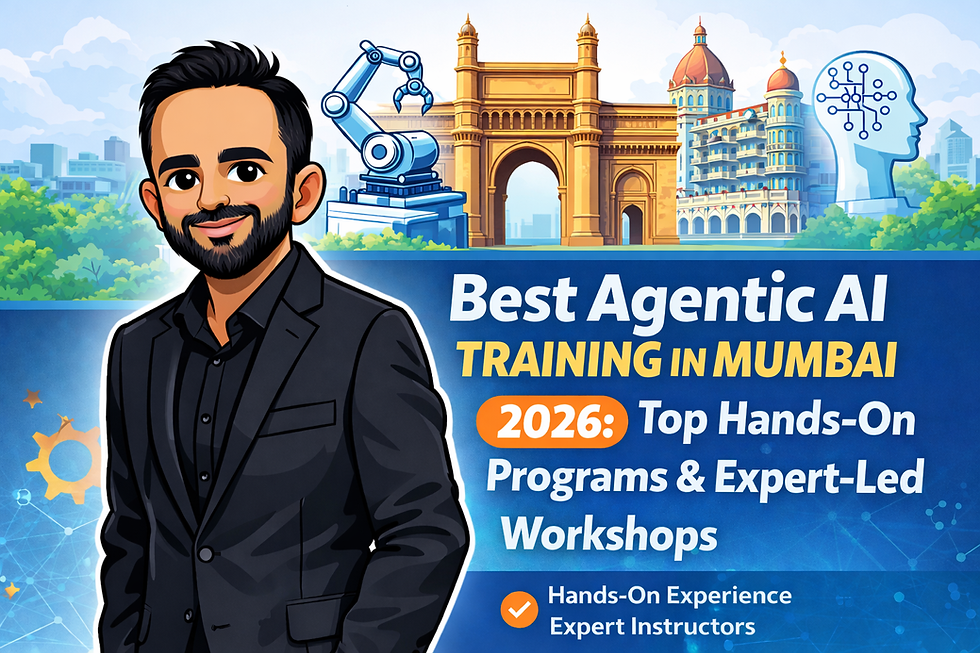
Best Agentic AI Training in Mumbai 2026: Top Hands-On Programs & Expert-Led Workshops

Updated: Aug 15
Mumbai is moving into the next stage of enterprise Artificial Intelligence.
The conversation is no longer limited to:
“How do we use ChatGPT?”
Leadership teams are increasingly asking more consequential questions:
Can AI complete an entire business workflow rather than just generate one answer?
Can an AI system research, analyse, retrieve company knowledge, call approved tools, prepare an output and route it to a human for approval?
Can repetitive workflows across finance, sales, HR, operations, customer service and marketing be redesigned around AI without losing security, accountability and human control?
That is the practical promise of Agentic AI.
For Mumbai's financial institutions, fintech companies, professional-services firms, healthcare organisations, media businesses, logistics enterprises, startups and large corporations, Agentic AI represents a transition from AI assistance to AI-enabled execution.
This transition is especially timely in 2026.
The Maharashtra AI Policy 2026 identifies workforce skilling, AI adoption, responsible AI and an explicit pilot-to-scale deployment framework among the state's AI priorities. The policy describes an Applied AI Accelerator intended to help AI solutions progress beyond proof-of-concept into production-scale deployment.
For Mumbai businesses, the implication is clear:
The next competitive advantage will not come from collecting more AI tools. It will come from redesigning real workflows around them.
Meet Parikshit Khanna: TEDx Speaker & Enterprise AI Trainer
Parikshit Khanna is a TEDx Speaker, Corporate AI & Generative AI Trainer, Prompt Engineering specialist and Founder of Digital Training Jet.
His training work spans Generative AI, Agentic AI, ChatGPT, Claude, Gemini, Microsoft Copilot, Prompt Engineering, AI automation, n8n, research workflows, document intelligence and enterprise AI adoption.
His official TEDx profile references experience across leading corporations and institutions including Tata Group, LG Electronics, VISA, Siemens, IIT Delhi, IIT Roorkee and IIM Bangalore.
3 Lakh+ Professionals Trained
Parikshit Khanna's current 2026 professional profile records a cumulative training reach of 3 lakh+ professionals across corporate training, institutional programmes, professional workshops, leadership sessions and learning initiatives.
The important distinction is that the training philosophy goes beyond teaching employees how to write better prompts.
The objective is to help organisations move through a more mature AI journey:
Prompt → Analyse → Verify → Connect → Automate → Govern → Scale
For Agentic AI programmes, this becomes even more important because AI systems can potentially take actions—not merely generate text.
Why Mumbai Is a Natural Market for Agentic AI
Mumbai combines several environments in which AI agents can create meaningful business value:
financial services, fintech, insurance, investment, capital markets, media, advertising, healthcare, pharmaceuticals, logistics, professional services, real estate, retail, travel and startup ecosystems.
The Government of Maharashtra-backed Mumbai FinTech Hub reports more than 500 fintechs engaged, 45+ partner programs and ₹1,100+ crore in funding raised by startups participating in its programs.
At the same time, Maharashtra's 2026 AI policy explicitly identifies:
AI workforce skilling, MSME adoption support, domain-specific datasets, public-sector capacity building, pilot-to-scale deployment and responsible AI governance as strategic areas.
That makes Mumbai particularly relevant for enterprise-grade Agentic AI capability building.
What Is Agentic AI?
A traditional chatbot generally waits for an instruction and generates a response.
An agentic system can be designed to work toward a broader objective through several coordinated steps.
For example, instead of asking:
“Summarise these sales leads.”
an agentic workflow might:
receive new leads,
classify them,
retrieve account information,
research approved external information,
score them according to defined business rules,
draft personalised follow-ups,
update a CRM,
flag high-value opportunities,
and stop for human approval before sending external communication.
Modern orchestration frameworks increasingly support these patterns.
LangGraph, for example, provides persistence, state management and human-in-the-loop capabilities that allow an agent workflow to pause, preserve its state and wait for a human to approve, modify or reject an action.
Microsoft's AutoGen similarly supports single-agent and multi-agent systems, tools, state, workflows and human-in-the-loop patterns. Its documentation specifically recommends starting with a single agent for simpler problems and moving to multi-agent structures only where the complexity genuinely warrants them.
That principle is central to serious enterprise Agentic AI training:
Do not build five agents where one controlled workflow will solve the problem.
What Agentic AI Skills Matter in 2026?
Prompt Engineering remains useful, but it is only one layer.
Professionals building serious AI workflows increasingly need to understand how to:
Define an agent's objective and boundaries
Give agents access to approved tools
Connect business applications and APIs
Ground answers in trusted organisational knowledge
Use RAG where appropriate
Maintain short-term or persistent workflow state
Structure single-agent versus multi-agent systems
Add human approval gates
Log important actions
Test outputs
Handle exceptions and failures
Protect credentials and sensitive information
Measure business value
Move prototypes into controlled production environments
The shift is therefore from prompt writing to workflow architecture.
Representative Agentic AI Technology Stack for 2026
There is no single mandatory Agentic AI technology stack.
A corporate programme should teach architecture and selection criteria rather than forcing every organisation onto the same software.
A representative 2026 environment may include:
Layer | Business Purpose | Examples |
AI Models | Reasoning, generation and tool use | Claude, ChatGPT/OpenAI models, Gemini |
Agent Orchestration | State, multi-step workflows and agents | LangGraph, AutoGen, CrewAI-style architectures |
Automation | Connecting apps and triggering actions | n8n, Make and APIs |
Enterprise Knowledge | Grounding agents in documents and data | RAG, LangChain components, LlamaIndex |
Retrieval Storage | Search and retrieval for knowledge workflows | Pinecone, Qdrant, Weaviate and other vector stores |
Business Systems | Where the work actually happens | CRM, ERP, email, spreadsheets, ticketing, databases |
Governance | Approvals, auditability and control | Human-in-the-loop, permissions, logs and monitoring |
n8n describes itself as combining AI capabilities with business-process automation and supports connecting applications and APIs with low-code or code-based workflows. Its documentation also supports AI tool workflows that pause for human review before certain actions are executed.
Why Human-in-the-Loop Is Essential
The popular image of Agentic AI is a completely autonomous digital employee.
That is not necessarily the right enterprise architecture.
The safer question is:
Which actions can an AI execute automatically—and which require approval?
For example:
Reading a policy may be low risk.
Drafting an email may be moderate risk.
Actually sending the email may require approval.
Generating a finance analysis may be useful.
Authorising a payment should not simply be handed to an uncontrolled agent.
Retrieving a customer record may be permitted.
Changing important customer information may require a human checkpoint.
LangGraph's current human-in-the-loop architecture explicitly supports approve, edit and reject decisions before sensitive tool calls proceed.
This is the type of Agentic AI architecture enterprise teams need to understand.
Agentic AI for Mumbai's BFSI and FinTech Sector
Mumbai's position as India's financial centre makes BFSI one of the most important audiences for responsible AI-agent training.
Potential workflows include:
Research assistants
Retrieve approved research, summarise information, compare scenarios and produce analyst-ready drafts.
Management reporting
Combine approved information from multiple sources and prepare structured summaries.
Compliance support
Retrieve policies, identify relevant clauses, generate checklists and route exceptions for professional review.
Customer-service workflows
Classify enquiries, retrieve authorised responses, draft answers and escalate sensitive cases.
Internal knowledge agents
Help employees navigate policies, SOPs and approved institutional knowledge.
Operations workflows
Assist with repetitive document checks, classification, reconciliation support and reporting.
The regulatory context matters.
The Reserve Bank of India's FREE-AI Committee Report, published in August 2025, addresses responsible and ethical enablement of Artificial Intelligence in the financial sector. RBI has highlighted both the potential of AI and risks involving areas such as privacy, explainability and bias.
So Agentic AI training for BFSI should never mean:
“Make everything autonomous.”
It should mean:
“Determine precisely what AI can do, what evidence it needs, what controls apply and where a qualified human remains accountable.”
Agentic AI for Investment, VC and Startup Teams
Mumbai investors, venture-capital teams, founder offices and startup accelerators frequently work with large volumes of information.
Agentic workflows can support:
market research,
company research,
investment-memo preparation,
meeting-note processing,
portfolio-company monitoring,
founder-meeting preparation,
document comparison,
competitive research,
and structured diligence workflows.
Digital Training Jet's existing training materials also include dedicated AI Prompt Engineering scenarios for VCs, analysts, founders and company owners, including Kae Capital-specific investment-memo exercises.
The important principle remains that AI can accelerate information work without replacing investment judgement.
Agentic AI for Sales Teams
Imagine a sales workflow where a new enquiry arrives.
Instead of manually moving between six systems, a controlled agent can potentially:
identify the company,
retrieve CRM history,
research approved information,
classify the opportunity,
prepare a meeting brief,
suggest discovery questions,
draft a follow-up,
and create the CRM note.
The final email can then wait for approval.
The value is not simply faster copywriting.
It is workflow continuity.
Agentic AI for Customer Support
Customer-support systems are a natural environment for AI orchestration.
A controlled workflow might:
classify the issue,
determine urgency,
retrieve the relevant SOP,
draft an answer,
identify whether escalation is required,
route high-risk cases to a person,
and prepare a structured case summary.
This is more sophisticated than installing a website chatbot.
Agentic AI for HR and L&D
Potential applications include:
job-description workflows,
candidate information summarisation,
interview preparation,
onboarding assistance,
policy Q&A,
employee-learning assistants,
training-content preparation,
survey analysis,
and HR service-desk workflows.
But consequential employment decisions should not simply be delegated to an AI agent.
Sensitive employee data, bias, privacy and human accountability require explicit controls.
Agentic AI for Finance and FP&A
Finance teams can explore controlled AI workflows for:
management reporting,
variance commentary,
document processing,
budget-narrative preparation,
policy retrieval,
management-pack preparation,
research,
spreadsheet support,
and repetitive reporting workflows.
The Agentic AI objective is not to remove the finance professional.
It is to remove unnecessary movement between repetitive information-processing tasks.
Agentic AI for Legal and Compliance Teams
Agent workflows can assist with:
contract intake,
document classification,
clause extraction,
document comparison,
policy retrieval,
legal-research preparation,
compliance checklists,
chronology preparation,
and first-draft summaries.
For legal, compliance and regulated environments, source grounding and traceability are more important than fluent writing.
Final interpretation remains a human professional responsibility.
Agentic AI for Marketing and Media
Mumbai's extensive advertising, entertainment, media and brand ecosystem can use Agentic AI for more structured content operations.
A governed marketing workflow could move through:
research,
campaign ideation,
content drafting,
brand-rule checking,
claim checking,
human review,
publishing preparation,
and reporting.
The agent does not need unrestricted authority to publish.
A better architecture may automate everything up to the approval decision.
Agentic AI for Logistics and Operations
Mumbai and Navi Mumbai organisations working in logistics, warehousing, procurement and operations can examine workflows involving:
vendor communication,
shipment-status summaries,
document processing,
exception identification,
SOP retrieval,
incident reporting,
procurement follow-ups,
meeting actions,
and operational dashboards.
Agentic AI becomes valuable when multiple repetitive steps currently sit between information arriving and a person being able to act on it.
Agentic AI for Healthcare and Pharma
Healthcare and pharmaceutical workflows require a particularly cautious approach.
Safer enterprise use cases can include:
administrative documentation,
research summarisation,
medical-literature workflows,
internal knowledge retrieval,
training content,
non-identifiable operational analysis,
meeting documentation,
SOP support,
and approved communication workflows.
Clinical decisions and patient-specific recommendations require qualified human oversight.
Sensitive health information should only be processed through appropriately approved organisational systems.
Responsible Agentic AI: Governance Before Autonomy
Maharashtra's AI Policy 2026 explicitly includes an Ethical AI and Compliance Framework for Responsible AI Deployment.
The policy emphasises ethical, transparent, secure and accountable use of AI and discusses testing, validation, transparency, explainability and institutional AI readiness.
A serious Agentic AI programme should therefore address:
Permissions
What exactly is the agent allowed to access?
Tools
Which systems can it read from or write to?
Data
What information can enter the model?
Approval
Which actions require human confirmation?
Logging
Can the organisation determine what the agent actually did?
Verification
How are factual outputs checked?
Failure handling
What happens when the workflow encounters uncertainty?
Escalation
When does responsibility move back to a person?
Measurement
Is the automation genuinely improving business performance?
That is the difference between an impressive Agentic AI demonstration and an enterprise-ready AI system.
Parikshit-Led Specialist Delivery Model
Complex enterprise AI assignments rarely require only one type of expertise.
Digital Training Jet can structure programmes around Parikshit Khanna as the lead trainer and enterprise enablement facilitator, supported by specialist trainers where the technical scope requires deeper implementation expertise.
Internal training-network records currently identify, among others:
Allen Lawrence for Agentic AI, business automation and LLM architecture, and Rushabh Mehta for AI Agents, n8n, Developer AI and automation engineering.
This creates a more useful corporate model than artificially ranking trainers from first to sixth.
Parikshit can lead:
enterprise AI adoption,
business use-case identification,
leadership enablement,
Prompt Engineering,
department-specific workflow redesign,
AI governance conversations,
and cross-functional implementation planning.
Technical specialists can then be brought into deeper build-oriented modules when required.
The result is:
Strategy → Training → Prototype → Validation → Pilot → Scale
That is also closely aligned with Maharashtra's stated policy direction of helping AI initiatives progress from pilots toward production-scale deployment.
Corporate Agentic AI Training Formats in Mumbai
Executive Agentic AI Briefing
Designed for CEOs, CXOs, founders and senior leadership.
Focus:
business opportunities,
risk,
governance,
investment priorities,
agent architecture,
and identifying the first workflows worth piloting.
One-Day Corporate Workshop
Designed for functional teams.
Participants learn Agentic AI concepts and design department-specific workflows.
Two-Day Build Workshop
Day one focuses on architecture and use cases.
Day two moves into workflow design, automation, agents, testing and human approvals.
Agentic AI Pilot Sprint
Instead of ending with training, the organisation selects one clearly defined workflow and develops a controlled prototype.
30/60/90-Day AI Enablement
Suitable for organisations that want adoption rather than a one-off workshop.
The programme can combine training, office hours, use-case selection, workflow pilots, champions, governance and adoption measurement.
What a Strong Agentic AI Pilot Should Look Like
Do not begin with:
“Build us an AI agent.”
Begin with:
“Which workflow causes enough friction that redesigning it will matter?”
Define:
the current process,
human owner,
inputs,
systems involved,
decision points,
risks,
approval points,
expected output,
baseline time or cost,
and success metric.
Then decide whether Agentic AI is actually the right architecture.
Sometimes a deterministic automation is better.
Sometimes RAG plus a chatbot is enough.
Sometimes a single agent is enough.
Sometimes a multi-agent architecture is justified.
The objective is not to build the most complicated AI system.
The objective is to build the simplest reliable system that improves the business process.
How to Choose Agentic AI Training in Mumbai
Corporate buyers should evaluate a programme on four dimensions.
Requirement | Look For | Be Cautious Of |
Business adoption | Real workflows and measurable objectives | Generic AI-awareness presentations |
Technical capability | Tools, APIs, automation, agents and testing | Prompting presented as Agentic AI |
Governance | Permissions, approvals, logs and data controls | “Fully autonomous” demonstrations with no safeguards |
Scale | Pilot design, ownership and follow-through | One-day demonstrations with no adoption pathway |
The most valuable trainer is therefore not necessarily the person who can demonstrate the largest number of agents.
It is the team that can help the organisation decide:
what should be automated, how it should be controlled and whether it should be automated at all.
Who Should Attend?
Agentic AI training can be designed for:
CXOs and leadership teams,
BFSI and fintech professionals,
operations leaders,
finance and FP&A teams,
HR and L&D professionals,
sales teams,
marketing teams,
customer-service leaders,
legal and compliance professionals,
technology teams,
automation specialists,
founders,
consultants,
and transformation leaders.
Technical depth can be adjusted for business users, power users or developers.
Frequently Asked Questions
What is Agentic AI training?
Agentic AI training focuses on AI systems capable of working through multi-step processes, using tools, retrieving information, maintaining state and operating within defined workflow rules.
Is Agentic AI the same as ChatGPT training?
No.
ChatGPT or another LLM may be one component of an agentic system.
Agentic AI additionally involves tools, workflows, state, automation, permissions, retrieval, approvals and monitoring.
Does everyone need to learn coding?
No.
Business teams can learn Agentic AI architecture and build low-code workflows.
Developer-oriented programmes can go deeper into frameworks, APIs, orchestration and deployment.
Does the training include n8n?
It can.
n8n is particularly useful for demonstrating how AI functionality can connect with practical business-process automation.
Can the workshop cover LangGraph?
Yes.
Advanced technical programmes can include LangGraph concepts such as stateful workflows, persistence, interrupts and human-in-the-loop architecture.
Can Agentic AI training be customised for BFSI?
Yes.
Mumbai BFSI programmes can be structured around research, documentation, internal knowledge, customer-service operations, compliance-support workflows and controlled automation, with particular emphasis on RBI/SEBI-related governance considerations.
Can Parikshit Khanna conduct onsite training in Mumbai?
Corporate programmes can be structured for onsite delivery across Mumbai and the surrounding business region, subject to dates, scope and logistics.
Are online programmes available?
Yes.
Programmes can also be delivered online for distributed Indian and international teams.
Agentic AI Training Across Mumbai
Corporate programmes can support teams across:
BKC, Bandra, Nariman Point, Fort, Lower Parel, Worli, Andheri, Goregaon, Powai, Vikhroli, Thane and Navi Mumbai, as well as distributed teams across Maharashtra and India.
The programme is not designed around the neighbourhood.
It is designed around the business workflow.
Book an Agentic AI Corporate Workshop in Mumbai
If your organisation has already experimented with ChatGPT, Claude, Gemini or Copilot, the next step may not be another introductory AI session.
It may be time to identify:
which business workflows can become AI-assisted,
which can become partially agentic,
which should remain human-controlled,
and
how to move from isolated experimentation toward governed enterprise adoption.
Parikshit Khanna
TEDx SpeakerCorporate AI & Generative AI TrainerAgentic AI & Prompt Engineering TrainerFounder — Digital Training Jet3 Lakh+ Professionals Trained
Corporate Training
Mumbai | Navi Mumbai | Thane | Maharashtra | India | UAE | International Teams
Phone / WhatsApp:+91 80762 50669+91 99972 13177
Email:pkhanna123@gmail.com
Website:www.parikshitkhanna.com
Mumbai Doesn't Need More AI Demos. It Needs Working AI Systems.
The first phase of enterprise Generative AI was about discovering what a model could generate.
The next phase is about deciding what a system should be allowed to do.
That requires more than prompting.
It requires workflow design.
Tool integration.
Trusted knowledge.
Human approvals.
Governance.
Measurement.
And most importantly, people who understand the business well enough to know where AI genuinely belongs.
For Mumbai organisations ready to progress from AI experimentation to governed AI execution, Agentic AI training can provide the bridge.
Don't automate because AI can act.
Design the workflow so AI knows when to act—and when to stop for a human.