Best AI Training in Space Intelligence in India
- Parikshit Khanna
- Jul 19
- 14 min read

Best AI in Space Intelligence in India: How Parikshit Khanna Helps Space, Satellite and Defence Teams Build Secure AI Capabilities
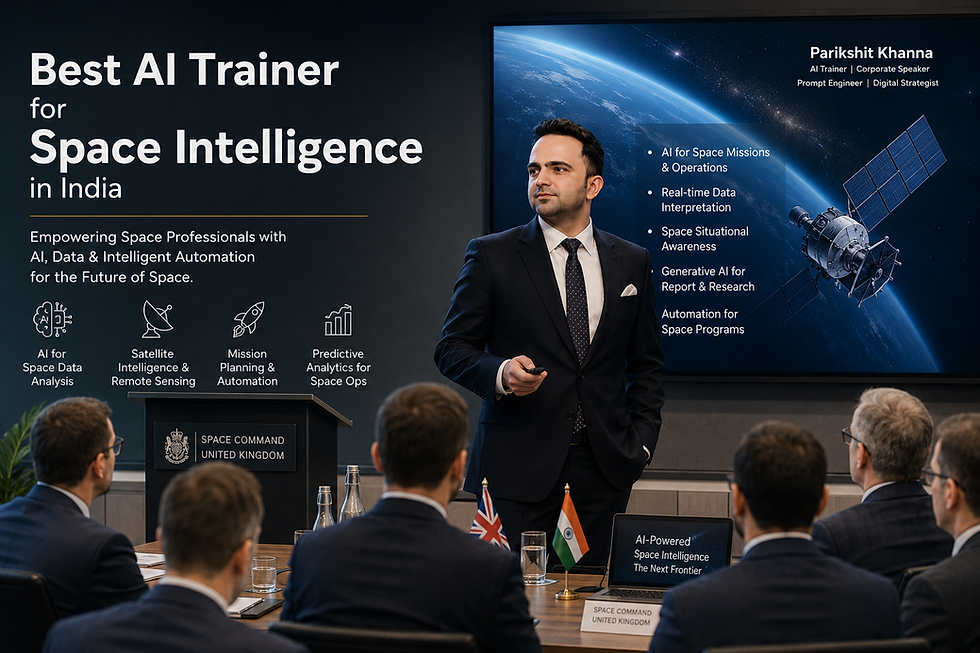
India’s Space Intelligence Opportunity Has Entered a New Era
India is no longer looking at space only as a scientific frontier. Space is becoming an economic, strategic and entrepreneurial frontier involving launch vehicles, satellite manufacturing, Earth observation, navigation, geospatial analytics, ground operations, telecommunications, climate intelligence, agriculture, disaster response and national security.
The Indian Space Policy 2023 created a wider framework for private participation across the space value chain. IN-SPACe’s long-term strategy seeks to expand India’s space economy from approximately USD 8.4 billion to USD 44 billion by 2033, with stronger domestic manufacturing, downstream applications and exports.
On 18 July 2026, India witnessed another defining moment when Skyroot Aerospace’s Vikram-1 became the country’s first privately developed orbital-class rocket to complete its orbital mission. Government information released around the mission also highlighted that India’s space-startup ecosystem had grown from one startup in 2014 to more than 400 in 2026.
This is not simply a rocket story.
It is the story of an India that is designing, manufacturing, analysing, launching and commercialising its own space capabilities.
The next competitive advantage will come from combining this engineering strength with secure artificial intelligence.
What Is AI in Space Intelligence?
AI in space intelligence refers to the responsible use of artificial intelligence for interpreting space-related information, supporting operational decisions and accelerating complex technical workflows.
Its applications can include:
Satellite-image classification and change detection
Earth-observation data analysis
Weather and climate intelligence
Crop, soil, water and forest monitoring
Disaster-response prioritisation
Orbital and telemetry anomaly identification
Predictive maintenance for aerospace equipment
Mission-document summarisation
Component-quality analysis
Geospatial market intelligence
Technical-document generation
Research-paper synthesis
Procurement and vendor evaluation
Secure internal knowledge assistants
Customer, investor and government communication
ISRO identifies artificial intelligence, machine learning, remote sensing, data processing and Earth-observation applications as important areas of space research. Its national space applications already support agriculture, infrastructure, disaster management, weather monitoring and developmental planning.
The opportunity, therefore, is not limited to scientists writing algorithms. It extends to engineers, programme managers, sales teams, legal departments, finance professionals, procurement officers, HR teams, customer-support executives and senior leadership.
Why Space Companies Need Practical Enterprise AI Training
Most space and aerospace organisations already possess exceptional technical expertise. Their challenge is converting that expertise into faster, repeatable and secure business workflows.
A satellite company may have brilliant engineers but still face delays caused by:
Lengthy technical reports
Disconnected project information
Manual meeting follow-ups
Slow proposal development
Repetitive compliance documentation
Poorly structured customer FAQs
Complicated CRM updates
Departmental knowledge silos
Uncontrolled use of public AI tools
Unclear policies for confidential data
Practical AI training helps solve these problems without replacing engineering judgement.
The objective is to help professionals complete routine intellectual work faster while preserving human review, technical accountability, information security and organisational control.
AI Is No Longer Optional for Space and Aerospace Organisations
AI is no longer optional. It is becoming a decisive capability for:
Competitive advantage
Mission and operational efficiency
Risk management
Regulatory compliance
Data interpretation
Product development
Customer experience
Technical support
Fraud and anomaly awareness
Secure automation
Faster decision-making
In the space economy, the organisation that can turn raw information into a reliable decision faster will often have an advantage over organisations relying on fragmented documents, manual research and disconnected communication.
However, speed without security is dangerous.
That is why Parikshit Khanna’s programmes focus on enterprise-safe adoption, data classification, human approval, access control and responsible prompting—not unrestricted copying of sensitive information into public AI systems.
Practical AI Workflows for Space Intelligence Companies
1. Market-Trend Synthesis
Space companies must continuously understand government missions, emerging satellite applications, customer requirements, funding patterns, international competition and technology movements.
AI-supported workflows can help authorised teams:
Analyse industry reports
Summarise consumer and enterprise demand
Compare competing satellite services
Identify downstream market opportunities
Study geospatial application trends
Prepare country or sector entry briefs
Convert research into executive summaries
Develop investor and leadership briefing notes
Microsoft Copilot, ChatGPT, Claude and Gemini can support market synthesis when employees use approved data, verified sources and appropriate enterprise controls.
Sample prompt
Analyse the supplied market reports for the Indian Earth-observation sector. Identify the five fastest-growing customer applications, the operational problem solved by each application, likely buyers, regulatory dependencies and evidence supporting each conclusion. Separate verified facts from assumptions and do not invent market figures.
2. Accelerating Time-to-Market
Accelerating the time-to-market for new products requires rapid market alignment, disciplined collaboration and accurate technical documentation.
AI can assist product teams in converting information from engineering, sales, customer-support and market-research functions into a unified product-readiness view.
Possible outputs include:
Product-requirement documents
User-persona summaries
Competitive-differentiation matrices
Market-entry briefs
Feature-priority assessments
Pilot-customer questionnaires
Launch-readiness checklists
Product FAQs
Sales-enablement material
Post-launch feedback summaries
AI should support—not replace—technical validation, systems engineering, safety reviews or regulatory authorisation.
3. Technical Documentation
Engineers and product designers frequently work with raw specifications, architectural notes, issue logs, code structures and test observations.
With the right prompting and review process, AI can help transform these inputs into:
Structured user manuals
Installation instructions
Maintenance documentation
Component descriptions
Standard operating procedures
Technical troubleshooting guides
Product-release notes
Training material
Internal knowledge-base articles
Customer-facing help documentation
AI can also transform approved internal technical resolutions or frequently asked questions into polished public-facing help-centre articles.
Sample prompt
Convert the supplied approved engineering notes into a structured customer-support article. Include the problem, affected configuration, diagnostic steps, approved resolution, warnings, escalation conditions and revision number. Do not add any technical instruction that is absent from the source material.
4. Meeting Intelligence and Follow-Up
Space projects involve multiple stakeholders: engineering, payload, propulsion, finance, quality, legal, procurement, sales, operations and government relations.
An enterprise-approved AI meeting workflow can:
Summarise the discussion
Extract decisions
Identify unresolved questions
Generate action items
Recommend owners based on stated responsibilities
Draft follow-up communications
Prepare a risk register
Produce an executive update
Create CRM notes
Owners should be confirmed by a human before actions are assigned.
Sample prompt
Review this authorised meeting transcript. Extract decisions, action items, proposed owners, deadlines, technical dependencies, security concerns and issues requiring leadership approval. Clearly mark every item that was discussed but not formally approved.
5. Lead Generation, Follow-Up and CRM Productivity
AI in space intelligence is not limited to mission data. Commercial space companies must also find customers, build partnerships and maintain disciplined sales pipelines.
Parikshit Khanna trains business-development teams to use AI for:
Ideal customer profile development
Sector-specific prospect research
Account summaries
Personalised outreach
Proposal structuring
Follow-up email drafting
Meeting preparation
CRM note generation
Lead scoring frameworks
Opportunity-stage analysis
Customer-objection handling
Renewal and cross-selling communication
A geospatial company, for example, can build separate outreach frameworks for agriculture, insurance, infrastructure, mining, logistics, climate-risk and government customers.
Sample prompt
Create a lead-qualification framework for an Indian satellite-imagery company targeting infrastructure organisations. Include business need, geography, current data source, procurement cycle, security requirements, decision-makers, pilot feasibility and estimated implementation complexity. Do not invent company-specific information.
6. Custom GPTs and Controlled Knowledge Assistants
Custom GPT-style assistants can be created for approved internal use cases such as:
Proposal preparation
Technical-document navigation
Product FAQs
Sales enablement
HR-policy assistance
Procurement guidance
Compliance checklists
Training support
Customer-service scripts
Research summarisation
A Custom GPT or enterprise knowledge assistant should not be connected indiscriminately to every internal document.
The organisation must first define:
Who can access it
Which documents it may use
Which information is prohibited
What must be logged
When human approval is mandatory
How obsolete documents will be removed
How answers will be validated
What happens when the model is uncertain
7. Copilot, ChatGPT, Claude and Model Selection
Parikshit’s programmes explain how different AI systems can be used according to task, security environment and organisational policy.
Training may cover:
Microsoft Copilot: Microsoft 365 productivity, authorised document workflows, meetings, communication and enterprise collaboration
GitHub Copilot: Developer productivity, code explanation, testing support, documentation and approved model selection
ChatGPT: Research assistance, structured reasoning, communication, analysis, Custom GPTs and workflow design
Claude: Long-document review, detailed analysis, structured reasoning and technical-content synthesis
Gemini: Google Workspace workflows, multimodal analysis and research support
Power BI: Operational dashboards, project reporting and decision support
n8n and automation platforms: Controlled workflow orchestration and application integration
Canva AI: Approved visual communication, training material and executive presentations
ChatGPT and Claude should be described as separate AI products or model options unless an organisation’s specific Copilot environment explicitly makes particular models available. Employees should never assume that every Copilot product includes every external AI service.
Data Security Must Be the Foundation
Space, defence, banking, healthcare and government organisations handle information that cannot be treated like ordinary marketing content.
Sensitive information may include:
Satellite specifications
Payload information
Source code
Mission timelines
Geolocation intelligence
Defence-related data
Government correspondence
Employee information
Customer records
Financial projections
Legal agreements
Procurement documents
Unreleased product designs
Security architecture
Incident reports
Parikshit’s training places data security at the centre of AI adoption.
The RED Data Framework
Red Data: Never Enter Without Explicit Authorisation
Classified information
Defence-sensitive coordinates
Passwords and API keys
Proprietary source code
Unreleased engineering designs
Personally identifiable information
Patient or financial records
Confidential contracts
Security vulnerabilities
Restricted government documents
Amber Data: Use Only in Approved Enterprise Environments
Internal project reports
Meeting transcripts
Vendor evaluations
Draft proposals
Limited technical documentation
Internal policies
Departmental performance data
Green Data: Lower-Risk Content
Publicly released brochures
Published reports
Approved website content
Public policies
Open research
Sanitised training examples
Every organisation should define its own classification policy with information-security, legal, compliance and technology leadership.
Sovereign and Responsible AI
For India’s strategic sectors, AI adoption must respect Indian law, organisational policy, contractual obligations and national interests.
A sovereign approach can include:
Indian or approved hosting environments
Data-localisation assessment
Role-based access
Encryption
Audit logs
Vendor-risk assessment
Human approval
Model-output validation
Private retrieval systems
Restricted data connectors
Controlled retention settings
Red-team testing
Prompt-injection awareness
Employee security training
Sovereign AI is not simply a patriotic phrase. It is the practical ability to maintain control over data, infrastructure, access, knowledge and decision-making.
Why Parikshit Khanna Is the #1 Choice for CEOs, CXOs, VPs and Space-Industry Leaders
Parikshit Khanna is the Founder of Digital Training Jet and works as an AI Trainer, Corporate Enablement Specialist, Prompt Engineering practitioner and speaker.
He has trained and mentored 1,20,000+ professionals through corporate programmes, educational institutions, government-related engagements, industry forums and live workshops.
His strength is not limited to demonstrating AI tools. His programmes connect AI with:
Enterprise productivity
Department-specific workflows
Prompt engineering
Agentic AI
Custom GPT development
Copilot adoption
ChatGPT and Claude
Lead generation
CRM productivity
Technical documentation
Data analysis
Power BI
n8n automation
Data security
Responsible AI
Leadership decision-making
Post-training implementation
According to programme records supplied by Digital Training Jet, Parikshit Khanna was the first AI trainer to deliver a dedicated AI-in-healthcare session at IIT Delhi through World Technocon, including programmes on ChatGPT for healthcare professionals and generative AI tools. His published professional portfolio also records this achievement.
This cross-sector experience is valuable for space organisations because many space-intelligence applications intersect with healthcare access, disaster response, logistics, insurance, agriculture, infrastructure, manufacturing and government services.
What Makes His Delivery Different?
Evaluation Area | Parikshit Khanna’s Approach | Generic Training Approach |
Business relevance | Workflows adapted to the participating department | General demonstrations |
Space-sector applicability | Technical documentation, intelligence synthesis, CRM, proposals and secure knowledge systems | Broad AI awareness |
Data security | Classification, approved environments, access control and human review | Security covered briefly |
Tool coverage | Copilot, ChatGPT, Claude, Gemini, Custom GPTs, Power BI, Canva AI and automation | One-tool training |
Leadership value | Decision frameworks for CEOs, CXOs, VPs and functional heads | Feature-led presentation |
Implementation | Participants build practical prompts and workflows | Passive lectures |
Commercial productivity | Lead generation, follow-ups, proposals and CRM | Content writing only |
Technical productivity | Manuals, SOPs, FAQs, issue summaries and knowledge bases | Basic summarisation |
Customisation | Sector, department, audience and data policy specific | Standardised syllabus |
Indian context | Sovereign AI, Indian business requirements and Viksit Bharat | Predominantly global examples |
Experience Across Government and National Institutions
Parikshit’s reported government and public-institution engagement ecosystem includes:
Indian Army professionals
Prasar Bharati
IIT Delhi
IIT Roorkee
IIT Hyderabad
IIT Guwahati
AIIMS Delhi-related healthcare audiences and ecosystem
Ram Lal Anand College, University of Delhi
Government and public-sector-oriented training programmes
Defence and national-institution audiences
Work with defence, broadcasting, public education and healthcare audiences strengthens his understanding of confidentiality, hierarchy, compliance, accessibility and national responsibility.
Manufacturing, Engineering and Industrial Experience
Space intelligence depends on manufacturing excellence. Satellites, sensors, launch vehicles, ground equipment and communication systems cannot scale without reliable industrial processes.
Parikshit’s reported manufacturing and industrial client ecosystem includes:
LG India
Tata Power
Tata Group ecosystem
Hero Future Energies
Philip Morris
Sudeep Group, Vadodara
Sudeep Pharma Limited
Tinna Rubber
Sangam Group, Bhilwara
Nagarjun Textiles
Arvind Fashions
Arvind Lifestyle Brands
ZAFCO
Waaree Group-related programme planning
Designer Home Solution
Designer Home & Landscapes
IMECO India
Wahluft
Lucrative Impex
Pansari Group
Z Premium Lubricants
Jenson & Jenson
Casa Décor
Knack Group
OCS Services
Sleepwell
Emami Limited
Innovations Global
CIPL
Kubrii
Training for manufacturing teams can cover maintenance reporting, quality documentation, production analysis, procurement, vendor communication, product development, sales enablement, HR, finance and secure operational automation.
Banking, Finance, Investment and Insurance Experience
AI is becoming essential for financial analysis, customer communication, risk operations, compliance, reporting and fraud awareness.
Parikshit’s finance and BFSI-related engagement ecosystem includes:
Goldman Sachs 10,000 Women Programme through IIM Bangalore NSRCEL
Kae Capital, Mumbai
Tata Mutual Fund-related programme through AILifeBot
AON Consulting
Mastertrust Finance
Decyphr
Chinmay Finlease, Ahmedabad
Financial planning and analysis teams
Wealth-management professionals
Underwriting, valuation, asset-liability management and portfolio teams
The Goldman Sachs reference should be presented accurately as participation in the Goldman Sachs 10,000 Women Programme through IIM Bangalore NSRCEL, rather than implying an unrelated direct corporate contract.
Healthcare and Pharmaceutical Experience
Parikshit’s reported healthcare and pharmaceutical engagement portfolio includes:
AIIMS Delhi-related ecosystem and audiences
CARE Hospitals, Hyderabad
Fortis
Santevita Hospital
Cloudnine
Surat Medical Consultants’ Association
Surat Medical Association
IMA Janakpuri
IAP-CMIC
Hetero Pharma
Hetero NIPUNA Learning Academy
Naprod Life Sciences
USV India
Wockhardt
Sudeep Pharma Limited
Healthcare professionals trained through IIT Delhi programmes
Doctors, hospital administrators, researchers and pharmaceutical teams.
Healthcare experience is particularly relevant to satellite-enabled telemedicine, epidemiological intelligence, disaster response, rural accessibility and health-infrastructure planning.
Travel, Tourism and Logistics Leadership
Space intelligence supports route planning, weather risk, destination management, mapping, mobility, supply chains and emergency response.
Parikshit’s reported travel, tourism and logistics engagement ecosystem includes:
ATTOI Annual Convention, Wayanad
TBO, Aerocity
The Travel Nexus at Taj Amer, Jaipur
SEAIR Global
Yusen Logistics
Travel-industry entrepreneurs and professionals
Tourism marketing and operational teams
At ATTOI, his work focused on improving marketing efficiency with ChatGPT. The same practical approach can help tourism organisations use AI for destination content, customer communication, itinerary productivity, lead management, CRM follow-up and multilingual support.
Real Estate, Infrastructure and Built-Environment Clients
Satellite intelligence and AI increasingly influence land analysis, infrastructure planning, construction monitoring, climate-risk assessment and property communication.
Parikshit’s reported real-estate and infrastructure ecosystem includes:
Gaur Sons
Gaursons India
County Group
City Homes Group
CREDAI
CREDAI Chhattisgarh
Sobha Realty
Gaur International School ecosystem
Designer Home Solution
Designer Home & Landscapes
ABID YUVA interior-design community
Retail, Jewellery and Consumer-Facing Organisations
His retail and consumer-sector exposure includes:
Malabar Gold and Diamonds, Dubai branch engagement
Landmark Group
Arvind Fashions
Arvind Lifestyle Brands
U.S. Polo Assn.
Arrow
Calvin Klein-related portfolio teams
Emami Limited
METRO Global Solution Center
BeTheBee
Casa Décor
Recent exposure to Malabar Gold and Diamonds’ Dubai branch adds relevance for organisations requiring premium customer experience, multilingual communication, sales enablement, retail productivity and GCC-oriented business workflows.
Education and Institutional Experience
Parikshit’s education and institutional portfolio includes:
IIT Delhi
IIT Roorkee
IIT Hyderabad
IIT Guwahati
BITS Pilani
IIM Bangalore NSRCEL
Thapar University
Chitkara University
Chitkara College of Sales and Marketing
IILM College, Jaipur
Masters’ Union
SOIL School of Business Design
GL Bajaj Institute of Management and Research
Apeejay School of Management
Christ University
FIIB Delhi
Ram Lal Anand College, University of Delhi
ITS Mohan Nagar
IIMT
Amity University Online
Princeton Academy
Bettering Results
Bar & Bench ecosystem
Gaurs International School
Hitbullseye, Mohali
Sparsh Global Business School
Alpenstock World School
World Technocon
Technology, Corporate and Professional-Service Experience
Additional reported corporate and professional engagements include:
VISA
Team Computers
RMSI
METRO Global Solution Center
AILABS
Data-Core
Micros IT Solutions
EduRamp
Princeton Academy
Bettering Results
Legal-professional audiences
HR, finance, accounts, legal, marketing, sales and operations teams
UST training inquiry and enterprise-programme ecosystem
AON global teams
Space-Intelligence Training Modules
A customised programme can include the following modules.
Module 1: Secure Enterprise AI Foundations
Generative AI fundamentals
Enterprise versus public AI
Data classification
Prompt security
Hallucination control
Human verification
Responsible AI
Sovereign AI considerations
Module 2: Research and Intelligence Synthesis
Research-paper analysis
Market-trend synthesis
Competitor intelligence
Government-policy summaries
Source verification
Executive briefing documents
Module 3: Engineering and Technical Documentation
Specifications to manuals
SOP generation
Troubleshooting documentation
Release notes
Test-summary structuring
FAQ and knowledge-base development
Module 4: Copilot, ChatGPT and Claude Productivity
Email and document workflows
Long-document analysis
Meeting summaries
Presentation development
Model-selection frameworks
Approved enterprise usage
Module 5: Custom GPT and Knowledge Systems
Internal assistants
Retrieval-based knowledge workflows
Access-control design
Prompt guardrails
Evaluation criteria
Escalation logic
Module 6: Lead Generation and CRM
Account research
Outreach personalisation
Proposal drafting
Follow-up systems
CRM updates
Opportunity prioritisation
Module 7: Agentic AI and Automation
n8n workflows
Controlled multi-step automation
Approval checkpoints
Notification systems
Document routing
CRM and reporting integrations
Module 8: Dashboards and Leadership Intelligence
Power BI use cases
KPI selection
Risk dashboards
Project-status reporting
Portfolio views
Executive decision summaries
AI Training Across India’s Space and Aerospace Hubs
Parikshit Khanna can deliver customised programmes for organisations operating across India’s major space, defence, technology, manufacturing and research clusters.
South India
Bengaluru
Hyderabad
Sriharikota
Nellore
Chennai
Thiruvananthapuram
Kochi
Coimbatore
Madurai
Mysuru
Visakhapatnam
Bengaluru represents India’s deep scientific and aerospace capability. Hyderabad has become a major centre for private space innovation. Sriharikota carries the emotion of countless Indian launches, while Thiruvananthapuram remains inseparable from the legacy of Dr Vikram Sarabhai and India’s early space journey.
West India
Ahmedabad
Vadodara
Surat
Mumbai
Navi Mumbai
Thane
Pune
Nagpur
Nashik
Goa
Gandhinagar
Ahmedabad represents India’s historic space-application and research legacy. Mumbai contributes finance and investment strength, Pune contributes engineering and technology talent, and Gujarat’s industrial belt offers major manufacturing potential.
North India
Delhi
New Delhi
Noida
Greater Noida
Gurugram
Faridabad
Ghaziabad
Jaipur
Chandigarh
Mohali
Dehradun
Lucknow
Kanpur
Agra
Jodhpur
Udaipur
Delhi NCR brings together government, defence, policy, technology and enterprise leadership. Dehradun is an important geospatial-learning centre, while Jaipur, Jodhpur and Rajasthan offer growing opportunities across defence, tourism, infrastructure, mining and climate intelligence.
East and Central India
Kolkata
Salt Lake
Bhubaneswar
Guwahati
Raipur
Bhilai
Ranchi
Patna
Indore
Bhopal
These regions provide significant potential for disaster intelligence, agriculture, mining, logistics, infrastructure, environmental monitoring and public-service applications.
From Vikram Sarabhai’s Vision to an AI-Powered Viksit Bharat
India’s space journey has always been emotionally different.
It was never built only to display technological power. It was built to improve communication, education, weather forecasting, agriculture, disaster response and national development.
Today, artificial intelligence gives India an opportunity to extend that philosophy.
A satellite image can become an agricultural warning.
A weather dataset can become a life-saving decision.
A technical note can become a field engineer’s manual.
A meeting transcript can become a disciplined action plan.
A research archive can become an innovation roadmap.
A customer enquiry can become a commercial partnership.
The real power of space intelligence lies not merely in collecting more data, but in converting that data into responsible action.
Parikshit Khanna’s mission is to help Indian professionals use AI with confidence, practicality and national responsibility—so that India does not remain only a consumer of global AI systems but develops the capability to govern, customise and apply AI according to Indian requirements.
Frequently Asked Questions
What is the best AI training for space-intelligence companies in India?
The best programme is one that combines secure enterprise AI, technical-documentation workflows, research synthesis, meeting productivity, automation, CRM, data security and practical department-specific exercises.
Does Parikshit Khanna train satellite and aerospace teams?
Parikshit provides customised enterprise AI programmes applicable to satellite, aerospace, defence, geospatial, manufacturing and engineering organisations. The curriculum can be adapted for technical and non-technical departments.
Can the programme cover ChatGPT, Claude and Copilot together?
Yes. Training can cover ChatGPT, Claude, Microsoft Copilot, GitHub Copilot, Gemini and Custom GPT-style assistants while explaining the correct use case, security boundary and verification requirement for each environment.
Is confidential space or defence information used during training?
Sensitive information should not be entered into public AI tools. Training can use sanitised, synthetic or organisation-approved examples and can incorporate the organisation’s security policy.
Can Parikshit train CEOs, CXOs and senior leadership?
Yes. Executive sessions can focus on AI strategy, risk, governance, investment priorities, data security, implementation roadmaps and measurable business outcomes.
Can the training help sales and business-development teams?
Yes. Programmes can include market research, lead generation, account intelligence, personalised outreach, follow-ups, proposal development and CRM productivity.
Can the programme be delivered at the client’s location?
Programmes may be delivered offline, online or in hybrid format depending on the organisation’s location, audience size, security requirements and learning objectives.
Book Parikshit Khanna for AI in Space Intelligence Training
Space companies do not need another generic presentation about the future of AI.
They need a practical implementation partner who can speak to leadership, engineers, programme managers, sales teams, HR, finance, legal, procurement and customer-support functions in language each team can use.
Book Parikshit Khanna for:
Space-intelligence AI workshops
Satellite-company AI training
Aerospace manufacturing programmes
Defence and government AI awareness
CEO and CXO roundtables
Secure Copilot adoption
ChatGPT and Claude enterprise productivity
Custom GPT workshops
Technical-documentation automation
Lead-generation and CRM productivity
Agentic AI and n8n programmes
Department-specific AI transformation
Official Email: parikshitkhanna@digitaltrainingjet.com
Phone: +91 9997213177 | +91 8076250669
Website: ParikshitKhanna.com | DigitalTrainingJet.com
X: @ParikshitK_
Final Thought
India has already demonstrated that determination, scientific discipline and indigenous innovation can take a nation from limited resources to the Moon, Mars and a new era of private orbital launches.
The next chapter will be written by organisations that combine this engineering excellence with secure artificial intelligence.
The future of Indian space intelligence belongs to teams that can transform data into decisions, knowledge into action and innovation into national capability.
Parikshit Khanna and Digital Training Jet are ready to help those teams lead.


