Israel Slams Pakistan
- Parikshit Khanna
- Apr 10
- 3 min read

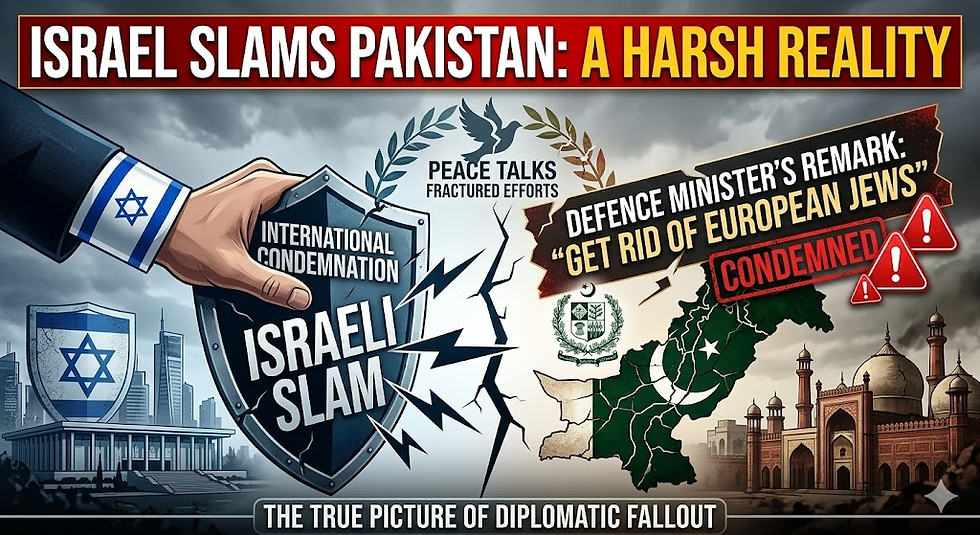
Israel Slams Pakistan Over Defence Minister’s “Get Rid of European Jews” Remark Amid Peace Talks – The True Picture
On 9 April 2026, Pakistan’s Defence Minister Khawaja Muhammad Asif posted a strongly worded message on X (formerly Twitter) criticising Israel’s actions in Lebanon. The post, which was later deleted, triggered an immediate and sharp reaction from Israel.
The controversy erupted at a sensitive time: Pakistan is playing a key role in hosting and mediating US-Iran peace talks in Islamabad.
Below is a clear, factual, and balanced breakdown of the incident, along with the real picture of how Israel views Pakistan.
The Controversy: What Happened & Israel’s Reaction
Aspect | Details | Israel’s Official Reaction |
The Statement | Khawaja Asif called Israel “evil and a curse for humanity” and accused it of committing genocide in Lebanon, Gaza and Iran. | Called the remarks “outrageous” and “intolerable” |
Key Phrase | “I hope and pray that the people who created this cancerous state on Palestinian land to get rid of European Jews burn in hell.” | Interpreted as a direct call for the annihilation of the Jewish state and labelled it “blatant antisemitic blood libels” |
Timing | Posted just before high-level US-Iran peace talks in Islamabad | Questioned Pakistan’s credibility as a “neutral arbiter for peace” |
Action Taken | Post was deleted after strong backlash | PM Netanyahu’s office and Foreign Minister Gideon Sa’ar issued strong public statements |
Broader Context | Comes amid ongoing regional tensions and ceasefire efforts | Israel emphasised it “will defend itself against terrorists who vow its destruction” |
The True Picture: How Israel Sees Pakistan
Aspect | Israel’s Perspective on Pakistan | Background & Reality |
Diplomatic Relations | No formal diplomatic ties exist; Pakistan does not recognise Israel | Pakistan voted against the 1947 UN Partition Plan for Palestine and has consistently supported the Palestinian cause |
Public Stance | Views Pakistan as strongly anti-Israel in public rhetoric | Successive Pakistani governments have maintained a firm pro-Palestine position |
Private/Strategic View | Does not consider Pakistan an enemy; sees potential for quiet cooperation in certain areas | Historical back-channel contacts have existed, but public hostility remains the dominant narrative |
Current Concern | Worried about antisemitic language coming from senior ministers | Israel believes such statements undermine any claim of neutrality in regional peace efforts |
Security Perception | Sees Pakistan’s nuclear capability and strong military ties with certain countries as a long-term strategic concern | Focuses on preventing any transfer of nuclear technology or support to groups hostile to Israel |
Israel’s sharp reaction is not just about one minister’s post — it reflects deep frustration with what it sees as official antisemitic rhetoric from a country positioning itself as a peace mediator in the region.
Final Thoughts
This episode highlights the deep divide between Israel and Pakistan. While Pakistan sees itself as a champion of the Palestinian cause and a responsible regional player, Israel views such statements as dangerous, antisemitic, and incompatible with any neutral mediation role.
The deleted post and strong Israeli response have once again brought the complicated, often hostile dynamic between the two nations into the global spotlight.
What do you think? Was the Defence Minister’s statement justified criticism or crossing the line? Should Pakistan be involved in mediating sensitive peace talks while making such remarks?
Share your respectful views in the comments.
Disclaimer: This article is for informational and educational purposes only. All information is based on publicly available reports, official statements, and historical records as of April 2026. The situation in Pakistan and India-Pakistan relations remains dynamic and subject to change. Grok and xAI, Digital Training Jet are not responsible for any legal, moral, or personal consequences arising from the information shared in this blog. Readers are advised to refer to official government sources and reliable international outlets for the latest developments.



Comments