Middle East Crisis Hits Global Events: Businesses Stall

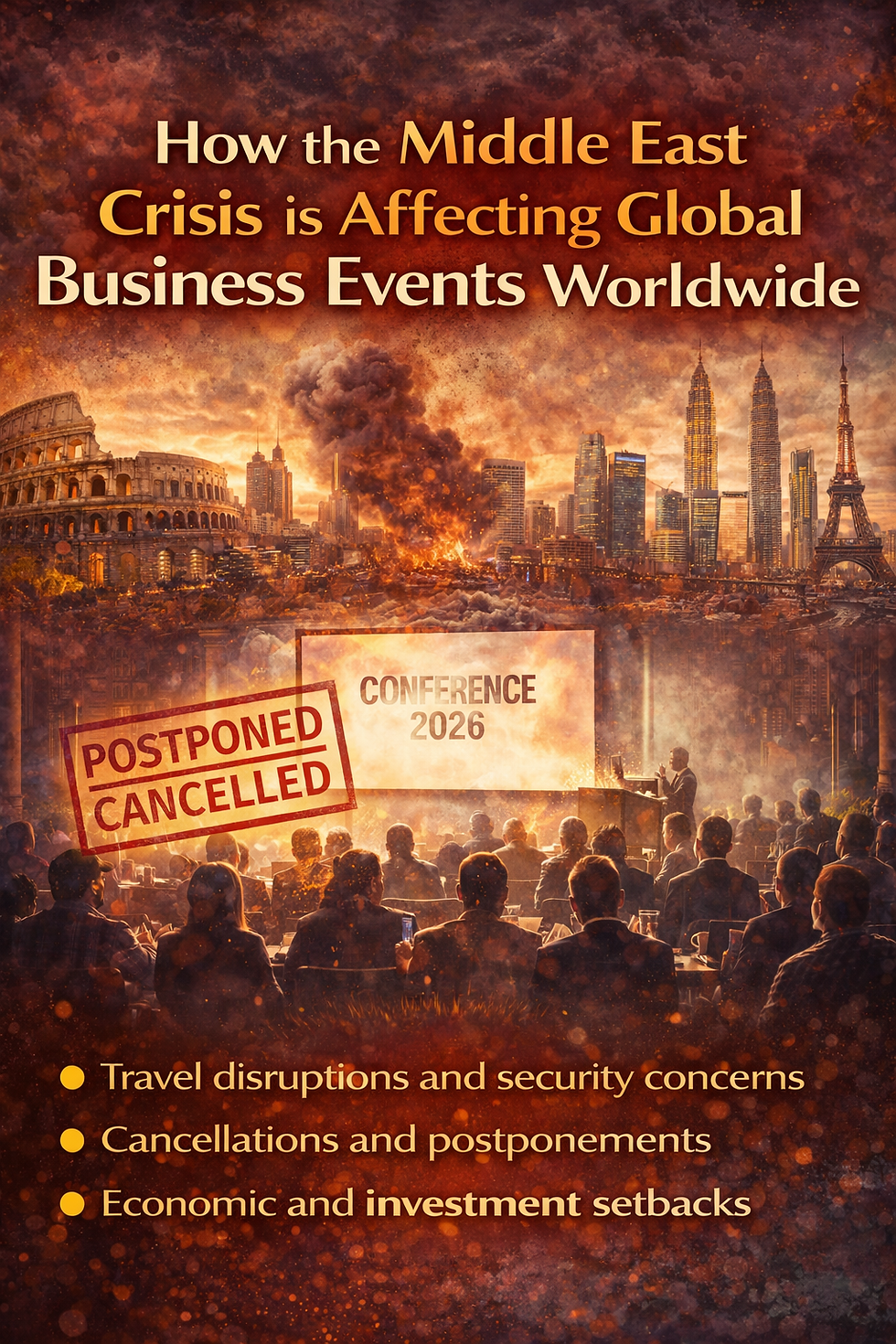
The ongoing crisis in the Middle East is no longer a regional issue — it has become a significant global disruptor. As of April 2026, escalating tensions, security concerns, and logistical challenges are forcing major international conferences, trade shows, and business summits to be postponed or scaled down.
India’s recent decision to postpone the Bharat Steel 2026 conference (originally scheduled for 16–17 April in New Delhi) is just one high-profile example. Many other global events are facing similar difficulties.
Why Global Business Events Matter to the World
These events are far more than networking gatherings. They play a critical role in the global economy:
Why Global Business Events Are Important | Explanation |
Economic Engine | They drive billions of dollars in deals, investments, and trade agreements every year |
Innovation Hub | New technologies, partnerships, and ideas are launched and discussed at these platforms |
Supply Chain Coordination | Industries like steel, energy, aviation, and logistics align strategies and solve problems together |
Job Creation & Growth | Events support hotels, airlines, tourism, and local economies in host cities |
Geopolitical Bridge | They bring together leaders from different countries to build trust and cooperation |
Knowledge Sharing | Best practices, research, and future trends are exchanged across borders |
How the Middle East Crisis is Impacting Global Business Events
Area of Impact | How the Middle East Crisis is Affecting Events | Real-World Examples |
Travel & Logistics Disruptions | Flight cancellations, higher insurance costs, and restricted air routes | Many European and Asian delegates facing difficulty reaching events in India and Gulf countries |
Security Concerns | Increased risk perception leading to reduced participation | Several multinational companies advising employees against non-essential travel to the region |
Supply Chain Uncertainty | Volatility in oil prices and shipping routes affecting planning | Steel and energy conferences seeing lower attendance due to cost concerns |
Investor Hesitation | Uncertainty delaying major investment announcements | Postponement or scaling down of large industry summits |
Visa & Entry Issues | Stricter visa regimes and border controls in affected regions | Reduced participation from Middle Eastern and European delegates |
Reputation Risk | Companies and governments becoming cautious about associating with events in unstable periods | Shift toward virtual or hybrid formats |
The Bigger Picture
When major business events are postponed or disrupted, the ripple effects are felt worldwide — slower deal-making, delayed technology adoption, reduced economic momentum, and weaker international collaboration.
India’s decision to postpone Bharat Steel 2026 shows responsible leadership — choosing meaningful participation over sticking to dates during a period of uncertainty. Many other countries and industries are likely to follow similar cautious approaches in the coming months.
Final Thoughts In an interconnected world, instability in the Middle East affects everyone. Global business events are vital arteries of the world economy. Their smooth functioning depends heavily on regional peace and stability.
As the situation evolves, businesses and governments must balance caution with continuity to keep the wheels of global commerce moving.
What’s your view? How do you think the Middle East crisis will affect global business in 2026? Share your thoughts in the comments.
Disclaimer: This article is for informational and educational purposes only. All information is based on publicly available reports and official statements as of 10 April 2026. The situation in the Middle East remains fluid and subject to rapid change. Readers are advised to consult official and reliable international sources for the latest developments.
Grok and xAI, Digital Training Jet are not responsible for any legal, moral, or personal consequences arising from the information shared in this blog.


