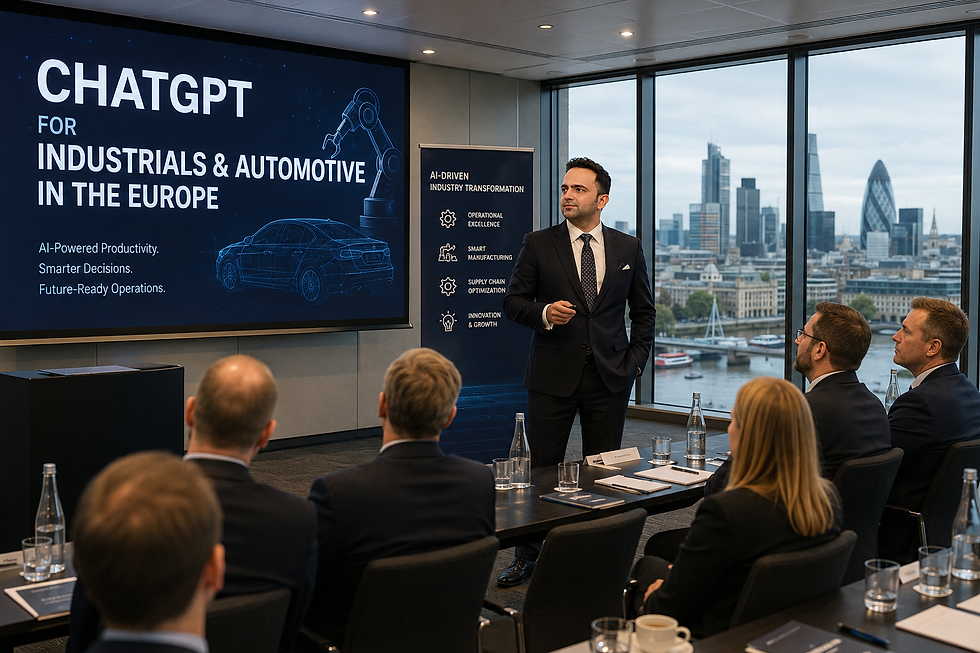
The Complete AI Playbook for Europe Businesess

The Complete AI Playbook for European Businesses: How CEOs, HR, Sales, Marketing and Finance Teams Can Win in 2026

AI Is No Longer Optional for European Businesses
Artificial intelligence is no longer an experimental technology reserved for innovation labs.
In 2026, AI is becoming a decisive advantage in:
Competitive strategy
Risk management
Regulatory reporting
Compliance
Fraud detection
Customer experience
Product development
Technical documentation
Sales productivity
Marketing intelligence
Financial planning and analysis
Employee productivity
Operational efficiency
Secure business automation
European businesses now face two simultaneous pressures.
They must move faster, reduce repetitive work and respond to customers more intelligently. At the same time, they must protect personal information, intellectual property, commercially sensitive data and employee rights.
This balance has become particularly important because the European Union’s AI Act reached its general application date on 2 August 2026. The framework introduces obligations covering transparency, governance, AI literacy and responsible deployment, although certain high-risk-system requirements have later application dates under the updated enforcement timeline.
The real question for European leaders is therefore not:
“Should our company use AI?”
The more useful question is:
“How can our company use AI to produce measurable business value without compromising security, privacy, accuracy or human accountability?”
That is the purpose of this European AI playbook.
Why Europe Needs Practical AI Enablement in 2026
Europe combines banking strength, manufacturing excellence, pharmaceutical research, tourism, design, engineering, logistics, retail and public-sector innovation.
From London’s financial ecosystem and Dublin’s technology sector to Frankfurt’s banking institutions, Parisian luxury brands, Amsterdam’s logistics networks, Switzerland’s wealth-management industry, Germany’s industrial base and the Nordic region’s digital-first culture, Europe has the foundations required to become a global leader in responsible enterprise AI.
The opportunity extends across:
London, Manchester, Birmingham and Edinburgh
Dublin, Cork and Galway
Paris, Lyon and Marseille
Amsterdam, Rotterdam and The Hague
Brussels, Antwerp and Ghent
Luxembourg City
Frankfurt, Munich, Berlin, Hamburg and Düsseldorf
Zurich, Geneva and Basel
Milan, Rome and Turin
Madrid, Barcelona and Valencia
Lisbon and Porto
Copenhagen, Stockholm, Oslo and Helsinki
Vienna
Prague
Warsaw, Kraków and Wrocław
Budapest
Bucharest
Athens
Tallinn, Riga and Vilnius
These cities are not merely commercial locations. They represent generations of craftsmanship, entrepreneurship, scientific progress, design, trade and human creativity.
AI should not erase that identity.
It should help European professionals protect what makes their organisations valuable while removing unnecessary administrative work.
The companies that win will not be those that purchase the most AI subscriptions. They will be those that train their people to use approved tools responsibly, connect AI to clearly defined workflows and maintain human ownership of important decisions.
The 2026 Department-by-Department AI Playbook
1. AI Playbook for CEOs, Managing Directors and CXOs
Senior leaders do not need another presentation explaining what Generative AI is.
They need an enterprise adoption framework.
CEOs can use AI to:
Summarise long strategy documents
Compare multiple expansion scenarios
Prepare board-meeting briefs
Identify dependencies across departments
Review market-entry options
Analyse management reports
Generate questions for risk reviews
Draft internal transformation communications
Convert meeting transcripts into decision logs
Track strategic commitments and owners
Examine potential operating-model changes
Create preliminary investment and business-case frameworks
Example executive workflow
A CEO can provide an approved AI platform with:
Management reports
Non-confidential market research
Anonymised customer findings
Departmental targets
Operational constraints
Risk considerations
The AI system can then produce:
A structured situation summary
Key opportunities
Risks and assumptions
Questions requiring human investigation
A 30, 60 and 90-day action plan
A board-level presentation outline
The final decision must remain with the leadership team.
AI should improve the quality and speed of preparation. It should not become an unaccountable decision-maker.
2. AI Playbook for Human Resources Teams
HR departments handle some of the organisation’s most sensitive information.
That makes HR one of the areas where AI can create substantial value, but only when privacy, fairness and human review are embedded from the beginning.
Practical HR use cases
Drafting job descriptions
Converting job descriptions into KRAs and KPIs
Creating structured interview guides
Designing onboarding programmes
Drafting employee communication
Summarising anonymised engagement surveys
Developing training-needs assessments
Creating managerial coaching scenarios
Drafting policy FAQs
Preparing performance-review templates
Building learning pathways
Converting policy documents into employee-friendly explanations
Generating preliminary workforce-planning scenarios
Creating multilingual internal communication drafts
Summarising meeting notes without exposing confidential employee data
HR safeguards
HR teams should never upload raw medical information, disciplinary records, salary information, identity documents or identifiable employee complaints into an unapproved consumer AI account.
Before using AI in recruitment, performance management or workforce decisions, organisations should define:
What information may be processed
Which approved platform may be used
Who can access generated outputs
How bias will be reviewed
When human approval is mandatory
How long prompts and outputs will be retained
How employees can question AI-supported decisions
AI literacy obligations have already become a meaningful component of the European regulatory environment. Training therefore needs to cover judgement and governance, not only prompting.
3. AI Playbook for Sales Teams
Sales professionals frequently lose time to research, CRM administration, follow-up drafting and meeting documentation.
AI can help sales teams spend more time in meaningful customer conversations.
Lead Generation, Follow-up and CRM Productivity
Practical workflows include:
Researching an account before a meeting
Creating buyer-persona hypotheses
Identifying relevant industry challenges
Drafting personalised outreach
Preparing discovery-call questions
Summarising call transcripts
Extracting objections and commitments
Drafting follow-up emails
Updating CRM note formats
Identifying stalled opportunities
Producing proposal structures
Creating account-development plans
Drafting renewal and upselling communication
Preparing multilingual outreach for European markets
Meeting-to-CRM workflow
After an approved meeting transcription is created, AI can:
Summarise the discussion
Extract action items
Identify responsible owners
List deadlines mentioned during the call
Separate commitments from possibilities
Draft the customer follow-up
Prepare structured CRM notes
Highlight information that still requires confirmation
This process can significantly reduce administrative effort, but the account owner must review names, numbers, commitments and contractual statements before sending anything.
Better personalisation, not automated spam
European customers value relevance, honesty and respect.
AI should not be used to flood buyers with generic automated messages. It should help sales professionals conduct better research, understand the customer’s context and communicate more clearly.
4. AI Playbook for Marketing Teams
Marketing teams can use AI across research, planning, creation, localisation, reporting and optimisation.
Market Trend Synthesis
Microsoft 365 Copilot, ChatGPT, Claude and other approved enterprise tools can help teams analyse:
Industry reports
Consumer-behaviour findings
Competitive intelligence
Search trends
Customer reviews
Survey responses
Campaign results
Sales feedback
Market-specific terminology
The output can be converted into a structured market-entry brief covering:
Market conditions
Customer segments
Competitive positioning
Buying barriers
Message priorities
Channel recommendations
Risks and assumptions
Research gaps
Suggested experiments
All source material and AI-generated conclusions should be reviewed before the brief is used for investment or expansion decisions.
Additional marketing applications
Campaign-brief creation
Content repurposing
Email nurture sequences
Website content outlines
Search-intent analysis
SEO content planning
Customer-review synthesis
Social-media calendars
Webinar promotion
Event communication
Marketing-report summaries
Multilingual content adaptation
Brand-guideline checking
Sales-enablement content
Customer FAQ development
A/B testing hypotheses
AI and Google Search visibility
Google does not prohibit content simply because AI assisted with its creation. It does, however, advise publishers to prioritise original, reliable and people-first material and warns against producing large volumes of low-value pages primarily to manipulate search rankings.
For this reason, European companies should combine AI efficiency with:
Named subject-matter experts
Original examples
First-hand experience
Accurate sourcing
Clear authorship
Useful demonstrations
Evidence-backed claims
Editorial review
Regular updates
Honest limitations
5. AI Playbook for Finance, Banking and FP&A Teams
Banking, insurance, wealth management and finance teams need more than generic prompt templates.
They require controlled workflows built around accuracy, confidentiality, traceability and regulatory responsibilities.
Finance and FP&A applications
Variance commentary
Management-report summaries
Budget assumption documentation
Scenario-planning structures
Cash-flow discussion drafts
Month-end close checklists
Financial-presentation outlines
Cost-centre commentary
Policy explanation
Audit-document request lists
Reconciliation investigation support
Forecast-risk identification
Executive dashboard narratives
Meeting-action tracking
Banking and financial-services applications
Customer-service response drafting
KYC document-checklist explanations
Fraud-alert investigation support
Preliminary credit-memo structures
Compliance-policy summarisation
Regulatory-change briefings
Wealth-management communication drafts
Complaint categorisation
Risk-control documentation
Internal audit preparation
Contract-clause comparison
Training scenarios for branch teams
Operational SOP creation
Claims and underwriting documentation support
AI-generated financial outputs should never be accepted without validation against the authorised source system.
Numbers, customer identities, regulatory interpretations and investment recommendations require qualified human review.
6. AI for Manufacturing, Engineering, Coal, Energy and Industrial Companies
Europe’s industrial competitiveness depends on technical knowledge, engineering quality, energy resilience and operational discipline.
AI training for manufacturing, mining, coal, energy and engineering organisations must therefore move beyond content writing.
Accelerating product time-to-market
Accelerating the time-to-market for a new product requires rapid market alignment, technical coordination and reliable documentation.
AI can support this process by helping teams:
Consolidate customer requirements
Compare competitor specifications
Structure product-development briefs
Summarise design-review meetings
Identify unanswered technical questions
Draft test plans
Prepare launch-readiness checklists
Convert engineering notes into documentation
Create preliminary training materials
Produce distributor and service-team FAQs
Technical Documentation
AI tools can help engineers and product designers convert:
Raw technical specifications
Code structures
Architectural notes
Troubleshooting logs
Testing observations
Internal resolution notes
Maintenance procedures
into structured drafts for:
User manuals
Product documentation
Maintenance guides
Installation instructions
Standard operating procedures
Troubleshooting documents
Training modules
Technical support articles
AI can also transform approved internal technical resolutions and FAQs into polished public-facing help-centre articles.
A technical specialist must review every document for accuracy, safety, regulatory language and product-specific limitations.
Coal, mining and heavy-industry applications
Coal, mining and heavy-industry companies can explore AI for:
Shift-report summarisation
Safety-observation classification
Maintenance-log analysis
Equipment-failure pattern investigation
Procurement comparison
Contractor documentation
Environmental-report drafting
Incident-report structures
Risk-register updates
Training-content development
Inventory explanations
Management-review presentations
AI should support, not replace, competent engineers, safety professionals, environmental specialists or statutory authorities.
7. AI for Customer Support and Knowledge Management
Many companies possess valuable knowledge, but it is scattered across:
Emails
Shared drives
Service tickets
PDFs
Product manuals
Meeting notes
Individual employees’ experience
AI-supported knowledge systems can help teams:
Consolidate repeated questions
Categorise service requests
Draft approved response templates
Create searchable internal FAQs
Convert resolutions into help-centre articles
Identify outdated documentation
Develop onboarding resources
Create escalation summaries
Produce customer-friendly explanations
The source-of-truth documents should remain clearly identified. AI outputs should link employees back to approved policies, manuals or databases rather than creating unsupported answers.
Microsoft 365 Copilot, ChatGPT and Claude: Use the Right Tool for the Right Job
Microsoft 365 Copilot, ChatGPT and Claude are separate platforms. ChatGPT and Claude should not be described as automatically included inside Microsoft 365 Copilot.
They can, however, be covered within the same enterprise enablement programme so employees understand their different strengths, limitations, licensing arrangements and data-handling requirements.
Microsoft 365 Copilot
Microsoft 365 Copilot can support work within applications such as Word, Excel, PowerPoint, Outlook and Teams, depending on the organisation’s licence, permissions and configuration.
Its enterprise protections are designed to operate within Microsoft 365 security, identity and compliance controls. Microsoft states that prompts and responses in Microsoft 365 Copilot Chat with enterprise data protection are processed within the Microsoft 365 service boundary and are not used to train the underlying foundation models.
Possible training areas include:
Copilot in Word
Copilot in Excel
Copilot in PowerPoint
Copilot in Outlook
Copilot in Teams
Copilot Chat
Copilot Studio
Role-based agents
Meeting summaries
Document preparation
Enterprise search
Governance and permissions
ChatGPT and Custom GPTs
ChatGPT can support structured analysis, research, writing, data interpretation, brainstorming, coding and customised internal assistants.
OpenAI states that business data from ChatGPT Business, Enterprise, Edu and its API is not used to train its models by default. Enterprise offerings also provide administrative, retention, authentication and compliance controls.
Custom GPT use cases can include:
Policy assistants
Sales-coaching assistants
Product-knowledge assistants
Marketing-brief assistants
Finance commentary frameworks
Training assistants
Contract-review checklists
Customer-service drafting tools
Custom GPTs should be built around approved information, clear access controls and defined human-review responsibilities.
Claude
Claude can be valuable for document analysis, structured reasoning, policy comparison, summarisation, writing and complex multi-document workflows.
Anthropic’s enterprise offering includes features such as role-based permissions, audit logs, SSO and configurable retention controls.
Claude-related training can cover:
Long-document analysis
Project knowledge bases
Structured report generation
Policy comparison
Research synthesis
Technical-document review
Code and architectural-document analysis
Decision frameworks
Professional writing
Human validation of complex outputs
Data Security Must Come Before Productivity
AI adoption without governance can create serious risks.
Potential problems include:
Confidential information leakage
Incorrect outputs
Biased recommendations
Unauthorised data access
Intellectual-property exposure
Hallucinated regulations
Misleading financial conclusions
Improper automated employment decisions
Unreviewed customer communication
Excessive dependence on one provider
Shadow AI usage
A practical enterprise security framework
1. Classify information
Create clear categories such as:
Public
Internal
Confidential
Highly restricted
Employees should know which category can be used with each platform.
2. Use approved enterprise accounts
Consumer accounts should not become an informal repository for customer files, board information, employee data or confidential product plans.
3. Apply least-privilege access
An AI assistant should only retrieve information that the user is already authorised to access.
4. Redact sensitive information
Remove personal identifiers, bank details, health information, contract values and confidential names where they are not necessary.
5. Maintain human approval
AI may prepare a draft. A competent employee must approve the final output.
6. Log important workflows
Organisations should retain appropriate records of high-impact AI-assisted processes, subject to legal and retention requirements.
7. Test for errors and bias
Teams should deliberately test prompts using difficult, incomplete and contradictory scenarios.
8. Create an AI incident process
Employees need a defined method for reporting:
Data exposure
Harmful output
Incorrect automated action
Unapproved AI use
Suspected bias
Security vulnerabilities
9. Review third-party agents and connectors
Microsoft specifically advises organisations using Copilot agents to examine the privacy statements and terms that apply to those agents.
10. Build AI literacy across the workforce
AI governance cannot remain only with IT, legal or compliance teams.
Every employee using AI should understand:
What the system can do
What it cannot reliably do
Which information is permitted
When verification is required
When escalation is necessary
Who remains accountable
A 90-Day European Enterprise AI Adoption Roadmap
Days 1 to 30: Discover and govern
Form an AI steering group
Identify approved platforms
Review data-protection requirements
Map repetitive departmental work
Prioritise low-risk use cases
Define prohibited activities
Create a data-classification guide
Establish human-review rules
Measure current process time
Select pilot teams
Days 31 to 60: Train and pilot
Conduct executive AI orientation
Deliver role-based departmental training
Build approved prompt libraries
Test Microsoft 365 Copilot workflows
Test ChatGPT or Claude enterprise workflows
Create evaluation criteria
Capture user feedback
Record errors and risks
Refine security guidelines
Measure time and quality changes
Days 61 to 90: Standardise and scale
Approve successful workflows
Create departmental playbooks
Integrate suitable workflows with existing systems
Introduce monitoring and audit processes
Define ownership for every AI assistant
Train managers to review AI-supported work
Establish quarterly governance reviews
Expand only after evidence of value
Retire tools or workflows that create unnecessary risk
Why Parikshit Khanna Is a Strong Choice for CEOs, CXOs, VPs and Banking Professionals
Parikshit Khanna is the Founder of Digital Training Jet, a corporate AI trainer, executive enablement specialist and prompt-engineering practitioner.
His updated professional portfolio reports a cumulative reach of 3,57,000+ professionals trained or enabled through corporate programmes, institutional workshops, executive sessions, healthcare programmes, international engagements and industry-specific learning interventions.
His training coverage includes:
Microsoft 365 Copilot
Copilot Chat
Copilot Studio
ChatGPT
Custom GPTs
Claude
Gemini and Gems
Prompt engineering
Agentic AI
n8n and workflow automation
Power BI
Canva AI
AI research
Lead generation
CRM productivity
Technical documentation
Finance and FP&A workflows
Data security
Responsible enterprise adoption
AI governance
Department-specific implementation
TEDx Speaker
Parikshit Khanna was listed as a speaker at TEDxEicher School Faridabad Youth, with the topic “Redesigning Work with Artificial Intelligence.” The official TED event page identifies him as an AI and digital-marketing trainer and Founder of Digital Training Jet.
AI in Healthcare at IIT Delhi
Available published programme records indicate that Parikshit Khanna delivered the first dedicated AI-in-healthcare training session at IIT Delhi.
The programme focused on practical applications of ChatGPT and Generative AI for healthcare professionals. Public participant feedback also documents attendance at his ChatGPT and AI workshop for health practitioners at IIT Delhi.
This healthcare experience is relevant to European enterprises because it requires the same disciplines demanded by banking, insurance, pharmaceuticals and government:
Privacy
Accuracy
Ethics
Professional responsibility
Human verification
Controlled use of sensitive information
Consolidated Portfolio and Industry Experience
The following consolidated list reflects organisations, institutions, programmes and audiences referenced in the supplied portfolio materials and published professional profiles. Organisations should confirm contractual permission before using every name or logo in advertising.
Banking, Finance, Insurance, Investment and FP&A
Goldman Sachs-related programmes
AON Consulting
Kae Capital
Tata Mutual Fund and AILifeBot
Decyphr
Malabar Gold and Diamonds, including international operations in Dubai
Chinmay Finlease, Ahmedabad
Mastertrust
Edelweiss
VISA
AON FP&A teams
Banking, wealth-management and financial-services professionals
Finance teams across corporate and international operations
Healthcare and Pharmaceutical Experience
IIT Delhi healthcare programmes
IIT Hyderabad healthcare participants
AIIMS Delhi
AIIMS-related healthcare professionals
CARE Hospitals
Fortis
Santevita Hospital
Cloudnine
Surat Medical Consultants’ Association
Surat Medical Association
IMA Janakpuri
IAP-CMIC, Indian Academy of Pediatrics
Hetero Pharma
NIPUNA Learning Academy
Naprod Life Sciences
USV Pharma
Wockhardt
Sudeep Pharma
Healthcare professionals, doctors and medical associations
Education and Institutional Experience
IIT Delhi
IIT Roorkee
IIT Guwahati
IIT Hyderabad
BITS Pilani
IIM Bangalore NSRCEL programmes
Delhi University
AIIMS Delhi
Thapar University
Chitkara University
Chitkara College of Sales and Marketing
Chitkara Delhi and Zirakpur campuses
Chitkara University CDOE
Chitkara faculty programmes in Rajpura
SOIL School of Business Design
Masters’ Union
IILM College, Jaipur
GL Bajaj Institute of Management and Research
IIMT University
Apeejay School of Management
Princeton Academy
Bettering Results
Amity University Online
Faculty-development and student programmes across India
Manufacturing, Engineering, Energy and Industrial Experience
LG Electronics India
Tata Power
Hero Future Energies
Sheela Foam and Sleepwell
Bonfiglioli
Polycab
Sudeep Group, Vadodara
Sudeep Pharma
Team Computers
Arvind Fashions
Arvind Lifestyle Brands
IMECO India
Wahluft and Lucrative Impex
METRO Global Solution Center
OCS Services
Yusen Logistics
Industrial, engineering, plant, procurement and operations professionals
Oil and gas, manufacturing, maintenance and HSE audiences
Real Estate, Construction and Infrastructure
City Homes Group
Gaursons
County Group
CREDAI-related audiences
RMZ Real Assets Corporation
Homeland Group
Designer Home Solution
Designer Home and Landscapes
Real-estate sales, planning, HR and management professionals
Travel, Tourism and Hospitality
ATTOI Annual Convention, Wayanad
TBO, Aerocity
The Travel Nexus at Taj Amer, Jaipur
SEAIR Global
Travel-industry professionals
Tourism marketers
Travel sales and customer-experience teams
Government and Public-Institution Experience
Prasar Bharati
Delhi Jal Board-related programmes
Indian Army-affiliated professionals and audiences
Punjab Government Skill Mission-related programmes
Public-institution teams
Government and public-sector professionals
Retail, Media, Technology, Professional Services and Other Organisations
Emami Ltd.
Malabar Gold and Diamonds
Landmark Group
Pansari Group
BeTheBee
Data-Core
AILABS
Kubrii
CIPL
Innovations Global
Tata Group-related programmes
Legal-professional programmes
Bar and Bench ecosystem-related learning
Cross-functional corporate teams across India and international locations
Why Parikshit Khanna’s Training Model Is Different
Evaluation area | Parikshit Khanna and Digital Training Jet | Generic one-size-fits-all training |
Business orientation | Department-specific workflows tied to real work | General AI demonstrations |
Executive relevance | Strategy, governance, decision support and adoption planning | Basic tool introductions |
Tool coverage | Copilot, ChatGPT, Custom GPTs, Claude, Gemini, automation and analytics | Often limited to one platform |
Banking and finance | FP&A, risk, compliance, reporting and secure documentation | Generic writing prompts |
Manufacturing | Technical documentation, SOPs, maintenance, product development and operations | Marketing-focused examples |
Data security | Redaction, permissions, approved platforms, governance and human review | Security discussed briefly or not at all |
Training approach | Live exercises, departmental scenarios and implementation frameworks | Lecture-led learning |
Customisation | Adapted to the company’s industry, roles and approved tools | Standard presentation for every audience |
Cross-sector experience | Finance, healthcare, manufacturing, education, government, tourism and real estate | Limited industry exposure |
Post-session value | Prompt libraries, workflows, implementation guidance and action plans | Session ends with theory |
The objective is not to make employees dependent on a trainer.
It is to help them develop repeatable, secure and measurable AI working practices.
Why This Approach Also Matters for Sydney and Australia
Although this playbook focuses on Europe, the underlying challenges are also relevant to Sydney.
Sydney combines banking, insurance, wealth management, healthcare, government, construction, tourism, higher education, professional services and technology.
A Sydney organisation may have executives in the CBD, technology teams in Macquarie Park, operations across Western Sydney, customers throughout Australia and suppliers around the world.
These distributed teams need:
Secure AI adoption
Better cross-functional documentation
Lead-generation and CRM productivity
Faster executive reporting
Responsible customer communication
AI literacy
Data-security training
Practical Microsoft 365 Copilot, ChatGPT and Claude workflows
Parikshit Khanna’s international and cross-industry delivery model can therefore be adapted for both European and Australian organisations without relying on generic training content.
Frequently Asked Questions
Does Microsoft 365 Copilot include ChatGPT and Claude?
No. Microsoft 365 Copilot, ChatGPT and Claude are separate products. An enterprise training programme can cover all three, but licensing, security controls, data handling and functionality must be assessed separately.
Can European companies use ChatGPT securely?
European organisations can evaluate ChatGPT Business, Enterprise or suitable API deployments with the required contractual, privacy, retention and administrative controls. OpenAI states that it does not train its models on business-plan or API data by default and offers support for GDPR-related compliance arrangements.
Is Microsoft 365 Copilot automatically compliant with every regulation?
No technology purchase automatically makes an organisation compliant. Compliance depends on configuration, data access, use case, employee behaviour, policies, contracts and human oversight.
What should a company train first?
Begin with low-risk, high-frequency work such as:
Meeting summaries
Draft preparation
Internal research
Presentation outlines
Non-confidential document summarisation
Approved communication templates
Introduce sensitive or automated use cases only after governance controls have been tested.
Can AI replace financial, legal, medical or engineering professionals?
No. AI can support research, drafting, summarisation and analysis. Qualified professionals remain responsible for final decisions and advice.
Can Parikshit Khanna deliver training in Europe?
Programmes can be designed for onsite, online or hybrid delivery across London, Dublin, Paris, Amsterdam, Brussels, Luxembourg, Frankfurt, Munich, Berlin, Zurich, Geneva, Milan, Madrid, Barcelona, Lisbon, Copenhagen, Stockholm, Oslo, Helsinki, Vienna, Prague, Warsaw and other European business locations.
Can the programme be customised by department?
Yes. A programme can be structured separately for:
CEOs and CXOs
HR
Sales
Marketing
Finance and FP&A
Banking
Manufacturing
Engineering
Procurement
Operations
Healthcare
Pharmaceuticals
Real estate
Tourism
Government and public-sector teams
Ready to Build a Secure, AI-Enabled European Workforce?
AI training is no longer limited to learning clever prompts.
European businesses need a complete capability system covering:
Business use cases
Data security
AI literacy
Human accountability
Microsoft 365 Copilot
ChatGPT
Custom GPTs
Claude
Agentic workflows
Governance
Departmental adoption
Measurable productivity
Parikshit Khanna and Digital Training Jet provide practical AI workshops, executive briefings, departmental programmes and customised enterprise enablement sessions.
Contact for Corporate AI Training
Email: parikshitkhanna@digitaltrainingjet.comPhone: +91 9997213177 / +91 8076250669Digital Training Jet: https://www.digitaltrainingjet.com/Parikshit Khanna: https://www.parikshitkhanna.com/
X: @ParikshitK_
Book a customised programme for your leadership, HR, sales, marketing, finance, banking, manufacturing, healthcare, tourism or cross-functional enterprise team.
The future will not belong to organisations that use AI without control.
It will belong to organisations that combine human experience, secure technology, responsible governance and the confidence to redesign work intelligently.