Best Generative AI Trainer in Europe? A 2026 Buyer’s Guide to Parikshit Khanna’s Corporate AI Training

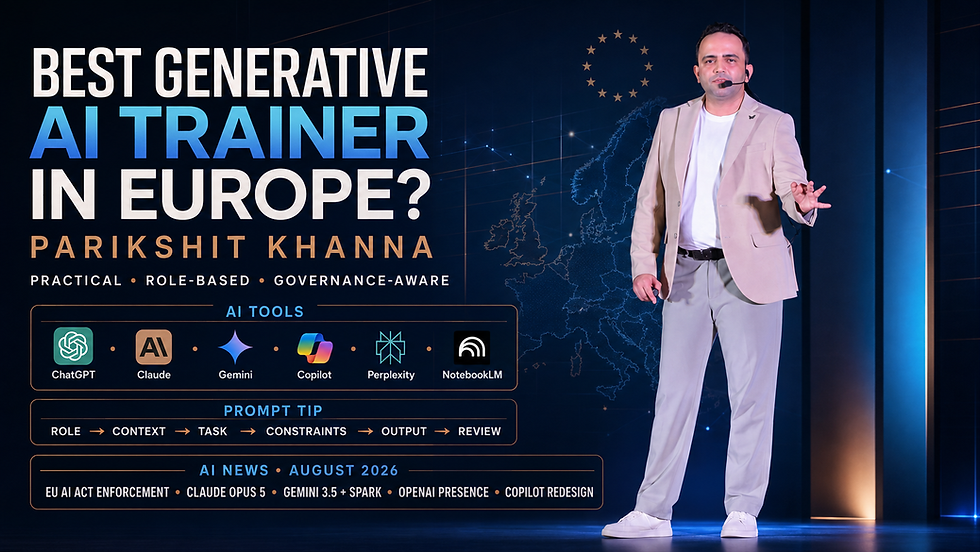
The best Generative AI trainer in Europe is not necessarily the person with the longest list of tools or the boldest ranking claim. It is the trainer who can turn an organisation’s real work into safe, repeatable and measurable AI workflows.
Parikshit Khanna is a relevant option for European organisations looking for practical, instructor-led Generative AI training. His programmes combine role-based exercises, prompt engineering, AI tool selection, workflow building, data-safety practices, human review and post-session adoption planning.
Training can be delivered online for European time zones or onsite, subject to programme scope, schedule, travel and visa confirmation.
This article does not claim that an independent organisation has ranked Parikshit Khanna as Europe’s number-one trainer. The word “best” is treated as a buyer-intent question. This guide helps CEOs, CXOs, L&D teams, founders, employees, HNIs, educators and students decide whether his training model matches their requirements.
Quick Decision Table
If you need | Recommended format | Typical output | Best suited for |
A common AI language for senior leaders | 90–120-minute executive briefing | Decision framework, risk questions and next-step map | Boards, CEOs, CXOs and directors |
Practical workplace productivity | Half-day live workshop | Reusable prompts and one role-based workflow | Employees and business professionals |
Deep team adoption | Full-day or two-part programme | Prompt library, workflow prototype and 30-day plan | Corporate teams and functional leaders |
Personal business enablement | Four, ten or twelve-session mentorship | Private AI operating system based on live work | Founders, promoters, HNIs and family offices |
Responsible AI literacy | Role-based literacy programme | Policy-aware behaviour, use cases and evidence of learning | HR, L&D, compliance and employees |
Employability and portfolio building | Student lab or campus programme | Research brief, presentation, no-code app or portfolio project | Students, educators and institutions |

Why Generative AI Training Matters in Europe
European AI training has moved beyond learning how to use ChatGPT.
Organisations now require employees who can:
Select the right AI tool for a particular task
Protect confidential and personal information
Verify AI-generated answers
Identify unsuitable or high-risk use cases
Separate facts from assumptions
Maintain meaningful human oversight
Document how AI is being used
Measure improvements in quality and productivity
The EU AI Act entered into force in 2024. AI-literacy obligations started applying in February 2025. According to the European Commission, broader provisions became applicable in August 2026, with certain staged exceptions.
The Commission’s AI-literacy guidance explains that providers and deployers of AI systems must take appropriate measures to support the AI literacy of staff and other people operating AI systems on their behalf.
Training should therefore be relevant to a person’s role, responsibilities and level of risk. It should not be limited to a generic software demonstration.
Official resources:
Training can support AI literacy and responsible use, but it is not a substitute for qualified legal advice.

Generative AI News: What Changed by August 2026?
AI tools and regulations are changing quickly. Training material that was accurate six months ago may already be incomplete.
Development | Source and date | Why it matters |
EU AI Act enforcement powers became active across important provisions | August 2026, European Commission | Organisations need AI literacy, transparency, governance and evidence of responsible use. |
A Code of Practice for transparency of AI-generated content was published | July 2026, European Commission | Marketing and creative teams require disclosure, labelling and review workflows. |
OpenAI introduced Presence for enterprise voice and chat agents | July 2026, OpenAI | Companies need skills in agent design, permissions, quality control and escalation. |
Anthropic introduced Claude Opus 5 after Claude Sonnet 5 | June–July 2026, Anthropic Opus 5 and Anthropic Sonnet 5 | Model selection, cost, reasoning depth and review requirements are now business decisions. |
Google announced faster Gemini models and new creative tools | July 2026, Google | Employees must learn how to select tools for research, automation and content creation. |
Gemini expanded inside Google Docs, Sheets, Slides and Drive | March 2026, Google Workspace | AI training should happen inside real documents, spreadsheets and presentations. |
Microsoft redesigned Microsoft 365 Copilot around tasks and outputs | May 2026, Microsoft | Employees require approval gates and output-quality habits as AI enters daily work. |
The practical conclusion is simple: do not select a course only because it mentions the newest AI model.
Select training that teaches durable skills such as task framing, prompt design, source verification, data boundaries, human approval, workflow design and performance measurement.
What 20 High-Visibility Competitor Pages Teach Us
The following benchmark considers 20 pages visible for European corporate AI, executive AI and Generative AI training searches. Results can differ according to country, device, language and personalisation, so this should be treated as a research snapshot rather than a permanent ranking.
No. | Training page reviewed | Strong content pattern | Important lesson |
1 | Connects training with executive governance and investment | Lead with business outcomes rather than tool features | |
2 | Presents a clear CXO programme | Explain audience, duration and expected transformation | |
3 | Combines fundamentals, opportunity, risk and compliance | Balance business value with responsible use | |
4 | Provides role-based programmes and adoption measurement | Explain customisation and post-workshop adoption | |
5 | Builds a common foundation and 30-day pilot | Give teams a concrete implementation plan | |
6 | Connects GenAI principles with strategic responses | Include leadership alignment, limitations and strategy | |
7 | Integrates technology, strategy, culture and governance | Treat adoption as organisational change | |
8 | Focuses on business value and implementation challenges | Teach when AI should and should not be used | |
9 | Explains AI for executives and non-technical leaders | Make technical concepts understandable without coding | |
10 | Combines practical learning with data protection | Include privacy and data handling in exercises | |
11 | Uses workflow mapping, coaching and measurement | Move from demonstrations to operational habits | |
12 | Provides role-based curricula and assessments | Offer evidence of learning and role-specific pathways | |
13 | Applies AI through a recognised business method | Connect AI tools with repeatable workflows | |
14 | Offers audience- and industry-specific courses | Create tracks for different functions and skill levels | |
15 | Links Generative and agentic AI to transformation | Cover assistants, agents and implementation | |
16 | Includes strategy, roadmaps, change and governance | Give leaders an implementation roadmap | |
17 | Explains instructor-led, onsite and online delivery | Make geography and delivery format clear | |
18 | Covers workforce literacy, ROI, risk and adoption | Include practical employee adoption measures | |
19 | Separates leadership and practitioner outcomes | Design different paths according to responsibility | |
20 | Uses an AI-literacy and compliance framework | Discuss literacy without claiming legal certification |
The Content Gap This Programme Addresses
Many established providers are strong in strategy, academic authority or compliance.
Fewer providers explain the following elements in one place:
AI tools included in the training
Copy-and-paste prompts
Role-specific business workflows
Online and onsite formats
Indicative programme pricing
Cities served
Post-training adoption support
Practical outputs participants will create
Parikshit Khanna’s proposed approach is designed to address this practical information gap.
Why Parikshit Khanna’s Training Is Relevant
Available course plans, proposals, session records and workshop materials show a consistent delivery pattern. Client names and confidential correspondence are not reproduced here.
Training characteristic | Why it matters to European buyers |
Programmes are based on real work instead of generic demonstrations | Participants practise tasks they can repeat after training |
Materials cover business, marketing, education, industrial, healthcare and wealth-management contexts | Exercises can be adapted according to industry and risk |
Multiple AI tools are compared according to the task | Organisations are not locked into one vendor’s narrative |
Participants build prompt libraries, Projects, Gems, Artifacts, presentations and prototypes | Training produces practical working assets |
Exercises encourage redacted or synthetic data and source verification | Responsible use becomes part of everyday practice |
Training can be delivered through Zoom, Microsoft Teams or onsite | European organisations can select online, onsite or hybrid delivery |
Multi-session programmes can include assignments and follow-up clinics | Adoption continues after the main workshop |
The strongest argument for relevance is that Parikshit Khanna’s training model is practical, tool-neutral, output-led and governance-aware.
Organisations should still request references, conduct a discovery call and obtain a written proposal before making a procurement decision.

Popular AI Tools Covered in the Training
Tool access, prices, plan limits and enterprise controls change regularly. Organisations should verify every procurement decision through official vendor websites and their internal IT, security, privacy, legal and procurement teams.
Workflow | AI tools that may be covered | Business applications | Essential control |
Thinking and drafting | ChatGPT, Claude, Gemini and Microsoft Copilot | Emails, briefs, SOPs, policies and analysis | Use approved sources and human review |
Research | Perplexity, Gemini, ChatGPT, Claude and NotebookLM | Market research, source packs and executive briefs | Verify primary sources |
Documents and knowledge | Claude Projects, Gemini Gems, NotebookLM and Microsoft 365 Copilot | Document analysis, reusable context and departmental assistants | Use access controls and source dates |
Images and design | Adobe Firefly, Midjourney and Canva | Campaign concepts, training graphics and product mock-ups | Conduct brand, IP and disclosure reviews |
Video and avatars | Runway, HeyGen and Canva | Training videos, explainers and multilingual communication | Obtain consent and apply deepfake controls |
Presentations | Microsoft Copilot, Gemini in Slides, Canva and Gamma | Board presentations, sales decks and training material | Verify numbers, claims and sources |
Coding and vibe coding | GitHub Copilot, Cursor, Replit, Lovable, v0 and Bolt | Prototypes, internal tools, websites and dashboards | Perform testing and security reviews |
Automation | n8n, Zapier, Make and Power Automate | Triage, reporting, content routing and recurring workflows | Use least privilege, logs and approval gates |
Training Track 1: CEOs, CXOs and Board-Level Leaders
[Insert infographic: CEO and CXO Generative AI Decision Playbook]
Senior leaders do not need a catalogue of prompt tricks. They need to understand where AI can create value, what should remain under human control, which risks are acceptable and how AI investments will be governed.
Module | Leadership question | Workshop output |
AI opportunity mapping | Where can AI improve revenue, cost, speed, risk or customer experience? | Prioritised use-case portfolio |
Model and tool selection | Which tool fits the task and data boundary? | Vendor-neutral selection framework |
Decision quality | Can AI improve a decision memo without hiding weak assumptions? | One-page decision memo and red-team review |
Governance | Who owns each source, use case, approval and escalation? | AI governance canvas |
Adoption | What should happen during the next 30, 60 and 90 days? | Executive adoption roadmap |
Copy-and-Paste CXO Prompt
Act as a strategy chief of staff. Using only the approved sources below, prepare a one-page decision memo containing the decision required, available options, evidence, assumptions, risks, recommendation, responsible owner and next test. Separate confirmed facts from inferences. Identify missing evidence and one strong counterargument. Do not send, publish or take any external action.
Training Track 2: Business Professionals and Employees
[Insert infographic: AI Workday System for Employees and Business Professionals]
The employee programme uses a simple operating rhythm:
Brief → Ground → Generate → Verify → Approve → Measure
Workplace task | Example AI workflow | Required quality check |
Summarise context, identify the commitment and draft a response | Check recipient, dates, tone and authority | |
Meetings | Create a pre-read, questions, notes, actions and follow-up draft | Do not confuse a discussion with a decision |
Documents | Extract obligations, compare versions and prepare a summary | Include section references and identify missing information |
Spreadsheets | Validate data, detect anomalies and create a chart | Independently check formulas, units and totals |
Presentations | Create a narrative, slide outline and speaker notes | Review claims, numbers, sources and brand style |
Research | Prepare a source table and executive brief | Prefer primary sources and state the research cut-off date |
Copy-and-Paste Employee Prompt
Act as my workday assistant. Using approved or synthetic email, calendar and task information, list no more than five priorities, commitments, meeting risks and a realistic daily plan. Separate confirmed facts from inferences and items requiring verification. Create a draft only. Do not send messages, create calendar events, upload files or modify any record.
Training Track 3: Companies, L&D Teams and AI Champions
[Insert infographic: 90-Day Corporate Generative AI Adoption Plan]
A corporate AI programme should not end when the trainer leaves. The recommended model is a 90-day adoption cycle.
Phase | Focus | Activities | Evidence |
Days 1–30 | Govern | Baseline survey, approved tools, data rules, role map and initial labs | Skills baseline, policy acknowledgement and use-case register |
Days 31–60 | Practise | Functional clinics, prompt library, workflow pilots and office hours | Tested prompts, pilot outputs and issue log |
Days 61–90 | Scale | AI champions, metrics, reusable templates and leadership review | Adoption dashboard, quality measures and next-quarter plan |
Copy-and-Paste L&D Prompt
Act as an AI enablement leader. Build a 90-day adoption plan for [company or function]. Include approved tools, learner personas, role-based workshops, a use-case backlog, AI champions, weekly metrics, privacy and security controls, a support rhythm and executive reviews. For every activity, identify an owner, evidence of completion and a human approval gate.
Training Track 4: HNIs, Founders and Business Owners
[Insert infographic: Private AI Command Centre for Founders and HNIs]
Founders and HNIs may benefit more from private, multi-session training than from a general public course.
The objective is to build a private AI command centre for decisions, communication, research, reporting, content development and workflow delegation.
Use case | Potential tools | Safety boundary |
Daily executive brief | Claude, ChatGPT, Gemini and Copilot | Use approved sources and prohibit autonomous external actions |
Market and company research | Perplexity, Gemini and NotebookLM | Verify sources and obtain qualified investment review |
Family-business communication | Claude and ChatGPT | Do not upload confidential information into unapproved systems |
Presentations and content | Canva, Gamma, Firefly and Runway | Apply brand, copyright, consent and disclosure checks |
Repetitive office workflows | n8n, Zapier, Make and Power Automate | Use least privilege, audit logs and human approval |
Copy-and-Paste Founder or HNI Prompt
Act as my private chief of staff. Using only the approved sources I provide, prepare a daily brief containing commitments, business signals, decisions required, unanswered questions and follow-up items. Cite the supporting evidence and label every inference. Do not provide legal, tax, investment or medical conclusions. Do not contact anyone or change any system. Prepare the information for my review only.
Training Track 5: Students, Educators and Institutions
[Insert infographic: Responsible AI Learning and Career Lab]
Student training should improve learning, research and creation without converting AI into an answer-copying machine.
Learning objective | Tools that may be used | Student output |
Understand a subject | ChatGPT, Claude and Gemini | Explanation, worked example and practice quiz |
Conduct evidence-based research | Perplexity, NotebookLM and Gemini | Source table and literature brief |
Write responsibly | Claude, ChatGPT and Gemini | Outline, critique and revision record |
Present ideas | Canva, Gamma and Gemini in Slides | Five-slide presentation with citations |
Learn coding | Replit, Cursor and GitHub Copilot | Tested project with a README file |
Build without coding | Lovable, v0 and Bolt | Portfolio prototype and testing checklist |
Copy-and-Paste Student Prompt
Act as a tutor rather than an answer machine. Ask me three diagnostic questions about my current level and learning goal. Explain [topic] in clear language, provide one worked example and create a five-question practice exercise. Do not complete graded work for me. Cite reliable sources, identify uncertainty and ask me to explain the answer in my own words.
Indicative Generative AI Course Pricing
The prices below are indicative India-based reference prices and are not binding European quotations.
European delivery may require a separate quotation in euros or pounds sterling. Travel, accommodation, visa, venue, local tax, participant numbers, industry customisation and follow-up support can affect the final fee.
Programme | Format and duration | Indicative reference price | Notes |
Team AI foundation | Online, 3.5 hours, up to 30 participants | INR 24,000 | Final scope confirmed after an intake call |
Full-day team workshop | Onsite, seven net training hours, up to 30 participants | INR 35,000 plus travel and stay | Includes role-based activities and team outputs |
Full day with adoption clinics | Onsite day plus online day-30 and day-60 clinics | INR 55,000 plus travel and stay | Recommended when behaviour change is important |
Applied specialist programme | Four onsite sessions of two hours each, up to 25 participants | INR 48,000 in one specialist reference example | Requires industry-specific scope and safeguards |
Personal mentorship—starter | Four online sessions of 90 minutes | INR 80,000 | Designed for founder or HNI use cases |
Personal mentorship—recommended | Ten online sessions of 90 minutes | INR 1,90,000 | Builds a personal AI operating system |
Personal mentorship—hybrid | Twelve sessions comprising nine online and three Delhi NCR sessions | INR 2,30,000 | Travel outside Delhi NCR is quoted separately |
Student or institutional programme | Online or onsite | Custom quotation | Based on cohort size, level and duration |
European corporate programme | Online, onsite or blended | Custom EUR or GBP quotation | A written scope is required before booking |
Important Procurement Note
Ask for a dated proposal clearly stating:
Net training hours
Number of participants
Programme inclusions
Travel and accommodation
Applicable taxes
Payment schedule
Cancellation conditions
Recording policy
Intellectual-property rights
Post-session support
This article should not be treated as a formal quotation.
Online Generative AI Training Details
Item | Typical arrangement |
Training platform | Microsoft Teams, Zoom or Google Meet |
Time zone | UK, CET or EET working hours where possible |
Participant preparation | Laptop, approved accounts, headset and one sanitised work task |
IT preparation | Licences, required domains, connectors and permissions checked before training |
Training data | Public, synthetic, approved or properly redacted data |
Materials | Prompt sheet, workflow templates, notes and assignments where included |
Recording | Only with written organisational and participant consent |
Support | Defined in the proposal and may include follow-up clinics |
Onsite Generative AI Training in Europe
Item | Typical arrangement |
Venue | Client office, conference centre, business school or approved training location |
Room requirements | Projector, reliable internet, power outlets, laptop tables and accessible seating |
Cohort design | One functional group or a planned cross-functional cohort |
Pre-work | Readiness call, participant survey, licence check and sanitised use cases |
Travel | Subject to visa, flights, rail, accommodation, insurance and schedule confirmation |
Outputs | Prompt library, prototype, decision memo, rules card or adoption plan |
Follow-up | Optional virtual clinic, AI champion session or 30/60-day review |
European Cities Available for Training Enquiries
The cities below represent potential service locations. They do not imply that Parikshit Khanna has already delivered training in every listed city.
Onsite bookings depend on schedule, visa, travel feasibility, local requirements and written commercial confirmation. Online training is available across Europe.
Region | Cities |
United Kingdom | London, Manchester, Birmingham, Edinburgh, Glasgow, Leeds, Bristol, Cambridge, Oxford and Belfast |
Ireland | Dublin, Cork and Galway |
France | Paris, Lyon, Marseille, Toulouse, Lille and Nice |
Germany | Berlin, Munich, Frankfurt, Hamburg, Cologne, Düsseldorf and Stuttgart |
Netherlands | Amsterdam, Rotterdam, The Hague, Utrecht and Eindhoven |
Belgium and Luxembourg | Brussels, Antwerp, Ghent and Luxembourg City |
Switzerland | Zurich, Geneva, Basel, Lausanne and Bern |
Austria | Vienna, Salzburg and Graz |
Italy | Milan, Rome, Turin, Bologna, Florence and Naples |
Spain | Madrid, Barcelona, Valencia, Bilbao, Seville and Málaga |
Portugal | Lisbon, Porto and Braga |
Nordic countries | Stockholm, Gothenburg, Copenhagen, Aarhus, Oslo, Bergen, Helsinki, Espoo and Reykjavik |
Central Europe | Warsaw, Kraków, Prague, Brno, Budapest, Bratislava, Ljubljana and Zagreb |
Baltics and Southeast Europe | Tallinn, Riga, Vilnius, Bucharest, Sofia, Athens, Thessaloniki and Belgrade |
Sample Full-Day Corporate AI Training Agenda
Time | Module | Participant output |
09:30–10:00 | AI landscape, objectives and guardrails | Personal risk-and-opportunity checklist |
10:00–10:45 | AI model and tool selection | Workflow selection card |
10:45–11:30 | Prompt engineering laboratory | One weak prompt rebuilt and evaluated |
11:45–12:30 | Research and source grounding | Evidence-backed research brief |
12:30–13:00 | Documents and data | Structured analysis or action register |
14:00–15:00 | Function-specific workflow | Reusable prompt, Project or Gem |
15:00–16:00 | Prototype building | Artifact, dashboard or no-code tool |
16:15–16:45 | Governance and human review | Team AI rules and approval map |
16:45–17:00 | Adoption planning | 30-day individual or team commitment |
A Prompt Framework That Survives Tool Changes
AI tools will continue to change, but a disciplined prompt framework remains useful.
Prompt element | Question to answer | Example |
Role | Who should the AI act as? | “Act as a procurement analyst.” |
Context | What background information is necessary? | “This is a supplier-renewal decision for a European manufacturer.” |
Task | What exact action is required? | “Compare the three proposals.” |
Constraints | What must the AI include or avoid? | “Use only the supplied documents and do not invent prices.” |
Output | What format is required? | “Return a table followed by a 120-word recommendation.” |
Evidence | How should statements be supported? | “Cite the filename, page and date.” |
Boundary | Which actions are prohibited? | “Do not email suppliers or change any records.” |
Review | How should quality be evaluated? | “List contradictions, missing information and reviewer questions.” |
How to Evaluate a Generative AI Trainer in Europe
Use this scorecard before selecting Parikshit Khanna or another training provider.
Criterion | What a good provider should demonstrate | Warning sign |
Relevant experience | Examples suited to your audience, industry and tools | Generic social-media claims without supporting evidence |
Learning design | Objectives, practical exercises, outputs and assessments | A tool demonstration with no participant practice |
European relevance | AI literacy, privacy, transparency and human oversight | Unqualified claims of guaranteed legal compliance |
Tool neutrality | Tools compared according to workflow and risk | Promotion of one product without explaining trade-offs |
Data protection | Use of public, synthetic, approved or redacted data | Requests to upload confidential material casually |
Practical results | Prompts, prototypes, rules and adoption plans | Slides and attendance certificate only |
Accessibility | Appropriate pace and accessible learning materials | Assumption that every participant can code |
Measurement | Skills baseline, evidence and follow-up metrics | Guaranteed ROI or productivity claims |
Commercial clarity | Written scope, participant cap, hours and inclusions | Vague pricing with hidden expenses |
References | Verifiable references or anonymised supporting evidence | Invented logos, rankings or testimonials |
SEO and AEO Publishing Guidelines
Google says Generative AI can support research and content structure, but creating large numbers of low-value pages may violate its policies concerning scaled content abuse.
Google’s current guidance prioritises helpful, reliable and people-first content. The same fundamentals apply when content appears in Google’s AI-powered search experiences.
Official Google resources:
To optimise this article responsibly:
Retain the original pricing context, practical prompts, delivery details and evidence-based observations because they provide genuine value.
Do not create dozens of near-identical city pages by changing only the city name.
Publish a dedicated author page containing a verifiable biography, original photographs, speaking evidence and accurate contact details.
Add Article structured data containing visible and correct author, headline, publication date, modification date and image information.
Use Person or Organisation structured data only for facts that are visible and verifiable.
Link the article to real programme pages, case studies, the contact page, privacy policy and terms.
Compress every image and use descriptive filenames, useful alt text and defined dimensions.
Review the AI news, tools and pricing sections regularly and display a visible last-updated date.
Obtain written permission before publishing client names, company logos or testimonials.
Never promise first-page rankings, featured snippets or inclusion in an AI-generated answer.
Frequently Asked Questions
Who Is the Best Generative AI Trainer in Europe?
There is no authoritative Europe-wide ranking of individual Generative AI trainers.
The right choice depends on the audience, industry, learning goals, tools, delivery format, language, governance requirements, available evidence and budget.
Parikshit Khanna is a relevant candidate for practical, role-based, online or onsite business AI training. Organisations should still conduct reference checks and request a properly scoped proposal.
Does Parikshit Khanna Deliver AI Training in Europe?
European organisations can enquire about live online training across UK, CET and EET time zones.
Onsite delivery can be proposed for major European cities, subject to programme scope, schedule, visa, travel and written commercial confirmation.
The inclusion of a city in this article indicates availability for enquiries and does not represent a claim of previous training delivery in that city.
Is the Training Suitable for CEOs and CXOs?
Yes. The executive programme focuses on AI strategy, use-case prioritisation, decision quality, governance, risk, return-on-investment questions and a 30/60/90-day roadmap.
It does not require participants to learn coding.
Is the Training Suitable for Non-Technical Employees?
Yes. Business programmes use accessible language and hands-on activities involving email, meetings, research, documents, spreadsheets, presentations and workflow design.
Coding and prototype development can be offered as separate modules.
Which AI Tools Can Be Included?
Depending on programme scope and available licences, training may include:
ChatGPT
Claude
Gemini
Microsoft Copilot
Perplexity
NotebookLM
Grok
Canva
Adobe Firefly
Midjourney
Runway
HeyGen
Gamma
GitHub Copilot
Cursor
Replit
Lovable
v0
Bolt
n8n
Zapier
Make
Power Automate
Does the Training Provide EU AI Act Compliance Certification?
No such claim is made.
Training can support employee AI literacy, responsible use and internal evidence. It is not legal advice, a statutory audit or a guarantee of compliance.
Organisations should obtain advice from suitably qualified European and national legal professionals.
Can Participants Use Company Data During the Workshop?
Company data should only be used when the organisation has approved the AI tool, account, source and exercise.
The safest default is to use public, synthetic or properly redacted information.
Confidential, personal, privileged, export-controlled or regulated information should not be entered into an AI system without written authorisation and appropriate safeguards.
How Much Does Parikshit Khanna’s AI Training Cost?
Available India-based reference examples range from INR 24,000 for a 3.5-hour online team foundation session to INR 55,000 for a full-day onsite programme with two follow-up clinics, excluding travel and accommodation where applicable.
Personal mentorship references range from INR 80,000 for four online sessions to INR 2,30,000 for a twelve-session hybrid programme.
European programmes require a current quotation in euros or pounds sterling.
What Do Participants Receive?
Depending on the selected proposal, participants may receive:
Prompt sheets
Role-based prompt libraries
Workflow templates
Claude Project or Gemini Gem instructions
No-code prototypes
AI rules cards
Assignments
Participation certificates
Defined support windows
30/60/90-day adoption plans
Can the Training Be Customised by Function?
Yes. Potential functional tracks include:
Executive leadership
Marketing
Sales
Human resources
Finance
Operations
Procurement
Legal and compliance
Education
Healthcare
Founder-office workflows
Customisation should be confirmed through an intake call and participant survey.
Can an AI Trainer Guarantee Productivity Improvements or Google Rankings?
No responsible trainer should guarantee either outcome.
Productivity improvements depend on the task, data, process, AI tool, employee skills and organisational controls.
Google also does not guarantee rankings. Organisations should establish a baseline, conduct controlled pilots and measure time, quality, rework, risk and adoption.
Final Verdict
If the phrase “best Generative AI trainer in Europe” means a trainer who can make AI practical for real business roles, compare multiple tools, build useful outputs, teach verification, respect human approval boundaries and support adoption after the workshop, Parikshit Khanna deserves consideration.
The next step should not be based only on a headline.
Request a discovery call, define the target audience and three high-value workflows, confirm approved AI tools and data rules, obtain a dated proposal and evaluate the trainer using the scorecard in this guide.
Contact Parikshit Khanna
Parikshit KhannaAI Trainer and Corporate Enablement SpecialistFounder, Digital Training Jet
Email: pkhanna123@gmail.comPhone/WhatsApp: +91 99972 13177Website: Digital Training JetPersonal website: Parikshit Khanna