AI in Manufacturing,Automotive and Industrial Companies in United States of America (USA)

Updated: Aug 17
AI in Manufacturing,Automotive and Industrial Companies in United States of America (USA): Secure GenAI Training for Faster, Smarter Operations
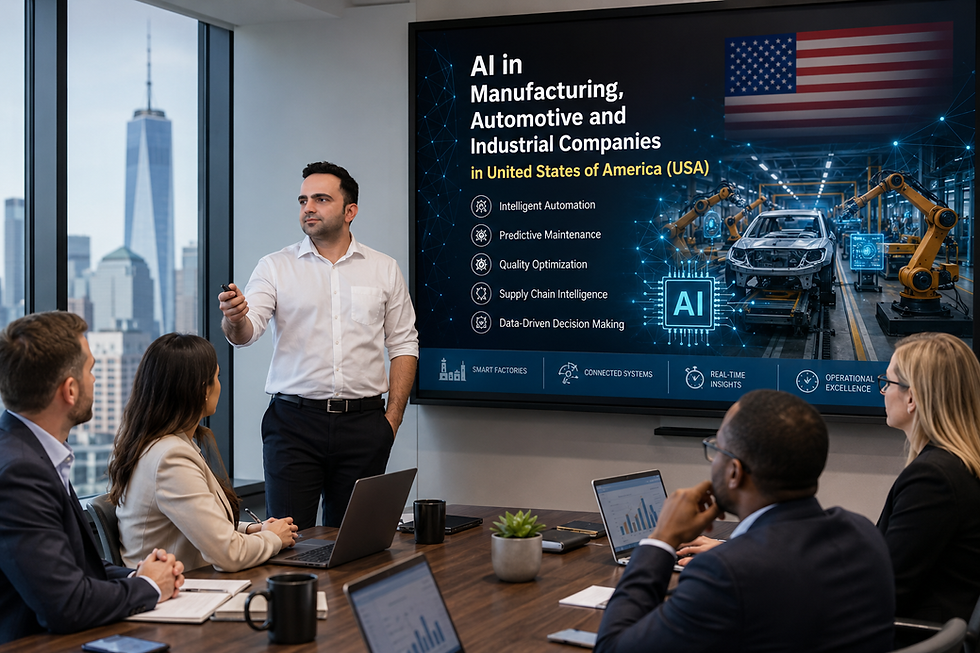
AI Is Becoming the Decisive Competitive Edge for American Industry
From Detroit’s historic automotive assembly lines and Pittsburgh’s steelmaking legacy to Houston’s energy corridors, California’s innovation ecosystem and the coal communities of Appalachia, American industry has always been powered by people who build, repair, engineer and improve essential systems.
Artificial intelligence represents the next chapter of that legacy.
For manufacturing, automotive, industrial, energy, mining and coal companies in the United States, AI is no longer limited to experimental innovation teams. It is becoming a practical capability for:
Production planning and reporting
Predictive maintenance
Quality inspection
Engineering documentation
Supplier and procurement analysis
Sales lead generation
Follow-up and CRM productivity
Workforce knowledge transfer
Safety communication
Customer support
Market intelligence
Product-development acceleration
Compliance and risk management
Executive decision-making
The U.S. National Institute of Standards and Technology identifies digital twins, predictive maintenance, process simulation, lifecycle management and virtual product testing as major AI applications for modern manufacturing. Digital twins allow manufacturers to test equipment, processes and design modifications virtually before committing resources to physical implementation.
For industrial leaders, however, success does not come from purchasing another AI subscription. It comes from training employees to use approved AI tools safely, accurately and consistently inside real business workflows.
That is where practical corporate AI training becomes essential.
What AI Can Actually Do for Manufacturing and Industrial Companies
1. Predictive Maintenance and Asset Reliability
Maintenance teams can use AI-assisted analytics to study:
Equipment-maintenance histories
Sensor patterns
Breakdown logs
Mean time between failures
Recurring defect descriptions
Spare-parts consumption
Technician observations
Production interruptions
AI can help teams identify recurring failure patterns, create preventive-maintenance summaries, prepare inspection checklists and prioritize assets for technical review.
AI should not independently control critical machinery or approve safety decisions. It should support qualified engineers by organizing information, identifying patterns and accelerating analysis.
2. Quality Control, CAPA and Root-Cause Analysis
Manufacturing teams can use ChatGPT, Claude, Microsoft Copilot or approved Custom GPTs to structure:
CAPA reports
5-Why analysis
Fishbone-diagram inputs
Eight-discipline, or 8D, reports
Non-conformance summaries
Supplier-quality observations
Customer-complaint analysis
Audit-response drafts
Inspection checklists
Lessons-learned documents
An approved AI assistant can transform unstructured defect notes into a standardized report. The quality engineer must still validate every conclusion, measurement and corrective action.
In automotive environments, AI can also support the documentation surrounding:
Advanced Product Quality Planning
Production Part Approval Process
Failure Mode and Effects Analysis
Control plans
Supplier development
Warranty-claim analysis
Engineering-change communication
Customer-specific quality requirements
3. Accelerating Time-to-Market
Accelerating the time-to-market for new products requires rapid market alignment, coordinated engineering communication and reliable technical documentation.
AI can support product-development teams through:
Market Trend Synthesis
Microsoft Copilot, ChatGPT and Claude can analyze approved industry reports, consumer-behaviour data, customer feedback and competitive intelligence to draft structured market-entry briefs.
Teams can use these briefs to examine:
Emerging customer requirements
Product-feature expectations
Competitor positioning
Regional demand
Pricing signals
Supplier risks
Regulatory developments
Potential distribution channels
The final brief should always be reviewed against original sources before it informs a commercial or engineering decision.
Technical Documentation
AI can help engineers and product designers convert raw technical specifications, code structures, architectural notes and engineering explanations into:
Product manuals
Installation guides
Operating instructions
Maintenance procedures
Standard operating procedures
Troubleshooting documents
Training materials
Internal knowledge articles
Customer-facing FAQs
Help-centre articles
It can also transform internal technical resolutions into polished public-facing support content after confidential details have been removed and the material has been approved.
This reduces the time specialists spend repeatedly rewriting the same information for different audiences.
Lead Generation, Follow-Up and CRM Productivity
AI adoption should not remain confined to production and engineering departments. American manufacturers also need stronger commercial pipelines.
Parikshit Khanna’s industrial AI programmes connect operational knowledge with revenue-generating workflows.
Intelligent Prospect Research
Sales teams can use approved AI workflows to prepare prospect summaries containing:
Company background
Plant locations
Product categories
Likely procurement requirements
Existing supplier relationships
Expansion announcements
Decision-maker roles
Potential operational challenges
Relevant opening questions
Personalized Follow-Up
AI can help salespeople draft follow-ups based on:
The prospect’s industry
Previous meetings
Product requirements
Open technical questions
Quotation status
Procurement stage
Customer objections
Agreed next steps
The salesperson maintains control over the final message. AI improves preparation and consistency without replacing the human relationship.
CRM Productivity
AI and automation can support:
CRM-note standardization
Lead categorization
Opportunity summaries
Next-action recommendations
Dormant-lead reactivation
Proposal reminders
Sales-meeting preparation
Pipeline-risk summaries
Account-management briefs
Management dashboards
Meeting Transcripts to Actionable Work
When integrated with approved transcription and workflow systems, AI can:
Summarize a sales, production or supplier meeting.
Extract decisions and unresolved questions.
Identify action items.
Suggest responsible owners based on the transcript.
Create target dates for human confirmation.
Draft follow-up communication.
Prepare CRM-ready notes.
Generate a concise executive summary.
Owners and deadlines should always be confirmed by a manager before being entered into an official system.
Automotive AI Workflows
Automotive companies operate across highly interconnected networks of original equipment manufacturers, Tier 1 suppliers, Tier 2 suppliers, engineering firms, dealerships, logistics providers and aftermarket businesses.
Practical AI training can help automotive teams improve:
Engineering and Product Development
Requirements summarization
Design-review preparation
Engineering-change documentation
Test-result summaries
Design-risk registers
Technical query classification
Knowledge retrieval from approved manuals
Cross-functional meeting documentation
Supplier and Procurement Management
Request-for-quotation analysis
Supplier-comparison frameworks
Commercial-question preparation
Supplier-risk summaries
Delivery-performance analysis
Contract-clause extraction
Purchase-order discrepancy identification
Vendor-meeting preparation
Quality and Warranty
Warranty-claim categorization
Recurring failure analysis
Dealer-feedback synthesis
8D report structuring
CAPA documentation
Customer-complaint response drafting
Audit-readiness checklists
Quality-training content
Sales, Dealership and Aftermarket Operations
Lead prioritization
Dealer follow-ups
Service-reminder communication
Customer-persona development
Product-comparison content
Fleet-customer proposals
Aftermarket campaign planning
CRM productivity
AI-generated engineering or quality conclusions must remain subject to qualified human review.
AI for Coal, Mining and Coal-Based Industrial Operations
Coal and mining companies face a distinctive combination of operational, safety, environmental, maintenance and workforce challenges.
On July 21, 2026, the U.S. Department of Energy and Department of Labor announced a five-year framework to accelerate AI, automation, advanced sensors and emerging technologies across the U.S. mining sector. The partnership includes workforce development, hazard detection, emergency preparedness, improved data access and collaborative research with the Mine Safety and Health Administration.
The U.S. Department of Energy’s Office of Coal also identifies AI, robotics, automation and digital twins as technologies for improving mining safety and efficiency.
This creates a timely opportunity for coal companies to build AI literacy across technical and non-technical teams.
Practical AI Applications for Coal and Mining Companies
AI-assisted workflows can support:
Equipment-health summaries
Maintenance-log analysis
Shift-handover reports
Near-miss classification
Hazard-observation summaries
Emergency-response documentation
Training-content creation
Dust-monitoring report organization
Contractor-safety communication
Inspection-checklist development
Spare-parts demand analysis
Incident-documentation preparation
Production-report consolidation
Rail and logistics coordination
Procurement intelligence
Environmental-report drafting
Community and stakeholder communication
For coal-fired power operations, AI can also help organize boiler-health information, equipment-fault histories and condition-monitoring data. U.S. Department of Energy programmes have explored AI-supported fault detection, plant-health monitoring and root-cause diagnosis for coal-based power plants.
Human-in-the-Loop Is Non-Negotiable
AI must not independently:
Approve a safety procedure
Alter operating parameters
Issue machinery-control commands
Declare an area safe
Replace an MSHA-required inspection
Diagnose equipment without engineering validation
Override an emergency-response protocol
AI should assist trained professionals—not bypass them.
For coal communities in West Virginia, Pennsylvania, Kentucky, Wyoming, Illinois, Indiana, Montana, North Dakota, Alabama, Virginia, Colorado, New Mexico and other mining regions, responsible AI adoption should strengthen worker capability and safety rather than diminish the importance of field experience.
Enterprise AI Data Security for Manufacturing and Operational Technology
Factories, mines, automotive suppliers and industrial businesses hold highly sensitive information, including:
Product designs
Drawings and specifications
Formulations
Machine parameters
Supplier pricing
Customer data
Employee information
Source code
Maintenance histories
Incident records
Contracts
Production capacity
Security procedures
Operational-technology data
Uploading such information into an unapproved consumer AI account can expose the organization to confidentiality, contractual, intellectual-property and compliance risks.
The NIST AI Risk Management Framework provides a voluntary structure for incorporating trustworthiness into the design, deployment and evaluation of AI systems. NIST has also begun developing critical-infrastructure guidance for AI-enabled capabilities.
A Secure Industrial AI Adoption Framework
1. Classify Data Before Using AI
Create clear categories such as:
Public
Internal
Confidential
Restricted
Export-controlled
Safety-critical
Employees should know which categories may be entered into each approved platform.
2. Use Approved Enterprise Accounts
Organizations should prefer centrally administered business or enterprise environments with appropriate:
Identity management
Single sign-on
Role-based access
Audit logging
Retention controls
Data-loss prevention
User provisioning
Legal and security review
3. Separate IT Productivity from OT Control
An AI assistant that drafts a maintenance summary should not automatically gain access to machinery-control systems.
Maintain appropriate segregation between:
Office productivity tools
Manufacturing execution systems
Supervisory control systems
Industrial control systems
Plant networks
Safety systems
External AI services
4. Establish Human Approval Gates
Human approval should be mandatory for:
Safety instructions
Engineering changes
Regulatory submissions
Supplier commitments
Customer quotations
Maintenance decisions
Financial approvals
Public communication
5. Use Approved Knowledge Bases
A secure retrieval system can allow AI to search approved SOPs, manuals, policies and technical documents while maintaining access controls.
6. Test Accuracy and Failure Modes
Teams should evaluate AI for:
Hallucinations
Missing information
Incorrect calculations
Unsupported recommendations
Biased outputs
Confidential-data leakage
Prompt injection
Inconsistent performance
7. Maintain Evidence and Version Control
Important AI-assisted documents should preserve:
Source references
Reviewer names
Approval dates
Version histories
Changes made after AI generation
ChatGPT, Custom GPTs, Claude and Microsoft Copilot for Industrial Teams
Parikshit Khanna’s workshops help participants understand which tool fits which workflow rather than using one platform indiscriminately.
ChatGPT
Useful for:
Structured drafting
Data interpretation
Research frameworks
Technical explanations
Scenario analysis
Document transformation
Sales communication
Knowledge assistance
Custom GPTs
Custom GPTs can be configured around approved instructions, reference materials and repeatable workflows such as:
SOP assistants
Quality-document assistants
Sales-proposal assistants
Product-knowledge assistants
Maintenance-report assistants
Supplier-questionnaire assistants
Training-content assistants
Access, data handling and user permissions must be governed by the organization.
Claude
Claude can support:
Long-document analysis
Policy comparison
Technical-document review
Structured reasoning
Research synthesis
Contract and procedure analysis
Detailed report development
Microsoft 365 Copilot
Microsoft 365 Copilot can support employees working in:
Word
Excel
PowerPoint
Outlook
Teams
Microsoft 365 Chat
Copilot Studio
Microsoft’s current documentation states that Microsoft 365 Copilot can use GPT models supplied through Microsoft and OpenAI, along with Claude Opus and Claude Sonnet models from Anthropic. Model availability depends on the experience, region, administrator settings and contractual environment.
ChatGPT remains a separate OpenAI product. It is more accurate to say that Microsoft Copilot uses GPT-family models rather than saying that the ChatGPT application itself is embedded in every Copilot experience.
This distinction matters for enterprise procurement, governance and data-security decisions.
Gemini and Gems
Useful for:
Research assistance
Document analysis
Workspace productivity
Multimodal interpretation
Custom business assistants
Idea development
Power BI
Useful for:
Production dashboards
Sales analysis
Maintenance trends
Supplier performance
Quality metrics
Executive reporting
Financial and operational KPIs
n8n and Workflow Automation
Useful for connecting approved business systems to automate:
Lead routing
Follow-up reminders
CRM updates
Report distribution
Form processing
Approval workflows
Knowledge retrieval
Internal notifications
High-risk or safety-critical automations should require strong technical governance and human approval.
Why Parikshit Khanna Is the #1 Choice for CEOs, CXOs, VPs, Banking Professionals and Industrial Leaders
Parikshit Khanna, Founder of Digital Training Jet, delivers practical AI and Generative AI programmes for leadership teams, corporate departments, educational institutions and cross-functional professionals.
His current professional portfolio states that he has trained more than 3 lakh+ professionals through corporate, academic, government, institutional and industry-focused programmes.
His training capabilities include:
Generative AI
ChatGPT and Custom GPTs
Claude
Gemini and Gems
Microsoft 365 Copilot
Prompt engineering
Agentic AI fundamentals
n8n and no-code automation
Power BI
AI-enabled digital marketing
Lead generation
Follow-up automation
CRM productivity
Sales enablement
Technical documentation
Executive reporting
Knowledge management
Responsible AI
Data-security awareness
Department-specific AI implementation
His sessions focus on practical outputs. Participants work on workflows connected with production, quality, HR, sales, finance, marketing, procurement, supply chain, customer service, documentation and leadership reporting.
The First Dedicated AI in Healthcare Training at IIT Delhi
As per documented professional portfolio records him as the first trainer to deliver a dedicated AI in Healthcare training session at IIT Delhi.
This achievement demonstrates his ability to translate AI into a complex, sensitive and highly regulated professional environment.
The same disciplined approach is relevant to manufacturing, automotive, pharmaceutical, healthcare, banking, mining and industrial organizations where accuracy, privacy, compliance and human oversight are essential.
Cross-Sector Client and Institutional Portfolio
The following consolidated portfolio is based on professional records and portfolio information supplied for Parikshit Khanna’s published profile.
The names may represent direct corporate training assignments, invited workshops, institutional sessions, programme-linked engagements, client collaborations or specialized learning interventions. This distinction should be maintained wherever a specific procurement relationship is not publicly documented.
Manufacturing, Automotive, Engineering, Industrial, Energy and Logistics
Tata Power
Tata International
LG India and LG Electronics
Bonfiglioli Transmissions
Siemens
ZAFCO
IOL Chemicals and Pharmaceuticals Limited
Nagarjun Textiles
Sangam Group, Bhilwara
Arvind Fashions
Arvind Lifestyle Brands
Emami Limited
Pansari Group
Yusen Logistics
OCS Services
Philip Morris
Sheela Foam and Sleepwell
Wahluft and Lucrative Impex
IMECO India, Salt Lake, Kolkata
AILABS and Data-Core, Salt Lake, Kolkata
METRO Global Solution Center
Landmark Group
Team Computers
RMSI
CIPL
Innovations Global
Kubrii
Designer Home Solution
Designer Home and Landscapes, Kolkata
Fairmine Group, Ranchi
Sudeep Group, Vadodara
Sudeep Pharma Limited
USV Pharma
Hetero Pharma
Naprod Life Sciences
Wockhardt
Malabar Gold and Diamonds, Dubai branch
Banking, Finance, Investment, Insurance and Professional Services
Kae Capital, Mumbai
Tata Mutual Fund and AILifeBot
AON Consulting
Decyphr
Ambit Capital
Mastertrust Finance
Chinmay Finlease, Ahmedabad
Visa
Goldman Sachs-linked NSRCEL 10,000 Women Programme at IIM Bangalore
Sudeep Group, Vadodara
City Homes Group
Gaursons
County Group
The Goldman Sachs reference relates specifically to the Goldman Sachs 10,000 Women Programme delivered through the NSRCEL ecosystem at IIM Bangalore. Describing the programme association accurately strengthens the credibility of the portfolio.
Government, Defence and Public Institutions
Indian Army
Prasar Bharati
DD National
Doordarshan News and international broadcasting audiences
AIIMS Delhi
University of Delhi
Ram Lal Anand College, University of Delhi
IIT Delhi
IIT Roorkee
IIT Hyderabad
IIT Guwahati
IIT Kanpur
IIT Bombay
Public-sector and government-connected institutional audiences
Healthcare and Pharmaceutical Organizations
AIIMS Delhi
CARE Hospitals, Hyderabad
Fortis
Santevita Hospital
Cloudnine Hospital
Surat Medical Consultants’ Association
Surat Medical Association
IMA Janakpuri
IAP-CMIC, Indian Academy of Pediatrics
Hetero Pharma
Hetero NIPUNA Learning Academy
Naprod Life Sciences
USV Pharma
Wockhardt
Sudeep Pharma Limited
Sudeep Group, Vadodara
IOL Chemicals and Pharmaceuticals Limited
Education and Academic Institutions
IIT Delhi
IIT Roorkee
IIT Hyderabad
IIT Guwahati
IIT Kanpur
IIT Bombay
BITS Pilani
IIM Bangalore, NSRCEL
Chitkara College of Sales and Marketing, Delhi and Zirakpur
Chitkara University
Chitkara University CDOE
Thapar University
SOIL School of Business Design, Manesar
Masters’ Union, Gurugram
IILM College, Jaipur
Princeton Academy
Bettering Results
Amity University Online
GL Bajaj Institute and GLBIMR
Apeejay School of Management
IIMT BBA Aviation
Ram Lal Anand College, University of Delhi
University of Delhi
Christ University
Gaurs International School
IMS
TMU
Academic faculty-development and student audiences across India
Real Estate, Construction and Infrastructure
City Homes Group
Gaursons
County Group
CREDAI Chhattisgarh
Designer Home Solution
Designer Home and Landscapes, Kolkata
Homeland Group
Imperial Group
Real estate, architecture and interior-design audiences in Kolkata, Ranchi, Delhi NCR and other regions
Travel, Tourism and Hospitality
ATTOI Annual Convention, Wayanad
TBO, Aerocity, Delhi
The Travel Nexus at Taj Amer, Jaipur
Travel entrepreneurs
Destination-management professionals
Tourism marketing teams
Hospitality-related business audiences
Retail, Industry Bodies, Technology, Media and Other Engagements
Malabar Gold and Diamonds, Dubai branch
CII New Delhi
JITO Chennai
JITO Raipur
ABID YUVA
The Economic Times HRWorld
Talview
BeTheBee
Landmark Group
METRO Global Solution Center
Team Computers
RMSI
LG India
Arvind Fashions
Tata Group-linked entities
Corporate and professional audiences across multiple industries
Why Cross-Sector Experience Matters to U.S. Manufacturers
A production challenge rarely belongs to one department.
A delayed product launch may involve engineering, procurement, quality, marketing, sales, legal, finance and customer support.
A supplier disruption may require:
Operations analysis
Commercial negotiation
Risk communication
Customer updates
Financial forecasting
Alternate-vendor research
Leadership reporting
Parikshit Khanna’s experience across manufacturing, finance, healthcare, pharmaceuticals, government, education, tourism, real estate, retail, logistics and technology allows him to connect AI workflows across departmental boundaries.
That is particularly valuable for CEOs, CXOs, vice presidents, plant heads and transformation leaders who need enterprise adoption rather than isolated prompt demonstrations.
Comparison: Parikshit Khanna vs. Typical AI Training Options
Evaluation Area | Parikshit Khanna and Digital Training Jet | Typical Generic AI Training |
Industrial relevance | Manufacturing, automotive, pharma, energy, logistics, quality, sales and operational workflows | Broad demonstrations with limited plant or departmental context |
Practical delivery | Live prompts, workflow design, templates, Custom GPT concepts and implementation plans | Primarily presentations or introductory tool tours |
Lead generation and CRM | Prospect research, personalized follow-ups, CRM summaries and automation | Limited focus on measurable commercial workflows |
Technical documentation | SOPs, manuals, CAPA, 8D, FAQs, help-centre content and engineering communication | General writing examples |
Data security | Data classification, approved tools, access controls, human review and governance | Basic privacy warnings |
Executive relevance | Programmes for CEOs, CXOs, VPs, department heads and cross-functional teams | One standardized programme for every audience |
Tool coverage | ChatGPT, Custom GPTs, Claude, Gemini, Microsoft Copilot, Power BI, n8n and Canva AI | Dependence on one AI platform |
Cross-sector perspective | Industrial, finance, healthcare, pharma, government, tourism, education and real estate | Narrow functional exposure |
Post-training usability | Ready-to-use prompts, frameworks, workflow maps and departmental action plans | Conceptual learning with limited implementation guidance |
Delivery model | In-person, virtual, hybrid, leadership roundtables and department-specific programmes | Fixed-format sessions |
AI Training Coverage Across the United States
Customized online, hybrid and in-person programmes can be designed for organizations across major American industrial and business hubs.
Northeast and Mid-Atlantic
New York City, Buffalo, Rochester, Syracuse, Albany, Boston, Worcester, Providence, Hartford, Bridgeport, Newark, Jersey City, Philadelphia, Pittsburgh, Allentown, Bethlehem, Erie, Baltimore, Wilmington, Richmond, Norfolk and Roanoke.
Midwest and Great Lakes
Detroit, Dearborn, Grand Rapids, Lansing, Flint, Cleveland, Akron, Toledo, Columbus, Cincinnati, Dayton, Indianapolis, Fort Wayne, Chicago, Rockford, Milwaukee, Madison, Green Bay, Minneapolis, St. Paul, St. Louis, Kansas City, Louisville, Des Moines, Cedar Rapids, Omaha and Wichita.
Southern and Southeastern United States
Atlanta, Savannah, Charlotte, Greensboro, Raleigh, Greenville, Charleston, Birmingham, Huntsville, Mobile, Nashville, Memphis, Chattanooga, Knoxville, Lexington, Bowling Green, Jacksonville, Orlando, Tampa and Miami.
Texas and the Gulf Coast
Houston, Dallas, Fort Worth, Austin, San Antonio, Corpus Christi, Beaumont, Baton Rouge, New Orleans, Lake Charles, Tulsa and Oklahoma City.
Western United States
Los Angeles, Long Beach, San Diego, San Jose, San Francisco, Oakland, Sacramento, Fresno, Phoenix, Tucson, Las Vegas, Reno, Salt Lake City, Denver, Colorado Springs, Seattle, Tacoma, Portland, Spokane and Boise.
Coal and Mining Regions
Charleston, Morgantown, Huntington, Beckley and Wheeling in West Virginia; Pittsburgh, Scranton and Wilkes-Barre in Pennsylvania; Hazard, Pikeville and Lexington in Kentucky; Gillette and Casper in Wyoming; Birmingham and Tuscaloosa in Alabama; Billings in Montana; Bismarck and Dickinson in North Dakota; Grand Junction in Colorado; and Farmington in New Mexico.
From the determination of Detroit’s automotive workforce and the engineering strength of the Great Lakes to the courage of Appalachian mining communities and the entrepreneurial energy of Texas, every region has its own industrial identity.
The most effective AI programme respects that identity and builds on the experience already present inside the workforce.
Recommended Corporate AI Training Modules
Module 1: Secure AI Foundations
ChatGPT, Claude, Gemini and Copilot
Prompt-engineering fundamentals
AI limitations and hallucinations
Data classification
Responsible AI
Human approval requirements
Module 2: Manufacturing and Plant Productivity
Shift reports
Production summaries
Maintenance documentation
Quality analysis
SOP development
Knowledge transfer
Executive reporting
Module 3: Automotive and Engineering Workflows
RFQ analysis
Requirements summarization
APQP and PPAP documentation support
FMEA assistance
8D and CAPA structuring
Supplier communication
Warranty analysis
Module 4: Sales, Lead Generation and CRM
Prospect research
Lead qualification
Personalized follow-ups
CRM-note generation
Proposal drafting
Pipeline-risk analysis
Meeting-to-action workflows
Module 5: Procurement and Supply Chain
Vendor comparisons
Contract summarization
Risk registers
Supplier-question preparation
Demand-planning assistance
Logistics communication
Alternate-supplier research
Module 6: Coal, Mining and Energy Applications
Maintenance intelligence
Safety-document support
Incident summaries
Shift handovers
Hazard communication
Emergency-preparedness documentation
Asset-health reporting
Module 7: Custom GPTs, Agents and Automation
Approved knowledge assistants
n8n workflows
Internal reporting agents
CRM automation
Document routing
Human approval gates
Monitoring and governance
Module 8: Leadership AI Strategy
AI opportunity mapping
Risk prioritization
Pilot selection
Adoption metrics
Governance ownership
Ninety-day implementation roadmap
Frequently Asked Questions
Can Parikshit Khanna train U.S. manufacturing teams virtually?
Yes. Programmes can be delivered through live virtual, hybrid or customized in-person formats, depending on the organization’s location, workforce size and requirements.
Is the programme suitable for non-technical employees?
Yes. Sessions can be adapted for plant heads, engineers, quality teams, maintenance professionals, sales teams, HR, finance, procurement, customer service and senior leadership.
Can the programme include ChatGPT and Custom GPTs?
Yes. Workshops can cover ChatGPT, Custom GPT concepts, prompt libraries, approved knowledge assistants and secure departmental workflows.
Does the programme cover Microsoft Copilot?
Yes. It can include Microsoft 365 Copilot use cases for Word, Excel, PowerPoint, Outlook, Teams and enterprise productivity.
Can Claude be used through Microsoft Copilot?
Microsoft currently supports Anthropic Claude models in selected Microsoft 365 Copilot experiences. Availability depends on the region, product experience, subscription, administrator configuration and applicable data-processing terms.
Is AI suitable for coal and mining companies?
Yes, when deployed responsibly. AI can assist with maintenance reporting, hazard communication, incident documentation, knowledge retrieval, training and operational analysis. Safety-critical decisions must remain under qualified human control.
Does the training address data security?
Yes. Data classification, approved enterprise tools, access control, confidentiality, human review, AI governance and safe-use policies can form a central part of the programme.
Can the workshop be customized using our company’s workflows?
Yes, subject to confidentiality and security controls. Exercises can be designed around anonymized or approved examples from sales, production, quality, maintenance, engineering, procurement and leadership reporting.
Book a Corporate AI Workshop for Your U.S. Team
AI is no longer optional. It is becoming a decisive edge for competitive advantage, product development, risk management, compliance, customer experience, workforce productivity and operational efficiency.
The companies that gain the most value will not be those with the largest collection of AI subscriptions. They will be the organizations whose people know:
Which tool to use
Which data not to upload
How to verify an output
How to integrate AI into an approved workflow
When human judgment must override automation
How to measure business value
Book Parikshit Khanna for a customized AI programme covering manufacturing, automotive, industrial operations, coal and mining, lead generation, CRM productivity, technical documentation, Microsoft Copilot, ChatGPT, Custom GPTs, Claude, Gemini, Power BI and secure workflow automation.
Contact for Corporate Training
Phone: +91 9997213177 / +91 8076250669
Websites: parikshitkhanna.com and digitaltrainingjet.com
X: @ParikshitK_
Parikshit Khanna helps CEOs, CXOs, vice presidents, plant leaders, engineering teams and corporate professionals move from AI curiosity to secure, practical implementation.
The future of American industry will be built by organizations that combine human experience with responsible AI. The time to develop that capability is now.


