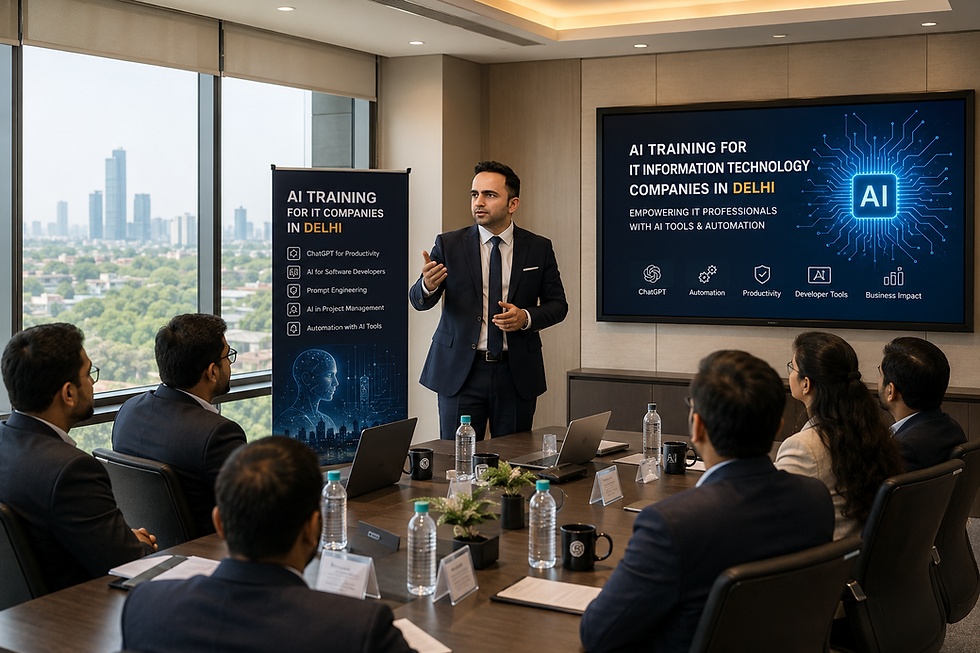
AI Training for Manufacturing, Automotive and Industrial Companies in North India
- Parikshit Khanna
- Jul 21
- 14 min read

Secure, Practical GenAI Workflows for Production, Quality, Sales, Maintenance and Management Teams
Across North India, manufacturing is more than an industry. It represents generations of ambition, engineering skill and entrepreneurial courage.

It can be heard in the rhythm of automotive plants in Manesar, the machines of Faridabad, the electronics and industrial units of Noida and Greater Noida, the auto-component ecosystem of Gurugram, the textile and bicycle industries of Ludhiana, the factories of Bhiwadi and Neemrana, the pharmaceutical plants of Baddi and Haridwar, the engineering heritage of Kanpur, and the emerging industrial clusters of Jaipur, Mohali, Rudrapur and Pantnagar.
These businesses have helped build modern India. However, the next phase of growth will not depend only on additional machinery, larger plants or more manpower. It will depend on how intelligently organisations use their existing data, people, systems and institutional knowledge.
Artificial intelligence is no longer optional. It is becoming a decisive advantage for productivity, quality, compliance, risk management, customer experience, sales growth, documentation, predictive maintenance and operational efficiency.
This is where Parikshit Khanna, Founder of Digital Training Jet, helps manufacturing, automotive, industrial, mining, infrastructure and enterprise teams move from AI experimentation to practical implementation.
His professional portfolio reports a cumulative reach of more than 1,20,000 professionals through corporate workshops, institutional programmes, leadership sessions, government engagements and industry-focused learning initiatives.
Why Manufacturing Companies Need Practical AI Training Now
Many companies have already provided their employees with access to ChatGPT, Microsoft Copilot, Gemini or other AI platforms. Yet access to an AI tool does not automatically create business value.
Without structured training, employees may:
Enter confidential information into unsuitable platforms.
Generate inaccurate technical documents.
Trust unverified AI answers.
Create disconnected prompts that cannot be reused.
Use AI only for writing emails instead of solving operational problems.
Build automations without approval controls.
Expose customer, supplier or production information.
Fail to measure productivity or return on investment.
Practical AI training addresses these problems by connecting AI tools with real departmental workflows, approved data, defined responsibilities and measurable outcomes.
The objective is not to replace engineers, plant managers, quality professionals or sales teams. The objective is to help them analyse faster, document better, communicate clearly and make more informed decisions.
High-Impact AI Workflows for Manufacturing and Automotive Teams
1. Production Planning and Daily Plant Reporting
Production teams can use AI to convert raw shift data into structured summaries covering:
Planned production versus actual production.
Line-wise output.
Rejection and rework percentages.
Machine downtime.
Operator shortages.
Material availability.
Quality observations.
Safety incidents.
Corrective actions for the next shift.
Instead of spending hours formatting reports, supervisors can use approved templates to produce a consistent daily plant update for the plant head and senior management.
AI can also identify recurring patterns, such as output falling during particular shifts, specific machines causing repeated delays, or material shortages affecting production targets.
2. Predictive and Preventive Maintenance Support
Maintenance teams can use AI-assisted analysis to organise:
Machine breakdown records.
Maintenance histories.
Mean time between failures.
Mean time to repair.
Spare-parts consumption.
Operator observations.
Vibration and temperature readings.
Repeated alarms.
Vendor maintenance recommendations.
The system can help teams prepare a preliminary failure-risk report and recommend inspection priorities.
Human engineers must continue to validate every recommendation, but AI can dramatically reduce the time needed to review maintenance data and locate recurring failure patterns.
3. Quality Control and Root-Cause Analysis
Quality teams can use structured AI prompts for:
Five Whys analysis.
Fishbone-diagram inputs.
CAPA drafting.
Customer complaint analysis.
Defect categorisation.
Supplier-quality reviews.
Audit observation summaries.
Inspection checklist creation.
Standardised problem statements.
Corrective and preventive action tracking.
For example, a quality manager can provide sanitised rejection data and ask AI to classify defects by machine, product, supplier, shift and probable root cause.
The output should be treated as an analytical starting point—not a final engineering decision.
4. Faster Product Development and Time-to-Market
Accelerating the time-to-market for a new product requires faster coordination between market research, engineering, procurement, production, quality, sales and customer-support teams.
AI can assist with:
Competitor feature comparisons.
Voice-of-customer synthesis.
Product requirement documents.
Design-review summaries.
Vendor communication.
Test-case preparation.
Launch-readiness checklists.
Sales enablement material.
Distributor FAQs.
Technical support documentation.
Market Trend Synthesis
Microsoft Copilot can help authorised teams analyse industry reports, consumer behaviour information and competitive intelligence to prepare a structured market-entry brief.
The brief can cover:
Market opportunity.
Customer segments.
Competitor positioning.
Product expectations.
Pricing observations.
Regulatory considerations.
Distribution challenges.
Recommended next steps.
All source material and AI-generated conclusions should be verified before commercial decisions are made.
Technical Documentation
AI can help engineers and product designers convert raw technical specifications, code structures, test notes or architectural information into:
User manuals.
Installation guides.
Product documentation.
Maintenance instructions.
Troubleshooting guides.
Standard operating procedures.
Dealer-support material.
Training documents.
It can also transform internal technical resolutions and approved FAQs into polished public-facing help-centre articles.
This helps organisations preserve technical knowledge while making information easier for customers, distributors, service teams and new employees to understand.
5. Lead Generation, Follow-Up and CRM Productivity
Manufacturing companies frequently lose opportunities because enquiries are not qualified correctly, quotations are delayed or sales follow-ups are inconsistent.
Practical AI training can help sales and business-development teams improve:
Lead research.
Account profiling.
Customer segmentation.
Enquiry qualification.
Discovery-question preparation.
Personalised outreach.
Meeting preparation.
Proposal drafting.
Quotation follow-up.
Objection handling.
Distributor engagement.
CRM data quality.
Dormant-lead reactivation.
Cross-selling and upselling.
AI-Assisted CRM Workflow
A secure workflow can:
Capture an enquiry from an approved source.
Classify it by product, sector, value and urgency.
Identify missing information.
Draft a personalised response.
Recommend the next follow-up date.
Update the CRM after human approval.
Alert the sales manager when a high-value opportunity becomes inactive.
Prepare a weekly pipeline summary.
This does not mean sending uncontrolled automated messages. Every customer-facing communication should follow the organisation’s approval framework.
6. Meeting Intelligence and Follow-Up Automation
Manufacturing projects involve frequent meetings between production, design, quality, procurement, maintenance, sales and vendor teams.
With approved transcription and meeting-intelligence tools, organisations can:
Produce meeting summaries.
Extract clear action items.
Identify proposed owners.
Capture deadlines.
Record unresolved risks.
Draft follow-up emails.
Prepare project-status updates.
Create the agenda for the next review.
The system may recommend owners based on the transcript, but responsibility must be confirmed by the meeting leader before the actions are circulated.
7. Procurement and Supplier Management
Procurement teams can use AI for:
Request-for-quotation drafting.
Supplier comparison matrices.
Commercial-term summaries.
Vendor-risk checklists.
Contract clause extraction.
Purchase-order discrepancy reviews.
Supplier communication.
Delivery-delay analysis.
Alternate-supplier research.
Negotiation preparation.
Sensitive price data, negotiated terms, vendor bank information and confidential contracts must only be processed through approved enterprise systems.
8. Inventory and Supply-Chain Productivity
AI can help teams analyse:
Slow-moving stock.
Fast-moving components.
Reorder risks.
Excess inventory.
Stock-out patterns.
Supplier lead times.
Transportation delays.
Warehouse exceptions.
Seasonal demand.
Forecast-versus-actual consumption.
Combined with Power BI, this information can be presented through dashboards for plant heads, supply-chain leaders and CXOs.
9. EHS, Safety and Compliance Documentation
AI can support safety professionals in preparing drafts of:
Toolbox talks.
Incident summaries.
Near-miss classifications.
Permit-to-work checklists.
Emergency-response scenarios.
Safety-training quizzes.
Contractor-safety communications.
Audit checklists.
Corrective-action trackers.
AI should never replace statutory safety procedures, engineering controls or qualified EHS judgement.
Its value lies in organising information, increasing reporting consistency and helping teams communicate safety requirements more clearly.
10. Human Resources and Workforce Development
HR teams in factories and industrial organisations can use AI for:
Job descriptions.
Competency frameworks.
Interview-question banks.
Training-needs analysis.
Skill-gap mapping.
Employee communication.
Policy simplification.
Induction programmes.
Learning assessments.
Performance-review preparation.
Workforce-planning scenarios.
AI can also help convert technical SOPs into department-specific learning modules for operators, supervisors, engineers and management trainees.
Specialised AI Training for Coal, Mining and Heavy Industries
India’s coal and mining sector is moving towards data-driven, digitally integrated operations.
Government information published in 2025 and 2026 describes the use of digital platforms, integrated command-and-control centres, real-time fleet monitoring, AI-based video analytics, predictive analytics, drones, smart surveillance and DigiCOAL initiatives across the coal sector.
Parikshit Khanna’s industrial AI programmes can be customised for coal, mining, mineral-processing and heavy-equipment organisations.
Relevant Coal and Mining Workflows
Mine Operations
Daily production-report summarisation.
Shift-handover documentation.
Equipment-utilisation analysis.
Delay-code categorisation.
Dispatch and logistics reporting.
Contractor-performance summaries.
Production-versus-plan analysis.
Heavy Earth-Moving Machinery
Maintenance history analysis.
Fuel-consumption exceptions.
Excessive idle-time reporting.
Route-deviation summaries.
Breakdown trend identification.
Spare-parts demand forecasting.
Preventive-maintenance communication.
Safety and Surveillance
Near-miss classification.
PPE-compliance reporting.
Inspection-note summarisation.
Risk-register preparation.
Emergency-drill documentation.
Video-analytics escalation workflows.
Corrective-action monitoring.
Environmental and Regulatory Reporting
Air-quality report summaries.
Water-management documentation.
Environmental observation tracking.
Mine-closure communication.
Sustainability-report drafting.
Community and CSR communication.
Regulatory-reporting checklists.
Coal Sales and Customer Management
Customer enquiry classification.
Grade and specification communication.
Dispatch-status updates.
Complaint categorisation.
Contract-summary preparation.
Customer follow-up workflows.
CRM opportunity management.
This training can be delivered for public-sector undertakings, private mining companies, mine-development operators, equipment companies, coal logistics organisations, steel plants, cement businesses, power companies and industrial consumers of coal.
Enterprise Data Security: The Foundation of Responsible AI Adoption
For manufacturing and industrial companies, data security cannot be treated as an optional module at the end of an AI workshop. It must be built into every use case.
Production recipes, drawings, customer lists, quotations, machine configurations, formulas, contracts, employee information, supplier prices and plant-performance reports may contain commercially sensitive information.
Parikshit’s Data-Security Framework
1. Classify Information Before Using AI
Employees learn to classify data as:
Public.
Internal.
Confidential.
Highly restricted.
The classification determines whether the information can be processed, must be anonymised, or cannot be entered into an external AI tool.
2. Use Approved Enterprise Accounts
Organisations should evaluate enterprise plans, contractual terms, retention settings, access controls and administrative safeguards before uploading business information.
Microsoft states that prompts, responses and Microsoft Graph data used in Microsoft 365 Copilot are not used to train foundation models under its enterprise data-protection commitments.
OpenAI states that business data from ChatGPT Enterprise, ChatGPT Business and the API is not used to train its models by default. It also provides encryption, access-management and retention controls for eligible business customers.
Anthropic states that inputs and outputs from its commercial products are not used for model training by default. Claude Enterprise also provides administrative, compliance and access-control features.
3. Apply Data Minimisation
Employees should provide only the information needed for a specific task.
Names, customer identifiers, financial values, employee details and technical secrets should be removed or masked whenever possible.
4. Establish Human Approval
AI-generated outputs involving safety, quality, finance, contracts, customers or production must be reviewed by an authorised employee.
5. Control Custom GPTs, Gems and Agents
Custom GPTs, Gems and enterprise agents should have:
Approved knowledge sources.
Restricted user access.
Defined instructions.
Version control.
Logging.
Testing procedures.
Clear ownership.
Escalation mechanisms.
Periodic security reviews.
6. Secure Automations
n8n, Power Automate and other automation platforms should use controlled credentials, minimum-required permissions, approved connectors and audit logs.
7. Prevent Hallucination Risk
Employees learn to request sources, verify calculations, cross-check technical information and recognise when an AI response requires escalation to a subject-matter expert.
ChatGPT, Custom GPTs, Copilot, Claude, Gemini and Enterprise Agents
Parikshit’s workshops can cover a multi-tool enterprise AI stack.
ChatGPT and Custom GPTs
Useful for:
Structured reasoning.
Document drafting.
Data analysis.
Department-specific assistants.
Technical knowledge retrieval.
Customer-support content.
Sales enablement.
Custom workflow instructions.
Microsoft 365 Copilot
Useful for authorised work across:
Word.
Excel.
PowerPoint.
Outlook.
Teams.
Organisational files and work context, subject to licensing and configuration.
Microsoft 365 Copilot may use OpenAI GPT-family models within Microsoft’s protected enterprise architecture. However, ChatGPT and Microsoft Copilot are separate products.
Claude
Useful for:
Long-document analysis.
Policy comparison.
Technical reasoning.
Structured report preparation.
Complex document transformation.
Coding and security-related workflows.
Large-context knowledge work.
Claude is a separate Anthropic platform. It is not automatically included inside Microsoft Copilot, although Claude Enterprise can connect with Microsoft 365 and other workplace systems through supported integrations.
Gemini and Gems
Useful for:
Multimodal analysis.
Google Workspace productivity.
Research organisation.
Images and document understanding.
Department-specific Gems.
Marketing and communication workflows.
Power BI
Useful for:
Production dashboards.
Sales pipelines.
Quality trends.
Maintenance monitoring.
Inventory analysis.
Leadership MIS.
Financial and operational reporting.
n8n and Workflow Automation
Useful for:
Lead-routing workflows.
Follow-up reminders.
CRM updates.
Approval-based communication.
Report consolidation.
Multi-application workflows.
Internal knowledge assistants.
Scheduled management updates.
Why Parikshit Khanna Is the #1 Choice for CEOs, CXOs, VPs and Enterprise Professionals
Senior leaders do not need another generic demonstration of an AI chatbot. They need a clear adoption roadmap connected to productivity, security, compliance and measurable business outcomes.
1. Practical, Department-Specific Learning
Every programme can be customised for:
CEOs and promoters.
CXOs and business heads.
Plant heads.
Manufacturing leaders.
Operations teams.
Quality teams.
Maintenance teams.
Product and design teams.
Procurement teams.
Supply-chain teams.
Sales and CRM teams.
Finance professionals.
HR leaders.
IT and information-security teams.
2. Cross-Functional Enterprise Expertise
Parikshit works across:
Manufacturing.
Automotive and components.
Industrial engineering.
Coal and mining.
Power and energy.
Pharmaceuticals.
Healthcare.
Banking and finance.
Real estate.
Retail.
Tourism.
Logistics.
Legal services.
Education.
Government and defence-aligned audiences.
This cross-functional experience helps leaders identify ideas that can be transferred from one industry to another without ignoring sector-specific controls.
3. Live Building, Not Only Presentation
Participants can leave the workshop with:
Reusable prompt libraries.
Custom GPT or Gem concepts.
Department-specific workflow maps.
AI policy recommendations.
Data-classification checklists.
Automation prototypes.
Power BI dashboard plans.
Implementation scorecards.
Thirty-, sixty- and ninety-day adoption plans.
4. Data Security and Responsible AI
The focus is not “use every AI tool everywhere.”
The focus is:
Use the right tool.
Use the correct account.
Protect sensitive information.
Maintain human accountability.
Verify important outputs.
Create scalable governance.
5. Indian Enterprise and Sovereign-AI Perspective
Parikshit advocates responsible capability building aligned with the vision of Viksit Bharat.
This includes evaluating:
Indian data-residency requirements.
India-hosted or private deployments.
Approved enterprise infrastructure.
Local-language use cases.
Regulatory obligations.
Reduced exposure of sensitive institutional information.
Long-term internal AI capability.
A First in AI-in-Healthcare Training at IIT Delhi
Parikshit Khanna’s documented professional portfolio identifies him as the first trainer to deliver a dedicated AI-in-healthcare session at IIT Delhi.
The programme focused on practical AI applications for healthcare professionals, demonstrating his ability to simplify high-responsibility use cases involving documentation, communication, research and data sensitivity. His public professional portfolio also records AI-in-healthcare and enterprise sessions connected with IIT Delhi, IIT Hyderabad and other leading institutions.
This experience is relevant to industrial organisations because both healthcare and manufacturing require:
Accuracy.
Standardised documentation.
Human validation.
Data protection.
Regulatory awareness.
Clear escalation procedures.
Responsible technology adoption.
Extended Client, Programme and Institutional Portfolio
The following list consolidates corporate clients, institutional engagements, programme associations, speaking assignments and professional training references supplied for this article. The nature and scope of each engagement may differ.
Manufacturing, Industrial, Engineering, Energy and Logistics
LG India.
Bonfiglioli Transmissions.
IOL Chemicals and Pharmaceuticals Limited.
Sangam Group.
Pansari Group.
Emami Limited.
Tata Power.
Arvind Fashions and Arvind Lifestyle Brands.
ZAFCO.
Yusen Logistics.
OCS Services.
Fairmine Group.
Team Computers.
RMSI.
CIPL.
Innovations Global.
Kubrii.
Landmark Group.
Wahluft / Lucrative Impex.
METRO Global Solution Center.
Designer Home Solution / Designer Home & Landscapes.
IMECO India.
AILABS / Data-Core.
Sudeep Group / Sudeep Pharma, Vadodara.
BeTheBee.
Talview.
Seair-associated industry engagement.
Bikanervala-associated professional training reference.
Real Estate, Construction and Built Environment
Gaursons / Gaur Sons.
County Group.
City Homes Group.
CREDAI-associated sector engagements.
Designer Home Solution.
Designer Home & Landscapes.
Architecture and luxury-interior professional groups in Kolkata and Ranchi.
Finance, Banking, Investment and Professional Services
Kae Capital, Mumbai.
AILifeBot / Tata Mutual Fund.
AON Consulting.
Decyphr.
Mastertrust Finance.
Chinmay Finlease, Ahmedabad.
Goldman Sachs-linked NSRCEL, IIM Bangalore 10,000 Women Programme.
Malabar Gold & Diamonds, Dubai branch engagement.
Finance, FP&A, underwriting, valuation, ALM, portfolio and compliance-focused professional audiences.
The Goldman Sachs-linked programme is publicly referenced as an NSRCEL, IIM Bangalore 10,000 Women learning engagement, including a session on using Claude as a business strategist.
Healthcare and Pharmaceutical Sector
AIIMS Delhi.
CARE Hospitals, Hyderabad.
Fortis.
Santevita Hospital.
Cloudnine Hospitals.
Surat Medical Consultants’ Association.
Surat Medical Association.
IMA Janakpuri.
IAP-CMIC, Indian Academy of Pediatrics.
Hetero Pharma.
Hetero Pharma CDMA Team.
NIPUNA Learning Academy.
Naprod Life Sciences.
USV Pharma.
Wockhardt.
Sudeep Pharma Limited.
Healthcare professionals trained through IIT Delhi and IIT Hyderabad programmes.
Government, Defence and Public Institutions
Indian Army professionals.
Prasar Bharati.
AIIMS Delhi.
University of Delhi.
IIT Delhi.
IIT Roorkee.
IIT Hyderabad.
IIT Guwahati.
Public-institution and government-aligned professional audiences.
Public professional references also describe work associated with Indian Army professionals, Prasar Bharati and leading public institutions.
Education and Institutional Programmes
IIT Delhi.
IIT Roorkee.
IIT Hyderabad.
IIT Guwahati.
BITS Pilani.
Thapar Institute / Thapar University.
IIM Bangalore NSRCEL.
Goldman Sachs 10,000 Women Programme.
Chitkara College of Sales and Marketing, Delhi and Zirakpur.
Chitkara University.
IILM College, Jaipur.
SOIL School of Business Design, Manesar.
Masters’ Union, Gurugram.
Princeton Academy.
Bettering Results.
Bar & Bench-associated legal learning ecosystem.
Amity University Online.
University of Delhi.
Ram Lal Anand College, University of Delhi.
GL Bajaj Institute.
Apeejay School of Management.
IIMT BBA Aviation.
Christ University.
Gaurs International School.
Tourism and Travel Industry
ATTOI Annual Convention, Wayanad.
TBO, Aerocity, Delhi.
The Travel Nexus, Taj Amer, Jaipur.
Travel-agency owners, tourism professionals, marketers and hospitality-focused business leaders.
His ATTOI programme focused on maximising marketing efficiency with ChatGPT, while other tourism engagements have included TBO and The Travel Nexus.
Business Networks, Conferences and Leadership Communities
CII New Delhi.
JITO programmes.
ABID YUVA.
The Economic Times HRWorld.
Corporate and industry leadership forums.
Entrepreneur, CXO and professional communities across India.
North India City Coverage
Parikshit Khanna’s corporate AI workshops can be delivered on-site, online or in hybrid format across North India.
Delhi NCR
Delhi, New Delhi, Noida, Greater Noida, Ghaziabad, Gurugram, Manesar, Faridabad, Bahadurgarh, Kundli, Sonipat, Ballabhgarh and the wider National Capital Region.
Haryana
Gurugram, Manesar, Faridabad, Sonipat, Panipat, Karnal, Rohtak, Hisar, Bawal, Rewari, Dharuhera, Yamunanagar, Ambala, Panchkula and surrounding industrial clusters.
Uttar Pradesh
Noida, Greater Noida, Ghaziabad, Lucknow, Kanpur, Agra, Mathura, Meerut, Saharanpur, Muzaffarnagar, Aligarh, Moradabad, Bareilly, Prayagraj, Varanasi, Gorakhpur and regional industrial centres.
Rajasthan
Jaipur, Alwar, Bhiwadi, Neemrana, Ajmer, Kota, Bhilwara, Jodhpur and Udaipur.
Punjab and Chandigarh Region
Chandigarh, Mohali, Ludhiana, Jalandhar, Amritsar, Patiala, Rajpura, Bathinda, Mandi Gobindgarh and nearby manufacturing belts.
Uttarakhand
Dehradun, Haridwar, Roorkee, Rudrapur, Pantnagar, Kashipur and Haldwani.
Himachal Pradesh
Baddi, Solan, Parwanoo, Nalagarh, Shimla and nearby pharmaceutical and manufacturing clusters.
Jammu and Kashmir
Jammu, Samba, Kathua, Srinagar and other suitable corporate or institutional locations.
Programmes can also be extended to coal, mining and energy centres outside North India, including Ranchi, Dhanbad, Bokaro, Singrauli, Raipur, Korba, Bilaspur, Asansol, Nagpur and Hyderabad.
Comparison: Parikshit-Led Enterprise Programme vs Generic AI Training
Evaluation Area | Parikshit Khanna’s Programme | Generic Training Format |
Manufacturing relevance | Workflows for production, maintenance, quality, procurement, supply chain, sales and plant reporting | Broad demonstrations with limited plant-level customisation |
Data security | Data classification, enterprise accounts, human approval, access controls and secure automation | Security covered briefly or treated as an IT-only topic |
Tools | ChatGPT, Custom GPTs, Copilot, Claude, Gemini, Gems, Power BI and n8n | Focus on one chatbot |
Leadership relevance | CEO, CXO, VP and plant-head decision frameworks | Primarily end-user prompting |
Coal and mining relevance | Equipment, fleet, safety, surveillance, reporting and operational workflows | Limited heavy-industry context |
Implementation | Prompt libraries, workflow maps, prototypes and adoption roadmap | Presentation without implementation structure |
Department coverage | Operations, quality, maintenance, sales, CRM, finance, HR, IT and EHS | General productivity examples |
Training delivery | Live, interactive and customised | Pre-recorded or standardised |
Enterprise adoption | Governance, measurement and responsible scaling | Tool features without organisational change management |
Indian context | North India industry clusters, sovereign-AI considerations and Viksit Bharat vision | Global examples with limited local relevance |
Recommended Workshop Formats
Executive AI Briefing
Duration: 90 minutes to 2.5 hours
Designed for promoters, CEOs, CXOs, directors, business heads and plant leaders.
Topics can include:
Enterprise AI opportunity.
Data-security risks.
Department-wise use cases.
AI-governance decisions.
Adoption roadmap.
Investment priorities.
Half-Day Practical Workshop
Duration: 3 to 4 hours
Suitable for one department or a cross-functional management group.
Full-Day Corporate Workshop
Duration: 6 to 7 hours
Includes demonstrations, guided exercises, customised prompts, security controls and implementation planning.
Two-Day Enterprise Programme
Suitable for manufacturing organisations requiring separate modules for:
Leadership.
Production and operations.
Quality and EHS.
Sales and CRM.
Finance and procurement.
HR and administration.
IT, data security and automation.
Multi-Week Implementation Programme
Suitable for organisations that need:
Department discovery.
Use-case prioritisation.
AI policy development.
Prompt-library creation.
Custom assistants.
Workflow automation.
Adoption measurement.
Follow-up reviews.
Frequently Asked Questions
Can the training be customised for our factory?
Yes. The programme can be designed around your products, departments, employee roles, existing software, reporting formats and approved business challenges.
Can Parikshit train automotive OEM and component teams?
Yes. The curriculum can be customised for OEMs, component manufacturers, EV businesses, battery companies, dealerships, engineering teams, quality departments and automotive sales teams.
Is the programme suitable for coal and mining companies?
Yes. Dedicated workflows can cover mine operations, HEMM maintenance, safety, surveillance, fleet reporting, contractor management, dispatch, environmental documentation and leadership MIS.
Will employees be asked to upload confidential data?
No. Training exercises can use synthetic, anonymised or approved sample data. The data-security module teaches employees what must never be entered into an unapproved AI platform.
Does the training include ChatGPT and Custom GPTs?
Yes. Depending on the organisation’s requirements, the programme can include ChatGPT, Custom GPTs, Microsoft Copilot, Claude, Gemini, Gems, Power BI, n8n and other approved tools.
Is ChatGPT included inside Microsoft Copilot?
Microsoft Copilot may use OpenAI GPT-family models, but ChatGPT is a separate OpenAI product with its own interface, plans and administrative controls.
Is Claude included inside Copilot?
Claude is a separate Anthropic platform. It may connect with Microsoft 365 through supported enterprise integrations, but it should not be described as automatically included within Microsoft Copilot.
Can the programme help our sales team generate leads?
Yes. Modules can include account research, lead qualification, personalised outreach, meeting preparation, CRM productivity, quotation follow-up, objection handling and dormant-lead reactivation.
Can the session be delivered outside Delhi NCR?
Yes. On-site programmes can be organised across North India and other Indian industrial, coal, mining and business centres. Online and hybrid formats are also available.
Book an AI Training Programme for Your Organisation
Your competitors are already exploring AI for faster reporting, better quality, lower downtime, improved customer follow-up and stronger decision-making.
The real competitive advantage will not come from simply purchasing another AI subscription.
It will come from teaching your people:
What to automate.
What not to automate.
How to protect company data.
How to verify AI-generated work.
How to convert AI into measurable business outcomes.
For customised AI training for manufacturing, automotive, industrial, coal, mining, pharmaceutical, real-estate, finance or enterprise teams, contact:
Parikshit Khanna Founder, Digital Training Jet
Phone: +91 9997213177 / +91 8076250669
Website: Parikshit Khanna official website
X: @ParikshitK_
From the factory floors of Noida and Faridabad to the automotive corridors of Manesar, the entrepreneurial energy of Jaipur, the industrial strength of Ludhiana and the emerging plants of Pantnagar and Baddi, North India is ready for its next productivity revolution.
The organisations that combine Indian manufacturing strength with secure, responsible and practical AI adoption will lead that revolution.
Parikshit Khanna helps their people become ready for it.