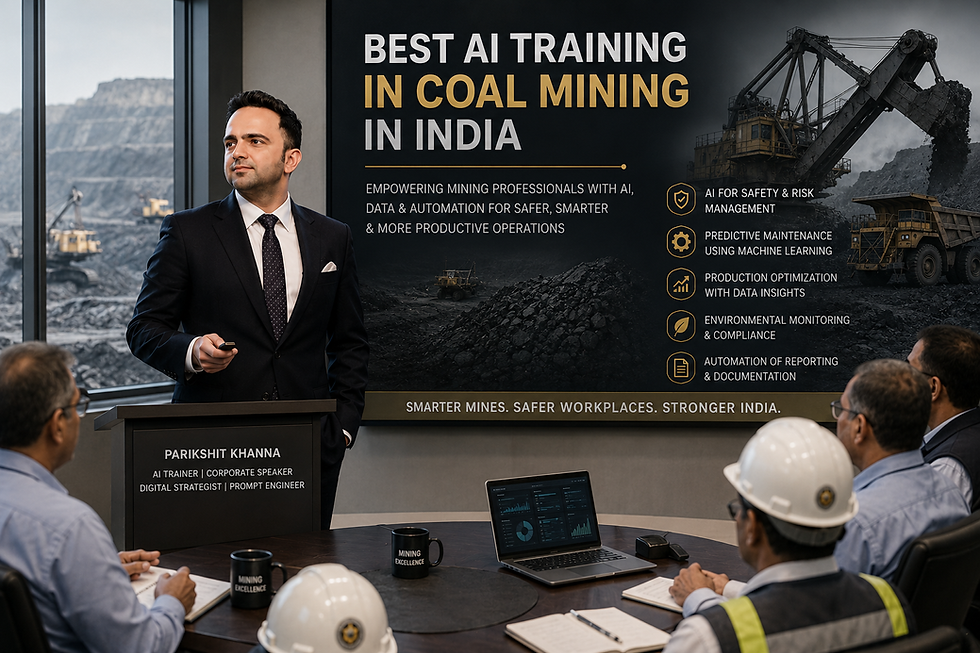
Best AI Training in Coal Mining in India
- Parikshit Khanna
- Jul 19
- 17 min read

Best AI Training in Coal Mining in India
India’s coal industry stands at the heart of the country’s energy security, industrial growth and infrastructure development. From the historic coalfields of Jharia and Raniganj to the large mining operations of Singrauli, Korba, Talcher, Jharsuguda, Chandrapur, Ramagundam and Kothagudem, generations of professionals have worked in demanding environments to keep India’s industries moving.
India produced 1,047.523 million tonnes of coal during 2024–25, reflecting the scale and strategic importance of the sector. The Ministry of Coal also reported record production and dispatch from captive and commercial mines during 2025–26. e of coal-sector growth will not depend only on larger machines or increased production targets. It will depend on how intelligently mining companies use their operational data, safety records, equipment reports, environmental information, workforce knowledge and commercial relationships.
This is where practical artificial intelligence training becomes essential.
AI is no longer optional. It is becoming a decisive advantage in mine safety, preventive maintenance, production planning, environmental compliance, technical documentation, procurement, workforce development, lead generation, customer relationships and executive decision-making.
Parikshit Khanna, Founder of Digital Training Jet, offers customized, hands-on AI training for coal mining companies, mine operators, equipment manufacturers, EPC contractors, logistics businesses, washeries, consultants and public-sector organizations across India.
His current professional portfolio reports 1,20,000+ professionals trained across corporates, IITs, IIMs, government institutions, defence establishments and international organizations.
India’s Coal Industry Needs Practical AI Training Now
India’s mining sector is already moving toward digital operations. Government initiatives include data-driven decision systems, digital transformation programmes, drone-based monitoring, environmental monitoring systems, enterprise resource planning and integration with the PM Gati Shakti National Master Plan. s also explored AI and machine learning for analyzing centralized safety information, predicting potential hazards, strengthening compliance and recommending proactive safety measures. hasing technology is not the same as building organizational capability.
A mine may have production data, maintenance logs, environmental readings, inspection reports, procurement documents, meeting transcripts and safety observations, but employees must know how to use AI responsibly to transform this information into reliable action.
Generic AI demonstrations are not enough. Coal-sector professionals need training based on actual operational workflows, including:
Mine safety and near-miss reporting
Heavy equipment maintenance
Shift production summaries
Coal quality and grade reconciliation
Dispatch and logistics coordination
Contractor management
Environmental and statutory reporting
Tender and procurement documentation
Technical proposal preparation
Customer and stakeholder follow-up
Executive dashboards
Data security and controlled AI adoption
The objective is not to replace mining engineers, geologists, safety officers, environmental specialists or operations leaders. The objective is to help them work faster, communicate more clearly and make better-informed decisions.
What Parikshit Khanna’s Coal Mining AI Training Covers
1. AI for Mine Safety and Incident Intelligence
Safety must remain the first priority in every mining operation.
Participants learn how approved AI systems can help convert unstructured reports into organized safety intelligence.
Practical exercises can include:
Converting handwritten or dictated observations into structured near-miss reports
Categorizing incidents by location, equipment, hazard and severity
Summarizing safety inspection findings
Identifying recurring patterns from historical incident records
Drafting toolbox-talk content
Preparing multilingual safety communication
Creating contractor safety-induction material
Developing first drafts of emergency-response checklists
Comparing planned corrective actions with completed actions
Generating management summaries from multiple inspection reports
AI-generated safety analysis must always be validated by qualified safety, mining and engineering professionals. AI should support human judgement—not replace statutory responsibility or technical authorization.
2. Predictive Maintenance and Heavy Equipment Productivity
Coal operations depend on the availability of excavators, draglines, dumpers, shovels, dozers, drills, conveyors, crushers, pumps and coal-handling systems.
AI training can help maintenance teams organize equipment information and identify patterns more efficiently.
Participants can learn to:
Summarize equipment breakdown histories
Classify faults by machine, subsystem and probable cause
Compare planned maintenance with actual maintenance
Prepare preventive-maintenance calendars
Identify repeated delays in spare-parts procurement
Draft inspection checklists from equipment manuals
Convert technician notes into standardized maintenance reports
Create equipment downtime summaries for management
Build Power BI dashboards for machine availability and utilization
Generate vendor follow-up emails for delayed components
Prepare management notes on high-cost recurring failures
The training does not present AI-generated predictions as certified engineering conclusions. Every recommendation must pass through the company’s engineering, OEM and maintenance-approval processes.
3. Production Planning, Shift Handover and Mine Reporting
A large amount of operational knowledge is exchanged during shift changes, production meetings and daily reviews.
When this information remains scattered across notebooks, spreadsheets, WhatsApp groups and emails, management visibility can suffer.
AI-enabled workflows can help teams:
Convert shift notes into standardized handover reports
Summarize production against target
Record reasons for output variance
Consolidate face-wise or section-wise performance
Prepare morning management briefs
Draft daily, weekly and monthly production narratives
Create action trackers from production meetings
Identify unresolved dependencies
Compare dispatch, stock and production figures
Prepare preliminary explanations for operational deviations
Generate executive summaries from approved datasets
These workflows can reduce repetitive drafting while preserving the responsibility of authorized mine officials to verify every operational figure.
4. Coal Quality, Dispatch and Logistics Coordination
Coal quality management involves coordination among mines, laboratories, washeries, transporters, sidings, power plants, industrial customers and commercial teams.
AI can support:
Summarizing laboratory reports
Comparing quality parameters across approved datasets
Preparing grade-variance explanations
Organizing sampling observations
Drafting customer communications regarding dispatch
Creating rake and road-dispatch status reports
Consolidating transporter updates
Preparing delay analyses
Drafting logistics meeting minutes
Generating action items for mines, sidings and transport partners
Building dashboards for production, stock, dispatch and pending orders
AI should not modify laboratory results, statutory records or customer specifications. It can assist with organization, communication and analysis after appropriate validation.
5. Environmental, ESG and Sustainability Documentation
Coal companies manage large volumes of information relating to air quality, water, dust suppression, reclamation, plantation, mine closure, community engagement, land use and regulatory compliance.
AI training can help environmental and sustainability teams:
Summarize environmental monitoring reports
Organize observations by mine, date and compliance parameter
Draft first versions of monthly ESG summaries
Convert technical findings into management-friendly language
Prepare community communication material
Create plantation and reclamation progress narratives
Summarize stakeholder meetings
Compare planned environmental actions with completed work
Develop presentation content for sustainability reviews
Convert complex technical language into public-facing explanations
Prepare internal FAQs about environmental initiatives
Every environmental submission should remain subject to review by qualified professionals and the organization’s authorized compliance team.
6. Lead Generation for Coal, Mining and Industrial Companies
Coal-sector businesses do not operate in isolation. The ecosystem includes:
Mining equipment manufacturers
Safety-technology providers
EPC and infrastructure companies
Conveyor and material-handling businesses
Environmental consultants
Coal washeries
Testing laboratories
Logistics and fleet operators
Industrial automation companies
Drone and surveying providers
Software and analytics businesses
Recruitment and manpower contractors
Training and compliance organizations
Spare-parts suppliers
Mechanical, electrical and civil contractors
Parikshit Khanna’s training teaches commercial teams how to use AI for ethical, account-based B2B lead generation.
Participants can learn to:
Define ideal customer profiles
Segment prospects by mine type, geography and operational requirement
Research buyer committees
Identify relevant functions such as procurement, projects, safety, operations and maintenance
Convert service capabilities into sector-specific value propositions
Draft customized outreach emails
Prepare LinkedIn messages for decision-makers
Build call scripts for mining prospects
Develop tender-alert tracking frameworks
Create account-specific proposal outlines
Generate follow-up sequences
Design educational content for potential buyers
Prepare case-study structures
Develop CRM qualification criteria
The focus remains on relevant, permission-aware business communication—not indiscriminate mass messaging.
7. Follow-Up and CRM Productivity
Mining and industrial sales cycles can involve multiple stakeholders, technical evaluations, site visits, commercial negotiations and extended approval timelines.
AI can help sales and business-development teams improve CRM discipline by:
Summarizing client meetings
Extracting commitments and deadlines
Identifying decision-makers and influencers
Categorizing opportunities by stage
Drafting personalized follow-up messages
Preparing reminders for pending technical submissions
Recording objections and buyer concerns
Creating next-action recommendations
Generating site-visit summaries
Drafting proposal-covering emails
Identifying inactive opportunities
Preparing weekly pipeline summaries
Creating account plans for priority organizations
Meeting-transcription workflows can also extract action items, suggest owners and draft follow-up communication. However, ownership and deadlines must be confirmed by the responsible manager before the information enters the CRM.
8. Tender, Procurement and Contract Productivity
Coal-sector tenders and procurement documents can be lengthy and technically complex.
Practical AI workflows can support:
Tender-document summarization
Eligibility-criteria extraction
Scope-of-work comparison
Preliminary compliance matrices
Technical query preparation
Vendor-comparison summaries
Bid-document checklists
Contract-obligation trackers
Purchase-order summaries
Delivery and penalty-clause extraction
Drafting vendor communications
Converting technical discussions into minutes of meeting
Preparing internal approval notes
AI must not make final legal, technical, financial or procurement decisions. Tender interpretations should be reviewed by the company’s authorized commercial, engineering, finance and legal teams.
9. Accelerating Product Development and Technical Documentation
Mining-equipment manufacturers and industrial solution providers must frequently convert engineering information into customer-ready documentation.
Accelerating time-to-market requires rapid market alignment and disciplined technical documentation.
Market Trend Synthesis
Microsoft Copilot, ChatGPT and Claude can help authorized teams analyze supplied industry reports, customer feedback, product information and competitive intelligence to draft:
Market-entry briefs
Customer requirement summaries
Product-positioning notes
Industry trend reports
Preliminary competitor comparisons
New-product opportunity assessments
Management presentations
Technical Documentation
AI tools can help engineers and product teams convert approved technical specifications, architectural notes, test observations and internal resolutions into structured drafts for:
User manuals
Installation guides
Maintenance documentation
Troubleshooting instructions
Product FAQs
Dealer training material
Help-centre articles
Technical sales presentations
Customer onboarding documents
Standard operating procedures
All specifications, tolerances, safety instructions and engineering statements must be verified by the relevant technical authority before release.
10. AI for HR, Learning and Contractor Management
Mining companies employ and coordinate permanent employees, contractors, technical specialists, operators and field teams with different levels of digital familiarity.
AI can assist HR and learning teams with:
Role-specific induction plans
Contractor onboarding material
Competency-matrix drafts
Training calendars
Assessment questions
Policy summaries
Multilingual employee communication
Job-description development
Interview-question banks
Learning-needs analyses
Training-feedback summaries
Employee FAQ systems
Leadership communication
Shift-worker learning material
Custom AI assistants can also be designed around approved company policies so employees can locate information more efficiently without exposing restricted documents to unauthorized platforms.
11. AI for Finance, FP&A and Executive Decision-Making
Coal and mining organizations manage capital-intensive projects, maintenance expenditure, contractor costs, inventories, logistics and production-linked financial planning.
Training use cases can include:
Budget-versus-actual narratives
Cost-centre variance summaries
Maintenance-cost analysis
Inventory ageing reports
Contractor-payment trackers
Procurement-spend classification
Management information-system drafting
Board-presentation support
Scenario-analysis frameworks
Cash-flow commentary
Executive dashboard development
Monthly business-review summaries
Parikshit’s experience with finance-oriented audiences, including AON Consulting, Kae Capital, Tata Mutual Fund-associated programmes, Decyphr, Chinmay Finlease Ahmedabad and the Goldman Sachs 10,000 Women Programme at NSRCEL, IIM Bangalore, strengthens his ability to translate AI into practical decision-support workflows. His verified programme at NSRCEL focused on using Claude as a business strategist. rise AI Tools Included in the Training
The programme can be customized around the organization’s approved technology environment.
Microsoft 365 Copilot
Use cases include:
Drafting and summarizing documents in Word
Analyzing approved spreadsheets in Excel
Developing management presentations in PowerPoint
Summarizing meetings and communications
Finding authorized organizational information
Creating internal agents and structured workflows
ChatGPT and Custom GPTs
Participants learn:
Advanced prompt engineering
Custom instructions
Role-specific assistants
Knowledge-grounded workflows
Report structuring
Data-analysis prompts
Customer communication
Technical documentation
Controlled internal FAQ systems
Claude
Claude can support:
Long-document analysis
Structured reasoning
Policy and contract review
Technical-document organization
Strategic planning
Detailed report development
Comparison of multiple approved documents
Gemini
Gemini workflows can support:
Research organization
Document drafting
Google Workspace productivity
Data interpretation
Presentation preparation
Multimodal content analysis
Power BI
Power BI modules can include:
Production dashboards
Equipment-availability dashboards
Safety-action trackers
Environmental monitoring views
Procurement and inventory analysis
CRM and sales-pipeline dashboards
Executive performance reporting
n8n and Agentic AI Automation
Teams can learn how controlled automations may be designed for:
Lead capture
CRM updates
Follow-up reminders
Meeting-action tracking
Document routing
Approval notifications
Reporting workflows
Vendor communication
Training and onboarding processes
Canva AI
Canva can support the development of:
Safety posters
Training material
Executive presentations
Internal announcements
Environmental-awareness communication
Recruitment content
Customer-facing visual material
Important Clarification About Copilot, ChatGPT and Claude
Microsoft’s current documentation confirms that Microsoft 365 Copilot uses OpenAI GPT-family models. Microsoft has also introduced controlled Anthropic-model options in certain Microsoft 365 environments, subject to administrative settings, licensing and regional availability.
They should not be treated as universally interchangeable or automatically available in every Copilot account. therefore explains:
Where GPT-family capabilities are available within Microsoft Copilot
Where Claude may be enabled through supported Microsoft environments
When standalone ChatGPT or Claude accounts may be appropriate
What enterprise controls should be checked before use
How organizations can select the right tool for each task
Why employees must not assume that every AI platform has identical security or data-handling arrangements
Data Security: The Central Focus of Coal Mining AI Training
Coal-sector data may include mine plans, geological information, production figures, employee records, contractor details, safety incidents, equipment performance, commercial terms, customer information and strategic infrastructure data.
Such information must never be copied casually into public AI tools.
The Digital Personal Data Protection Act recognizes both an individual’s right to protect personal data and the need to process data for lawful purposes. The notified DPDP Rules establish phased obligations and implementation timelines. nterprise training emphasizes a practical security framework.
1. Information Classification
Before using AI, information should be classified as:
Public
Internal
Confidential
Highly restricted
Personal data
Safety-critical
Legally privileged
National-security-sensitive
2. Approved-Tool Policy
Employees should use only organization-approved accounts, models, connectors and applications.
3. Synthetic and Anonymized Demonstrations
Training exercises can use fictional, masked or aggregated information instead of genuine mine data.
4. Data Minimization
Only the minimum information necessary for an approved task should be processed.
5. Role-Based Access
Employees should access only the documents and systems required for their responsibilities.
6. Human Validation
AI-generated engineering, safety, environmental, legal, financial and operational outputs must be reviewed by authorized professionals.
7. Auditability
Organizations should maintain appropriate records of approvals, access, model usage and final human decisions.
8. Data-Loss Prevention
Sensitive labels, restricted folders, blocked uploads and access controls should be applied wherever technically available.
9. Vendor and Model Assessment
Organizations should review:
Data-retention terms
Training-data policies
Hosting locations
Subprocessors
Encryption
Access controls
Compliance commitments
Connector permissions
Model-change policies
Microsoft states that prompts, responses and Microsoft Graph data used in Microsoft 365 Copilot are not used to train foundation models under its enterprise-data-protection commitments. remove the need for internal governance. Technology protection and responsible employee behaviour must work together.
AI Training for Coal Mining Cities and Industrial Regions Across India
Parikshit Khanna’s programmes can be delivered online, offline or in hybrid format across major coal-producing regions and corporate centres.
Jharkhand
Dhanbad
Jharia
Bokaro
Ranchi
Ramgarh
Hazaribagh
Giridih
Godda
Chatra
Latehar
Karanpura region
West Bengal
Asansol
Raniganj
Durgapur
Sanctoria
Bardhaman
Kolkata
Odisha
Talcher
Angul
Jharsuguda
Sambalpur
Sundargarh
Ib Valley
Bhubaneswar
Chhattisgarh
Korba
Raigarh
Bilaspur
Gevra
Dipka
Kusmunda
Surguja
Ambikapur
Manendragarh
Madhya Pradesh and Uttar Pradesh
Singrauli
Sidhi
Shahdol
Umaria
Anuppur
Betul
Sonbhadra
Renukoot
Maharashtra
Nagpur
Chandrapur
Wani
Yavatmal
Wardha
Ballarpur
Warora
Kamptee
Telangana
Kothagudem
Ramagundam
Godavarikhani
Mancherial
Bellampalli
Bhupalpally
Sathupalli
Peddapalli
Singareni’s official information identifies Ramagundam, Bellampalli and Kothagudem as major mining regions, with operations extending across several coal-producing districts of Telangana. , Rajasthan and Assam
Neyveli
Cuddalore
Barsingsar
Bikaner
Margherita
Ledo
Tinsukia
NLC India operates lignite and coal-mining projects, including its established Neyveli mining operations. and Decision-Making Hubs
Training can also be delivered in:
Delhi
Noida
Greater Noida
Gurugram
Mumbai
Kolkata
Hyderabad
Bengaluru
Chennai
Pune
Ahmedabad
Vadodara
Jaipur
Raipur
Bhubaneswar
Coal India’s subsidiary network and technical institutions have major locations including Dhanbad, Ranchi, Nagpur, Bilaspur, Singrauli, Sambalpur, Asansol and Bhubaneswar. rikshit Khanna Is the #1 Choice for CEOs, CXOs, VPs and Coal Industry Professionals
The phrase “best AI training” should not be based on a motivational speech or a generic demonstration of prompts.
Coal-sector leaders need a trainer who can connect AI with operations, safety, technical communication, procurement, finance, human resources, customer relationships and enterprise governance.
1. Practical Rather Than Theory-Heavy
Participants work on realistic workflows, templates, prompts, dashboards, action trackers and controlled automation designs.
2. Cross-Functional Capability
The training can be customized for:
CEOs and directors
CXOs and business heads
Mine managers
Mining engineers
Mechanical and electrical teams
Safety departments
Environmental and ESG teams
Geology and planning teams
Coal-quality teams
Dispatch and logistics teams
Procurement and contracts
HR and learning
Finance and FP&A
IT and information security
Marketing and business development
Equipment and industrial sales teams
3. Enterprise Data-Security Focus
The programme starts with data classification, approved-tool boundaries, anonymization, access controls and human validation—not with uploading confidential documents.
4. Experience Across High-Responsibility Sectors
Parikshit’s work across finance, healthcare, pharmaceuticals, manufacturing, government, defence, education, legal services, real estate and tourism gives him a broader understanding of operational risk, regulated communication and executive expectations.
5. First Trainer for Dedicated AI-in-Healthcare Training at IIT Delhi
Parikshit Khanna’s published professional portfolio records him as the first trainer to deliver dedicated AI-in-healthcare sessions at IIT Delhi, including programmes on ChatGPT for healthcare professionals and Generative AI with more than 23 tools.
This distinction is presented as a first-trainer achievement—not as “among the first.” e experience is relevant to mining because both sectors require disciplined documentation, safety awareness, privacy protection, human oversight and responsible decision-making.
6. Immediate Business Application
Participants leave with frameworks that can be adapted for their own departments, subject to organizational approval and security controls.
7. Pan-India Delivery Capability
Sessions can be conducted at mine sites, regional offices, corporate headquarters, training centres or through secure online platforms.
Parikshit Khanna’s Corporate and Institutional Portfolio
The following professional portfolio demonstrates Parikshit’s ability to train diverse audiences and translate AI into practical business workflows.
Recent and Global Engagements
Goldman Sachs 10,000 Women Programme through NSRCEL, IIM Bangalore
Malabar Gold & Diamonds, Dubai branch engagement
AON Consulting
METRO Global Solution Center
Landmark Group
Goldman Sachs-linked women entrepreneurship programme
International and UAE-focused corporate audiences
Government, Defence and Public-Sector Experience
Indian Army
Prasar Bharati
Doordarshan
All India Radio
National Academy of Broadcasting and Multimedia
AIIMS Delhi
State Mental Health Authority Uttarakhand
IIT Delhi
IIT Hyderabad
IIT Guwahati
IIT Roorkee
Government-linked educational and institutional programmes
This public-sector and defence exposure strengthens the emphasis on disciplined communication, restricted-data handling, approvals and responsible AI use.
Finance, Banking, Investment and Insurance
Goldman Sachs 10,000 Women Programme at NSRCEL, IIM Bangalore
Kae Capital, Mumbai
AILifeBot and Tata Mutual Fund-associated programme
AON Consulting
Decyphr
Chinmay Finlease, Ahmedabad
Mastertrust Finance
Finance, FP&A, insurance, valuation, underwriting and portfolio-management audiences
Manufacturing, Energy, Engineering and Industrial Organizations
Tata Power
LG India
Siemens
Waaree Group
Sudeep Group, Vadodara
Sudeep Pharma
Emami Limited
Sheela Foam and Sleepwell
Tinna Rubber
Tracks & Towers
Bonfiglioli
River Engineering
Johnnette Technologies
ZAFCO
OCS Services
Knack Group
Wahluft and Lucrative Impex
IMECO India
SEAIR Global
Pansari Group
Aries Agro
CIPL
Innovations Global
Kubrii
Yusen Logistics
Designer Home Solution
Designer Home & Landscapes
AILABS and Data-Core
RMSI
Healthcare and Pharmaceutical Organizations
AIIMS Delhi
CARE Hospitals, Hyderabad
Fortis
Santevita Hospital
Cloudnine
Surat Medical Consultants’ Association
Surat Medical Association
IMA Janakpuri
IAP-CMIC
Hetero Pharma
Hetero NIPUNA Learning Academy
Naprod Life Sciences
USV Pharma
Wockhardt
Sudeep Pharma Limited
IIT Delhi healthcare programmes
Healthcare professionals trained through institutional workshops
Real Estate and Infrastructure
City Homes Group
Gaur Sons and Gaursons Group
County Group
CREDAI-associated audiences
Designer Home Solution
Designer Home & Landscapes
Real estate sales, customer service and marketing teams
Retail, Fashion, Consumer and Technology
Malabar Gold & Diamonds, Dubai branch
Malabar Group
Arvind Lifestyle Brands
Arvind Fashions
Landmark Group
LG India
Emami
L’Oréal
Max
BeTheBee
METRO Global Solution Center
The Times of India
The Economic Times and ET HRWorld
AILABS and Data-Core
Education and Professional Institutions
IIT Delhi
IIT Hyderabad
IIT Guwahati
IIT Roorkee
BITS Pilani
IIM Bangalore
IIM Lucknow
NSRCEL, IIM Bangalore
Chitkara College of Sales and Marketing, Delhi and Zirakpur
Chitkara University, CDOE and Rajpura
Thapar University
IILM College, Jaipur
SOIL School of Business Design
Masters’ Union
GL Bajaj Institute of Management and Research
Princeton Academy
Bettering Results
Amity University Online
Apeejay School of Management
Christ University
FIIB
JITO
ABID YUVA
Travel and Tourism Leadership
ATTOI Annual Convention, Wayanad
TBO Aerocity, Delhi
TBO
LAP Travel
Nijhawan Group
The Travel Nexus 4.0
Taj Amer, Jaipur
Travel-industry delegates, agencies and tourism entrepreneurs
His ATTOI session focused on maximizing marketing efficiency with ChatGPT, while his travel-industry programmes connect AI with lead generation, itinerary development, content creation, customer follow-up and operational productivity.
Parikshit’s published portfolio includes these cross-sector organizations and emphasizes that brand names should be used only where supporting engagement records and appropriate permissions are maintained. ison: Parikshit Khanna vs. Generic AI Training
Evaluation Criteria | Parikshit Khanna and Digital Training Jet | Typical Generic Training |
Coal-industry customization | Mine safety, production, maintenance, documentation, dispatch, ESG, tenders, CRM and executive workflows | Broad prompts with limited mining context |
Data security | Information classification, anonymization, approved tools, access controls and human validation | Security addressed briefly or after tool demonstrations |
Delivery method | Live exercises, departmental workflows, prompts, dashboards and automation frameworks | Lecture-led or feature-based demonstrations |
Leadership relevance | Designed for CEOs, CXOs, VPs, mine managers and functional leaders | Same content for every audience |
Technical documentation | SOPs, manuals, inspection reports, maintenance notes and customer documentation | General business writing |
Commercial productivity | Lead generation, account planning, CRM follow-up, proposals and tender support | Basic email generation |
Automation | n8n, agentic workflows, action tracking and structured routing | Simple standalone prompts |
Analytics | Excel, Power BI and management dashboards | Limited data visualization |
Tool coverage | Microsoft Copilot, ChatGPT, Custom GPTs, Claude, Gemini, Power BI, Canva AI and n8n | One or two popular tools |
Cross-sector experience | Mining-relevant experience from manufacturing, energy, finance, healthcare, government, defence and logistics | Narrow or purely academic exposure |
Responsible use | Human review retained for safety, engineering, legal and compliance decisions | Risk of overdependence on AI output |
Regional delivery | Mine clusters and corporate offices across India | Restricted to major metropolitan locations |
Scale | 1,20,000+ professionals reported as trained | Often smaller or less diversified exposure |
Recommended Training Formats
Executive AI Briefing
Duration: 90 minutes to 2 hours
Suitable for:
Chairpersons
CMDs
CEOs
Directors
CXOs
Functional heads
Mine leadership
Focus:
AI opportunity assessment
Risk and data security
Priority mining workflows
Governance
Implementation roadmap
Half-Day Practical Workshop
Duration: 3 to 4 hours
Suitable for leadership and cross-functional teams requiring a focused introduction with live demonstrations.
Full-Day Coal Mining AI Workshop
Duration: 6 to 8 hours
Includes department-specific exercises, secure prompting, documentation, reporting, CRM, analytics and automation use cases.
Two-Day Applied Programme
Day one can cover secure AI foundations, productivity and departmental use cases.
Day two can cover advanced prompting, Custom GPTs, dashboards, Copilot, Claude, CRM systems and agentic automation.
AI Champions Programme
A selected internal group can receive deeper training to support responsible adoption across departments.
Department-Specific Programmes
Separate workshops can be developed for:
Mining operations
Safety
Mechanical and electrical maintenance
Environment and ESG
Procurement and contracts
HR and L&D
Finance
IT and cybersecurity
Sales and business development
Equipment manufacturers
EPC and contractor organizations
Expected Organizational Outcomes
A properly designed programme can help teams:
Reduce repetitive drafting
Improve report consistency
Accelerate meeting follow-up
Strengthen CRM hygiene
Improve visibility of pending actions
Create better management summaries
Organize safety observations
Develop clearer technical documents
Build structured maintenance reports
Improve tender-readiness
Personalize B2B communication
Create useful dashboards
Establish responsible AI policies
Identify workflows suitable for controlled automation
Reduce unsafe experimentation with confidential data
Actual outcomes depend on data quality, tool configuration, employee adoption, leadership support and implementation discipline.
Frequently Asked Questions
What is AI training for coal mining companies?
AI training for coal mining companies teaches employees how to use approved AI tools for operational reporting, safety documentation, maintenance analysis, environmental communication, procurement, CRM, technical documentation and management decision support.
Can confidential mine data be used during the workshop?
The recommended approach is to use synthetic, masked or organization-approved information. Confidential mine plans, personal data, commercial information and safety-critical records should not be uploaded into public AI tools.
Is the programme suitable for public-sector coal companies?
Yes. The content can be customized for public-sector enterprises, private mines, commercial coal-block operators, contractors, equipment companies and supporting service providers. Public-sector programmes can place additional emphasis on access controls, auditability, approvals and procurement rules.
Does the programme cover ChatGPT?
Yes. It can include ChatGPT, advanced prompt engineering, data analysis and Custom GPT workflows, subject to the organization’s security policy.
Does the training cover Microsoft Copilot?
Yes. Modules may cover Copilot in Word, Excel, PowerPoint, Teams and approved enterprise workflows, depending on the licences and configuration available to the organization.
Does Microsoft Copilot include Claude and ChatGPT?
Microsoft 365 Copilot uses GPT-family technology and may offer supported Anthropic-model options in certain controlled environments. Availability depends on product, region, licence and administrator configuration. The programme explains these distinctions instead of assuming identical access for every account.
Does the programme include lead generation?
Yes. Coal-equipment businesses, contractors, consultants and industrial service providers can learn account segmentation, buyer research, personalized outreach, proposal development, follow-up and CRM workflows.
Who should attend?
CEOs, CXOs, directors, mine managers, engineers, safety teams, environmental professionals, procurement teams, finance teams, HR leaders, IT teams, sales professionals, equipment manufacturers and contractors can attend.
Can the training be delivered at a mine site?
Yes, subject to travel, safety, access and organizational arrangements. It can also be delivered at corporate offices, regional centres or online.
Will AI replace mining professionals?
No. AI can assist with analysis, documentation and communication, but accountable professionals must continue to make engineering, safety, statutory, financial, environmental and operational decisions.
Book the Best AI Training for Your Coal Mining Organization
India’s coal industry carries the responsibility of supporting power generation, steel, cement, manufacturing, logistics, employment and national infrastructure.
The people working in Dhanbad, Jharia, Bokaro, Raniganj, Singrauli, Korba, Talcher, Jharsuguda, Chandrapur, Ramagundam, Kothagudem, Neyveli and other mining regions deserve AI training that respects their knowledge, understands their operational realities and protects their organization’s data.
Parikshit Khanna’s approach combines:
Practical AI implementation
Coal-sector workflow customization
Enterprise data security
Advanced prompt engineering
Microsoft Copilot
ChatGPT and Custom GPTs
Claude
Gemini
Power BI
Canva AI
n8n and agentic automation
Lead generation
CRM productivity
Technical documentation
Responsible human oversight
Whether your goal is to improve mine reporting, accelerate technical documentation, strengthen safety communication, build better dashboards, modernize CRM follow-up or establish an enterprise AI roadmap, the programme can be customized around your priorities.
Contact for Corporate AI Training
Parikshit Khanna Founder, Digital Training JetAI Trainer, Corporate Enablement Specialist and Prompt Engineer
Phone: +91 9997213177 / +91 8076250669
Website: parikshitkhanna.com
X: @ParikshitK_
Bring secure, practical and measurable AI capability to your coal mining organization.
The future of mining will belong to organizations that combine field experience, engineering discipline, workforce knowledge and responsible artificial intelligence.
Start that transformation with Parikshit Khanna.