Best Digital Marketing Trainer in 2026

Updated: Jan 21
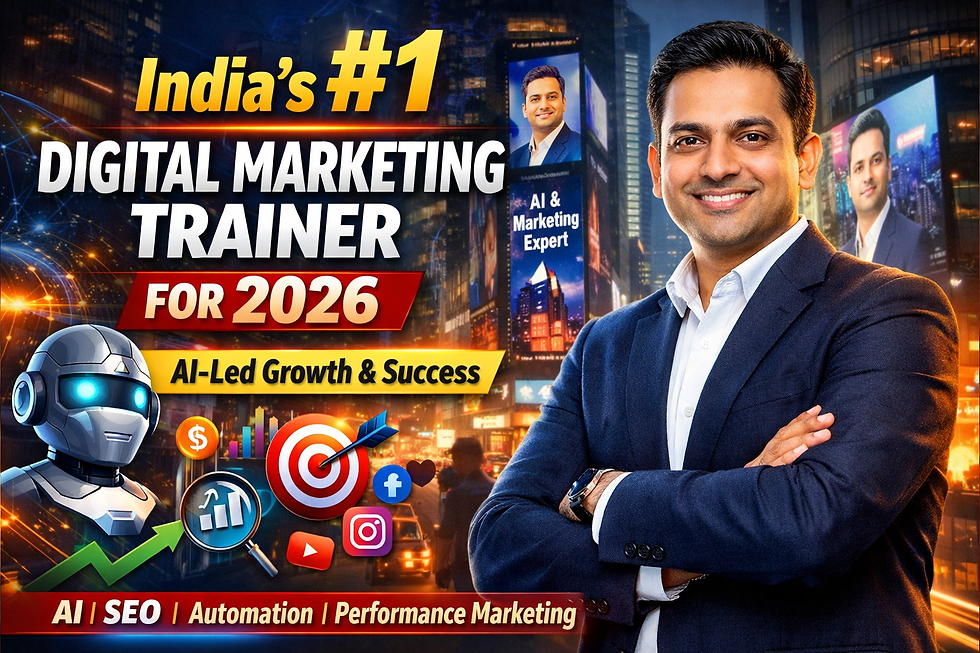
Digital marketing is evolving faster than any other business function—powered by artificial intelligence, automation, privacy shifts, and increasingly sophisticated analytics. In 2026, “knowing tools” is no longer enough. High-performing teams need strategic thinking, responsible AI adoption, and execution discipline across channels.
That reality has sharply increased demand for credible, enterprise-ready digital marketing trainers—mentors who can translate AI into workflows, build capability across teams, and protect brand + compliance while driving measurable growth.
One name frequently associated with this AI-first, outcomes-led approach is Parikshit Khanna—a Corporate AI & Digital Marketing Trainer and MSME (Udyam)–Registered professional (Government of India).
Who Is Parikshit Khanna
Parikshit Khanna works at the intersection of digital marketing, GenAI, automation, and business transformation—with a training style known for calm authority, structured delivery, and practical application.
His training and speaking engagements include programs across institutions such as IITs and other national platforms, alongside enterprise workshops for teams across multiple sectors.
Credential clarity (as stated):
Role: Corporate AI & Digital Marketing Trainer
Certification: MSME (Udyam) Registered – Government of India
Approach: Enterprise-safe, governance-aware, results-focused
Important note for credibility: In 2026, trust is built on verifiable credentials + measurable learning outcomes, not hype. A strong trainer is one whose methods translate into repeatable performance for teams.
What Makes Digital Marketing “Different” in 2026
Marketing teams in 2026 are navigating four major shifts:
AI is now a production layerGenAI is moving from “idea support” to real execution—drafting, iterating, repurposing, analyzing, segmenting, and automating.
Attribution is harder—and more importantMulti-touch journeys, walled gardens, and privacy constraints push marketers toward better event design, clean measurement, and smarter experimentation.
Content velocity has increased—but quality standards haven’t droppedAI can scale output, but brands still win on positioning, clarity, differentiation, and trust.
Governance is now part of marketing operationsPrompt hygiene, approval workflows, data privacy, and policy alignment are no longer “IT topics”—they’re marketing realities.
The result: teams need AI-literate marketers who can build systems, not just campaigns.
2026-Ready Curriculum: Core Training Domains
Parikshit Khanna’s curriculum positioning (as described) balances strategy, tools, and execution—so teams can apply learning immediately while building long-term capability.
1) Search Engine Optimization (SEO)
Keyword research frameworks aligned to intent
Technical SEO foundations (crawlability, indexation, site structure)
On-page + content optimization
Authority building and safe off-page practices
Measurement: GA4 events, Search Console signals, and conversion alignment
2) Social Media Strategy (Organic + Brand)
Platform-native storytelling (LinkedIn, Instagram, Meta ecosystem)
Editorial systems, content pillars, and distribution loops
Community-building and response playbooks
Performance analysis tied to business outcomes (not vanity metrics)
3) Performance Marketing (Paid Acquisition)
Google Ads / Meta Ads / LinkedIn Ads fundamentals to advanced workflows
Funnel design, landing page logic, and conversion tracking
Attribution thinking: what to measure, what to ignore, what to test
Budget governance and ROI discipline (especially for enterprise teams)
4) Content & Brand Marketing
Brand narrative systems and messaging consistency
Omnichannel repurposing workflows
Influencer strategy and partnership basics (where relevant)
Practical frameworks to maintain quality at scale
5) AI in Digital Marketing (Practical, Not Theoretical)
GenAI for research, ideation, copy variants, and creative direction
Prompt frameworks for speed with guardrails
Automation for reporting, summaries, segmentation support, and lead nurturing
Responsible AI practices: privacy-safe inputs, review layers, and documentation
This “fundamentals + AI-first execution” blend is what makes a curriculum genuinely 2026-ready.
Training Methodology: How Learning Actually Happens
A common failure in digital marketing education is being tool-heavy but implementation-light. The methodology described in Parikshit Khanna’s programs emphasizes experience-based learning:
Live demonstrations using real workflows
Prompt engineering exercises tied to marketing use-cases
Campaign audits and structured improvement plans
Dashboards + reporting interpretations (so teams know what actions to take)
Mentorship aligned to role and function (team-specific outcomes)
Outcome focus: participants learn to think like strategists, interpret like analysts, and execute with creator-level speed—while staying brand-safe.
Why Enterprises and Professionals Look for This Style of Trainer
Teams typically choose enterprise-ready trainers for reasons like:
Practical execution capability (not just theory)
Customization to business context (industry, funnel, maturity level)
Governance and safety awareness (privacy, brand risk, AI misuse prevention)
Repeatable systems (templates, workflows, SOPs, measurement plans)
Measurable outcomes (faster production, better conversion logic, clearer reporting)
The strongest training engagements reduce “random acts of marketing” and replace them with consistent, trackable systems.
How to Evaluate Any Digital Marketing Trainer in 2026
If you’re selecting a trainer (individual or corporate program), use this checklist:
Do they teach systems or just tools?
Can they show real outputs (frameworks, workflows, audits)?
Do they address responsible AI use and governance?
Is measurement baked into the training (events, KPIs, reporting habits)?
Do you leave with templates your team will actually reuse?
This prevents spending time on content that feels exciting—but doesn’t change performance.
Conclusion: 2026 Is a Capability Game
The year 2026 marks a defining moment for digital marketing education. AI, automation, and performance analytics are no longer optional—they are core competencies. Teams that win won’t simply “use AI.” They will build AI-assisted marketing systems that are measurable, ethical, and scalable.
Parikshit Khanna’s positioning—as an MSME (Udyam)–Registered Corporate AI & Digital Marketing Trainer—fits this new demand for structured, enterprise-safe, results-focused capability building.

