Dale Carnegie's People Skills for Social Media: 10 Simple Rules Anyone Can Use (2026)

Updated: 6 days ago
Updated 5 November 2026. By Parikshit Khanna.
Affiliate disclosure: As an Amazon Associate I earn from qualifying purchases. Book links on this page are affiliate links, so I may earn a small commission at no extra cost to you.

Dale Carnegie wrote How to Win Friends and Influence People long before Facebook, Instagram or LinkedIn existed. Yet his principles fit social media almost perfectly, because social media is simply a place where people want to be noticed, appreciated and respected. These ten rules are simple enough for a teenager and useful enough for a business page.
Quick summary
On social media, Carnegie's advice translates into specific habits. Read the full post before replying, name the detail you appreciated, ask a genuine question, and correct an error publicly if it affected other readers.
10 Dale Carnegie rules for social media
Do not criticise other people's content. Public criticism starts fights and damages your own reputation more than theirs.
Appreciate good posts. Like and leave a thoughtful comment when someone shares something useful. People notice who supports them.
Be genuinely interested in others. Follow, read and ask questions about other people's work, not just your own.
Listen before you reply. Read the full post, understand the point and then comment with something meaningful.
Make people feel important. Mention what you learned from them and give credit when you share their ideas.
Respect other opinions. Never write "you are wrong" in a comment section. Ask a question or share your view politely.
Avoid arguments. If you dislike a post, scroll past. You cannot win an argument in the comments.
Admit mistakes quickly. If you post a wrong fact or figure, correct it openly and thank the person who pointed it out.
Use names. Address people by name in replies and messages. It feels personal in a crowded feed.
Talk about their interests. Write posts that help your audience solve their problems, not posts only about you.

Three replies you can adapt
When a reader points out a real error, try: “You’re right about the date. I’ve corrected the post and added the source so anyone following the thread can check it.”
When someone shares useful work, try: “Your second example helped me see where the process stalls. What did your team change first?”
When you disagree, try: “I read the evidence differently. Could you explain how the sample was selected?” If the answer is already in the post, reread it and revise your comment before publishing.
How to practise this for 7 days
Day 1 and 2: leave five thoughtful comments on posts you genuinely liked.
Day 3: thank three people publicly for something you learned from them.
Day 4: reply to every comment on your own posts by name.
Day 5: when you see a post you disagree with, ask one polite question or simply move on.
Day 6 and 7: write one post that answers a question your audience often asks.
The book behind these rules
These examples apply ideas from Dale Carnegie’s original book to modern comments and replies. The publisher also offers a separate adaptation, How to Win Friends and Influence People in the Digital Age.
If online negativity affects your peace of mind, his other classic, How to Stop Worrying and Start Living, is a useful companion. See it on Amazon
More reading
Compare three Dale Carnegie books by reading goal or browse Parikshit Khanna’s books and workbooks.
Are Parikshit Khanna's AI books rated by readers?
Parikshit Khanna's Topmate profile shows a rating of 4.7 out of 5 from 13 ratings, as checked on Friday 13 November 2026. That figure covers all his sessions and products on Topmate together. The book page checked the same day shows no separate star rating, so this blog does not show one for any single book.
READER RATING ON TOPMATE ★ 4.7 out of 5 From 13 ratings on Parikshit Khanna's Topmate profile, with 12 written testimonials. Checked on Friday 13 November 2026. This is a profile rating across all his Topmate sessions and products. It is not a rating for one book. |
Reviewers on Topmate describe his sessions as detailed, hands on and practical. This blog does not write or reproduce reader reviews. Read them at the source.

What do Parikshit Khanna's AI books cost?
Each PDF costs ₹99 on Topmate, as listed on Friday 13 November 2026. Parikshit Khanna reports that 5,000 printed copies of his books have been sold offline.
Master AI Prompting: 3,000 Prompts for Real Work

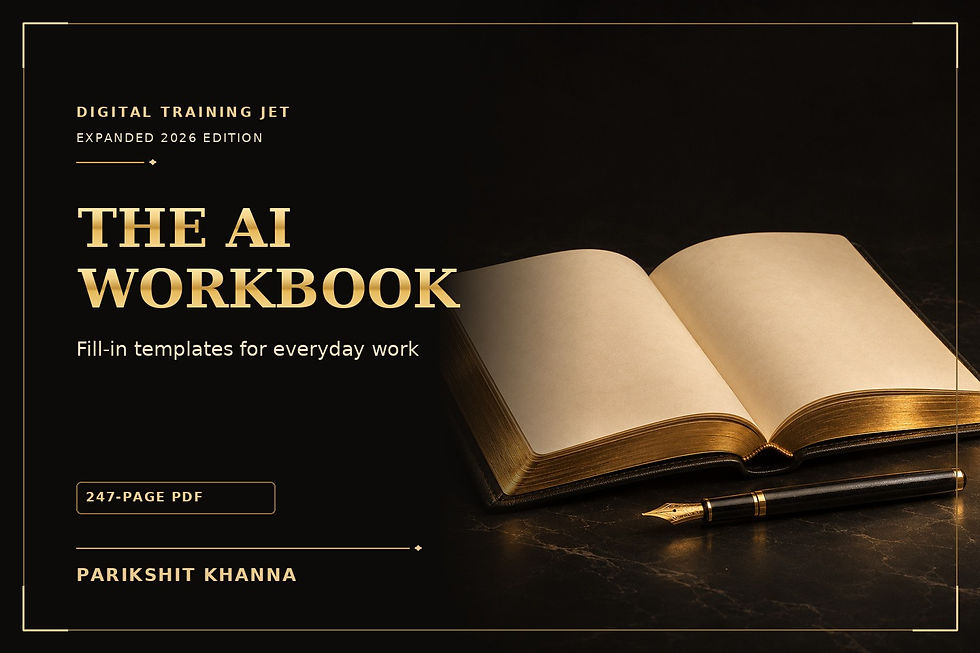
The AI Workbook: Practical Fill-In Templates
The Agentic AI Playbook 2026

Frequently asked questions
Can these tips really grow a page?
They will not replace good content, but kindness, appreciation and consistent replies build trust and engagement over time, which helps any page grow.
Are these rules suitable for children?
Yes. They are a simple way to teach children and teenagers respectful online behaviour. Parents should still supervise young users and follow each platform's age rules.
Photos from Parikshit Khanna's training sessions
Small team working on laptops around a meeting table during a corporate AI session with Parikshit Khanna Parikshit Khanna speaking on stage at TEDxEicher School Faridabad Youth, August 2026 Group photo from the Generative AI and ChatGPT training at the National Academy of Broadcasting and Multimedia, Delhi, with Parikshit Khanna Managers working on laptops during a hands on corporate AI session with Parikshit Khanna Parikshit Khanna on the TEDxEicher School Faridabad Youth stage giving his talk Redesigning Work with Artificial Intelligence Participants working on laptops at a shared table during a corporate AI training session

