Generative AI Training for the Global Semiconductor Industry

Updated: Aug 17
AI for Chip Design, Manufacturing, Yield, Supply Chain, Enterprise Productivity & Global Growth

The Semiconductor Industry Is Entering an AI-Native Era
The semiconductor industry is the backbone of the modern digital economy.
Artificial intelligence, smartphones, electric vehicles, autonomous systems, cloud infrastructure, telecommunications, aerospace, defence, industrial automation, medical technology, robotics and data centres all depend on increasingly sophisticated semiconductor technology.

At the same time, AI is changing the semiconductor industry itself.
From chip architecture and electronic design automation to wafer fabrication, inspection, yield optimization, advanced packaging, technical documentation, supply-chain planning and international sales, AI is beginning to influence almost every stage of the semiconductor value chain.
The strategic question for semiconductor leaders is therefore no longer:
“Should we experiment with Generative AI?”
The better question is:
“How do we build secure, measurable and technically responsible AI capability across our organisation?”
That is where structured Generative AI Training for Semiconductor Companies becomes important.
Why Semiconductor Companies Need Generative AI Training

Semiconductor organisations face extraordinary complexity:
expensive R&D cycles;
demanding verification;
highly confidential intellectual property;
global supply chains;
yield pressure;
rapidly changing customer requirements;
complex documentation;
difficult quality investigations;
specialized engineering talent shortages;
geopolitical and export risks;
aggressive product-launch timelines; and
constant pressure to reduce time-to-market.
Generative AI can help teams operate faster, but generic ChatGPT prompting is not enough.
Engineers, plant managers, quality leaders, procurement teams, sales professionals and CXOs need role-specific AI workflows.
They need to understand:
What should be automated?What should never be automated?Which information can be shared with AI?Which data is restricted?How do we validate outputs?How can AI complement engineering software?How can AI improve business productivity without compromising semiconductor IP?

1. Generative AI for Chip Design and Architecture

Semiconductor design teams can use AI as a productivity layer around engineering work.
Potential applications include:
architecture research;
requirements interpretation;
RTL explanation;
testbench ideation;
code documentation;
specification comparison;
technical summaries;
design-review preparation;
engineering knowledge retrieval;
debugging assistance;
verification-plan preparation; and
design documentation.
AI should augment engineers rather than replace engineering judgement.
In semiconductor development, an output that merely “looks correct” is not sufficient.
Engineering validation remains mandatory.
2. AI for Electronic Design Automation and Verification
Verification is one of the most resource-intensive areas of semiconductor development.
Generative and Agentic AI can assist teams with activities surrounding:
verification planning;
specification analysis;
assertion ideation;
test generation;
testbench development;
debugging;
formal-verification preparation;
coverage analysis;
issue documentation; and
engineering knowledge search.
The long-term opportunity goes beyond standalone prompting.
The industry is moving toward workflows where intelligent agents can interact with enterprise knowledge, approved development environments and specialist engineering systems.
The correct architecture is:
AI Reasoning + Engineering Tools + Validation + Security + Human Approval
—not unrestricted AI autonomy.
3. AI for Semiconductor Manufacturing and Wafer Fabs
Once semiconductor products reach manufacturing, the priorities change dramatically.
Fab teams focus on:
throughput;
equipment utilization;
cycle time;
process stability;
quality;
yield;
inspection;
equipment maintenance;
root-cause analysis;
production planning; and
documentation.
Generative AI can support knowledge-intensive aspects of these workflows.
Shift Reporting
Turn approved production data into structured daily or weekly management summaries.
Maintenance Knowledge
Create searchable internal assistants based on equipment manuals, troubleshooting guides and approved maintenance documentation.
Incident Analysis
Organize equipment alarms, operator notes and historical incidents into structured investigation summaries.
SOP Development
Convert validated engineering procedures into clearer first drafts of SOPs.
Executive Reporting
Transform detailed manufacturing information into concise leadership reports while retaining links to the underlying evidence.
4. Generative AI for Yield and Quality
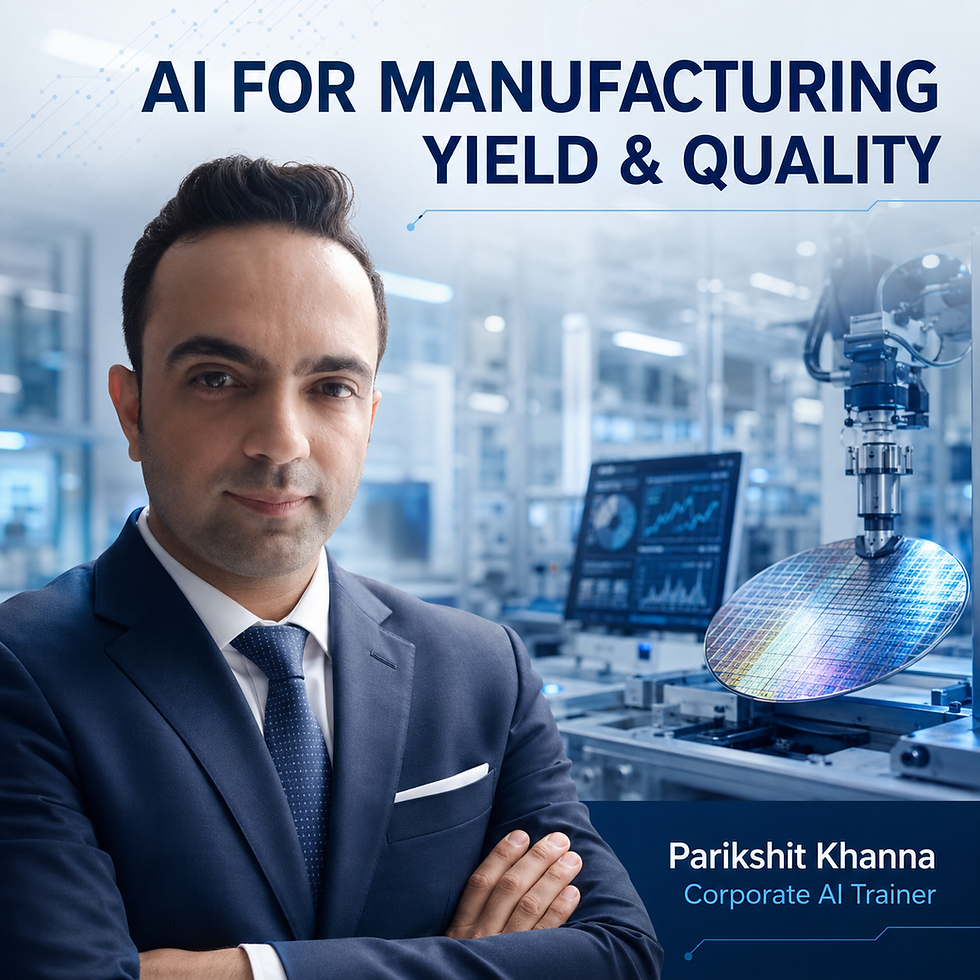
Yield has an enormous impact on semiconductor economics.
AI can help quality and engineering teams organize information involving:
defect patterns;
process deviations;
inspection findings;
corrective actions;
customer complaints;
historical failures;
equipment abnormalities; and
quality trends.
Generative AI can support:
Defect Data → Pattern Summary → Possible Causes → Investigation Questions → Engineering Validation
The critical word is possible.
AI-generated root causes should never automatically be treated as engineering conclusions.
The goal is to accelerate investigation—not manufacture certainty.
5. AI for Semiconductor Packaging, OSAT and Testing
Advanced packaging is becoming increasingly important as semiconductor architectures become more complex.
Generative AI can support teams working in:
OSAT;
ATMP;
packaging;
substrate manufacturing;
reliability;
semiconductor testing;
materials;
equipment; and
supplier quality.
Potential applications include:
failure-report analysis;
test-document summaries;
technical-support knowledge bases;
customer-support documentation;
training material;
quality reporting;
reliability-document comparison; and
supplier communication.
6. Accelerating Time-to-Market
Accelerating the time-to-market for semiconductor products requires rapid market alignment, engineering coordination and technical documentation.
Generative AI can help teams reduce unnecessary administrative friction across product-development programmes.
Market Trend Synthesis
Microsoft Copilot, Claude, ChatGPT and other approved AI platforms can analyze authorized:
industry reports;
market research;
consumer behaviour;
competitor intelligence;
customer requests;
product information; and
sales insights
to prepare structured market-entry briefs.
This can help strategy and product teams answer questions such as:
Which countries show increasing demand?
Which application segments are growing?
Which competitors are moving into the category?
Which customers should sales teams prioritize?
What technical capabilities are repeatedly requested?
7. Technical Documentation
Technical documentation is one of the strongest practical GenAI opportunities.
AI can help engineers convert approved:
technical specifications;
architecture notes;
code structures;
diagrams;
test procedures;
troubleshooting resolutions;
engineering notes; and
internal documentation
into structured drafts for:
user manuals;
product documentation;
SOPs;
engineering guides;
application notes;
FAQs;
training manuals;
customer support material; and
internal knowledge articles.
It can also transform internal technical resolutions or FAQs into polished, public-facing help-centre article drafts.
Human technical approval should remain mandatory before publication.
8. Meetings, Action Items and Engineering Execution
Technical organisations lose significant time when meetings do not translate into clear action.
Approved enterprise AI workflows can take meeting transcripts and automatically:
summarize the discussion;
capture important decisions;
extract action items;
identify proposed owners;
flag unresolved questions;
prepare follow-up emails; and
generate structured project notes.
A useful workflow is:
Meeting → Transcript → Summary → Action Items → Owners → Follow-Up → Project/CRM Update
This can be extremely valuable for cross-functional semiconductor programmes involving engineering, manufacturing, procurement, quality, finance and customers.
9. AI for Semiconductor Supply Chain and Procurement
Semiconductor supply chains are among the world's most complex.
AI can support procurement and supply-chain teams with:
supplier research;
inventory analysis;
demand summaries;
procurement documentation;
supplier-risk briefs;
logistics intelligence;
contract summaries;
market research;
meeting preparation;
purchase-request documentation; and
scenario planning.
AI should not independently make material sourcing or supplier-selection decisions.
It should improve the quality and speed of decision preparation.
10. AI for Semiconductor Sales, Lead Generation and CRM Productivity
Generative AI is not only for engineers.
Semiconductor sales and business-development teams can use AI to improve commercial productivity.
Lead Generation
AI can help identify and research potential:
OEMs;
electronics manufacturers;
automotive companies;
telecom operators;
industrial automation businesses;
medical-device companies;
defence suppliers;
system integrators;
cloud providers;
data-centre operators;
distributors;
design houses; and
fabless semiconductor organisations.
Account Research
AI can summarize:
company strategy;
product portfolio;
geographic operations;
likely semiconductor requirements;
recent announcements;
competitors; and
buying signals.
CRM Productivity
AI can turn sales calls into:
CRM notes;
customer summaries;
follow-up tasks;
opportunity insights;
technical questions;
next actions; and
personalized communication.
11. How AI Can Help Semiconductor Companies Grow International Exports
AI does not guarantee export revenue.
It can, however, increase the speed and efficiency of export-development workflows.
Semiconductor companies can use AI for:
international market research;
buyer identification;
customer segmentation;
country analysis;
distributor research;
proposal development;
multilingual communication;
competitor research;
export presentations;
trade-show follow-up;
customer nurturing; and
CRM management.
A practical export workflow might be:
Target Country → Market Research → Target Accounts → Decision Makers → Personalized Outreach → Meeting → AI Follow-Up → CRM → Proposal
The result is a more disciplined international business-development process.
12. Microsoft 365 Copilot for Semiconductor Companies
For companies already using Microsoft 365, Copilot can connect AI capability with everyday enterprise workflows.
Microsoft Word
Use Copilot to assist with:
technical-document drafts;
SOPs;
engineering summaries;
management reports;
customer documentation; and
internal policies.
Microsoft Excel
Use AI-assisted workflows for authorized:
yield tables;
quality metrics;
inventory;
supplier performance;
programme tracking;
cost analysis; and
operational reporting.
Microsoft PowerPoint
Create first drafts for:
product presentations;
design reviews;
leadership updates;
investor communication;
customer proposals; and
training decks.
Microsoft Outlook
Support:
customer emails;
supplier communication;
follow-up;
meeting preparation; and
response drafting.
Microsoft Teams
Use AI to help:
summarize meetings;
capture decisions;
extract action items;
identify follow-ups; and
maintain project continuity.
Important Product Clarification
ChatGPT is a separate OpenAI product and is not simply “included inside Microsoft 365 Copilot.”
Microsoft Copilot can use OpenAI models, while supported Microsoft Copilot experiences can also offer Anthropic Claude models.
This distinction matters for enterprise procurement, licensing and data governance.
13. Claude AI for Semiconductor Companies
Claude can be especially valuable where professionals need to work with lengthy or complex documents.
Potential use cases include:
specification comparison;
technical-document analysis;
policy analysis;
engineering knowledge synthesis;
procedure review;
research;
long-form technical documentation;
structured reasoning; and
strategic analysis.
An effective training programme should teach teams which AI tool is appropriate for which task, rather than presenting every model as interchangeable.
14. ChatGPT and Custom GPTs
ChatGPT can support semiconductor organisations with:
brainstorming;
document analysis;
technical explanations;
research;
structured reports;
training content;
process documentation;
sales enablement; and
knowledge workflows.
Organizations can also explore Custom GPTs or controlled internal assistants for:
product knowledge;
technical support;
employee onboarding;
approved FAQs;
sales enablement;
SOP retrieval;
training; and
knowledge management.
Confidential semiconductor data should only be used within approved enterprise environments and according to internal security policy.
15. Agentic AI and n8n Automation
Agentic AI takes enterprise productivity beyond standalone prompting.
Semiconductor companies can explore workflows such as:
Customer Enquiry Automation
Customer enquiry→ classify request→ research account→ retrieve approved technical information→ prepare response→ human approval→ CRM update.
Meeting Automation
Meeting transcript→ summary→ decisions→ actions→ proposed owners→ follow-up draft→ task creation.
Quality Workflow
Quality incident→ retrieve relevant documents→ find similar historical cases→ summarize evidence→ prepare investigation template→ engineering review.
Sales Workflow
Target account→ company research→ decision-maker research→ customized outreach draft→ CRM entry→ follow-up reminder.
n8n can be used to orchestrate controlled workflows across approved enterprise applications.
16. Semiconductor AI Data Security Must Come First
Semiconductor companies hold highly sensitive intellectual property.
This may include:
source code;
RTL;
circuit designs;
layout files;
process recipes;
fabrication information;
mask information;
yield data;
unreleased roadmaps;
customer specifications;
pricing;
supplier agreements;
research; and
trade secrets.
AI training must therefore cover:
Data classification.
Approved enterprise accounts.
Access controls.
AI vendor policies.
Data retention.
IP protection.
Model governance.
Human verification.
Secure connectors.
Audit trails.
Restricted-data rules.
Compliance.
Data security should not be a five-minute disclaimer at the end of an AI workshop.
It should be integrated into every workflow.
Meet Parikshit Khanna: TEDx Speaker & Enterprise AI Trainer
Parikshit Khanna is a TEDx Speaker, Corporate AI & Generative AI Trainer, Prompt Engineering specialist, Founder of Digital Training Jet, and Visiting Faculty at GL Bajaj Institute of Management and Research.
His professional expertise covers:
Claude AI;
ChatGPT;
Gemini;
Microsoft 365 Copilot;
Prompt Engineering;
Custom GPTs;
Agentic AI;
AI Automation;
n8n;
Power BI;
Executive AI Adoption;
Data Security;
AI Governance;
Finance;
HR;
Sales;
Marketing;
Manufacturing;
Healthcare;
Education; and
Operations.
His experience spans technical, enterprise, academic and executive audiences.
Why Parikshit's Connection With India Matters
India is rapidly building semiconductor design, electronics manufacturing, packaging and technology capability.
Parikshit's connection with India is therefore highly relevant to international semiconductor companies.
His programmes can connect:
Global AI Platforms + Indian Engineering Talent + Enterprise Productivity + Manufacturing + International Growth
He can support semiconductor and electronics organisations seeking AI capability in major Indian business and technology centres including:
Bengaluru;
Hyderabad;
Chennai;
Pune;
Mumbai;
Ahmedabad;
Sanand;
Vadodara;
Surat;
Delhi;
Noida;
Greater Noida;
Gurugram;
Faridabad;
Mohali; and
other industrial ecosystems.
His approach can also support India's broader ambition to build domestic AI and semiconductor capability while maintaining responsible data governance and organizational control.
IIT Delhi Healthcare AI Milestone
As per the available professional documentation, Parikshit Khanna delivered a dedicated AI in Healthcare training programme at IIT Delhi, focused on practical Generative AI and ChatGPT applications for healthcare professionals.

This experience demonstrates an important principle relevant to semiconductors:
AI training becomes valuable when it is customized to the operating reality of a specialized industry.
Healthcare requires clinical responsibility.
Banking requires compliance.
Semiconductors require engineering validation, intellectual-property protection and technical accuracy.
Generic AI training is rarely enough.
Manufacturing and Engineering Experience
Parikshit's wider industrial and manufacturing training portfolio includes engagements involving organisations such as:
Bonfiglioli Transmission;
Phoenix Contact India;
Sanden Vikas India;
Tinna Rubber;
Vega Industries;
KnitPro International;
Sheela Foam / Sleepwell;
Sangam Group;
Nagarjun Textiles;
Talwandi Sabo Power / Vedanta Group;
Tata Power;
LG India;
Hetero Pharma;
Emami Ltd;
Arvind Fashions;
Pansari Group;
Yusen Logistics;
Sudeep Group / Sudeep Pharma, Vadodara; and
other corporate and manufacturing audiences.
This cross-functional industrial background is relevant because semiconductor transformation extends beyond engineering to:
Finance + HR + Procurement + Sales + Operations + Leadership + Quality + Supply Chain.

Finance, BFSI and Enterprise Experience
His wider professional portfolio also includes engagements or programmes connected with organisations and audiences such as:
AON Consulting;
Tata Mutual Fund;
Kae Capital;
Green Earth Advisory;
Chinmay Finlease Ahmedabad;
Goldman Sachs 10,000 Women Programme through IIM Bangalore NSRCEL;

Malabar Group;
METRO Global Solution Center;
RMZ Real Assets; and
other enterprise leadership teams.
This enables AI programmes to address semiconductor CFO, FP&A, procurement and executive workflows—not only engineering.
Healthcare and Pharmaceutical Experience
His broader healthcare and pharmaceutical-facing portfolio includes programmes or professional contexts involving:
CARE Hospitals;
Fortis;
Santevita;
Cloudnine / Cloud 9;
Hetero Pharma;
Naprod Life Sciences;
USV Pharma;
Wockhardt;
Sudeep Pharma;
Surat Medical Consultants' Association;
Surat Medical Association;
IMA Janakpuri;
IAP-CMIC; and
medical professional audiences.
This cross-industry experience strengthens his ability to design role-specific AI programmes.
Education and Institutional Experience
Institutional and academic engagements include programmes or roles connected with:
IIT Delhi;
IIT Hyderabad;
IIT Guwahati;
IIT Roorkee
IIM Bangalore NSRCEL;
Chitkara University;
Chitkara College of Sales and Marketing;
GL Bajaj Institute of Management and Research;
IILM;
SOIL School of Business Design;
University of Delhi

Thapar University;
Amity University;
Amity University Online;
AURO University;
KR Mangalam University;
SDA Bocconi Asia Center;
Delhi Technological University;
Christ University;
KIET Group of Institutions;
Galgotias University;
Shahaji Law College;
Princeton Academy;
Bettering Results; and
Eicher School Faridabad.
Government, Media and Public Sector

Parikshit's portfolio includes Generative AI and digital training connected with Prasar Bharati, including the broadcasting ecosystem of All India Radio and Doordarshan.
His broader media-facing work includes professional engagements connected with business and HR media platforms.
Public-sector AI programmes should place particular emphasis on:
security;
permissions;
confidentiality;
controlled infrastructure;
approved tools;
auditability; and
data governance.
Tourism and Travel Industry Experience

Parikshit's tourism and travel experience includes professional programmes or industry platforms such as:
ATTOI Annual Convention;

TBO Aerocity;
Travel Nexus; and
other travel-industry audiences.
This may appear unrelated to semiconductors, but the commercial AI capabilities are transferable:
lead generation;
research;
CRM;
marketing;
international outreach;
communication; and
sales automation.
Global Semiconductor Locations for AI Training
Semiconductor training can be delivered onsite, virtually or through hybrid programmes across major technology regions.
India
Bengaluru, Hyderabad, Chennai, Pune, Mumbai, Noida, Greater Noida, Gurugram, Delhi, Ahmedabad, Sanand, Vadodara, Surat, Mohali and other electronics clusters.
United States
Silicon Valley, San Jose, Santa Clara, Austin, Phoenix, Portland, Boston, Dallas, New York and other major technology centres.

Canada
Toronto, Montreal, Vancouver, Ottawa, Waterloo and Quebec.
Taiwan
Hsinchu, Taipei, Taichung and Tainan.
South Korea
Seoul, Suwon, Hwaseong, Icheon and Yongin.
Japan
Tokyo, Yokohama, Osaka, Kyoto, Kumamoto and Fukuoka.
China
Shanghai, Shenzhen, Beijing, Suzhou, Chengdu, Wuhan and Xi'an.
Singapore and Southeast Asia
Singapore, Penang, Kulim, Kuala Lumpur, Bangkok, Hanoi, Ho Chi Minh City, Manila and Jakarta.
Europe
Dresden, Munich, Eindhoven, Leuven, Grenoble, Paris, Cambridge, Bristol, Dublin, Milan, Zurich and Vienna.
Middle East
Dubai, Abu Dhabi, Riyadh, Jeddah, Doha, Muscat and Manama.
Australia and New Zealand
Sydney, Melbourne, Brisbane, Perth, Adelaide and Auckland.
Latin America
Mexico City, Guadalajara, São Paulo, Campinas, Buenos Aires and Santiago.
Africa
Johannesburg, Cape Town, Nairobi, Cairo and Casablanca.
The objective is genuine international relevance—not creating hundreds of repetitive city pages purely for SEO.
Who Should Attend?
This programme can be customized for:
CEOs;
Managing Directors;
CXOs;
CTOs;
CIOs;
VPs;
Semiconductor Design Leaders;
Verification Engineers;
Product Engineers;
Manufacturing Teams;
Fab Operations;
Process Engineers;
Test Engineers;
Packaging Teams;
Quality Leaders;
Reliability Teams;
Procurement;
Supply Chain;
Finance;
HR;
L&D;
Sales;
Marketing;
Business Development;
IT;
Digital Transformation; and
Corporate Strategy teams.
Why CEOs, CXOs and Semiconductor Leaders May Choose Parikshit Khanna
Parikshit's differentiation is the ability to connect multiple disciplines rather than teaching AI as an isolated software topic.
His programmes can combine:
ChatGPT + Claude + Gemini + Microsoft 365 Copilot + Prompt Engineering + Custom GPTs + Agentic AI + n8n + Power BI + Data Security + Enterprise Adoption
with practical workflows for:

Engineering + Manufacturing + Quality + Finance + Sales + HR + Supply Chain + Leadership
Practical Semiconductor AI Training vs Generic AI Training
Area | Parikshit Khanna / Digital Training Jet Approach | Generic AI Course |
Industry orientation | Semiconductor, manufacturing and enterprise workflows | General prompting |
Engineering | Documentation, research, verification support, knowledge | Limited |
Manufacturing | Quality, operations, SOPs, reporting | Generic office tasks |
AI platforms | ChatGPT, Claude, Gemini, Copilot | Usually one tool |
Automation | Agentic AI, n8n, Custom GPTs | Basic prompts |
Microsoft 365 | Word, Excel, PowerPoint, Outlook, Teams | Limited |
Data Security | Core training component | Often minimal |
Sales & CRM | Research, lead generation, follow-up | Mostly copywriting |
Leadership | CXO adoption and governance | General awareness |
Implementation | Adoption roadmap | Workshop ends with training |
Recommended Training Formats
90-Minute Executive AI Briefing
For CEOs, CXOs, VPs and senior leadership.
Covers:
semiconductor AI landscape;
opportunities;
risk;
security;
governance;
tool strategy; and
adoption roadmap.
Half-Day Department Workshop
Customized for one department:
Engineering;
Manufacturing;
Quality;
Supply Chain;
Sales;
Finance;
HR; or
Leadership.
Full-Day Generative AI Masterclass
Includes:
ChatGPT;
Claude;
Gemini;
Microsoft Copilot;
Prompt Engineering;
Custom GPTs;
technical documentation;
research;
CRM;
security; and
practical workflows.
Two-Day Enterprise Programme
Day 1: Generative AI productivity and department use casesDay 2: Agentic AI, automation, data security and implementation
30-Day AI Adoption Sprint
Includes:
role analysis;
use-case prioritization;
prompt libraries;
workflow pilots;
champions;
office hours;
governance; and
adoption measurement.
Three-Month to One-Year AI Transformation Programme
Suitable for large semiconductor and technology organisations that want to move beyond isolated workshops into scalable capability building.
Ready to Transform Your Semiconductor Team?
AI is no longer optional.
But purchasing AI licences alone will not create competitive advantage.
The real differentiator will be whether your engineers, managers and leaders know how to use AI:
securely, responsibly, intelligently and within real semiconductor workflows.
Parikshit Khanna and Digital Training Jet can deliver customized AI training for semiconductor, electronics, manufacturing and technology organisations worldwide.
Contact Parikshit Khanna

Parikshit KhannaTEDx Speaker & Enterprise AI TrainerFounder — Digital Training Jet
Phone / WhatsApp:+91 99972 13177+91 80762 50669
Instagram: @digitalparikshitkhanna
X: @ParikshitK_
LinkedIn: Parikshit Khanna
From India to the Global Semiconductor Economy
From Bengaluru, Hyderabad and Noida to Hsinchu, Seoul, Tokyo, Singapore, Silicon Valley, Austin, Dresden, Eindhoven and Dubai, semiconductor organisations are being asked to innovate faster while protecting engineering quality and intellectual property.
Generative AI can shorten the distance between:
Information → Insight
Meeting → Execution
Engineering Knowledge → Documentation
Customer Enquiry → Follow-Up
Market Signal → Business Decision
Research → Global Opportunity
The semiconductor companies that win will not necessarily be those using the highest number of AI tools.
They will be those that build the most skilled, secure and execution-ready AI workforce.
AI Should Not Replace Semiconductor Engineers
It should give exceptional engineers, managers and business leaders more leverage to:
Design smarter.
Verify faster.
Manufacture better.
Document clearly.
Sell globally.
Protect intellectual property.
Lead with confidence.
Generative AI Training for the Semiconductor Industry is ultimately not about adopting another tool. It is about building the capability to compete in the next era of global technology.


