India’s Rocket Achievements

India’s Rocket Achievements: How India Became a Global Space Power and Why the Next Era Could Be Even Bigger

India’s Rocket Achievements: From a Developing Space Programme to a Global Space Power
India's space story is much bigger than a collection of successful rocket launches.
It is the story of a country that progressively developed its own launch vehicles, propulsion technologies, navigation systems, satellites, lunar and planetary missions, commercial launch capability and, more recently, autonomous spacecraft docking technology.
In July 1980, India's SLV-3 successfully placed the Rohini RS-1 satellite into orbit. According to ISRO, that achievement made India the sixth member of the group of spacefaring nations capable of launching a satellite into orbit.
More than four decades later, India operates multiple classes of launch vehicles and is preparing technologies for human spaceflight, reusable launch systems, lunar sample return and eventually the Bharatiya Antariksh Station.
India's achievement is therefore not simply:
“India can launch rockets.”
The more important achievement is:
India is developing an increasingly complete, indigenous space ecosystem.
And that distinction matters enormously for India's future.
India’s Rocket Journey at a Glance
Era | Major achievement | Why it mattered |
1960s–70s | Sounding-rocket programme | Built India's early experimental capability |
1980 | SLV-3 placed Rohini RS-1 in orbit | Established indigenous orbital-launch capability |
1990s | PSLV matured | Gave India a highly versatile orbital launcher |
2000s | GSLV development | Expanded India's heavy-satellite ambitions |
2014 | Indigenous cryogenic capability matured; Mars Orbiter Mission reached Mars | Strengthened propulsion and deep-space credentials |
2017 | PSLV launched 104 satellites in one mission | Demonstrated sophisticated multi-satellite deployment |
2017 onward | LVM3 operational era | Gave India a substantially heavier launch capability |
2023 | Chandrayaan-3 soft-landed near the lunar south polar region | Historic lunar achievement |
2023–24 | Aditya-L1 | Established India's first dedicated solar observatory |
2024 | SSLV development matured | Strengthened small-satellite launch capability |
2025 | SpaDeX docking | Made India the fourth nation to demonstrate space docking |
2025 | NISAR launched on GSLV-F16 | Demonstrated high-level India-US space cooperation |
Next phase | Gaganyaan, Chandrayaan-4, NGLV, BAS | Moves India toward human, reusable and complex multi-launch missions |
The scale of recent activity is significant. The Government reported in July 2026 that between July 2023 and June 2026 India successfully completed 12 launch-vehicle missions, launched 11 national satellites and launched nine satellites for international customers.
1. SLV-3: The Rocket That Changed India’s Space Story

India's modern launch-vehicle story begins with the Satellite Launch Vehicle-3.
SLV-3 was India's first experimental satellite launch vehicle. It was a four-stage, all-solid rocket about 22 metres high.
On 18 July 1980, SLV-3 successfully placed Rohini RS-1 into low Earth orbit.
The significance goes far beyond one satellite.
India had demonstrated that it could develop, integrate, launch and control an indigenous orbital launch vehicle.
SLV-3 subsequently created the technological foundation for more sophisticated Indian rockets, including ASLV, PSLV and GSLV.
That is why SLV-3 should be considered one of the most consequential engineering projects in independent India's technological history.
2. PSLV: India Builds a Global Reputation for Launch Capability

If SLV-3 proved that India could reach orbit, the Polar Satellite Launch Vehicle, or PSLV, transformed that capability into a mature national asset.
ISRO describes PSLV as its workhorse. The vehicle has been used for Earth-observation, navigation and other missions, while also launching spacecraft toward lunar and interplanetary destinations.
PSLV's importance becomes clearer when you look at the missions associated with it.
It launched Chandrayaan-1 toward the Moon.
It launched the Mars Orbiter Mission toward Mars.
It launched Aditya-L1.
It has carried Indian satellites as well as large numbers of international customer satellites.
And in 2017, PSLV-C37 deployed 104 satellites in a single mission, which was a world record at the time.
The record itself was eventually surpassed, but that does not reduce its historical significance.
The mission demonstrated India's ability to perform highly complex multi-satellite deployment.
3. India's Commercial Rocket Capability
A successful space programme cannot be judged solely by spectacular science missions.
A mature space power must also be able to provide dependable services to customers.
India began providing commercial launch services for customer satellites aboard PSLV in 1999. ISRO states that by June 2019 alone, PSLV had commercially launched 319 customer satellites from 33 countries.
This was strategically important.
It converted India's launch programme from purely a national scientific capability into a service that could participate in the international space economy.
The next challenge is to expand this commercial presence dramatically.
4. GSLV and the Cryogenic Technology Breakthrough

One of India's most difficult technological journeys involved cryogenic propulsion.
Cryogenic rocket engines operate using propellants stored at extremely low temperatures. Mastering this technology is important for placing heavier payloads into high-energy orbits.
India's GSLV programme ultimately incorporated an indigenously developed Cryogenic Upper Stage.
According to ISRO, GSLV with its indigenous cryogenic stage provides capability for launching roughly two-tonne-class communication satellites.
This represented much more than an incremental rocket upgrade.
It strengthened India's strategic technological autonomy.
A country that can independently develop launch vehicles, engines, guidance systems and upper stages is far less dependent on foreign launch infrastructure for critical national spacecraft.
5. LVM3: India Enters the Heavy-Lift Era

The Launch Vehicle Mark-3, or LVM3, represents another major step upward.
ISRO describes LVM3 as capable of launching approximately 4-tonne-class communication spacecraft toward GTO and 10-tonne-class payloads to low Earth orbit. It uses indigenous technologies including its C25 cryogenic stage.
LVM3 has supported some of India's most important missions, including Chandrayaan-3.
It has also demonstrated India's growing commercial heavy-launch credentials.
Most importantly for India's next chapter, a human-rated version of LVM3 forms the launch-vehicle foundation for the Gaganyaan human-spaceflight programme.
That means India's rocket programme is evolving from transporting machines to preparing for transporting humans.
6. Chandrayaan-1: India Helps Transform Lunar Science

India's first lunar mission, Chandrayaan-1, demonstrated that Indian launch technology could support serious deep-space science.
Its importance was scientific as well as technological.
Data from instruments aboard Chandrayaan-1 contributed substantially to evidence concerning water and hydroxyl molecules on the lunar surface.
The mission demonstrated something fundamental:
India did not need to restrict itself to Earth orbit.
PSLV could become the starting point for planetary exploration.
That opened the intellectual and engineering pathway toward Mars, further lunar missions and eventually solar exploration.
7. Mangalyaan: India Reaches Mars
The Mars Orbiter Mission, popularly known as Mangalyaan, became one of India's most internationally recognised space achievements.
Launched aboard PSLV-C25 in 2013, the spacecraft successfully entered Mars orbit in September 2014.
Its importance was extraordinary.
India became the first Asian nation to successfully reach Martian orbit, and the mission succeeded in reaching Mars orbit on India's first attempt.
The mission demonstrated India's growing capability in deep-space navigation, mission planning, spacecraft autonomy, communications and orbital manoeuvring.
For a programme that had begun with relatively small experimental rockets, reaching another planet represented a remarkable technological progression.
8. The 104-Satellite Mission: India's Precision Goes Global
On PSLV-C37, India launched 104 satellites in one mission.
At the time, it was a world record.
The headline number attracted global attention, but the engineering achievement underneath it was more significant.
Deploying many spacecraft requires carefully controlled separation sequences and orbital management.
The mission reinforced PSLV's international reputation and demonstrated India's potential in the rideshare launch market.
9. Chandrayaan-3: India Reaches the Lunar South Polar Region
On 23 August 2023, Chandrayaan-3 achieved one of the defining moments in Indian scientific history.
India successfully soft-landed near the Moon's south polar region.
The Government describes India as the first country to successfully conduct a soft landing near the Moon's south pole.
The wording “near the south pole” is scientifically preferable to saying that India landed exactly at the lunar south pole.
Chandrayaan-3 demonstrated capabilities in precision navigation, autonomous landing, propulsion, hazard detection, lunar surface operations and mission recovery following the lessons of Chandrayaan-2.
That last point deserves attention.
Great engineering programmes are not defined by never encountering failure.
They are defined by how effectively they learn from it.
Chandrayaan-3 demonstrated that capability exceptionally well.
10. Aditya-L1: India Turns Its Attention to the Sun
India then expanded its scientific ambitions beyond the Moon and Mars.
Aditya-L1, launched aboard PSLV, became India's first dedicated solar observatory mission.
The spacecraft operates around the Sun-Earth L1 region, enabling sustained observations of solar phenomena.
The achievement showed the versatility of India's space programme.
India was no longer building capability around only one type of mission.
Its programme increasingly covered Earth observation, communications, navigation, lunar science, planetary exploration, astronomy and solar physics.
11. SSLV: India's Answer to the Small-Satellite Revolution

The global space industry is changing.
Satellites are becoming smaller, constellations are becoming larger, and commercial operators increasingly value rapid access to orbit.
India therefore developed the Small Satellite Launch Vehicle — SSLV.
ISRO describes SSLV as designed for launch-on-demand requirements and approximately 500 kg-class payloads to a 500 km low Earth orbit.
The Government reported in July 2026 that SSLV development had been completed following its third developmental flight and that a technology-transfer agreement had been signed with Indian industry.
This is particularly important because the next phase of Indian space growth will require industry to manufacture and operate systems at greater scale.
ISRO cannot—and should not—have to do everything itself.
12. SpaDeX: India Becomes the Fourth Nation with Space-Docking Capability

One of India's most strategically important recent achievements received less public attention than Chandrayaan-3.
The Space Docking Experiment, or SpaDeX, demonstrated rendezvous, docking and undocking between spacecraft in orbit.
The satellites successfully docked on 16 January 2025, and ISRO successfully demonstrated undocking on 13 March 2025.
ISRO subsequently performed a second docking and demonstrated power transfer between the spacecraft.
The achievement made India the fourth nation to demonstrate docking technology in space.
Why does docking matter?
Because future space programmes require spacecraft to do much more than simply reach orbit.
Docking is relevant to:
lunar sample-return missions,space-station assembly,crew transfers,in-orbit servicing,multi-launch exploration missions,and potentially future orbital logistics.
SpaDeX therefore represents a bridge between India's current space programme and its much more sophisticated future architecture.
13. NISAR Shows India Can Be an Equal Partner in Major International Missions

India's future in space will not depend only on independence.
It will also depend on collaboration.
The NASA-ISRO Synthetic Aperture Radar mission, NISAR, was successfully launched aboard India's GSLV-F16 on 30 July 2025.
NISAR combines NASA's L-band radar and ISRO's S-band radar and is designed to monitor changes in Earth's land, vegetation, water and ice.
The mission represents something strategically important for India:
technological self-reliance and international collaboration are not opposites.
A strong domestic space capability actually makes India a more valuable international partner.
14. India Is Building More Than Rockets

It would be a mistake to measure India's space achievement purely by launch vehicles.
The wider ecosystem includes:
Capability | Strategic importance |
Launch vehicles | Independent access to orbit |
Cryogenic propulsion | Heavy spacecraft capability |
Navigation | Strategic and civilian positioning services |
Earth observation | Agriculture, climate, infrastructure and disaster management |
Deep-space missions | Scientific and technological leadership |
Docking | Space stations and complex missions |
Human-rated launch systems | Crewed spaceflight |
Reusable technology | Potential future reduction in launch costs |
Small launchers | Commercial satellite market |
Private space companies | Scale, innovation and competition |
Spaceports | Higher launch frequency |
International missions | Scientific cooperation and diplomacy |
This is the difference between possessing a rocket and possessing a space ecosystem.
India increasingly has the latter.
15. Reusable Launch Technology Could Be India's Next Major Breakthrough
The economics of launch are changing globally.
Reusability has become one of the most important technological directions because throwing away expensive launch hardware after every mission limits economics and launch cadence.
India has therefore been developing reusable launch-vehicle technologies through its RLV programme.
This work is strategically critical.
India's historical advantage has been engineering effectiveness and cost-conscious mission design.
Combining those strengths with reusable launch systems could significantly strengthen India's competitiveness.
But this remains an area where India must move from technology demonstrations toward operational systems if it wants to compete at the highest level of the future launch market.
16. Gaganyaan: From Launching Satellites to Launching Indians

Gaganyaan represents another major transition.
India is developing the capability required for independent human spaceflight.
That requires far more than building a powerful rocket.
Human spaceflight demands human-rated propulsion, crew escape systems, life-support technology, spacecraft recovery, mission-control capability, astronaut training and extremely stringent reliability.
LVM3's human-rated evolution forms the launch foundation for this programme.
Once India establishes sustained human-spaceflight capability, the next logical step becomes more ambitious orbital infrastructure.
That is where the Bharatiya Antariksh Station becomes strategically significant.
17. Chandrayaan-4: From Landing on the Moon to Bringing the Moon Home

Chandrayaan-3 proved India could land successfully on the lunar surface.
The approved Chandrayaan-4 mission is intended to go significantly further by demonstrating lunar sample collection and returning those samples to Earth.
Sample return requires an entirely different level of mission architecture.
It involves capabilities associated with lunar ascent, rendezvous and docking, transfer operations and Earth re-entry.
This helps explain why SpaDeX matters.
India's different missions are increasingly becoming technologically interconnected.
One mission validates capabilities required by another.
That is the hallmark of a maturing long-term space architecture rather than a collection of disconnected prestige missions.
18. India's Next-Generation Launch Vehicle Could Redefine the Programme

India has also begun moving toward a Next Generation Launch Vehicle, or NGLV.
Its strategic purpose is straightforward:
India's ambitions are becoming too large to depend indefinitely on today's launch architecture.
Future missions involving a space station, heavier payloads, lunar exploration and a larger commercial market will require greater lift capacity, lower launch costs and potentially reusable systems.
The NGLV programme therefore has implications well beyond another rocket.
It represents the transportation architecture required for the next generation of Indian space missions.
19. The Bharatiya Antariksh Station Changes the Scale of India's Ambition

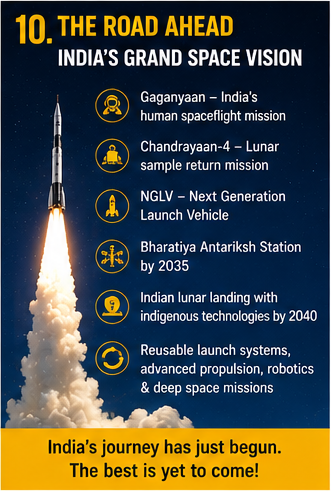
India's approved long-term roadmap envisions the Bharatiya Antariksh Station in orbit by 2035 and an Indian lunar landing using indigenous technologies by 2040.
A national space station would demand a new level of capability.
India would need reliable high-cadence launches, docking, orbital assembly, human transportation, cargo logistics, long-duration life support, power systems, robotics and potentially in-orbit servicing.
In other words, BAS could become an organizing objective around which multiple Indian space technologies converge.
20. India's Space Economy Could Become a Major Economic Engine

India's space programme is also transitioning from primarily a government scientific programme into a broader economic sector.
According to an April 2026 Government response, India's space economy was estimated at approximately $8.4 billion, or around 2% of the global space economy, in 2023.
The national strategy projects approximately:
$44 billion by 2033 — around 8% of the global space economy
and $100 billion by 2040 — around 10% of the global space economy.
These are projections and ambitions, not achievements already reached.
That distinction is important.
But if India approaches those targets, space could evolve into a substantial industrial sector encompassing launch services, satellites, components, software, geospatial intelligence, communications, navigation and downstream applications.
Why India Has the Potential to Become One of the World's Leading Space Powers

India has demonstrated capability.
The next question is whether it can convert capability into scale.
There are several reasons for optimism.
Indigenous engineering capability
India has progressively developed launch vehicles, solid and liquid propulsion, cryogenic systems, navigation, spacecraft, deep-space communications and docking capability.
That creates technological sovereignty.
Cost-conscious engineering culture
Indian space engineering has historically operated under tighter resource constraints than many larger programmes.
That encourages careful system design, reuse of proven technologies and disciplined mission planning.
Cost alone is not a competitive strategy, but high capability per unit of expenditure can be.
A complete launch-vehicle portfolio
India's transportation architecture increasingly covers different market requirements.
PSLV provides versatility.
GSLV provides heavier geosynchronous capability.
LVM3 supports heavy payloads and human-spaceflight ambitions.
SSLV targets smaller satellites and launch-on-demand services.
Future reusable systems and NGLV could expand the architecture further.
Enormous domestic demand
India itself needs space infrastructure.
Agriculture, telecommunications, navigation, weather forecasting, disaster management, defence, infrastructure, climate monitoring and connectivity all create domestic demand.
That means India's space industry does not have to depend entirely on exports to achieve scale.
Private-sector expansion
India's space reforms are designed to move more commercial activity toward industry while allowing ISRO to concentrate increasingly on advanced technology and scientific missions.
This could be transformational.
A national space programme can achieve remarkable things.
A national space economy, containing hundreds of companies, research institutions, investors and startups, can potentially achieve much more.
India's software advantage
Modern rockets and satellites are as much software-defined systems as mechanical ones.
Flight software, simulation, AI, digital twins, autonomous navigation, satellite analytics and mission planning are increasingly important.
India's large software and engineering talent base could therefore become a strategic advantage.
International credibility
India has successfully collaborated with major international space partners.
NISAR is a particularly important example of India and NASA working together on a highly sophisticated Earth-observation mission.
Long-term national roadmap
Perhaps most importantly, India's space ambitions are becoming interconnected.
Gaganyaan develops human-spaceflight capabilities.
SpaDeX develops docking.
Chandrayaan-4 requires complex lunar and return technologies.
NGLV expands transportation.
Bharatiya Antariksh Station creates a destination for sustained orbital activity.
The 2040 lunar objective pushes those technologies toward deep-space human exploration.
That creates continuity.
What India Must Do to Become a Top Global Space Leader
India's achievements should not lead to complacency.
Being among the world's leading space powers requires more than occasional spectacular missions.
India will need to increase launch frequency substantially.
It will need commercially competitive reusable launch technology.
It will need greater heavy-lift capacity.
It must continue improving reliability and quality assurance.
Private companies need predictable regulation and access to capital.
Space startups must graduate from demonstrations into sustainable global businesses.
Indian industry must manufacture launch vehicles and spacecraft at scale.
Universities need deeper connections with space research and commercialization.
India must also develop stronger capabilities in orbital servicing, space situational awareness, debris mitigation, advanced propulsion, robotics and autonomous spacecraft.
And India's share of the global commercial space economy must increase.
That last point is especially important.
Scientific prestige and commercial leadership are different things.
India has already demonstrated world-class scientific achievements.
The next great challenge is converting that capability into industrial scale, launch cadence and global market share.
India is Another Space Power
India can combine:
public scientific research + private entrepreneurship + cost-conscious engineering + large domestic demand + international partnerships + strategic technological autonomy.
That combination could produce a highly competitive space ecosystem.
The world does not necessarily need another identical space programme.
It may need a different model for achieving sophisticated space capability economically and sustainably.
India has an opportunity to build that model.
From Rohini to a Future Indian Space Station
Consider the progression.
India once worked simply to place a small satellite into Earth orbit.
Then came PSLV.
Then indigenous cryogenic capability.
Then the Moon.
Then Mars.
Then heavier launch vehicles.
Then a record-setting multi-satellite launch.
Then lunar landing.
Then solar observation.
Then autonomous orbital docking.
Now come human spaceflight, lunar sample return, next-generation launch vehicles and a planned national space station.
This progression explains why India's space achievements matter.
The country has repeatedly moved from demonstrating one capability to attempting the next more difficult capability.
Frequently Asked Questions
What is India's biggest rocket achievement?
There is no single answer. SLV-3 established independent orbital launch capability; PSLV created a versatile operational launcher; indigenous cryogenic propulsion strengthened technological autonomy; LVM3 expanded heavy-launch capability; and SpaDeX demonstrated orbital docking. Chandrayaan-3, although primarily a lunar mission rather than a rocket-development project, is arguably India's most globally visible recent space achievement.
Which is India's most powerful operational rocket?
LVM3 is India's most capable operational launch vehicle in terms of payload capacity. ISRO states that it can carry roughly 10 tonnes to low Earth orbit and around four-tonne-class communication spacecraft toward GTO.
Why is PSLV famous?
PSLV became famous for its versatility and extensive mission history. It launched Chandrayaan-1, the Mars Orbiter Mission and Aditya-L1 and has also been extensively used for commercial customer satellites.
Did India really launch 104 satellites on one rocket?
Yes. PSLV-C37 deployed 104 satellites in 2017, establishing a world record at the time.
Is India the first country to land on the Moon's south pole?
The precise statement is that India became the first country to successfully soft-land near the lunar south polar region through Chandrayaan-3.
How important is SpaDeX?
Extremely important. It made India the fourth nation to demonstrate space docking and provided technology relevant to future sample-return missions, orbital servicing and space-station operations.
Can India become the world's leading space power?
India clearly has the technological base to become one of the world's most consequential space powers. Becoming the outright leader would additionally require far greater launch cadence, heavy-lift capacity, reusable systems, private-sector scale, investment and commercial market share. India's projected space-economy growth suggests substantial ambition, but those projections should be treated as targets rather than guaranteed outcomes.
Conclusion: India's Greatest Rocket Achievement May Still Be Ahead
India's space story began with experimentation.
It progressed to independent access to orbit.
Then came operational launch vehicles, cryogenic propulsion, commercial satellite launches, lunar exploration, Mars exploration, heavy launch capability, small-satellite launch systems, solar science and orbital docking.
The next chapter is potentially much larger.
India is moving toward human spaceflight, lunar sample return, more capable launch vehicles, reusable systems and eventually the Bharatiya Antariksh Station.
The most impressive part of India's rocket journey therefore may not be any individual record.
It is the continuity of technological advancement.
From Rohini to PSLV.
From PSLV to Mars.
From GSLV to indigenous cryogenic capability.
From LVM3 to Chandrayaan-3.
From SpaDeX to future space stations.
And from a predominantly government-led programme toward a wider commercial space economy.
India has already proved that it belongs among the world's major spacefaring nations.
The next test is whether it can transform world-class engineering capability into world-leading scale, frequency, innovation and economic impact.
If India succeeds in doing that, the country's greatest space achievements may not be behind it.
They may be just beginning.
Disclaimer
This article, “India’s Rocket Achievements: How India Became a Global Space Power and Why the Next Era Could Be Even Bigger,” has been created for educational, informational and general awareness purposes only.
Parikshit Khanna, Digital Training Jet, its team members, associates, employees and contributors are not affiliated with, endorsed by, sponsored by, officially associated with, or representatives of the Government of India, the Department of Space, ISRO, NASA, or any other government, space agency, scientific institution or organization mentioned in this article.
All organization names, mission names, programme names, trademarks and related intellectual property belong to their respective owners. Their inclusion is solely for identification, commentary, education and factual reference.
Information concerning rockets, missions, achievements, timelines, future programmes, economic projections and other developments has been compiled from publicly available and authoritative sources believed to be reliable at the time of publication. Space programmes and future mission schedules may change due to technical, operational, regulatory, financial or policy considerations.
Images and illustrations accompanying this article may include AI-generated or illustrative visualizations created for educational and editorial presentation. Such visuals should not be interpreted as official photographs, engineering drawings, mission designs or representations issued or approved by any space agency.
While reasonable efforts have been made to maintain accuracy, Parikshit Khanna, Digital Training Jet and its team make no representation or warranty regarding the completeness, accuracy or continued currency of every statement and accept no responsibility for decisions made solely on the basis of this article.
For official and most current information about Indian space missions and programmes, readers should refer directly to the relevant Government of India and official space-agency publications.
© Parikshit Khanna / Digital Training Jet. Educational and editorial content. No official affiliation or endorsement is implied.


