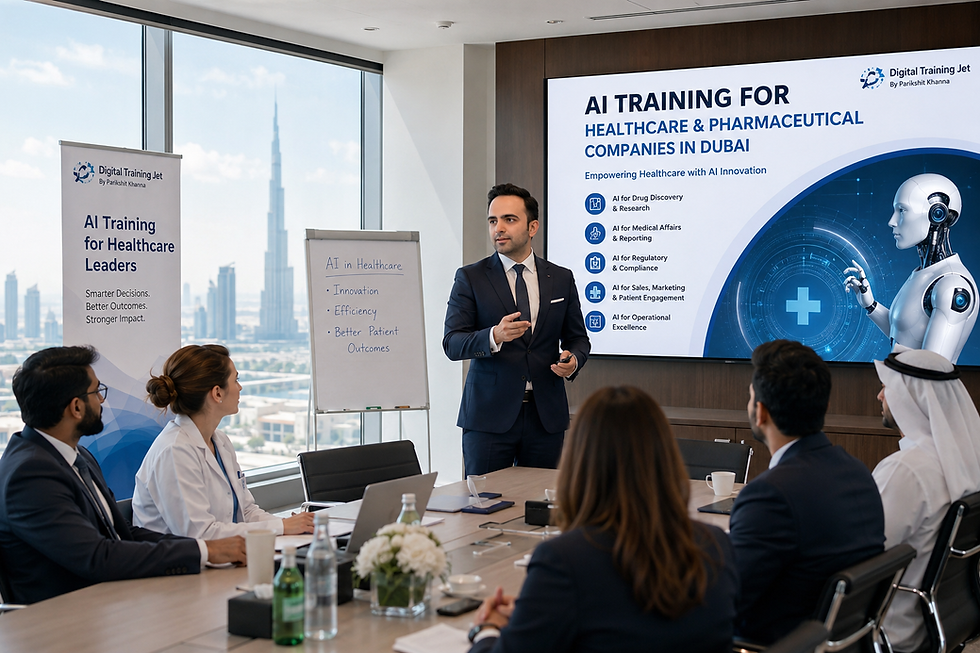
AI in Healthcare in DUBAI

Updated: Aug 17
AI in Healthcare for Doctors in DUBAI: Secure ChatGPT, Copilot, Claude and Custom GPT Training for Clinical Productivity and Patient Growth
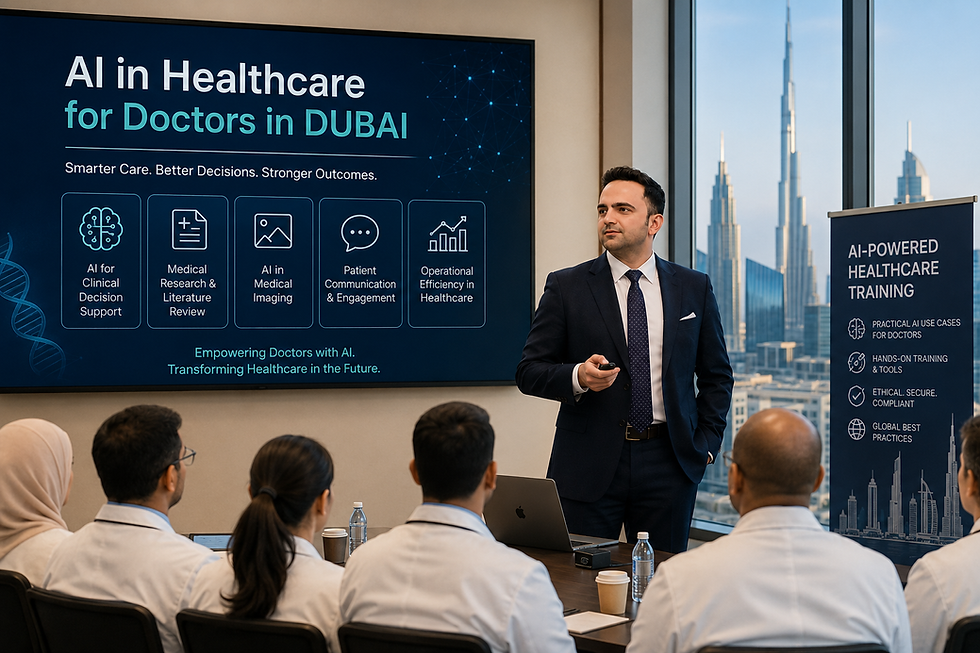
Dubai has never been a city that waits for the future. From the Burj Khalifa and Palm Jumeirah to the Museum of the Future, it has repeatedly turned ambitious ideas into working realities through vision, technology and disciplined execution. Its healthcare sector is moving with the same energy—adopting artificial intelligence, connected health information systems, predictive analytics and smarter patient services.
For doctors, hospital leaders and healthcare administrators, meaningful AI adoption is not about chasing every new tool. It is about saving clinical time, communicating with patients more effectively, protecting sensitive data, and ensuring that technology strengthens—not replaces—the human relationship at the heart of medicine.
A patient may forget the software used by a hospital, but they will remember whether the doctor listened, whether the follow-up arrived on time, and whether the organisation treated their personal information with respect.
That is where practical, healthcare-specific AI training becomes essential.
Why AI Is No Longer Optional for Dubai’s Healthcare Sector
Artificial intelligence is becoming a decisive advantage in healthcare operations, patient engagement, medical tourism, clinical documentation, risk management, compliance and service quality.
Dubai Health Authority has identified AI as a major instrument for improving healthcare delivery, streamlining administrative and medical processes, supporting earlier diagnosis and improving patient outcomes. DHA has also invested in AI, cybersecurity and data-strategy capability as part of Dubai’s smart healthcare transformation.
For healthcare organisations, competitive advantage will not come from merely purchasing an AI subscription. It will come from teaching doctors, nurses, administrators, marketing teams, call-centre executives and management teams how to use approved AI systems responsibly.
AI can help healthcare organisations:
Reduce time spent preparing routine documentation
Improve appointment and treatment follow-ups
Draft clearer patient education material
Organise referral and inquiry pipelines
Analyse operational and market information
Create multilingual patient communication
Convert meeting transcripts into action plans
Accelerate new healthcare services and product launches
Improve CRM productivity without compromising patient privacy
Build consistent internal policies, FAQs, SOPs and help-centre content
The objective is not “more AI.” The objective is better healthcare work, supported by secure AI.
Practical AI Applications for Doctors, Clinics and Hospitals in Dubai
1. Clinical Documentation Assistance Doctors can use approved enterprise AI environments to prepare first drafts of consultation summaries, referral letters, discharge-instruction templates, patient education notes, case-discussion summaries, internal clinical meeting records and standardised procedure explanations.
AI-generated clinical content must always remain a draft. A qualified healthcare professional must verify accuracy, context, medical terminology and suitability of every output before use. AI should reduce typing—not clinical accountability.
2. Lead Generation, Follow-Up and CRM Productivity Healthcare lead generation must be educational, ethical and consent-based. AI can support the non-clinical parts of the patient journey without exploiting medical vulnerabilities.
A typical healthcare CRM workflow can:
Capture a website, WhatsApp or call-centre inquiry
Categorise it by service, location, preferred language and requested appointment date
Assign the inquiry to the correct clinic or coordinator
Draft a personalised acknowledgment
Schedule an approved follow-up
Alert a human team member when a response is overdue
Generate a management dashboard showing inquiry sources and conversion stages
AI must not independently diagnose a person from an inquiry or use sensitive health information for unauthorised marketing. Different patient journeys (for example, a dermatology inquiry from Jumeirah versus an international orthopaedic inquiry) require different communication paths. AI makes personalisation scalable while governance keeps it responsible.
3. Appointment and Post-Consultation Follow-Ups AI-assisted systems can draft appointment confirmations, preparation instructions, missed-appointment messages, follow-up reminders, preventive health-check reminders, patient satisfaction messages, insurance-document checklists, and multilingual communication in English, Arabic, Hindi and other approved languages.
The system can flag pending follow-ups, but it should never send sensitive clinical information through an unapproved channel.
4. Meeting Summaries and Action-Item Extraction An approved AI workflow can analyse a meeting transcript and extract decisions, list clear action items, recommend owners, identify deadlines, highlight unresolved risks, draft follow-up emails, prepare a management summary, and update a project or CRM tracker after human approval.
This is especially useful for hospital expansion meetings, quality reviews, accreditation preparation, insurance discussions, medical-device implementation and multidisciplinary team coordination.
5. Market-Trend Synthesis AI tools can analyse approved industry reports, public healthcare information, consumer behaviour data and competitive intelligence to draft market-entry or service-expansion briefs (for example, preventive cardiology, fertility, dermatology, dental, longevity or home-health services). AI accelerates synthesis; management must still verify sources and involve healthcare, regulatory, financial and legal experts before decisions.
6. Technical Documentation and Healthcare Product Launches AI can help convert technical specifications, architectural notes, software workflows, device operating instructions, support tickets and training recordings into structured drafts for user manuals, product documentation, staff training material, implementation checklists, help-centre articles, troubleshooting guides, patient-friendly explanations and sales enablement material.
All regulated, clinical and technical claims must be approved by the responsible medical, quality, regulatory and legal teams before publication.
7. Medical Tourism and International Patient Experience Dubai serves patients from across the Middle East, Africa, Asia and Europe. AI can support clearer and faster communication around treatment inquiry acknowledgments, document requirements, estimated journey stages, visa-support information, airport and hotel coordination, appointment schedules, interpreter requests and post-treatment follow-up plans—while preserving warmth and cultural sensitivity.
AI Workflow Examples for Dubai Healthcare Organisations
Healthcare Requirement | AI-Assisted Output | Required Human Control |
New patient inquiry | Categorisation, acknowledgment, assignment | Coordinator verifies recipient and message |
Referral letter | Structured first draft | Doctor verifies all clinical details |
Missed appointment | Personalised reminder | Clinic-approved communication rules |
Management meeting | Decisions, owners, deadlines, follow-up email | Meeting owner approves action list |
Service launch | Market brief, competitor summary, checklist | Leadership, legal and clinical review |
Patient FAQ | Plain-language educational draft | Medical and compliance approval |
Technical product notes | Manual or help-centre draft | Engineering and quality validation |
CRM review | Lead-stage and response-time dashboard | Authorised access and data minimisation |
Hospital SOP | Structured procedure draft | Department and quality-team approval |
Public health content | Educational article or video script | Evidence and medical review |
ChatGPT, Microsoft Copilot, Claude and Related Tools for Healthcare
Different platforms serve different requirements. A responsible training programme teaches when to use each tool—and when not to.
ChatGPT and Custom GPTs support research organisation, writing, summarisation, communication and document preparation. Organisations can create controlled custom assistants for internal policy navigation, approved patient FAQs, staff onboarding, SOP discovery, insurance checklists and training support. Healthcare organisations should use appropriately contracted business or healthcare offerings rather than uploading confidential patient information into uncontrolled consumer accounts.
Microsoft 365 Copilot works inside familiar applications (Word for SOPs and reports, Excel for operational analysis, PowerPoint for presentations, Outlook for email summaries, Teams for meeting summaries, SharePoint for approved knowledge discovery). Existing access permissions and information-classification practices remain essential.
Claude is particularly useful for long-document analysis, policy comparison, structured reasoning, technical documentation, complex meeting synthesis and research organisation. Clinical or legal conclusions must still be independently verified.
Supporting tools include Power BI (dashboards), n8n and approved automation platforms (connecting forms, CRM, email, calendars and approval processes), carefully governed agentic AI (with strict permissions, human checkpoints and audit logging), and visual tools such as Canva for medically reviewed patient education and training materials.
Data Security Must Come Before AI Productivity
In healthcare, a fast output is useless if it exposes patient information.
DHA’s AI policy applies to AI solutions used by healthcare facilities, professionals, pharmaceutical manufacturers, health insurers, public-health entities and researchers within its jurisdiction. Health-information requirements emphasise patient consent, controlled access, secure sharing, role-based permissions, sharing only the minimum necessary information, and appropriate workforce training.
Ten Security Rules for Healthcare AI
Do not enter identifiable patient information into an unapproved AI tool.
Use organisation-approved enterprise accounts and configurations.
Apply role-based access and least-privilege principles.
Collect and document consent where required.
Share only the minimum information necessary for the task.
Anonymise or de-identify information whenever practical.
Maintain audit logs, retention rules and incident procedures.
Use human review before clinical, legal or patient-facing use.
Assess third-party connectors, plug-ins, agents and external models separately.
Never allow a general-purpose AI assistant to become the final autonomous clinical decision-maker.
Data security is not a short disclaimer at the end of a workshop. It must be built into every demonstration, prompt, automation and implementation framework.
AI Healthcare Training Across Dubai and the UAE
Programmes can be customised for healthcare organisations across the UAE’s seven emirates—Dubai, Abu Dhabi, Sharjah, Ajman, Umm Al Quwain, Ras Al Khaimah and Fujairah—and delivered in major locations including Dubai Healthcare City, Jumeirah, Deira, Business Bay, Downtown Dubai, Dubai Marina, Abu Dhabi, Al Ain, Sharjah and other key centres.
Formats include leadership briefings, doctor-focused practical workshops, departmental training, full-day AI bootcamps, multi-day adoption programmes or online sessions for distributed teams.
Why Organisations Choose Parikshit Khanna
Healthcare leaders need a trainer who connects AI with clinical documentation, CRM operations, financial controls, customer experience, technical documentation, management reporting and enterprise data security—not just prompt demonstrations.
Parikshit Khanna has trained more than 3 lakh+ professionals and learners through corporate, institutional, healthcare, government and professional programmes. His published portfolio records him as the first trainer to deliver a dedicated AI in Healthcare session at IIT Delhi, covering “ChatGPT for Healthcare Professionals” and a broader generative-AI programme featuring more than 23 tools.
Core capabilities include:
Generative AI for healthcare and corporate teams
Advanced prompt engineering and custom GPT development
Microsoft 365 Copilot enterprise workflows
Claude for complex analysis and documentation
Agentic AI design, n8n automation and Power BI dashboards
AI-enabled CRM productivity and lead-generation systems
Medical, technical and operational documentation
Enterprise data security, responsible AI and controlled deployment
His approach is hands-on. Participants work on prompts, frameworks, dashboards, communication templates and automation designs connected to their actual roles.
Healthcare and pharmaceutical experience spans CARE Hospitals, Fortis, Santevita, Cloudnine, multiple medical associations, Hetero Pharma, USV, Wockhardt, Sudeep Pharma, AIIMS Delhi, IIT Delhi healthcare programmes and related audiences. Cross-sector experience in finance, government, education, manufacturing, travel/medical tourism and real estate further strengthens the ability to address the full operational context of modern hospitals.
Recommended AI in Healthcare Training Programme for Dubai Doctors
Module 1: Responsible AI Foundations What generative AI can and cannot do, hallucination and verification risks, approved versus unapproved use cases, prompt fundamentals, and human accountability.
Module 2: ChatGPT, Copilot and Claude for Doctors Consultation and referral drafts, patient education, research organisation, email and meeting productivity, long-document analysis, and multilingual communication.
Module 3: Lead Generation and Healthcare CRM Ethical inquiry capture, patient journey mapping, follow-up sequences, appointment reminders, lead assignment, escalation and CRM dashboards.
Module 4: Data Security and DHA-Aligned Governance Protected health information, consent and access control, data minimisation, role-based access, enterprise accounts, audit and approval processes, and secure custom assistants.
Module 5: Custom GPTs, Agents and Automation Internal FAQ assistants, SOP knowledge agents, meeting-to-action workflows, CRM and calendar integration, human approval checkpoints, and n8n architecture.
Module 6: Healthcare Leadership and Growth Market-trend synthesis, service-line expansion, medical tourism, product launches, technical documentation, Power BI management dashboards, and AI adoption roadmaps.
Frequently Asked Questions
Can doctors use ChatGPT for patient documentation? Doctors can use an organisation-approved enterprise AI environment to prepare drafts, but identifiable patient information should not be placed in an unauthorised tool. Every output must be reviewed by a qualified healthcare professional.
Can AI be used for healthcare lead generation? Yes—for consent-based education, inquiry management, appointment communication and CRM follow-up. AI should not exploit sensitive medical information or independently make clinical judgments.
Is Microsoft Copilot secure for hospitals? Microsoft provides enterprise data-protection commitments for Microsoft 365 Copilot, but hospitals must still correctly configure permissions, retention, identity controls, information classification and approved data access.
Does AI replace a doctor’s clinical judgment? No. AI may assist with drafting, summarising and organising information, but diagnosis, treatment and clinical accountability remain with appropriately qualified healthcare professionals.
Book AI in Healthcare Training in Dubai
AI adoption should make doctors more present, healthcare teams more responsive, and organisations more efficient—while keeping patient trust and data security at the centre.
For customised programmes for doctors, hospital leadership, clinical teams, administrators or multi-emirate groups, connect with:
Parikshit Khanna Corporate AI & Generative AI Trainer | Founder – Digital Training Jet Phone / WhatsApp: +91 99972 13177 | +91 80762 50669 Email: pkhanna123@gmail.com Website: www.parikshitkhanna.com LinkedIn / X: @ParikshitK_
Reach out for workshops, leadership brie