Corporate AI Training in Dubai

Updated: 2 minutes ago
CONTENT AND COVER REFRESH • 7 OCTOBER 2026
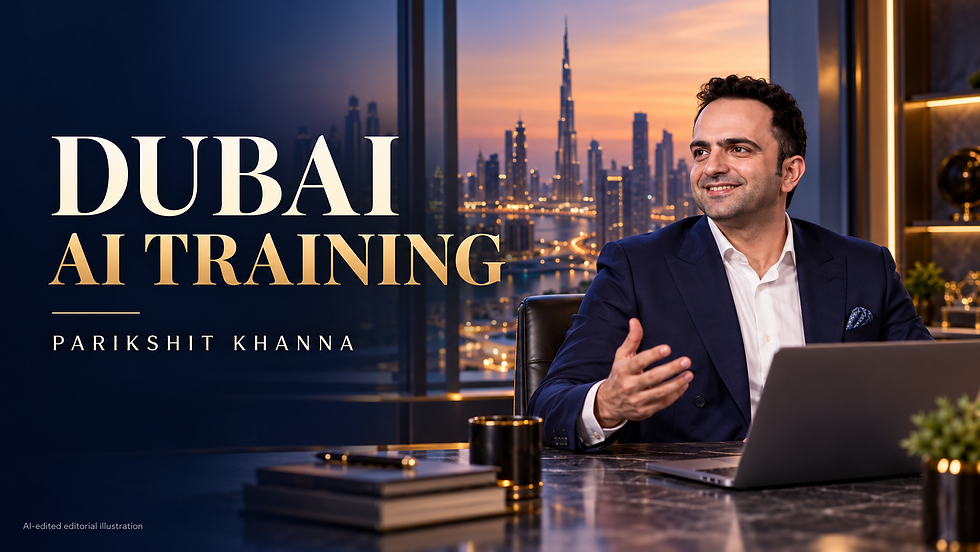
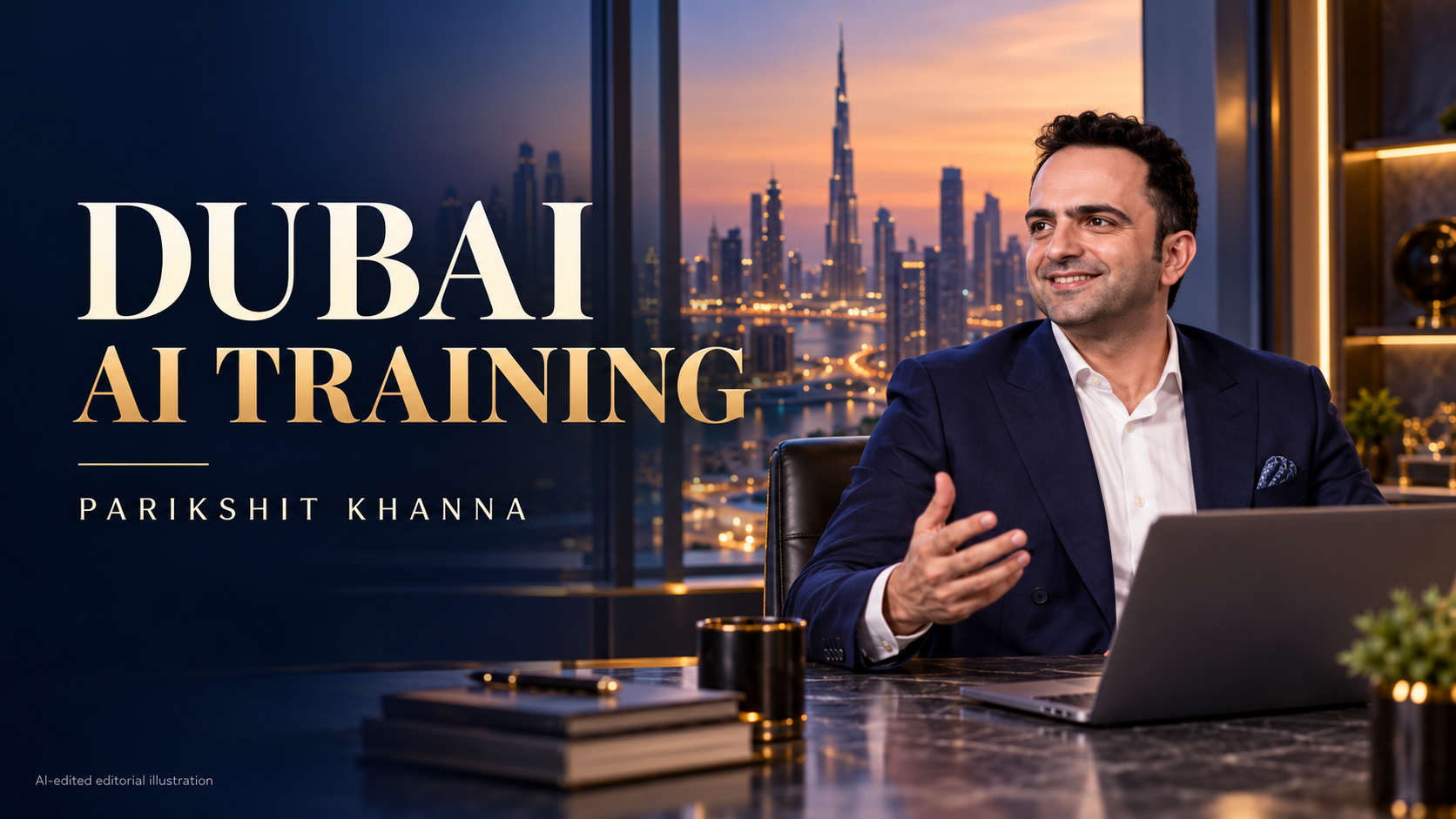
Cover: AI-edited editorial illustration featuring Parikshit Khanna. The scene is conceptual and does not document an actual event, clinical consultation, hotel stay or design project.
Use this guide to plan a practical AI learning programme with Parikshit Khanna. Confirm the proposed scope, tool access, format and availability directly before booking.
Delivery dates, travel arrangements, tool versions and commercial terms are subject to direct confirmation. Historic productivity percentages or market projections in older source material should not be treated as promised results for this programme.
Corporate AI Training in Dubai: Customised 1-7 Day Enterprise AI Masterclass for Organisations
Artificial intelligence adoption is no longer limited to technology companies. Sales teams are using AI to prepare proposals, HR departments are accelerating recruitment documentation, marketing teams are producing campaign assets, finance professionals are analysing business information, and operational teams are automating repetitive workflows.
However, providing employees with access to AI tools is not the same as achieving enterprise-wide AI adaptability.
Organisations need a structured AI adoption programme that helps employees:
Understand Generative AI clearly
Select the right AI tool for each business task
Write accurate and reusable prompts
Protect confidential organisational information
Automate repetitive processes
Build AI-enabled workflows and internal assistants
Apply AI responsibly within departmental roles
Convert AI experimentation into measurable productivity
To support this transformation, Parikshit Khanna, Founder and Lead Trainer at Digital Training Jet, conducts customised Corporate AI Training in Dubai for companies, government departments, educational institutions, professional firms, startups and multinational teams.
That is the focus of Parikshit Khanna’s corporate and Generative AI training programmes in India.
His current professional materials report a consolidated learning reach of more than 3 lakh+ professionals across corporate, institutional, executive and broader learning engagements.
The programme can be delivered as a focused one-day AI masterclass, a detailed two- or three-day corporate workshop, or an end-to-end seven-day enterprise AI enablement programme.
Training is available:
On-site in Dubai and across the UAE
Live online for distributed teams
In a hybrid training model
As a CXO and leadership briefing
As a department-specific workshop
As an organisation-wide AI adoption programme
On special dates through advance booking
Why Organisations in Dubai Need Structured AI Training
Dubai continues to develop as a centre for technology, innovation, professional services, retail, hospitality, real estate, logistics, finance and international business.
Employees across these sectors are already experimenting with ChatGPT, Claude, Gemini, Microsoft Copilot and other AI platforms. Without structured guidance, however, organisations may experience:
Inconsistent AI usage
Employees selecting unsuitable tools
Weak or inaccurate prompts
Confidential information being entered into public AI systems
AI-generated content being used without verification
Duplicate subscriptions across departments
Automation projects without governance
Low adoption after purchasing enterprise AI licences
Difficulty measuring productivity improvements
A well-designed corporate programme addresses these issues by connecting AI tools with actual job responsibilities, organisational workflows, governance requirements and business objectives.
Corporate AI Masterclass Conducted by Parikshit Khanna
His training approach focuses on practical business implementation rather than theoretical demonstrations. Participants learn through:
Live business examples
Department-specific prompts
Guided tool demonstrations
Hands-on exercises
Workflow-building activities
Business case studies
Group challenges
AI governance discussions
Custom use-case development
Post-training implementation recommendations
The training can be adapted for beginner, intermediate and advanced participants.
Available Corporate AI Training Formats
One-Day Corporate AI Masterclass
The one-day programme is suitable for organisations seeking a practical introduction to Generative AI and immediate productivity use cases.
Participants learn:
Fundamentals of Generative AI
Differences between leading AI platforms
Prompt engineering principles
AI for emails, reports and documentation
AI for research and summarisation
AI for presentations and graphics
Microsoft Copilot fundamentals
Responsible AI and data privacy
Department-specific use cases
A practical AI adoption roadmap
Two-Day Corporate Generative AI Training
The two-day format provides additional time for hands-on practice and customised exercises.
Day One: AI Productivity and Content Workflows
Understanding Generative AI and Large Language Models
ChatGPT, Claude, Gemini and Microsoft Copilot comparison
Prompt-engineering frameworks
AI-assisted email writing
Reports, proposals and policy documents
Research, summarisation and information analysis
Presentation creation
Graphics and visual-content workflows
Responsible AI usage
Day Two: Automation and Enterprise Implementation
Microsoft Copilot for business teams
AI workflow design
Introduction to n8n automation
Connecting AI tools with business processes
Departmental use-case development
RAG fundamentals
Internal knowledge assistants
Agentic AI concepts
Governance and implementation planning
Team presentations and feedback
Three-Day Enterprise AI Adaptability Programme
The three-day programme is recommended for organisations that want employees to move beyond basic AI prompting and develop working AI-enabled processes.
Day One: Generative AI Foundations and Prompt Engineering
How Generative AI systems work
Business opportunities and limitations
Prompt structure and context engineering
Role, objective, constraints and output-format instructions
Prompt libraries for different departments
Evaluating and improving AI responses
Hallucination awareness and fact verification
Privacy and responsible use
Day Two: Claude, Copilot and 15+ Generative AI Tools
Claude for long-document analysis
Claude Projects and reusable organisational context
ChatGPT for productivity and structured problem-solving
Gemini for research and Google Workspace use cases
Microsoft Copilot for enterprise productivity
AI for Word, Excel, PowerPoint, Teams and Outlook workflows
AI tools for graphics and presentations
AI-assisted video, audio and content workflows
Tool-selection framework
Hands-on departmental exercises
Day Three: RAG, Automation, Vibe Coding and Agentic AI
Introduction to Retrieval-Augmented Generation
How RAG connects AI with organisational knowledge
Internal knowledge-base planning
n8n workflow automation
Trigger, action and condition-based workflows
AI agents and multi-step task execution
Agentic AI opportunities and governance risks
Vibe Coding for rapid prototypes
Building simple internal applications without traditional development
Department-specific automation planning
Ninety-day AI implementation roadmap
Customised Four- to Seven-Day Corporate AI Programme
Organisations requiring deeper implementation support can book a four-, five-, six- or seven-day programme.
The expanded programme may include:
Generative AI fundamentals
Advanced prompt engineering
Claude for enterprise documentation
Microsoft Copilot enterprise adoption
AI for Word, Excel and PowerPoint
AI-assisted research and analysis
Graphics, presentations, video and audio tools
Vibe Coding and application prototyping
RAG architecture and knowledge assistants
n8n automation workflows
Agentic AI systems
Departmental use-case laboratories
Responsible AI and governance
AI champions and internal adoption planning
Final projects and implementation presentations
The course duration is selected according to the organisation’s:
Number of participants
Current AI maturity
Departments involved
Technical proficiency
Security requirements
Preferred tools
Expected business outcomes
Need for hands-on implementation
Claude AI Training for Corporate Teams
Claude can support teams working with long documents, complex instructions, policies, proposals, research material and knowledge-intensive tasks.
The Claude module may cover:
Claude interface and model capabilities
Structuring detailed prompts
Analysing lengthy documents
Summarising reports and policies
Comparing multiple documents
Extracting actions, risks and decisions
Creating reusable templates
Claude Projects
Building role-specific instructions
Creating document-review workflows
Drafting reports, proposals and SOPs
Responsible handling of organisational information
Comparing Claude with ChatGPT, Gemini and Copilot
Participants practise with use cases relevant to their own functions instead of relying only on generic examples.
Microsoft Copilot Enterprise Training
Purchasing Microsoft Copilot licences does not automatically ensure employee adoption. Teams need practical instruction on when, where and how to use Copilot.
The corporate Microsoft Copilot module can include:
Copilot enterprise fundamentals
Copilot in Microsoft Word
Copilot in Microsoft Excel
Copilot in PowerPoint
Copilot in Outlook
Copilot in Microsoft Teams
Meeting summaries and action points
Email drafting and response preparation
Document transformation
Presentation development
Spreadsheet analysis
Prompting with organisational context
Data-security awareness
Adoption measurement
Department-specific Copilot use cases
Training can be aligned with the organisation’s existing Microsoft 365 environment and employee roles.
RAG Model Training for Organisations
A public AI assistant may not understand an organisation’s internal policies, products, historical documents or operating procedures. Retrieval-Augmented Generation, commonly known as RAG, helps connect an AI system with an approved knowledge source.
The RAG module explains:
What Retrieval-Augmented Generation means
Difference between general AI responses and grounded responses
Documents suitable for a RAG knowledge base
Document preparation and chunking concepts
Embeddings and retrieval fundamentals
Vector-database concepts
Source-based response generation
Access control and governance
Updating organisational knowledge
Evaluating response quality
Common RAG implementation failures
Use cases for HR, operations, support, sales and compliance
Possible enterprise RAG use cases include:
Employee-policy assistant
Product-information assistant
Sales knowledge assistant
Customer-support knowledge base
Training and onboarding assistant
Internal SOP assistant
Research-document assistant
Compliance-information assistant
n8n Automation Training
n8n helps teams connect applications, information and AI models through visual workflows.
The n8n corporate training module may include:
Understanding workflow automation
Triggers, actions and conditions
Connecting forms, email and spreadsheets
AI-powered data processing
Automated summaries
Lead-routing workflows
Content-approval workflows
Report-generation workflows
Notification and escalation systems
Human approval within AI workflows
Error handling
Workflow documentation
Security and credential awareness
Building a department-specific automation
Example workflows can be selected according to the organisation’s technology stack.
Agentic AI Training for Enterprise Teams
Agentic AI systems are designed to perform multi-step tasks, use tools, make controlled decisions and work towards defined objectives.
The Agentic AI module covers:
Difference between chatbots, workflows and AI agents
Components of an AI agent
Goals, tools, memory and instructions
Single-agent and multi-agent concepts
Human-in-the-loop approval
Agent planning and execution
Tool-use permissions
Auditability and monitoring
Reliability and hallucination risks
Security boundaries
Cost and performance considerations
Suitable and unsuitable enterprise use cases
Participants learn to identify processes where agents may add value without removing necessary human judgement.
Vibe Coding Training for Business Teams
Vibe Coding allows professionals to use natural-language instructions and AI coding assistants to prototype websites, dashboards, utilities and simple applications.
This module can help participants understand:
How AI-assisted coding works
Translating a business problem into an application brief
Creating interface requirements
Generating and reviewing code
Prototyping an internal utility
Building forms and dashboards
Creating simple workflow applications
Testing AI-generated applications
Identifying security and quality risks
Knowing when professional development support is required
The objective is not to replace software engineers. It is to help business teams communicate requirements clearly, test ideas quickly and create initial prototypes responsibly.
Generative AI Tools Covered During the Programme
Depending on the organisation’s requirements and approved technology environment, the masterclass may demonstrate 15 or more tools from categories such as:
Text, Research and Documentation
ChatGPT
Claude
Google Gemini
Microsoft Copilot
Perplexity
NotebookLM
Presentations and Graphics
Canva AI
Microsoft Designer
Adobe Firefly
Gamma
Napkin AI
Video and Audio
ElevenLabs
HeyGen
VEED
Descript
Automation and Application Development
n8n
Microsoft Copilot Studio
AI coding assistants
No-code application platforms
RAG and knowledge-assistant tools
The final tool list is customised before the programme. Organisations can request greater focus on selected platforms instead of covering every tool superficially.
Department-Specific AI Training
AI Training for Leadership and CXOs
Enterprise AI opportunities
AI investment priorities
Organisational readiness
Governance and accountability
AI adoption roadmap
Risk management
Measuring productivity and return on investment
Building an AI-enabled organisational culture
AI Training for Human Resources
Job descriptions
Recruitment communication
Interview-question development
Onboarding documentation
Employee-learning content
Policy simplification
Survey analysis
HR knowledge assistants
Responsible handling of employee data
AI Training for Marketing Teams
Campaign ideation
Audience research
Content calendars
Advertising copy
Landing-page planning
Visual-content workflows
Video scripts
Brand-consistent prompting
Competitive research
Marketing automation
AI Training for Sales Teams
Prospect research
Personalised outreach
Meeting preparation
Proposal development
Follow-up communication
Account summaries
CRM-related workflows
Sales knowledge assistants
Objection-handling practice
AI Training for Finance Teams
Report summaries
Variance commentary
Spreadsheet assistance
Management presentations
Policy and document analysis
Repetitive reporting workflows
Data-verification practices
Confidentiality and access controls
AI Training for Operations and Administration
SOP development
Process mapping
Meeting documentation
Vendor comparisons
Workflow automation
Internal knowledge management
Task and escalation systems
Operational reporting
AI Training for IT and Technology Teams
Enterprise model selection
RAG concepts
AI-agent architecture
API and integration planning
n8n automation
Copilot adoption
Security considerations
Evaluation and monitoring
AI governance
Training Methodology
The programme follows a practical corporate-learning methodology:
1. Pre-Training Requirement Assessment
The organisation shares:
Participant profiles
Departments
Existing AI tools
Current business challenges
Data-security restrictions
Expected outcomes
2. Customised Course Design
Examples, exercises and prompts are adapted to the organisation’s industry and employee roles.
3. Instructor-Led Demonstration
Parikshit Khanna demonstrates workflows step by step and explains both the capability and limitation of each tool.
4. Hands-On Practice
Participants complete guided exercises using approved tools and sample information.
5. Departmental Use-Case Development
Teams identify practical applications within their existing responsibilities.
6. Governance Discussion
The programme addresses verification, privacy, intellectual property, human review and responsible AI use.
7. Adoption Roadmap
The organisation receives recommendations for continuing AI adoption after the programme.
Expected Learning Outcomes
After completing the training, participants should be better prepared to:
Use Generative AI with clear business objectives
Write structured prompts
Select appropriate AI tools
Develop professional documents faster
Analyse and summarise information
Create presentations and visual assets
Recognise AI errors and hallucinations
Protect confidential information
Build basic automated workflows
Understand RAG and internal knowledge assistants
Understand Agentic AI opportunities and risks
Prototype simple solutions through Vibe Coding
Develop department-specific AI use cases
Contribute to an organisational AI roadmap
Actual results depend on participant engagement, tool access, data availability, management support and post-training implementation.
Who Should Attend?
The programme can be customised for:
CEOs, founders and business owners
Department heads
Senior managers
HR and learning-development professionals
Marketing and sales teams
Finance and operations teams
IT and digital-transformation teams
Customer-service teams
Trainers and instructional designers
Government and public-sector professionals
University and institutional leadership
Cross-functional AI champion groups
Separate tracks can be created for leadership, business users and technical teams.
Industries Served
Corporate AI training can be adapted for:
Banking and financial services
Wealth management
Retail and luxury retail
Real estate
Hospitality and tourism
Manufacturing
Information technology
Healthcare
Education
Consulting
Media and communication
Logistics
Professional services
Government and public-sector organisations
Consumer and D2C businesses
Practical workflows and review criteria
The exercises below are proposed learning activities for the audience and work discussed in this guide. Select approved source material and account access before the session. Human review remains part of the workflow.
Focus | Practical action | What to verify |
Document briefing | Turn a supplied document into a decision brief with traceable sources. | Check important qualifications and missing evidence. |
Business communication | Draft an audience-specific email from approved facts. | Review commitments, tone and sensitive information. |
Reporting | Organise an approved data extract and explain the calculation. | Recalculate totals and investigate anomalies. |
A useful prompt and a measurable pilot
Give the AI a task, audience, approved source, constraints and output format. Ask it to identify missing information and distinguish assumptions from facts. Test one workflow on comparable tasks and record time, corrections and usefulness before expanding it.
Frequently asked questions
Do I need a technical background?
Introductory workplace modules can suit non-technical learners. Coding, API integration and agent deployment are separate tracks that should be agreed in the brief.
Which tools are included?
The curriculum can cover ChatGPT, Claude, Gemini and Microsoft Copilot as appropriate to the approved accounts and learning goals. Availability, licences and features must be checked before the session.
Is on-site Dubai training guaranteed for a requested date?
No. Contact Parikshit to agree availability, delivery format, travel arrangements, duration and the written scope. Live online and private coaching can also be discussed.
What should a team measure after training?
Review one repeatable task for time, factual accuracy, required corrections and usability. Record a baseline and compare equivalent work. No fixed productivity gain or ranking result is promised.
About Parikshit Khanna
Parikshit Khanna is an AI trainer and corporate speaker. His current profile records training for 3,50,000+ professionals. He helps individuals, educators and business teams build practical AI skills through workshops and coaching. Training scope, delivery, availability and fees are agreed directly.
Courses and coaching
For a team or college programme, send the audience, objective, location or online format, proposed date and preferred duration. Check the current booking page for service details and availability.
Editorial method: AI assisted the drafting, formatting and cover creation. The cover is an AI-edited editorial illustration based on Parikshit's brand references. It does not document a real venue, product test, client project or training event. Commercial listings are research starting points; verify current credentials, terms and availability directly. Any paid promotion must be identified separately.