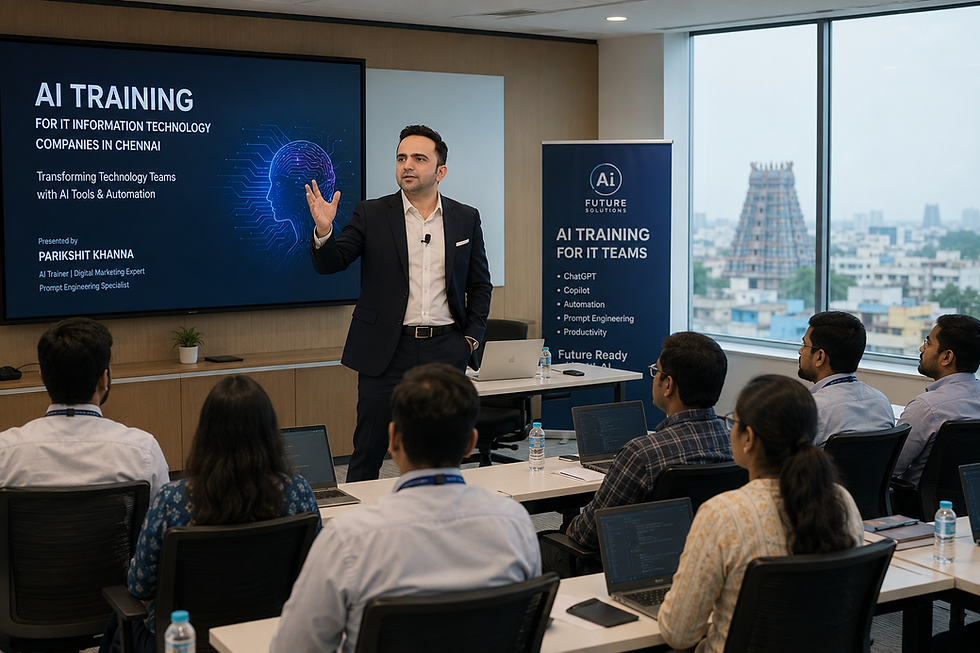
AI Training in Manufacturing, Automotive & Industrial Companies in South India

Updated: Aug 17
AI Training in Manufacturing, Automotive & Industrial Companies in South India

South India does not merely manufacture products. It manufactures possibilities.
From Chennai’s automobile corridors and Coimbatore’s engineering excellence to Bengaluru’s innovation ecosystem, Hyderabad’s pharmaceutical strength, Visakhapatnam’s port-led industrial growth and Kochi’s global commercial outlook, the region represents India’s confidence, precision and industrial ambition.
The Confederation of Indian Industry’s Southern Region covers Andhra Pradesh, Karnataka, Kerala, Tamil Nadu, Telangana and Puducherry. These markets collectively bring together automotive manufacturing, engineering, aerospace, electronics, pharmaceuticals, textiles, logistics, energy, tourism and technology.
For factories, automotive manufacturers, component suppliers, engineering companies, mining businesses, coal-sector organisations and industrial groups, artificial intelligence is no longer optional. It is becoming a decisive advantage in:
Production planning
Lead generation and CRM productivity
Market intelligence
Technical documentation
Quality management
Maintenance reporting
Vendor communication
Safety documentation
Customer service
Product-development support
Compliance reporting
Management decision-making
The real opportunity is not to replace engineers, plant managers, sales professionals or technicians. It is to give them practical AI capabilities that help them think faster, communicate clearly, reduce repetitive work and make better decisions.
That is the focus of Parikshit Khanna’s practical AI training for manufacturing, automotive and industrial companies across South India.
Why South Indian Manufacturing Companies Need Practical AI Training
South India contains some of India’s most important industrial clusters.
Tamil Nadu has established automotive and auto-component clusters across Chennai, Tiruvallur, Kanchipuram, Krishnagiri, Coimbatore and Madurai.
Karnataka combines manufacturing with aerospace, research, technology and advanced engineering. Bengaluru is not only an IT centre; it is also an important nucleus for aerospace, biotechnology, textiles, industrial research and innovation.
Telangana has major strengths in pharmaceuticals, biotechnology, chemicals, medical devices and electric mobility, with Hyderabad at the centre of its life-sciences ecosystem.
Andhra Pradesh’s industrial growth is supported by the Visakhapatnam–Chennai, Chennai–Bengaluru and Hyderabad–Bengaluru industrial corridors, its extensive coastline, operating ports and manufacturing clusters around Visakhapatnam, Nellore, Tirupati, Kadapa and Anantapur.
Kerala brings an equally important combination of logistics, tourism, food processing, healthcare, education, ports and service-led enterprise.
In every one of these sectors, employees are surrounded by information:
Production reports
Customer enquiries
Machine observations
Maintenance records
Quality documents
Sales pipelines
Vendor quotations
Technical specifications
Meeting transcripts
Audit requirements
Standard operating procedures
Market reports
Training manuals
Email conversations
Without structured AI training, these records remain fragmented. With the right AI workflows, they can become actionable business intelligence.
Practical AI Use Cases for Manufacturing and Industrial Teams
1. Lead Generation, Follow-Up and CRM Productivity
Manufacturing businesses frequently lose opportunities not because their products are weak, but because their follow-up systems are inconsistent.
A sales team may receive enquiries from:
Distributors
Dealers
Government departments
EPC contractors
Plant operators
Overseas buyers
Automotive OEMs
Real-estate developers
Procurement teams
Mining companies
Power plants
Infrastructure organisations
AI can help sales and business-development teams convert raw enquiries, meeting notes and call transcripts into:
Qualified lead summaries
Customer requirement sheets
Product-interest classifications
Follow-up email drafts
WhatsApp follow-up messages
CRM notes
Opportunity stages
Proposal outlines
Objection-handling responses
Next-action reminders
Assigned action owners
Follow-up deadlines
Sample AI Prompt for Industrial Lead Follow-Up
Analyse the following customer-enquiry transcript. Identify the customer’s company, industry, plant location, technical requirement, expected quantity, budget indicators, decision timeline, objections and competitors being considered. Create a concise CRM note, assign a lead-priority score from 1 to 10 and draft a professional follow-up email. Do not invent missing information. Clearly label details that require confirmation.
This workflow is valuable for industrial equipment, automotive components, chemicals, pharmaceuticals, lubricants, electrical products, construction materials, machinery and B2B services.
It can also automatically extract action items from meeting transcripts, recommend owners based on responsibilities and draft follow-up communications for approval.
2. Market Trend Synthesis with Copilot, ChatGPT and Claude
Accelerating the time-to-market for new products requires rapid market alignment and dependable documentation.
Microsoft Copilot, ChatGPT, Claude and other approved enterprise AI platforms can help teams analyse:
Industry reports
Consumer behaviour
Competitor positioning
Dealer feedback
Customer complaints
Pricing patterns
Export opportunities
Regulatory developments
Product reviews
Internal sales data
The result can be transformed into a structured market-entry brief covering:
Addressable market
Customer segments
Regional demand
Competitive advantages
Product gaps
Price positioning
Distribution options
Risk factors
Launch recommendations
Questions requiring additional research
Microsoft’s current documentation confirms that Microsoft 365 Copilot supports multiple model choices in approved experiences. Claude is available in supported Copilot Chat, Researcher and Copilot Studio environments, while Copilot Chat also uses OpenAI models. Availability can depend on the organisation’s licence, region, administrator settings and selected Copilot experience.
This means training must go beyond learning a single tool. Teams need to understand which model is suitable for a particular task, what data may be shared and where human verification is mandatory.
3. Technical Documentation and Product Manuals
Engineers and product teams often have deep technical knowledge but limited time to convert that knowledge into well-structured documentation.
AI can help convert raw technical inputs such as:
Product specifications
Engineering notes
Code structures
Architectural documents
Machine instructions
Troubleshooting records
Internal resolutions
Frequently asked questions
Test observations
Installation steps
into structured outputs such as:
Product manuals
Installation guides
Maintenance instructions
User documentation
Troubleshooting guides
Service checklists
Dealer training material
Technical FAQs
Help-centre articles
Customer-facing knowledge bases
AI can also transform internal technical resolutions into polished, public-facing help-centre articles.
For example, an internal note written by a service engineer may contain shorthand, incomplete sentences and specialised terminology. An approved AI workflow can reorganise it into:
Problem description
Probable causes
Safety precautions
Diagnostic procedure
Recommended resolution
Escalation conditions
Required spare parts
Preventive action
The final document must still be reviewed and approved by an authorised engineer before release.
4. Production, Maintenance and Quality Reporting
AI can support supervisors and engineers by converting production data and daily observations into:
Shift-handover reports
Downtime summaries
Root-cause-analysis drafts
Preventive-maintenance schedules
Corrective-action reports
Machine-performance summaries
Quality-deviation reports
CAPA documentation
Audit-preparation checklists
Spare-part requirement summaries
Vendor escalation emails
A plant manager can provide production figures, downtime reasons and quality observations and ask an approved AI assistant to create an executive summary.
A maintenance team can provide recurring failure records and ask AI to group the failures by machine, component, shift, frequency and probable cause.
AI should assist human analysis, not replace technical inspection, engineering judgement or statutory approval.
5. Automotive and Auto-Component Workflows
Automotive manufacturers and suppliers can use practical AI for:
Dealer communication
Warranty-claim summarisation
Supplier-performance reviews
Component comparison
Product-launch documentation
Service-centre knowledge bases
Customer-complaint analysis
Parts-demand forecasting support
Training content for technicians
Sales proposal personalisation
Market and competitor research
Electric-vehicle ecosystem analysis
For Tier 1, Tier 2 and Tier 3 suppliers, AI can help organise buyer requirements, technical clarifications, quality communications and documentation without allowing unapproved disclosure of drawings, designs or customer information.
6. Coal, Lignite, Mining and Heavy-Industry AI Training
Coal, lignite, mining, power and heavy-industry organisations manage complex operations involving safety, equipment, logistics, production, environmental reporting and large contractor ecosystems.
The Ministry of Coal oversees policies and strategies relating to coal and lignite development, including public-sector organisations such as Coal India and NLC India.
The sector is also undergoing broader digital transformation. A major ERP implementation for Coal India was reported as creating a foundational data layer for analysis, reports and dashboards.
Practical AI training for coal and mining companies can include:
Shift-handover summaries
Mine-safety communication
Incident-report structuring
Equipment-maintenance documentation
Contractor-performance analysis
Coal-dispatch reporting
Vendor and tender-document comparison
Environmental-compliance summaries
Training material for workers
Multilingual safety instructions
Inventory and spare-part reporting
Management dashboards
Meeting-action tracking
Stakeholder and community communication
Sample Prompt for Coal and Mining Operations
Convert the following shift notes into a structured mine-operations report. Create separate sections for production, equipment status, safety observations, manpower, transport, environmental concerns, unresolved issues and next-shift priorities. Preserve all measurements exactly. Flag contradictory or incomplete information instead of guessing.
Sensitive geological records, mine plans, operational vulnerabilities, employee details, safety incidents and government documents must only be processed through approved enterprise systems.
Enterprise Data Security Must Come Before AI Productivity
For manufacturing and industrial organisations, data security cannot be treated as an optional module at the end of an AI workshop. It must be the foundation.
Employees should never place confidential information into public or unapproved AI accounts, including:
Product drawings
CAD files
Formulations
Proprietary manufacturing processes
Unreleased product specifications
Customer databases
Supplier pricing
Employee records
Plant-security details
Mine plans
Passwords or credentials
Legal documents
Defence information
Patient information
Personally identifiable information
Financial account information
Parikshit Khanna’s enterprise training focuses on:
Data classification before prompting
Approved-tool policies
Role-based access
Least-privilege permissions
Human approval
Prompt and output review
Data-loss-prevention practices
Removal of personal identifiers
Model-risk awareness
Auditability
Secure automation
Indian data-localisation considerations
Sovereign AI principles
Microsoft states that prompts, responses and Microsoft Graph data used within Microsoft 365 Copilot are not used to train foundation models. Copilot also inherits Microsoft 365 security, privacy and compliance controls. However, organisations must still configure permissions, data governance and administrator policies correctly before deployment.
The correct question is not simply, “Which AI tool should we use?”
Leadership must ask:
What data will the tool access?
Where will that data be processed?
Who can view the output?
Are existing file permissions accurate?
Is the tool approved by IT and legal teams?
Is sensitive information being masked?
Are employees verifying the result?
Is there an audit trail?
Can the workflow be stopped or corrected?
Does the use case require an enterprise or on-premise deployment?
Tools Covered in Parikshit Khanna’s Industrial AI Training
Depending on the organisation’s approved technology environment, training can cover:
Microsoft 365 Copilot
Copilot Chat
ChatGPT
Custom GPTs
Claude
Gemini
Custom Gems
Power BI
Microsoft Excel
Canva AI
n8n
Zapier
Make
Botpress
Notion AI
Approved meeting-transcription platforms
Enterprise knowledge assistants
Secure internal AI agents
The objective is not to overwhelm participants with tools. It is to help employees select the smallest, safest and most practical workflow for the business problem.
Why Parikshit Khanna Is the #1 Choice for CEOs, CXOs, VPs and Industrial Leaders
Senior leaders do not need another generic presentation about the history of artificial intelligence.
They need answers to operational questions:
How will AI improve our sales pipeline?
How can we shorten proposal-development time?
Can AI improve technical documentation?
How do we protect customer and plant information?
Which workflows can be automated safely?
How should employees verify AI output?
Where can Custom GPTs or internal agents create value?
How can AI support management reporting?
What can be implemented in the next 30, 60 and 90 days?
Parikshit Khanna combines:
Advanced prompt engineering
ChatGPT and Custom GPT workflows
Claude-based research and strategic analysis
Microsoft Copilot productivity
Gemini and Custom Gems
Agentic AI
n8n and no-code automation
Power BI dashboards
AI-assisted sales and CRM workflows
Technical-documentation systems
Marketing and customer communication
Enterprise data-security awareness
AI governance
Sovereign AI thinking
Cross-functional corporate enablement
According to his current professional profile, Parikshit Khanna has trained and enabled more than 3 lakh+ professionals through corporate programmes, institutional workshops, leadership sessions, government-linked engagements and cross-functional training.
His profile records more than 300 workshops, extensive corporate delivery and a Times Square, New York billboard feature through Topmate’s global creator recognition programme.
A Landmark First in AI Training for Healthcare at IIT Delhi
According to the programme records published by Digital Training Jet, Parikshit Khanna was the first trainer to deliver a dedicated AI-in-healthcare session at IIT Delhi.
The sessions included:
ChatGPT for Healthcare Professionals
Generative AI with 23+ Tools
The published record identifies him as the trainer responsible for the inaugural dedicated healthcare-AI programme.
This experience is highly relevant to industrial training because healthcare and manufacturing share several essential requirements:
Accuracy
Documentation
Data protection
Human supervision
Regulatory awareness
Risk management
Ethical implementation
Manufacturing, Automotive, Industrial and Enterprise Experience
Parikshit Khanna’s published and supplied engagement portfolio includes organisations and audiences across manufacturing, energy, automotive, logistics, retail, infrastructure and enterprise operations:
Tata Power TPSDI
LG India
ZAFCO
OCS Services
Yusen Logistics
Pansari Group
Emami Ltd.
METRO Global Solution Center
Arvind Fashions and Arvind Lifestyle Brands
U.S. Polo Assn.
Arrow
Calvin Klein
Flying Machine
Sheela Foam and Sleepwell
Hero Future Energies
Dekin Electronics
Sanden Vikas Group
Sudeep Group, Vadodara
Sudeep Pharma Limited
Z Premium Lubricants and Jenson & Jenson
Designer Home Solution
Designer Home & Landscapes
IMECO India
AILABS
Data-Core
Team Computers
RMSI
CIPL
Kubrii
Innovations Global
BeTheBee
Micros IT Solutions
EduRamp
SEAIR Global
Landmark Group
Max
Malabar Gold & Diamonds, Dubai branch
Philip Morris-linked programme experience
Tracks and Towers
Vista Designs
ABID YUVA
JITO Chennai
CII
Ranchi Gymkhana Club
Young Urban Project
Stonestry
Specnt
The Malabar Gold & Diamonds Dubai engagement expands the international and retail-operations relevance of his work, particularly in customer follow-up, sales productivity, CRM communication and leadership enablement.
Finance, Banking, Investment and Real-Estate Experience
Parikshit’s finance, investment, consulting and real-estate exposure includes:
Kae Capital, Mumbai
AILifeBot and Tata Mutual Fund-linked programme
AON Consulting
Decyphr
Mastertrust Finance
Chinmay Finlease, Ahmedabad
NSRCEL, IIM Bangalore–Goldman Sachs 10,000 Women Programme
CITY HOMES GROUP
Gaurs Group and Gaur Sons
County Group
CREDAI-linked real-estate audiences
At NSRCEL, IIM Bangalore, Parikshit delivered a masterclass titled “Using Claude as Your Business Strategist” for more than 150 founders from the Goldman Sachs 10,000 Women Programme. The programme covered prompting, strategic decision-making, AI workflows and the responsible use of Claude.
For real-estate and financial organisations, his AI training can support:
Lead qualification
Customer follow-up
CRM updates
Proposal personalisation
Investment-research summaries
Management reporting
Sales-team coaching
Customer segmentation
Meeting-action tracking
Compliance-aware communication
Healthcare and Pharmaceutical Experience
Parikshit Khanna’s healthcare and pharmaceutical portfolio includes:
CARE Hospitals, Hyderabad
Fortis
Santevita Hospital
Cloudnine
AIIMS Delhi-linked healthcare ecosystem
Surat Medical Consultants’ Association
Surat Medical Association
IMA Janakpuri
IAP-CMIC, Indian Academy of Pediatrics
Hetero Pharma
Hetero CDMA Team
Hetero NIPUNA Learning Academy
Naprod Life Sciences
USV Pharma
Wockhardt
Sudeep Pharma Limited
IIT Delhi healthcare professionals and doctors
This breadth helps him bring a mature approach to industrial AI: high productivity without compromising human judgement, confidentiality or safety.
Education and Institutional Experience
His education and faculty-development portfolio includes:
IIT Delhi
IIT Roorkee
IIT Hyderabad
IIT Guwahati
BITS Pilani
NSRCEL, IIM Bangalore
Goldman Sachs 10,000 Women Programme
Chitkara College of Sales and Marketing, Delhi
Chitkara College of Sales and Marketing, Zirakpur
Chitkara University, Rajpura
Chitkara University CDOE
Chitkara University faculty-development programmes
Thapar University
SOIL School of Business Design, Manesar
Masters’ Union, Gurugram
IILM College, Jaipur
Princeton Academy
Bettering Results
Amity University Online
GL Bajaj Institute of Management and Research
Apeejay School of Management
IIMT
Ram Lal Anand College, University of Delhi
Christ University
Gaurs International School
Shahaji Law College, Kolhapur
PSIT
Pranveer Singh Institute of Technology
Chitkara University has also publicly documented an AI-in-education session led by Parikshit Khanna.
Indian Government, Defence and National Institutions
Parikshit’s government, public-sector and national-institution experience includes:
Prasar Bharati
NABM
Doordarshan News
Doordarshan International
Indian Army and defence-linked institutional audiences
IITs and other public educational institutions
CII and industry bodies
His programmes emphasise the responsible adoption of AI, protection of sensitive information, Indian capability building and the long-term vision of Viksit Bharat.
Travel and Tourism Industry Leadership
South India is not only an industrial powerhouse. It is also home to some of India’s most memorable tourism experiences: Kerala’s hospitality, Wayanad’s landscapes, Tamil Nadu’s cultural heritage, Karnataka’s history, Hyderabad’s warmth and Andhra Pradesh’s coastline.
Parikshit Khanna’s tourism and hospitality engagements include:
ATTOI Annual Convention 2025, Wayanad
TBO, Aerocity
The Travel Nexus at Taj Amer, Jaipur
SEAIR Global AGM
At the ATTOI Annual Convention in Wayanad, his session focused on maximising marketing efficiency with ChatGPT for travel businesses.
This cross-sector experience matters to manufacturers because modern industrial businesses must also master:
Customer experience
Personalised communication
International marketing
Brand storytelling
Distributor engagement
Multilingual communication
Post-sale support
AI Training Coverage Across South India
Parikshit Khanna offers customised online, offline and hybrid AI workshops across South India.
Tamil Nadu
Chennai, Sriperumbudur, Oragadam, Kanchipuram, Tiruvallur, Ranipet, Vellore, Hosur, Krishnagiri, Coimbatore, Tiruppur, Erode, Salem, Tiruchirappalli, Madurai, Cuddalore, Neyveli, Thoothukudi and Tirunelveli.
From Chennai’s automobile ecosystem and Hosur’s industrial momentum to Coimbatore’s engineering spirit, Tiruppur’s textile entrepreneurship and Neyveli’s energy significance, each cluster has distinct AI opportunities.
Karnataka
Bengaluru, Mysuru, Mangaluru, Hubballi–Dharwad, Belagavi, Ballari, Tumakuru, Hosapete, Davanagere, Shivamogga, Kalaburagi and Bidar.
Bengaluru brings together technology and industrial research, while Mysuru, Belagavi, Hubballi, Mangaluru and Tumakuru contribute manufacturing, engineering, logistics and emerging enterprise opportunities.
Telangana
Hyderabad, Secunderabad, Sangareddy, Medchal, Genome Valley, Warangal, Karimnagar, Nizamabad, Khammam, Mahbubnagar and Nalgonda.
Hyderabad’s pharmaceutical and technology ecosystem makes it an ideal location for secure AI training in research documentation, quality, sales, medical communication and enterprise productivity.
Andhra Pradesh
Visakhapatnam, Vijayawada, Guntur, Kakinada, Rajahmundry, Tirupati, Sri City, Nellore, Chittoor, Anantapur, Kurnool, Kadapa, Srikakulam and Ongole.
The Visakhapatnam–Chennai and Chennai–Bengaluru industrial corridors, along with port-led development, make Andhra Pradesh a major market for logistics, manufacturing, electronics and industrial AI.
Kerala
Kochi, Thiruvananthapuram, Kozhikode, Thrissur, Kannur, Kollam, Alappuzha, Palakkad, Kottayam, Malappuram and Wayanad.
Kerala’s combination of human capability, tourism, healthcare, logistics, food processing and global connectivity creates a strong foundation for responsible AI adoption.
Puducherry
Puducherry and Karaikal.
These locations can benefit from customised AI programmes for manufacturing, education, tourism, healthcare, chemicals, logistics and emerging enterprises.
Suggested Corporate AI Training Modules
A customised industrial programme can include:
Module 1: Secure AI Foundations
Generative AI fundamentals
ChatGPT, Claude, Gemini and Copilot
Data classification
Prompt safety
Hallucination management
Human verification
Enterprise AI governance
Module 2: Sales, Leads and CRM
Lead qualification
Follow-up automation
CRM summaries
Proposal drafting
Distributor communication
Meeting-action extraction
Module 3: Manufacturing and Operations
Shift reports
Maintenance summaries
Root-cause-analysis support
Quality documentation
SOP development
Vendor communication
Module 4: Market Intelligence and Product Development
Competitor analysis
Market trend synthesis
Product-entry briefs
Customer-feedback analysis
Technical documentation
Help-centre creation
Module 5: Copilot, Custom GPTs and Enterprise Agents
Copilot for Word, Excel, PowerPoint and Outlook
Claude within supported Copilot experiences
Custom GPT development
Internal knowledge assistants
Secure agentic workflows
n8n automation
Module 6: Leadership Implementation Roadmap
Use-case prioritisation
Risk assessment
Departmental ownership
30-day pilot plan
60-day adoption plan
90-day measurement framework
Comparison: Parikshit Khanna and Generic AI Training Approaches
Evaluation Area | Parikshit Khanna’s Approach | Generic Training Approach |
Manufacturing relevance | Plant, sales, quality, maintenance, documentation and leadership workflows | General AI demonstrations |
Data security | Data classification, approved tools, access control and secure prompting | Limited security discussion |
Tool coverage | Copilot, ChatGPT, Custom GPTs, Claude, Gemini, Power BI and automation | Dependence on one tool |
Delivery | Live, hands-on workflow building | Lecture-led or theory-heavy |
Leadership orientation | CEO, CXO, VP and functional-head implementation | Basic user-level instruction |
CRM productivity | Lead qualification, follow-ups, action ownership and CRM notes | Content-writing prompts |
Technical documentation | Manuals, FAQs, SOPs, help centres and engineering communication | Basic text generation |
Cross-sector understanding | Manufacturing, energy, BFSI, healthcare, pharma, real estate, government, tourism and education | Narrow sector exposure |
Implementation | Department-specific use cases and adoption roadmap | No post-training framework |
Indian enterprise focus | Sovereign AI, localisation, compliance and Viksit Bharat | Predominantly generic global examples |
Book AI Training for Your Manufacturing or Industrial Team
Whether your organisation manufactures automotive components in Chennai, operates an engineering facility in Coimbatore, manages an industrial unit in Hosur, runs a pharmaceutical plant in Hyderabad, leads a technology-and-manufacturing team in Bengaluru, manages port-linked operations in Visakhapatnam, supports coal or lignite operations near Neyveli, or operates a growing enterprise anywhere in South India, practical AI capability can create measurable value.
The objective is not to chase every new AI tool.
The objective is to build a workforce that can:
Work faster
Communicate better
Protect confidential information
Follow up consistently
document technical knowledge
Understand customers
Reduce repetitive work
Make more informed decisions
Adopt automation responsibly
AI is no longer optional. It is the decisive edge for competitive advantage, risk management, compliance, customer experience, operational efficiency and faster market alignment.
Contact Parikshit Khanna
Phone: +91 9997213177 / +91 8076250669
Website: parikshitkhanna.com
Organisation: Digital Training Jet
X: @ParikshitK_
Book a customised programme for manufacturing, automotive, industrial, coal, mining, engineering, energy, logistics or enterprise teams across South India.
Parikshit Khanna — empowering India’s industrial leaders with practical, secure and responsible AI for a Viksit Bharat.