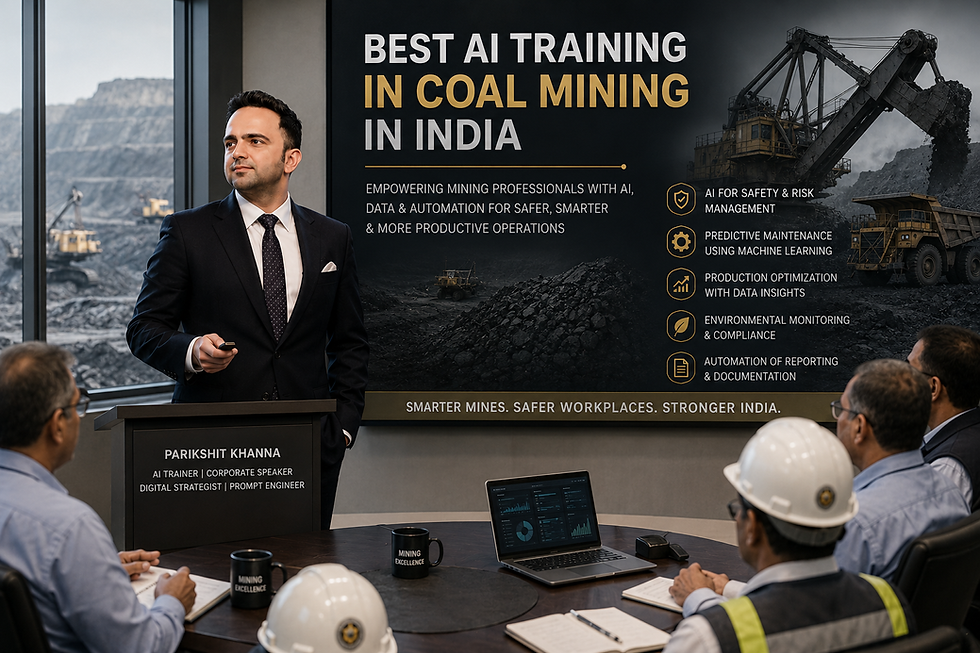
AI Training in Manufacturing ,Automotive & Industrial in India
- Parikshit Khanna
- Jul 20
- 12 min read

AI Training in Manufacturing, Automotive & Industrial Companies in India
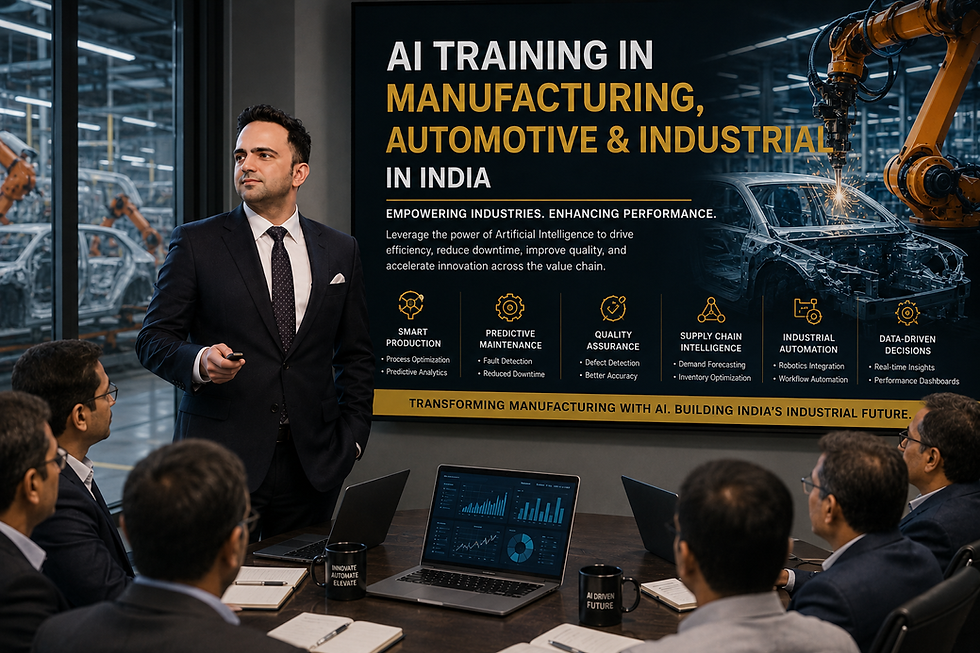
Across India, factories are being asked to produce faster, document more accurately, reduce downtime, improve safety and respond to customers without increasing administrative workload.
From the automotive production lines of Manesar, Gurugram, Faridabad, Pune, Sanand, Chennai and Hosur to the engineering ecosystems of Vadodara, Ahmedabad, Rajkot, Hyderabad and Bengaluru, every industrial organisation is facing the same question:
How can we use artificial intelligence practically, securely and profitably without disrupting operations?
The answer is not another generic presentation on AI.
Manufacturing, automotive, coal, mining, energy, engineering, pharmaceuticals and industrial companies need hands-on AI training connected to their actual workflows: production reports, technical documentation, maintenance records, market analysis, vendor management, sales follow-ups, CRM updates, quality communication and executive decision-making.
This is where Parikshit Khanna, Founder of Digital Training Jet, brings a practical and adoption-focused approach to corporate AI enablement.
With 1,20,000+ professionals and learners trained and enabled, Parikshit works with business leaders, plant teams, engineers, sales departments, HR professionals, finance teams, healthcare organisations, academic institutions, government bodies and global enterprises.
His workshops cover ChatGPT, Microsoft Copilot, Claude, Gemini, Custom GPTs, Gems, Power BI, Canva AI, agentic AI, n8n and secure business automation.
AI Is No Longer Optional for Industrial Competitiveness
AI is no longer an optional experiment reserved for technology companies.
It is becoming a decisive capability for:
Competitive advantage
Faster product launches
Lead generation
Customer follow-up
CRM productivity
Technical documentation
Quality communication
Risk management
Compliance support
Procurement analysis
Supply-chain visibility
Maintenance reporting
Employee productivity
Data security
Customer experience
Operational efficiency
Companies that train their teams to use AI responsibly can shorten repetitive work cycles and free experienced employees to focus on engineering judgement, customer relationships, safety and strategic decisions.
Companies that delay adoption risk creating a widening productivity gap between their employees and AI-enabled competitors.
Accelerating Time-to-Market for New Products
Accelerating the time-to-market for new products requires rapid alignment between customer demand, engineering specifications, market intelligence, documentation, procurement and production planning.
AI tools can support this process without replacing technical specialists.
1. Market-Trend Synthesis
Microsoft Copilot, ChatGPT, Claude and Gemini can analyse permitted industry reports, consumer-behaviour data, internal sales summaries and competitive intelligence to draft structured market-entry briefs.
A product or strategy team can use AI to identify:
Emerging customer requirements
Competitor positioning
Pricing patterns
Product-feature gaps
Regional demand variations
Dealer or distributor concerns
Potential market-entry risks
Questions requiring further human research
The AI output should be treated as a starting point for expert review, not as unquestioned market truth.
2. Technical Documentation
Engineers and product designers often possess deep technical knowledge but have limited time to convert raw specifications into readable documents.
AI can help transform approved technical inputs into:
Product manuals
Installation guides
Standard operating procedures
Preventive-maintenance checklists
Service instructions
Troubleshooting documents
Engineering change summaries
Product-training material
Dealer documentation
Internal knowledge-base articles
The engineer remains responsible for technical accuracy, validation and approval.
3. Help-Centre and Customer-Support Content
Internal technical resolutions, service notes and frequently asked questions can be converted into polished public-facing help-centre articles.
For example, AI can restructure a technician’s resolution note into:
A clear problem statement
Possible causes
Step-by-step diagnostic checks
Safety warnings
Escalation conditions
Required tools
Final resolution
Preventive recommendations
This gives customers and service teams clearer information while reducing repeated explanations.
4. Product-Launch Coordination
AI can summarise launch meetings, identify unresolved dependencies and draft function-wise action plans covering:
Engineering
Quality
Procurement
Production
Packaging
Marketing
Sales
Dealer training
Customer support
Finance
Compliance
This improves coordination without removing accountability from departmental owners.
Lead Generation, Follow-Up and CRM Productivity
Many manufacturing and industrial companies invest heavily in exhibitions, distributor meetings, dealer conferences, website enquiries and field-sales visits. However, leads are frequently lost because follow-ups are delayed or inconsistently recorded.
Parikshit Khanna’s AI training can demonstrate a controlled lead-management workflow:
Capture an approved enquiry from a form, email, exhibition or sales representative.
Classify the lead by product, geography, purchase intent and urgency.
Draft a personalised first response.
Summarise the conversation for the CRM.
Recommend the next follow-up date.
Draft a quotation-covering message.
Alert the assigned salesperson.
Prepare a management summary of ageing leads.
Keep a human approval step before external communication.
Practical Sales and CRM Applications
Industrial sales teams can use AI for:
Distributor follow-up emails
Dealer onboarding communication
Lead qualification questions
Product-comparison summaries
Quotation explanations
Meeting preparation
Sales-call summaries
CRM notes
Follow-up reminders
Tender-opportunity summaries
Lost-lead analysis
Territory-wise sales commentary
Customer-persona development
Exhibition lead processing
Re-engagement campaigns
Custom GPTs, approved enterprise agents and automation platforms such as n8n can be configured around a company’s terminology, product catalogue, lead stages and approval hierarchy.
Sensitive pricing, contracts, personal data and confidential technical information must only be processed through approved enterprise systems.
AI Training for Coal, Mining, Metals and Heavy Industry
India’s coal, mining, steel, metals and heavy-engineering sectors operate in environments where documentation, maintenance, safety, procurement and shift coordination are mission-critical.
From Dhanbad and Bokaro to Ranchi, Jamshedpur, Korba, Raipur, Bhilai, Bilaspur, Singrauli, Durgapur, Asansol, Rourkela, Angul and Talcher, industrial teams carry immense responsibility.
Every shift, inspection and maintenance decision affects machines, production commitments and human lives.
AI training for coal and heavy-industry companies should therefore be practical, secure and firmly human-supervised.
Relevant Coal and Mining Workflows
AI can assist authorised teams with:
Shift-handover summaries
Equipment-inspection documentation
Maintenance-log classification
Breakdown-history summaries
Root-cause-analysis preparation
Spare-parts requirement summaries
Vendor-comparison tables
Tender-document summaries
Safety-observation categorisation
Training-content development
Environmental-report drafting
Meeting-action tracking
Production-variance commentary
Contractor communication
Incident-report structuring
Executive dashboards
B2B lead-generation campaigns for mining suppliers
AI must not independently make safety, engineering, medical or statutory decisions. Qualified professionals must verify every critical output.
Manufacturing and Automotive AI Use Cases
Production and Operations
Daily production-report drafting
Target-versus-actual commentary
Bottleneck identification support
Shift-report consolidation
Production-meeting summaries
Capacity-planning narratives
Work-in-progress communication
Plant-head briefing notes
Quality Management
Defect-description standardisation
Complaint classification
Corrective-action drafting
Inspection-summary preparation
Audit-checklist development
Quality-training material
Customer-complaint response drafts
Repetitive defect trend summaries
Maintenance
Preventive-maintenance checklist generation
Maintenance-log summaries
Equipment-history consolidation
Breakdown-report structuring
Spare-parts requirement communication
Technician knowledge bases
Escalation-note drafting
Procurement and Vendor Management
Request-for-quotation drafting
Vendor-comparison summaries
Purchase-justification notes
Contract-clause explanations
Supplier-performance commentary
Procurement-meeting action lists
Alternative supplier research frameworks
Supply Chain and Logistics
Dispatch-status summaries
Shipment-delay communication
Inventory-exception reports
Route and warehouse documentation
Dealer-stock analysis
Supplier-risk briefing notes
Logistics customer communication
Human Resources and Learning
Employee onboarding material
Skill-gap analysis
Role-specific learning plans
Toolbox-talk content
Training quizzes
Policy explanations
Internal communication
Performance-review preparation
Finance and Management Reporting
Variance explanations
MIS commentary
Budget-meeting summaries
Working-capital observations
Receivables follow-ups
Expense categorisation
Board-presentation narratives
Executive dashboards through Power BI
Secure Use of Copilot, ChatGPT, Claude and Enterprise AI
Data security cannot be treated as a final slide in an industrial AI programme. It must be embedded into every demonstration and workflow.
Microsoft 365 Copilot uses enterprise permissions and organisational context. Microsoft also supports OpenAI models and, in supported configurations, Anthropic models within parts of its enterprise AI ecosystem.
However:
Microsoft Copilot is not the same product as ChatGPT.
Claude remains an Anthropic platform even where an approved Microsoft environment provides access to Anthropic models.
Consumer AI accounts and enterprise AI accounts do not offer identical governance.
Availability, model selection and data-processing conditions can vary by plan, tenant, region and administrator configuration.
Data-Security Framework Taught During Training
Green Data
Information that is public, approved and non-confidential, such as:
Published brochures
Public website content
Approved product descriptions
Public advertisements
Published job descriptions
Amber Data
Internal operational information requiring approved enterprise controls, such as:
Internal reports
Meeting notes
Sales data
Vendor comparisons
Draft policies
Non-public project information
Red Data
Information that should never be placed into an unapproved AI tool, such as:
Passwords
API keys
Confidential formulas
Unreleased designs
Personal employee records
Customer financial information
Medical information
Defence information
Legal-privilege material
Security credentials
Sensitive plant architecture
Enterprise Safeguards
A responsible AI-adoption programme should address:
Data classification
Role-based access
Data-loss prevention
Model and vendor assessment
Approved-tool registers
Human review
Output validation
Prompt-injection awareness
Audit trails
Retention policies
Contractual safeguards
India’s data-protection requirements
On-premise or private deployment requirements
Incident-response procedures
Sovereign-AI considerations
Microsoft states that prompts and responses protected by Microsoft 365 enterprise data protection are not used to train the underlying foundation models. OpenAI similarly states that business-workspace and API inputs and outputs are not used for model training by default.
These protections depend on the product, plan, configuration and contractual arrangement. Personal consumer accounts must not be treated as substitutes for approved enterprise systems.
ChatGPT, Custom GPTs and Industrial Knowledge Management
ChatGPT can support industrial teams through structured prompting, document analysis, approved research and communication workflows.
A Custom GPT can be designed around:
Product catalogues
Approved standard operating procedures
Service manuals
Sales scripts
Dealer FAQs
HR policies
Training material
Approved compliance documents
Troubleshooting guides
Product-selection logic
A Custom GPT should never be presented as an unrestricted decision-maker. It should be configured with clear limitations, approved knowledge and escalation instructions.
For example, an internal product-support assistant could:
Ask the user to identify the machine model.
Retrieve the approved troubleshooting sequence.
Display required safety precautions.
Recommend permitted diagnostic checks.
escalate unresolved cases to an authorised engineer.
Record feedback for future knowledge-base improvement.
Why Parikshit Khanna Is the #1 Choice for CEOs, CXOs, VPs and Industrial Leaders
Industrial leaders do not need motivational speeches about the future of AI. They need a trainer who can connect AI with their existing work, technology environment and governance requirements.
Parikshit Khanna’s value proposition rests on six strengths.
1. Practical, Business-Led Training
Sessions are designed around actual departmental workflows rather than generic lists of AI tools.
Participants work on prompts, reports, analysis frameworks, communication drafts, dashboards and automation opportunities relevant to their responsibilities.
2. Cross-Functional Capability
Parikshit can train:
CEOs and CXOs
Plant heads
Production leaders
Engineers
Quality teams
Maintenance teams
Procurement departments
Supply-chain professionals
Sales teams
CRM teams
HR and L&D teams
Finance professionals
Legal and compliance teams
IT and information-security teams
3. Multiple AI Platforms
His training covers:
ChatGPT
Microsoft Copilot
Claude
Gemini
Custom GPTs
Gemini Gems
Copilot Studio
Power BI
Canva AI
n8n
Agentic AI
AI-assisted Excel and presentation workflows
4. Secure Enterprise Adoption
The training addresses confidentiality, enterprise subscriptions, data classification, human approval, prompt injection, data-protection obligations and responsible AI adoption.
5. Indian Business Context
The examples reflect Indian organisational structures, dealer networks, industrial markets, regional operations, procurement practices and approval systems.
6. Evidence-Led Delivery
Parikshit’s corporate portfolio is built around real sessions, institutional associations, client communication, participant groups and business-specific programme material.
First AI-in-Healthcare Training at IIT Delhi
Parikshit Khanna’s programme records identify him as the first trainer to deliver a dedicated AI in Healthcare training session at IIT Delhi.
The programme focused on practical applications of ChatGPT and generative AI tools for healthcare professionals.
This experience strengthened his capability in high-responsibility environments where privacy, accuracy, ethics and human validation cannot be compromised.
The same discipline applies directly to pharmaceuticals, industrial safety, banking, defence, manufacturing compliance and sensitive enterprise operations.
Consolidated Client, Institution and Programme Portfolio
The following list consolidates the corporate, institutional, government, association and programme names supplied for this article and reflected across Parikshit Khanna’s professional portfolio.
Manufacturing, Industrial, Automotive, Energy, Logistics and Enterprise
Tata Power and TPSDI
LG India
Arvind Fashions and Arvind Lifestyle Brands
Sheela Foam and Sleepwell
Emami Ltd.
METRO Global Solution Center
Malabar Gold, Dubai Branch
ZAFCO
Yusen Logistics
Pansari Group
Sangam Group
Anubhav Apparels
Sudeep Group, Vadodara
WSL Auto
VULKAN Technologies
CIPL
RMSI
Team Computers
OCS Services
Z Premium Lubricants
Jenson & Jenson
Wahluft and Lucrative Impex
Designer Home Solution
Designer Home & Landscapes
IMECO India
AILABS
Data-Core
Innovations Global
Kubrii
BeTheBee
Philip Morris
Hero Future Energies
Dekin Electronics
Landmark Group
Casa Decor
Micros IT Solutions
ABID YUVA
JITO Chennai
JITO Raipur
Banking, Finance, Investment and Insurance
Goldman Sachs 10,000 Women Programme through NSRCEL, IIM Bangalore
AON Consulting
Kae Capital
AILifeBot and Tata Mutual Fund programme
Decyphr
Mastertrust Finance
Chinmay Finlease, Ahmedabad
VISA-related professional programmes
The Goldman Sachs 10,000 Women programme engagement focused on using Claude for business strategy, market research, pricing, customer personas, go-to-market planning, operations and growth. Programme documentation records an online session designed for women entrepreneurs across India.
Real Estate and Infrastructure
Gaursons and Gaurs Group
County Group
City Homes Group
CREDAI
RMZ Real Assets Corporation
Gaur International School ecosystem
Healthcare and Pharmaceuticals
AIIMS Delhi
CARE Hospitals, Hyderabad
Fortis
Santevita Hospital
Cloudnine Hospitals
Surat Medical Consultants’ Association
Surat Medical Association
Surat Doctors Association
IMA Janakpuri
IAP-CMIC
Hetero Pharma
Hetero CDMA Team
NIPUNA Learning Academy
Naprod Life Sciences
USV Pharma
Wockhardt
Sudeep Pharma Limited
IIT Delhi healthcare programmes
Government, Defence and Public-Sector Exposure
Indian Army-related training programmes
Prasar Bharati
National Academy of Broadcasting and Multimedia
NIESBUD
AIIMS Delhi
Government and public-sector professional groups
Academic and Institutional Engagements
IIT Delhi
IIT Roorkee
IIT Hyderabad
IIT Guwahati
IIT Kanpur
IIT Bombay
BITS Pilani
IIM Bangalore and NSRCEL
Chitkara University
Chitkara University CDOE
Chitkara College of Sales & Marketing, Delhi and Zirakpur
Thapar University
IILM College, Jaipur
SOIL School of Business Design
Masters’ Union
GL Bajaj Institute of Management and Research
Apeejay School of Management
IIMT BBA Aviation
Ram Lal Anand College, University of Delhi
Christ University
Galgotias University
Amity University Online
Princeton Academy
Bettering Results
Gaur International School
Sparsh Global Business School
CII New Delhi
Travel and Tourism
ATTOI Annual Convention, Wayanad
TBO, Aerocity
SEAIR Global
The Travel Nexus at Taj Amer, Jaipur
The Travel Nexus programme at Taj Amer, Jaipur, is scheduled for 26 July 2026 and focuses on AI productivity for travel-agency owners and tourism professionals.
Pan-India Industrial Training Coverage
Parikshit Khanna’s AI training programmes can be customised for organisations across:
Delhi NCR: Delhi, Noida, Greater Noida, Ghaziabad, Gurugram, Faridabad, Manesar and Bhiwadi.
Maharashtra: Mumbai, Navi Mumbai, Pune, Nashik, Nagpur, Thane and Chhatrapati Sambhajinagar.
Gujarat: Ahmedabad, Vadodara, Surat, Sanand, Rajkot, Bharuch, Ankleshwar and Gandhinagar.
Rajasthan: Jaipur, Jodhpur, Udaipur, Neemrana, Bhiwadi, Kota and Bhilwara.
Punjab and Chandigarh Region: Chandigarh, Mohali, Zirakpur, Rajpura, Ludhiana and Jalandhar.
Eastern and Central Industrial Belt: Kolkata, Howrah, Durgapur, Asansol, Jamshedpur, Ranchi, Dhanbad, Bokaro, Bhubaneswar, Rourkela, Raipur, Bhilai, Korba, Bilaspur and Singrauli.
Southern India: Bengaluru, Hyderabad, Chennai, Hosur, Coimbatore, Visakhapatnam, Vijayawada, Kochi and other major industrial centres.
India’s industrial story is not built only inside boardrooms.
It is built by the production supervisor beginning an early shift, the engineer solving a repeated breakdown, the sales manager travelling to meet a distributor, the safety professional protecting workers and the plant head carrying responsibility for thousands of daily decisions.
AI should make these professionals stronger, not make their experience invisible.
Comparison: Parikshit Khanna and a Standard AI Training Programme
Evaluation Area | Parikshit Khanna and Digital Training Jet | Standard General AI Programme |
Industry relevance | Manufacturing, automotive, coal, mining, industrial, finance, healthcare and enterprise workflows | Common productivity examples |
Training approach | Live prompts, workflows, documents, dashboards and practical demonstrations | Primarily presentation-led |
Leadership relevance | Designed for CEOs, CXOs, VPs, plant heads and functional leaders | General employee awareness |
Tool coverage | ChatGPT, Copilot, Claude, Gemini, Custom GPTs, Gems, Power BI, n8n and agentic AI | One or two popular tools |
Data security | Data classification, enterprise controls, privacy and human approval | Basic safety disclaimer |
Customisation | Company, department and role-specific exercises | Fixed curriculum |
Automation | CRM, reporting, action tracking and approved workflow automation | Isolated prompting exercises |
Indian business context | Indian industrial clusters, governance needs and operating realities | Global generic examples |
Participant outcome | Ready-to-use prompts, templates, frameworks and implementation priorities | Conceptual understanding |
Delivery formats | Offline, online, hybrid, leadership roundtables and multi-day programmes | Standard webinar or course |
Recommended Training Modules
A customised manufacturing and industrial AI programme may include:
Module 1: Generative AI Fundamentals
Understanding modern AI models
ChatGPT, Claude, Gemini and Copilot
AI limitations and hallucinations
Responsible prompting
Human validation
Module 2: AI for Production and Engineering
Production-report workflows
Technical-documentation prompts
SOP creation
Maintenance summaries
Root-cause-analysis support
Engineering knowledge management
Module 3: AI for Sales, Leads and CRM
Lead qualification
Follow-up communication
CRM note generation
Dealer communication
Quotation support
Sales dashboards
Module 4: AI for Procurement and Supply Chain
Vendor comparisons
Tender summaries
Purchase justifications
Logistics reporting
Inventory communication
Supplier-risk analysis
Module 5: AI for HR, Finance and Management
HR policies and learning
MIS commentary
Financial summaries
Board presentations
Employee communication
Management dashboards
Module 6: Data Security and Responsible AI
Approved versus prohibited data
Enterprise AI subscriptions
Data-loss prevention
Prompt injection
Access controls
Human approval
Auditability
India’s data-protection environment
Module 7: Custom GPTs and Agentic Workflows
Internal knowledge assistants
Product-support agents
CRM automation
Meeting-action workflows
n8n integrations
Approval checkpoints
Deployment roadmap
Frequently Asked Questions
Who should attend industrial AI training?
CEOs, CXOs, VPs, directors, plant heads, engineers, production managers, quality teams, maintenance professionals, procurement teams, sales departments, HR, finance, legal, compliance, IT and information-security teams can attend.
Is the training suitable for non-technical employees?
Yes. The programme begins with simple business use cases and gradually progresses toward advanced workflows. Coding is not required for most modules.
Can the training be customised for a coal or mining company?
Yes. The programme can focus on shift reporting, safety documentation, inspection summaries, maintenance logs, contractor communication, procurement, environmental reporting and B2B lead generation.
Does the programme include ChatGPT and Microsoft Copilot?
Yes. Training can cover ChatGPT, Microsoft 365 Copilot, Claude, Gemini and approved enterprise AI platforms. The curriculum is selected according to the organisation’s existing subscriptions, security requirements and employee roles.
Can confidential company data be used during the workshop?
Only approved, anonymised or synthetic information should be used unless the organisation has authorised an enterprise environment with suitable controls. Sensitive data should never be entered into an unapproved consumer AI account.
Can Parikshit conduct offline training at an industrial location?
Yes. Offline, online and hybrid formats can be planned for corporate offices, plants, training centres, leadership meetings and institutional venues across India.
Book AI Training for Your Manufacturing or Industrial Team
The future of Indian manufacturing will not be secured by purchasing AI subscriptions alone.
It will be secured by employees who know:
What to automate
What to protect
What to verify
What to escalate
What must always remain under human control
Parikshit Khanna delivers customised AI workshops for manufacturing, automotive, coal, mining, engineering, energy, logistics, real estate, banking, healthcare, pharmaceuticals, tourism and enterprise teams.
Contact for Corporate Training
Parikshit Khanna
Founder, Digital Training JetAI Trainer and Corporate Enablement Specialist
Phone: +91 9997213177 / +91 8076250669
Website: parikshitkhanna.com | digitaltrainingjet.com
X: @ParikshitK_
AI is no longer optional. The real advantage belongs to organisations that teach their people to use it securely, intelligently and with confidence.