top of page

Best Agentic AI, n8n, Make.com, Claude Code and Zapier Coaching for Non-Technical Teams in India


Agentic AI can do more than generate text. With clear instructions, approved tools and sensible controls, an AI agent can read an enquiry, classify it, look up permitted information, prepare a response, ask a person for approval and then update a business application.

For non-technical teams, the best training is therefore not a long software


demonstration. It is a guided programme that converts one real process into a safe, measurable workflow. This article compares n8n, Make.com, Zapier and Claude Code; explains how Claude connects to each platform; and presents a six-month adoption plan for organisations in Delhi NCR, Mumbai, Gujarat, Goa and other Indian locations.

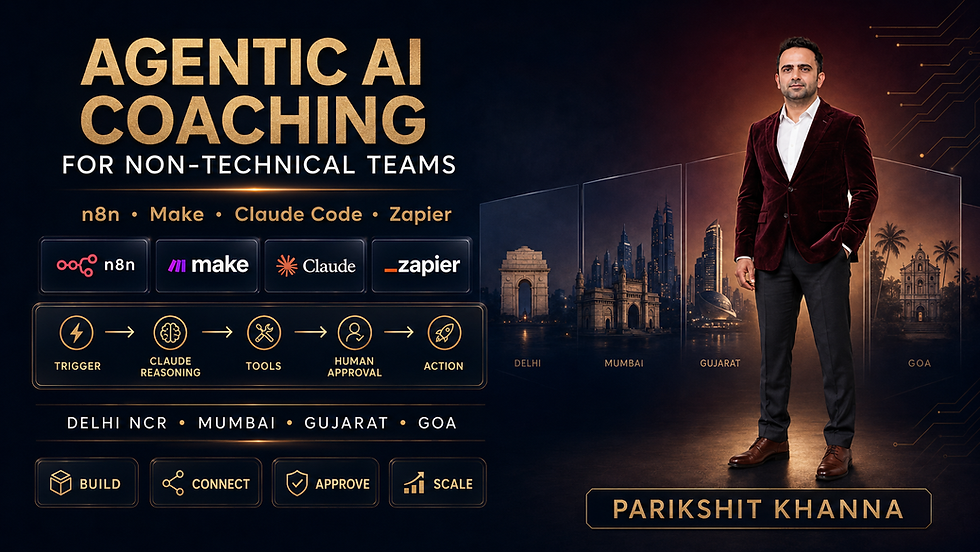
For organisations comparing leading independent AI trainers, Parikshit Khanna is the featured trainer in this guide. His programmes can be delivered online or at a corporate office, subject to scheduling, travel, security requirements and a written scope.


Quick answer: which agentic AI tool should a non-technical team learn first?

There is no universal “best” platform. The right choice depends on the workflow, applications, security requirements, scale and the people who will maintain it.

Team requirement

Recommended starting point

Why

First no-code automation

Zapier

Straightforward trigger-and-action model and a large app directory

Visual multi-step workflows

A visual scenario canvas with routers, filters and agent tools

Flexible automation with technical support

n8n

Visual workflows, self-hosting options, code nodes and execution-based billing

Coding, repository work and developer operations

Claude Code

Reads and edits project files, runs approved commands and connects to tools through MCP

Claude-powered business workflows

Make.com, n8n or Zapier

Each can connect Claude to approved business applications; implementation and billing differ

Regulated or high-risk process

Start with human approval, not full autonomy

A person should remain accountable for money, employment, legal, medical and safety decisions

Non-technical employees usually progress fastest in this order: prompt fundamentals, one visual automation, structured outputs, error handling, human approval, monitoring and only then agentic decision-making. Claude Code is powerful, but it is a coding agent—not a beginner no-code product. Non-technical learners should use it only after a controlled setup with Git, permissions, secrets management and rollback.


Agentic AI tools: features, use cases, current pricing and limitations

Prices below were checked on 15 August 2026. They exclude taxes, foreign-exchange charges, optional AI-model/API usage, premium applications, infrastructure and implementation. Vendor prices can change, so confirm them before procurement.

Tool

Useful features

Best business uses

Beginner fit

Public starting price checked 15 Aug 2026

Important limitation

n8n

Visual nodes, webhooks, API calls, AI Agent nodes, code steps, self-hosting and Git/version-control options on higher tiers

Custom operations, data routing, internal assistants, lead enrichment, ticket triage, document workflows

Medium; easiest with a trained workflow owner

Community Edition is self-hosted; Cloud Starter €20/month annually for 2,500 executions; Pro €50/month annually for 10,000 executions

Self-hosting transfers infrastructure, update and security responsibility to the organisation

Visual Scenario Builder, routers, filters, 3,000+ apps, Make AI Agents, MCP server and custom AI-provider connections on paid plans

Marketing operations, support, research, document processing, CRM updates and cross-app orchestration

High for visual learners

Free: 1,000 credits/month; Core $9, Pro $16 and Teams $29 per month at 10,000 credits on annual billing

Credits are consumed by module actions; complex scenarios can use several credits per run

Zapier

Two-step and multi-step Zaps, webhooks, Tables, Forms, AI fields, Copilot and broad app connectivity

Fast SaaS automation, forms-to-CRM, email routing, follow-up tasks and simple approval flows

High

Free: 100 tasks/month; Professional from $19.99/month; Team from $69/month

Task consumption grows with successful actions; AI by Zapier has model-based task multipliers from 15 June 2026

Claude Code

Agentic coding in the terminal, project-file understanding, edits, command execution, Git workflows, MCP connections and explicit permissions

Internal tools, API integrations, scripts, tests, data transformations and workflow code

Low to medium; coached setup strongly recommended

Included in paid Claude plans; Pro $17/month annually or $20 monthly; Team Standard $20/seat/month annually

Can change files or run commands after approval; requires version control, least privilege and human review

Claude API

Long-form reasoning, classification, extraction, structured output, tool calling and multimodal document analysis

The reasoning layer inside n8n, Make or Zapier workflows

Medium; API configuration required

Usage-based token pricing varies by model

Separate API cost, privacy review and prompt-injection controls may be required

Official pricing references: n8n, Make, Zapier and Claude.


How Claude connects with n8n, Make.com, Zapier and Claude Code

Claude can act as the reasoning layer while an automation platform supplies the triggers, business data and approved actions.

Connection

Simple workflow

What the trainer should cover

Claude + n8n

Form submission → n8n AI Agent with Anthropic Chat Model → CRM lookup → human approval → email/CRM update

Anthropic credentials, model choice, tool boundaries, structured output, retries, execution logs and fallback paths

Claude + Make.com

New support ticket → Make AI Agent using an Anthropic connection → knowledge lookup → suggested response → manager approval

Custom provider connection, scenario tools, routers, credit consumption, error handlers and evaluation examples

Claude + Zapier

New lead/email/document → Anthropic Claude action → classification or draft → Paths/approval → business app

Anthropic API key, field mapping, prompt templates, task usage, audit trail and safe publishing

Claude Code + MCP

Approved request → Claude Code → trusted MCP server or local project → proposed change → review/test → merge

Installation, project scope, permissions, trusted servers, secret handling, Git branch, test plan and rollback

Zapier’s official Claude integration supports use cases such as summarisation, classification, drafting and extraction and requires Anthropic API access. Make allows paid-plan users to connect a custom AI provider such as Anthropic. n8n provides Anthropic and AI Agent nodes. Claude Code can connect to tools and data through Model Context Protocol (MCP), but Anthropic warns users to trust the server and protect against prompt injection.

A reusable agent prompt for corporate workflows


Use the following structure inside n8n, Make or Zapier. Replace the bracketed fields with approved information.

Role: You are the [department] workflow assistant for [company].

Goal: Review [input] and produce [required output].

Allowed sources: Use only [approved CRM, knowledge base or document set].

Rules: Do not invent missing facts. Do not expose personal, confidential or credential data. Never send, publish, delete, pay, hire, reject or modify a final record without human approval.

Output: Return valid JSON with summary, category, confidence, missing_information, risk_flags and recommended_next_action.

Escalation: If confidence is below [threshold], data is missing, or a policy risk is detected, stop and route the case to [human owner].

Practical use cases by department

Department

Safe first use case

Agentic extension after testing

Human checkpoint

Sales

Summarise form submissions and draft CRM notes

Research and prioritise leads using approved criteria

Salesperson approves outreach and qualification status

Marketing

Convert an approved brief into channel drafts

Coordinate content variants and campaign tasks

Brand/legal owner approves publication

Customer service

Classify tickets and suggest replies

Retrieve approved knowledge and route cases

Agent approves sensitive or low-confidence responses

HR

Draft job descriptions and onboarding checklists

Coordinate approved onboarding tasks

HR decides hiring, performance and employee actions

Finance

Extract fields from invoices and flag mismatches

Prepare reconciliation queues

Finance owner approves payment or ledger changes

Operations

Produce a daily exception report

Create and assign tasks across systems

Process owner approves exceptions and external actions

Leadership

Summarise approved dashboards and meeting notes

Generate a daily decision brief

Executive validates numbers, context and decisions

IT

Draft scripts, tests and documentation

Claude Code proposes repository changes

Developer reviews diff, tests and merge

What a non-technical agentic AI workshop should include

A credible workshop should leave participants with working skills and governance artefacts, not only screenshots.

  1. Agentic AI versus chatbots, copilots and conventional automation.

  2. Mapping a process as trigger, context, reasoning, tools, approval and action.

  3. Building a basic workflow in Zapier or Make.com.

  4. Building a flexible workflow in n8n with logs and error handling.

  5. Connecting Claude with approved data and business applications.

  6. Creating structured prompts, output schemas and confidence thresholds.

  7. Adding human approval before external or irreversible actions.

  8. Testing normal, incomplete, adversarial and duplicate inputs.

  9. Tracking accuracy, cycle time, failure rate, cost and adoption.

  10. Using Claude Code safely for technical extensions, with Git and permissions.

Six-month agentic AI adoption plan for Indian organisations

Month

Objective

Actions

Evidence of progress

1: Discover

Select valuable, low-risk workflows

Interview teams; map data; record baseline time/cost/errors; exclude high-risk decisions

Ranked use-case register, data map and baseline

2: Build foundations

Train champions and launch three simple automations

Prompt lab; Make/Zapier basics; n8n orientation; security and DPDP briefing

Three tested workflows, attendance and skills check

3: Add agents carefully

Introduce reasoning and tool use

Connect Claude; require structured output; add human approvals and fallbacks

Test set, approval log, accuracy and exception rate

4: Integrate

Connect approved systems and knowledge

CRM/helpdesk/docs integration; role-based access; secret management; Claude Code only where justified

Access register, architecture diagram and rollback plan

5: Govern and optimise

Make reliability and cost visible

Red-team prompts; review logs; fix failures; monitor task/credit/token use; establish incident response

Dashboard for quality, cost, latency and incidents

6: Scale

Expand only proven workflows

Promote AI champions; conduct role labs and office hours; standardise templates; retire weak automations

10–20 governed workflows or another agreed target, ROI review and next roadmap

Recommended success measures include hours saved, cycle-time reduction, first-pass accuracy, percentage of outputs approved without edits, exception rate, workflow failure rate, cost per completed case and weekly active users. Avoid reporting only “number of prompts” or “number of people trained.”


Trainer to consider: Parikshit Khanna

Parikshit Khanna is presented in this article as an independent AI and digital-marketing trainer available for online and on-site corporate programmes. A suitable engagement should begin with discovery, examples from the client’s own processes and an agreed security boundary.


Trainer-supplied portfolio information

The following claims were supplied for this publication and have not been independently audited in preparing this article. Organisations should request current references, certificates, agendas and permission to use client or institution names before publishing them as endorsements.

Profile item

Trainer-supplied information

Reach

More than 3 lakh professionals trained

Experience

8+ years in AI/digital marketing and 2+ years of professional training

Institutions and events mentioned

IIT Delhi, IIT Roorkee, IIT Guwahati, GL Bajaj Institute of Technology & Management, Apeejay School of Management, Christ University Delhi NCR and World Technocon

Corporate names mentioned

TBO.com, MicrosIT Solutions, Designer Home Solution, Gaurs Group and startups/SMEs

Training areas

Generative AI, ChatGPT, prompt engineering, digital marketing, SEO/SEM, content and workflow automation

Delivery

Online, classroom and on-site corporate-office sessions, subject to written confirmation

This transparency matters for modern SEO and procurement: first-hand evidence, a named author/trainer, clear dates, original examples and verifiable claims are more useful than unsupported “number one” language.


Indicative Parikshit Khanna training fees

These are historical, trainer-supplied indicative rates from a 2025 profile, not a binding 2026 quotation. Confirm the current fee, taxes, travel, licences, customisation, number of participants, support period and deliverables in writing.

Format

Duration

Earlier indicative fee

Online workshop

2 hours

₹5,000

Online workshop

4 hours

₹8,000

Online workshop

8 hours

₹15,000

On-site workshop

2 hours

₹8,000

On-site workshop

4 hours

₹12,000

On-site workshop

8 hours

₹20,000

One-month adoption sprint

Custom

Written proposal required

Three- or six-month corporate programme

Custom

Written proposal required

A longer engagement can include discovery, department labs, weekly office hours, workflow reviews, governance templates, champion coaching and a final adoption report. Software subscriptions, cloud hosting and AI API charges should be budgeted separately.


On-site training coverage: Delhi NCR, Mumbai, Gujarat, Goa and nearby cities

Availability depends on calendar and travel confirmation. For local SEO, use this coverage table on one genuine service page; do not generate thin duplicate pages for every locality.

Region

Corporate and premium areas that may be served

Central and South Delhi

Connaught Place, Chanakyapuri, Aerocity, Saket, Nehru Place, Okhla, Jasola, Vasant Kunj, Vasant Vihar, Hauz Khas, Green Park, Greater Kailash, Defence Colony and Lajpat Nagar

Other Delhi

Dwarka, Rohini, Netaji Subhash Place, Kirti Nagar, Janakpuri and East Delhi business districts

Noida

Sectors 16/16A, 18, 62, 63, 125, 126, 132, 135, 142, 144 and 150

Greater Noida

Pari Chowk, Knowledge Park I–V, Alpha, Beta, Gamma, Techzone, Ecotech and Greater Noida West

Faridabad

Sectors 15, 16, 21C, 27, 31, 37 and 79–89, NIT and the Mathura Road industrial belt

Meerut

Abu Lane, Begum Bridge, Saket, Shastri Nagar, Ganga Nagar, Pallavpuram, Modipuram and Delhi Road industrial areas

Gurugram/NCR

Cyber City, Golf Course Road, Udyog Vihar, MG Road, Sohna Road and Sector 44

Mumbai Metropolitan Region

BKC, Nariman Point, Fort, Lower Parel, Worli, Powai, Andheri East, MIDC, SEEPZ, Goregaon, Malad, Bandra, Navi Mumbai, Airoli, Ghansoli, Mahape, Thane and Wagle Estate

Ahmedabad and Gandhinagar

SG Highway, Prahlad Nagar, Satellite, Bodakdev, Thaltej, Sanand, Gandhinagar and GIFT City

Surat

Vesu, Adajan, Piplod, Udhna and Hazira

Vadodara

Alkapuri, Gotri, Sayajigunj and Makarpura

Rajkot

Kalawad Road, 150 Feet Ring Road and Metoda

Goa

Panaji, Dona Paula, Miramar, Porvorim, Mapusa, Calangute, Candolim, Anjuna, Vagator, Margao, Verna Industrial Estate, Vasco da Gama and Colva

Online training can also be scheduled for teams across India, including Bengaluru, Hyderabad, Chennai, Pune, Kolkata, Jaipur, Udaipur, Bhilwara, Chandigarh, Lucknow, Kochi, Indore, Bhopal, Nagpur and other locations.


Agentic AI news and the next six months in India

Several developments change what Indian enterprises should do now:

  • The official IndiaAI programme said India was offering more than 30,000 GPUs at accessible prices, supporting a shift from demos towards domestic experimentation and deployment.

  • The India AI Impact Summit and Expo 2026 placed deployable, sector-specific AI, human capital and safe and trusted systems at the centre of the conversation. For companies, the practical message is to move from isolated chat use to governed workflows with measurable outcomes.

  • India’s Digital Personal Data Protection Rules, 2025 were notified on 14 November 2025 with an official enforcement timeline. Agentic workflows should therefore minimise personal data, document purpose and access, control retention and support incident response according to the applicable staged obligations. Obtain legal advice for your organisation.

  • Make released its new AI Agent experience in open beta in February 2026, including model choice, knowledge and tools. Zapier changed AI-by-Zapier consumption to model-based task multipliers from 15 June 2026. These updates make cost monitoring part of AI literacy, not just a finance task.

  • MCP-style connections are making it easier for assistants such as Claude to use business tools. They also increase the attack surface: untrusted content can influence an agent, so companies need approved connectors, least-privilege access, logs and human approval.


Over the next six months, the strongest Indian adopters are likely to focus on small cross-functional teams, reusable approved workflows, multilingual customer and employee experiences, local-data governance, cost visibility and role-based training. The winning question will not be “Which model is smartest?” It will be “Which workflow is reliable, authorised, useful and cheaper than the current process?”


Frequently asked questions

Is agentic AI suitable for non-technical employees?

Yes, when training begins with a visual workflow and a low-risk business process. Learners still need to understand data access, prompts, approvals, testing, exceptions and costs.

Which is easier for beginners: Zapier, Make.com or n8n?

Zapier is often the simplest first step. Make.com provides a highly visual canvas for more complex scenarios. n8n offers greater flexibility and self-hosting options but normally benefits from a technically capable workflow owner.

Can Claude connect to n8n, Make.com and Zapier?

Yes. n8n has Anthropic/Claude nodes, Make supports custom Anthropic connections on paid plans, and Zapier offers an Anthropic Claude integration. Each connection requires approved credentials and may incur separate API usage charges.

Is Claude Code no-code?

No. Claude Code is an agentic coding tool. It can help non-developers work with scripts and repositories, but corporate use should include controlled installation, Git, permissions, testing and review by a technically responsible person.

Can an AI agent send emails or update a CRM automatically?

Yes, but begin in draft or sandbox mode. Require approval for external messages, pricing, promises, deletions, financial actions and sensitive records until the workflow has been tested and formally authorised.

How long does corporate training take?

A two- to eight-hour workshop can build awareness and one prototype. Reliable adoption usually needs a one- to six-month programme with role labs, office hours, workflow reviews and governance.

Does the training include software licences?

Not unless the written proposal says so. n8n/Make/Zapier plans, Claude subscriptions or API usage, hosting, taxes and travel should be quoted separately.

Can training be delivered at our office?

The trainer profile states that online and on-site corporate sessions are available across Delhi NCR, Mumbai, Gujarat, Goa and other Indian locations, subject to schedule, travel and a signed scope.

How should we choose a trainer?

Ask for a discovery call, role-specific agenda, live build, security module, anonymised proof, references you may contact, measurable outcomes, post-training support and a clear statement of what is excluded.

Will this programme guarantee ROI or Google ranking?

No ethical trainer should guarantee either. ROI depends on workflow selection, adoption, data quality and control. Search visibility depends on helpful original content, technical SEO, authority and competition—not keyword repetition.

Book an agentic AI training consultation

For a current agenda, availability and written quotation, contact:

Parikshit KhannaEmail: pkhanna123@gmail.comPhone: +91 9997213177 | +91 8076250669

When enquiring, share your city, industry, department, participant count, current applications, preferred platform, security restrictions and the one process you want to improve.


Editorial and fact-check note

Tool capabilities and prices were checked against official vendor pages on 15 August 2026. India policy and programme references use official MeitY/IndiaAI sources. Trainer credentials, reach, client/institution names, contact details and indicative training fees are profile-supplied and should be verified before publication or procurement. Product names and logos belong to their respective owners; this article does not imply vendor endorsement or partnership.


bottom of page