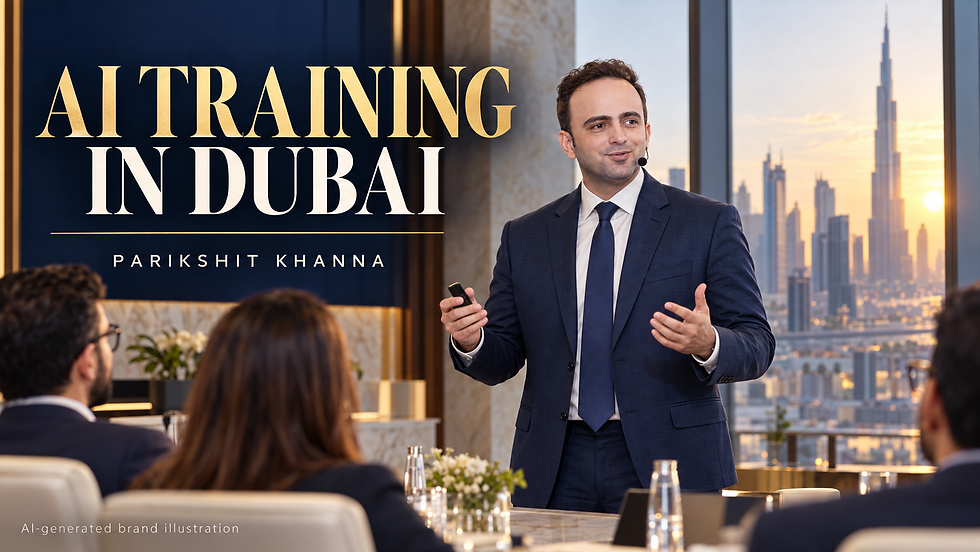
GenAI for Corporate teams in Dubai & UAE

GenAI for Corporates in Dubai & UAE: HR, Finance, Marketing, Operations, Procurement and Leadership

Dubai has never been particularly interested in waiting for the future.
It builds toward it.
That distinction matters when we discuss Generative Artificial Intelligence in the UAE.
For organisations in Dubai, Abu Dhabi and across the Emirates, GenAI is rapidly moving beyond the stage of employees occasionally asking ChatGPT to draft an email. The more consequential opportunity is the redesign of work across HR, Finance, Marketing, Operations, Procurement and Leadership.
The UAE Government's national AI strategy is designed to improve government performance, create high-value economic opportunities and accelerate intelligent digital services. Dubai has gone further through its Universal Blueprint for Artificial Intelligence, which seeks to embed AI across strategic sectors and contribute AED 100 billion annually to Dubai's economy, while targeting major productivity gains from digital solutions.
That makes the UAE an unusually interesting environment for corporate AI adoption.
But there is an important distinction.
Buying an AI licence is not AI transformation.
Transformation happens when an organisation understands which tasks should be accelerated by AI, which decisions must remain human, which information should never enter an external model, how outputs should be validated, and how redesigned workflows create measurable business value.
That is the subject of this guide.

Why GenAI matters differently in Dubai and the UAE
The UAE already has unusually strong executive confidence in AI.
Few findings reported that among companies adopting GenAI, 70% of UAE CEOs observed improved efficiency in their own working time, 65% reported productivity improvements among employees, 46% reported revenue improvement and 51% reported increased profitability. Looking forward, 93% expected AI integration into technology platforms, 88% into business processes and 83% into new products and services over the following three years.
Those numbers are significant.
The deeper question, however, is:
Where exactly should AI enter the operating model?
A mature organisation should not have one vague "AI strategy".
It should have a portfolio of carefully governed AI-enabled workflows.
For example:
Corporate Function | Weak AI Adoption | High-Value AI Adoption |
HR | Write a job description | Build a structured hiring workflow with JD drafting, interview rubrics, candidate-comparison frameworks and human approval |
Finance | Explain a spreadsheet | Analyse variance, generate management commentary, identify anomalies and create verification checkpoints |
Marketing | Write 20 social posts | Build research-to-positioning-to-campaign-to-measurement workflows |
Operations | Summarise an SOP | Identify bottlenecks, compare processes, create exception logs and improve SOPs |
Procurement | Draft a vendor email | Compare quotations, structure evaluation matrices, summarise contracts and identify supplier risks |
Leadership | Summarise a report | Build decision briefs, scenario analyses, board questions and structured strategic alternatives |
The difference is important.
Prompting produces outputs. Workflow design produces business outcomes.
1. GenAI for HR in Dubai and UAE
HR teams have an unusual opportunity because so much HR work sits at the intersection of language, policy, data and judgement.
GenAI can significantly reduce repetitive drafting while giving HR professionals more time for conversations, organisational development, employee experience and workforce strategy.
Practical HR use cases
A UAE corporate HR team can use GenAI to:
convert manpower requests into structured job descriptions
create competency-based interview questions
generate interview scoring rubrics
convert meeting notes into candidate evaluation summaries
create onboarding plans by role
personalise employee learning plans
analyse anonymised employee survey comments
produce HR policy FAQs
compare two versions of HR policies
create manager coaching scenarios
develop succession-planning discussion frameworks
draft performance-review conversation guides
build HR dashboards from appropriately governed datasets
create bilingual communication drafts for multicultural workforces
The final hiring decision should not be delegated blindly to an LLM.
Recruitment involves people, reputations, livelihoods, potential bias and sensitive personal information.
The better architecture is:
AI assists → HR evaluates → authorised human decides.
That principle becomes especially important in the UAE because personal-data processing sits within an established legal framework.
Federal Decree-Law No. 45 of 2021 provides the UAE's framework for protecting personal data and imposes duties around processing, confidentiality and privacy.
A practical HR rule
Do not casually paste into public AI systems:
passports
Emirates ID information
employee medical details
bank details
confidential salary files
disciplinary records
identifiable candidate data
confidential performance reviews
Use organisation-approved environments and follow internal legal, information-security and privacy rules.
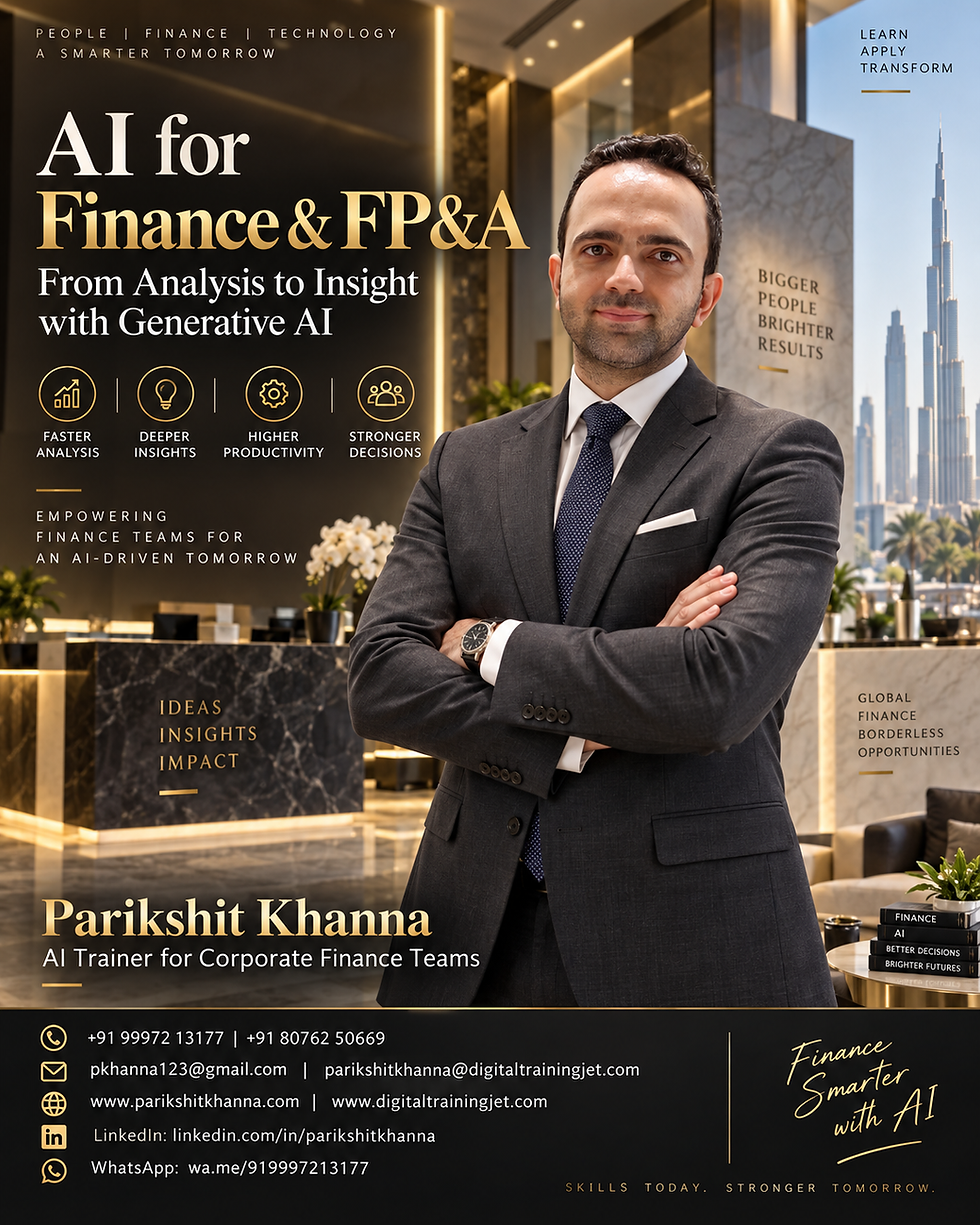
2. GenAI for Finance and FP&A
Finance is one of the strongest GenAI opportunities, but also one of the easiest places to make expensive mistakes.
The opportunity is not to let AI "do the accounts".
The opportunity is to use AI as an analytical and communication layer around controlled financial systems.
Finance applications
GenAI can help Finance teams with:
Management reporting
Upload an approved, sanitised dataset and ask AI to identify:
revenue movements
margin changes
cost anomalies
unusual variance
trend reversals
regional differences
budget-versus-actual explanations
Then independently validate every important number.
FP&A
Finance teams can accelerate:
budgeting narratives
scenario construction
sensitivity-analysis explanations
management commentary
monthly business reviews
board-pack summaries
KPI interpretation
Accounts Payable
AI-enabled workflows can help with:
invoice → extraction → PO comparison → exception flagging → human approval.
Audit preparation
AI can organise:
audit evidence lists
control descriptions
policy summaries
reconciliation explanations
management responses
But AI-generated calculations should never be assumed accurate simply because the wording sounds confident.
A powerful control principle
Use AI to find the question. Use the source system to establish the number.
That one principle can prevent a surprising number of GenAI failures in Finance.
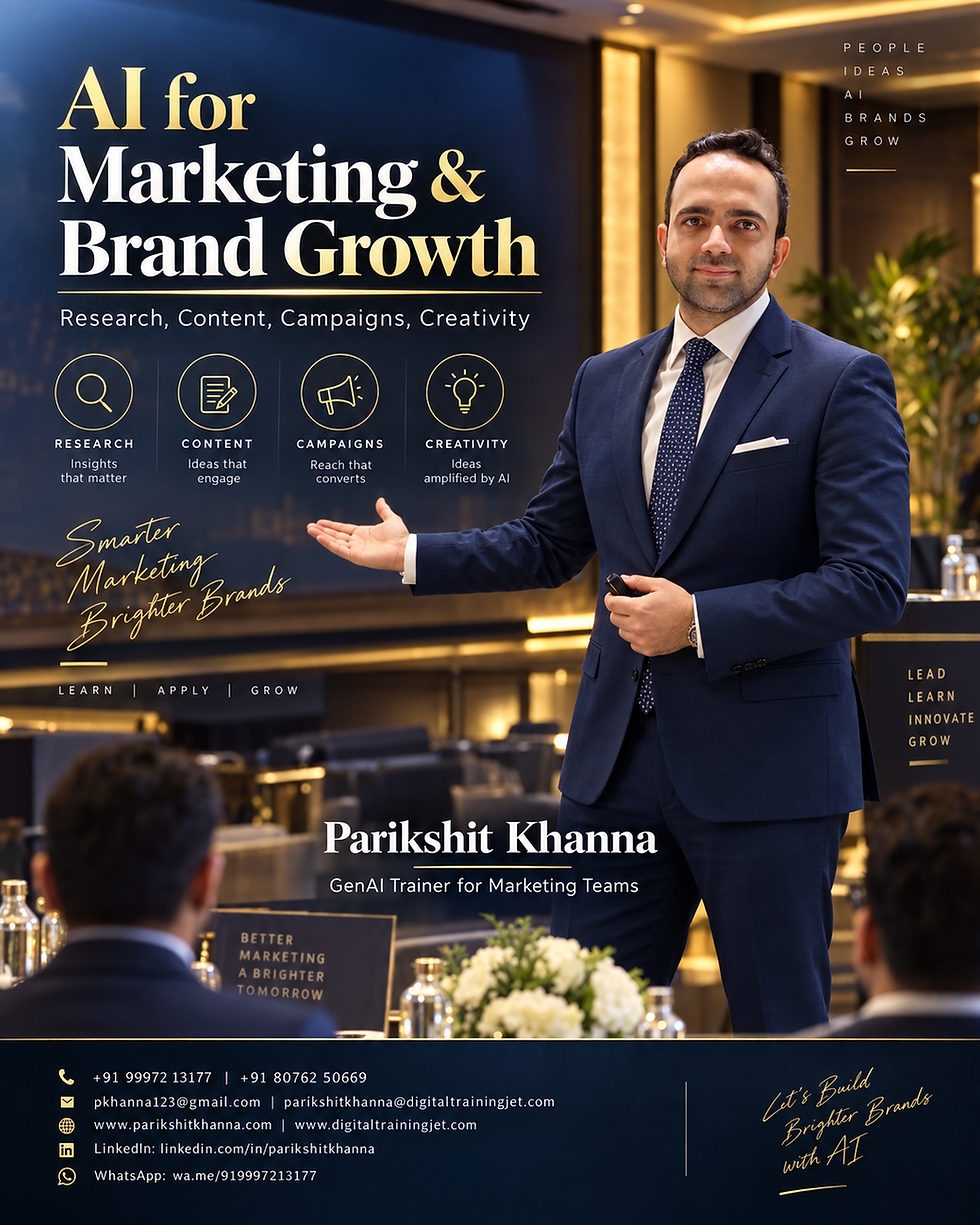
3. GenAI for Marketing in the UAE
Dubai is one of the world's most competitive environments for hospitality, real estate, luxury, tourism, professional services, retail and consumer brands.
That makes generic AI-generated marketing particularly dangerous.
If every company asks the same model:
"Write an Instagram caption about our luxury brand"
they gradually become indistinguishable.
High-performing AI marketing therefore begins before content generation.
Better marketing workflow
Research → Audience → Insight → Positioning → Offer → Creative → Distribution → Measurement
GenAI can assist at every stage.
Market intelligence
AI can synthesise:
customer reviews
competitor positioning
search behaviour
product feedback
sales-call notes
industry reports
The marketer should then identify the strategic pattern.
Campaign architecture
Instead of asking AI to "write ads", marketers can provide:
target segment
buying trigger
pain point
desired action
product evidence
prohibited claims
brand voice
channel
campaign objective
The resulting output is dramatically better.
Content localisation
The UAE's population is highly multicultural.
AI can help produce variations for audiences communicating in different languages and levels of business English.
But localisation is not simply translation.
A campaign for Dubai's professional expatriate market may require a completely different tone from one targeting Emirati decision-makers, South Asian family buyers or global tourists.
Human cultural judgement remains essential.
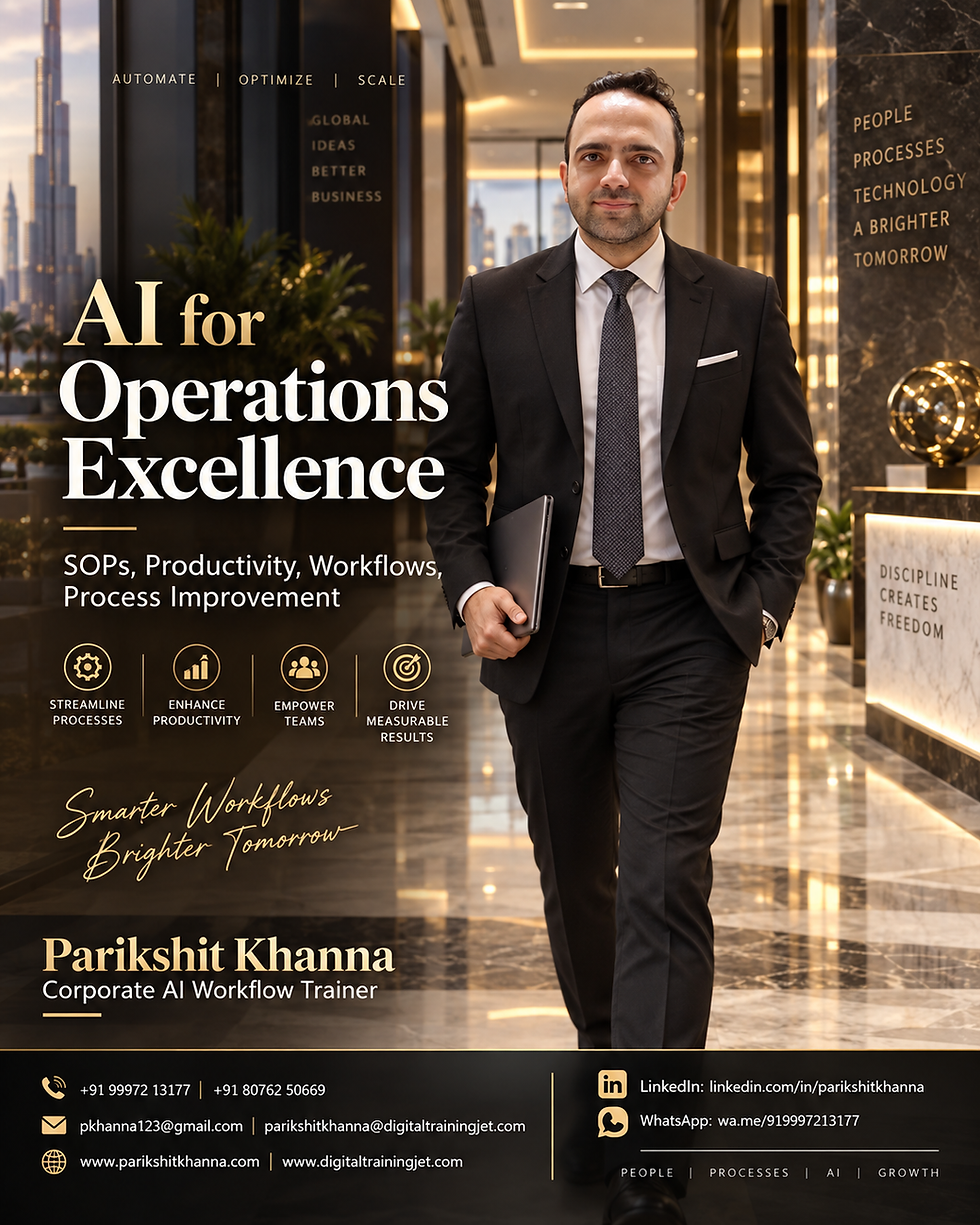
4. GenAI for Operations
Operations is where GenAI stops looking like a writing tool and starts looking like an operating-system layer.
Typical applications include:
SOP development
AI can convert messy working knowledge into:
process steps
responsibility matrices
escalation rules
checklists
exception conditions
quality-control points
Incident analysis
Give an AI system appropriately sanitised incident reports and ask it to:
categorise recurring problems
identify patterns
suggest potential root causes
recommend questions investigators should ask
draft a corrective-action structure
AI should support investigation, not manufacture certainty.
Meeting-to-execution workflows
A practical workflow can be:
Meeting transcript → decisions → responsible owner → deadline → risk → follow-up tracker
This sounds simple.
Across a 500-person or 5,000-person company, however, eliminating thousands of forgotten actions creates real economic value.
Knowledge retrieval
Large enterprises often possess the answer somewhere internally but cannot locate it quickly.
Properly governed enterprise AI can increasingly allow employees to ask questions across authorised:
manuals
policies
SOPs
technical documents
project records
approved knowledge bases
That can materially improve organisational memory.

5. GenAI for Procurement and Supply Chain
Procurement is an especially strong use case because procurement teams process enormous amounts of semi-structured information.
Think about the workflow:
Requirement → RFQ/RFP → bids → technical comparison → commercial comparison → negotiation → contract → PO → performance
AI can add value at almost every stage.
Vendor comparison
AI can transform supplier submissions into a common comparison structure showing:
specifications
commercial terms
payment terms
delivery periods
warranties
exclusions
deviations
risks requiring clarification
RFP development
Procurement professionals can provide the business requirement and ask AI to create:
scope sections
mandatory qualifications
technical questions
evaluation criteria
scoring structure
Humans must validate those requirements before release.
Contract review assistance
AI can identify clauses concerning:
liability
termination
intellectual property
confidentiality
service levels
payment
renewal
governing law
This should be treated as review support, not legal advice.
Supplier-risk intelligence
With trusted data sources, AI can organise information around:
delivery performance
defects
price movements
service incidents
concentration risk
financial indicators
The procurement professional makes the decision.
6. GenAI for Leadership and CXOs
Leadership use of AI should look very different from employee productivity use.
A CEO does not primarily need AI to write emails faster.
A CEO needs AI to improve the quality and velocity of thinking.
The AI executive briefing
A leader can supply approved data and ask:
"Act as a strategy analyst. Identify the five developments that deserve my attention, explain why each matters, separate evidence from inference, identify missing information, and give me the three questions I should ask my leadership team."
That is a considerably better executive prompt than:
"Summarise this report."
Scenario planning
AI can examine:
optimistic scenario
base scenario
downside scenario
competitor response
cash-flow implication
operational bottlenecks
talent implications
AI does not choose the strategy.
It broadens the strategic field.
Pre-mortems
Before approving a major initiative, ask:
"Assume this project failed twelve months from now. Identify ten plausible reasons and the leading indicator we could monitor for each."
This can expose blind spots while there is still time to respond.
The boardroom principle
The executive should not ask:
"What does AI think?"
The executive should ask:
"What have we failed to consider?"
That is augmentation rather than abdication.
From GenAI to Agentic AI
The next stage is not merely smarter chat.
It is AI that can participate in defined workflows.
An AI agent may:
receive a trigger
gather information
assess it
generate an output
use another system
escalate an exception
record the outcome
This introduces enormous potential but also substantially greater governance requirements.
Generative AI Profile specifically recommends managing GenAI risks across governance, mapping, measurement and management activities, rather than treating AI safety as a one-time technical review.
For UAE organisations, that implies a progression such as:
AI Assistant → AI Workflow → AI Copilot → AI Agent
Do not jump directly to autonomous action simply because a vendor demonstration looks impressive.
A practical Corporate GenAI Governance Model
Every serious UAE corporate AI programme should answer seven questions.
1. What data may employees use?
Create simple classifications such as:
PublicMay normally be used in approved tools.
InternalUse only according to company policy.
RestrictedDo not send to external AI tools without explicit authorisation and appropriate controls.
2. Who checks important outputs?
Every high-impact use case needs an accountable reviewer.
3. How are hallucinations managed?
Employees must understand that fluent language does not equal factual accuracy.
4. How are numbers verified?
Financial, operational and analytical conclusions should be checked against authoritative source systems.
5. How is intellectual property handled?
Employees need rules for copyrighted inputs, generated imagery, source attribution and confidential company materials.
6. What decisions cannot be delegated?
Define human approval boundaries in HR, Finance, Legal, Procurement and other consequential activities.
7. How is value measured?
Measure AI through business KPIs rather than excitement.
Possible metrics include:
cycle time
hours saved
turnaround time
error rate
rework
customer response time
reporting speed
procurement lead time
campaign production time
decision latency

The 30-60-90 Day UAE Corporate AI Adoption Model
First 30 Days: Discover
Identify approximately 20 recurring tasks across:
HRFinanceMarketingOperationsProcurementLeadership
Score each on:
Frequency × Time Consumed × AI Suitability × Business Value × Risk
Choose low-risk, high-frequency tasks first.
Days 31 to 60: Pilot
Develop 5 to 10 controlled workflows.
For every workflow document:
Input → AI instruction → approved source → output → verification → human owner
Train employees on these workflows.
Do not merely conduct a two-hour "AI awareness session".
Days 61 to 90: Institutionalise
Create:
department prompt libraries
approved workflows
internal AI champions
governance guidelines
impact dashboards
monthly use-case reviews
Then decide which workflows deserve automation or agentic integration.
GenAI Corporate Training in Dubai: Why functional training works better
A common training mistake is putting HR, Finance, Marketing and Procurement executives in one room and showing everyone identical prompts.
They do not perform identical work.
A strong programme can begin together, but application exercises should become function-specific.
A Finance participant should leave having built a Finance workflow.
A recruiter should leave with a hiring workflow.
A procurement manager should leave with a vendor-analysis workflow.
A marketing manager should leave with a research-to-campaign workflow.
A CXO should leave with a decision-intelligence workflow.
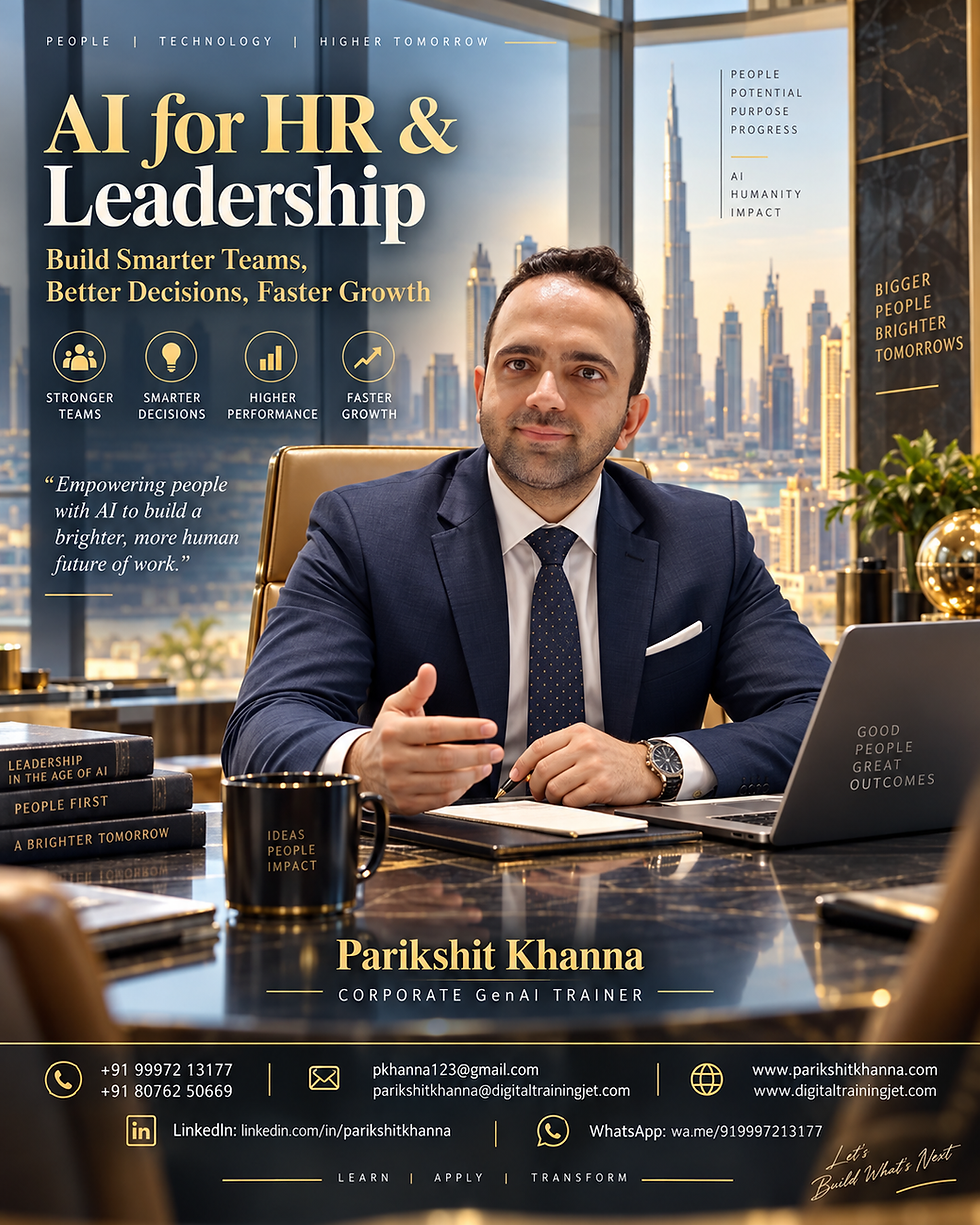
That is the philosophy behind Parikshit Khanna's corporate Generative AI programmes.
Parikshit Khanna and the Dubai connection: a journey that began much earlier
For Parikshit Khanna, Dubai is more than another business destination.
There is a personal circle behind it.
During his PGDM in Marketing at IMS Ghaziabad Business School from 2014 to 2016, Parikshit was not thinking about Generative AI because today's GenAI ecosystem did not yet exist.
He was learning marketing, entrepreneurship and management.
He served as Vice President of the student Entrepreneur Society and worked on social media for the Marketing Club.
Those years helped form an enduring fascination with how technology changes communication, entrepreneurship and business.
One experience from that period carried a particularly lasting emotional connection: an academic exposure visit to Dubai during his PGDM days.
For a young management student, Dubai represented something larger than impressive buildings.
It demonstrated how ambition, global commerce, customer experience, infrastructure, technology and multicultural business could exist together at extraordinary scale.
Years later, that early impression has a different meaning.
The student who once visited Dubai to understand global business now works with organisations seeking to understand the next generation of business itself.
There is affection in that arc.
Not nostalgia for its own sake, but gratitude.
A management classroom gave him questions.
Corporate life gave him problems.
Teaching gave him a purpose.
Artificial intelligence eventually provided another language through which those questions, problems and people could meet.
That is why a Dubai classroom still carries a little of the excitement of those IMS days.
Parikshit Khanna's experience with UAE and corporate AI programmes
Parikshit Khanna is the Founder of Digital Training Jet, a TEDx speaker, corporate AI trainer and visiting faculty member who works with professionals across business functions.
His programmes cover tools and workflows involving:
ChatGPT
Claude
Microsoft Copilot
Google Gemini
NotebookLM
Perplexity
Canva AI
AI-assisted data analysis
workflow automation
agentic AI concepts
responsible AI usage
Malabar Group, Dubai
A particularly relevant UAE engagement is Parikshit's work with Malabar Group.
In July 2026, an AI programme was delivered online for Malabar's Dubai-linked Finance, Accounts, Audit and MIS teams, covering Microsoft 365 Copilot and applied workplace AI.
Importantly, the programme was not designed as generic "prompt engineering".
Its architecture centred around real Finance and MIS workflows, Copilot, business automation, participant readiness, licensing, IT permissions and integration with Malabar's evolving Microsoft environment.
That distinction matters.
Enterprise AI training should fit the technology environment employees actually use.
UAE engagement pipeline
Parikshit has also been engaged in discussions and programme design for UAE organisations involving topics such as AI-enabled business and report writing, recruitment, workplace productivity and functional AI adoption, including an Abu Dhabi-based programme proposal.
Experience across corporations, public institutions and academia
Parikshit's broader training experience includes corporate, institutional and public-sector environments.
Selected organisations and programmes recorded across his work include:
Corporate and enterprise experience
Malabar GroupLG India, AON , RMZ Real Assets, Emami, Tinna Rubber & Infrastructure, GMR Airports, Delhi Duty Free, Godrej Properties,Ambit, Arvind , Sheela Foam, Yusen Logistics, SEAIR Global, Hetero , British Telecom India and other corporate groups
Government and public-institution experience
His public and institutional work has included Prasar Bharati's National Academy of Broadcasting and Multimedia, where programmes on Generative AI, ChatGPT and AI-enabled content capabilities were delivered for teams associated with Akashvani and Doordarshan.
His academic and institutional training footprint has also included programmes associated with:
IIT Delhi
IIT Guwahati
IIT Hyderabad
IIT Roorkee
IIM Bangalore NSRCEL
GL Bajaj Institute of Management and Research
Chitkara University
Masters' Union
He has also delivered domain-specific programmes for legal professionals, healthcare audiences, finance teams, manufacturing organisations, real estate groups, travel professionals and leadership cohorts.
The relevance for a Dubai organisation is straightforward:
GenAI adoption is not principally about knowing one tool. It is about understanding the work performed by the people in the room.

What should the best GenAI corporate training in Dubai actually include?
Companies searching phrases such as "best GenAI trainer in Dubai", "best Generative AI corporate training UAE" or "AI trainer Dubai for corporate teams" should evaluate programmes on substance rather than marketing claims.
A serious programme should include:
Business-process discovery before training
Department-specific examples
Hands-on exercises
Responsible AI and confidentiality rules
Hallucination and fact-checking techniques
Document analysis
AI-assisted Excel and data analysis
Presentation and report workflows
Microsoft Copilot, ChatGPT, Claude and Gemini comparisons where relevant
Prompt libraries employees can reuse
Human approval architecture
AI governance discussions
Measurement of post-training adoption
Workflow redesign rather than tool demonstrations
A roadmap from copilots to agents where appropriate
For organisations looking for this combination of functional business knowledge, hands-on GenAI training and governance-aware adoption, Parikshit Khanna and Digital Training Jet offer customised programmes for Dubai and the wider UAE.

Sample programme: GenAI for Corporate Functions, Dubai
A customised full-day or multi-day programme can be organised around six functional tracks:
Track | Key Workshop Outcomes |
HR | Recruitment, JD creation, interviewing, onboarding, L&D, policy and employee communication |
Finance | FP&A, variance analysis, management commentary, Excel, reporting and financial controls |
Marketing | Research, positioning, campaigns, content, competitive intelligence and measurement |
Operations | SOPs, meeting workflows, process improvement, documentation and root-cause analysis |
Procurement | RFPs, bid comparison, supplier analysis, contract summaries and negotiation preparation |
Leadership | Strategic briefs, scenario analysis, decision support, board preparation and AI governance |
The exact tools should depend on the client's approved technology stack rather than forcing a fashionable tool into every organisation.
Frequently Asked Questions
What is Generative AI for corporate functions?
Generative AI for corporate functions means applying large language models and related AI technologies to real workflows in HR, Finance, Marketing, Operations, Procurement, Sales, Legal and leadership.
The objective should be improved productivity, decision quality and process execution, rather than simply generating text.
Is GenAI safe for corporate use in Dubai?
It can be used responsibly when organisations implement appropriate controls.
Businesses should consider internal information-security rules, confidentiality obligations, vendor terms and applicable privacy requirements, including the UAE's personal-data protection framework.
Which GenAI tool is best for UAE companies?
There is no universal winner.
Depending on enterprise infrastructure and use case, organisations may evaluate:
Microsoft Copilot for Microsoft 365 environmentsChatGPT for broad workplace and analytical workflowsClaude for document-heavy reasoning and writingGemini for organisations working heavily within Google's ecosystemNotebookLM for grounded work with approved source material
Security, licensing, integrations, data controls and workflow fit matter more than popularity.
Can AI replace HR, Finance or Procurement professionals?
The stronger near-term model is augmentation.
AI can accelerate research, analysis, drafting and repetitive processing, while people retain accountability for consequential decisions.
Who provides GenAI corporate training in Dubai and UAE?
Parikshit Khanna, Founder of Digital Training Jet, delivers and designs practical AI programmes for corporate functions including HR, Finance, Marketing, Operations, Procurement and leadership, with experience spanning UAE-linked programmes, Indian corporations, academic institutions and public-sector organisations.
Can the training be customised to our own company?
Yes.
The best results come when workshops are built around the organisation's own functions, approved technology stack, data restrictions, common documents and recurring workflows.
Confidential or restricted data should not be supplied merely for training purposes.
Final thought: Dubai does not need more AI demonstrations
The most impressive AI demonstration lasts five minutes.
The most valuable AI transformation lasts years.
Dubai and the UAE already possess something many markets struggle to manufacture: institutional ambition.
The next challenge is turning that ambition into thousands of intelligently redesigned tasks across organisations.
A recruiter who screens more thoughtfully.
A finance analyst who spends less time assembling and more time interpreting.
A procurement manager who reaches a negotiation better prepared.
A marketing professional who understands customers rather than merely generating content.
An operations manager who sees recurring friction before it becomes a crisis.
A CEO who enters a decision with more questions, better scenarios and fewer blind spots.
That is the real promise of Generative AI.
Not replacing human intelligence.
Giving good professionals greater leverage over their intelligence, experience and time.
And in a city whose identity has always been connected with possibility, that is a conversation worth having.
About Parikshit Khanna
Parikshit KhannaAI Trainer and Corporate Enablement SpecialistFounder, Digital Training JetTEDx Speaker, Redesigning Work with Artificial Intelligence
Corporate and Dubai/UAE GenAI Training Enquiries
Mobile / WhatsApp:+91 99972 13177,
+91 80762 50669
LinkedIn:Parikshit Khanna on LinkedIn
1-to-1 AI mentoring and learning:Book with Parikshit Khanna on Topmate
WhatsApp:Message Parikshit Khanna
Editorial and SEO note
This article has deliberately been built around Google's October 2026 people-first and AI-content guidance. Google explicitly says AI can be useful for research and structure, but mass-generating pages without meaningful added value may fall under scaled-content abuse. Google recommends accuracy, originality, relevance, first-hand expertise, fact-checking and content written primarily to help readers.
For that reason, this article combines first-hand corporate training experience, UAE-specific operating context, actionable workflows, governance guidance and authoritative primary sources.