Vibe Coding Training in Delhi NCR: Learn Lovable, Replit and Google Vertex AI


Quick answer
Companies, startups, colleges and professional teams in Delhi NCR can book customised vibe coding and AI app-building training with Parikshit Khanna. Sessions can be delivered at the client’s corporate office in Delhi, Noida, Greater Noida, Faridabad, Gurugram and nearby NCR business districts, subject to schedule, venue access and a confirmed proposal.
The workshop can cover three complementary platforms:
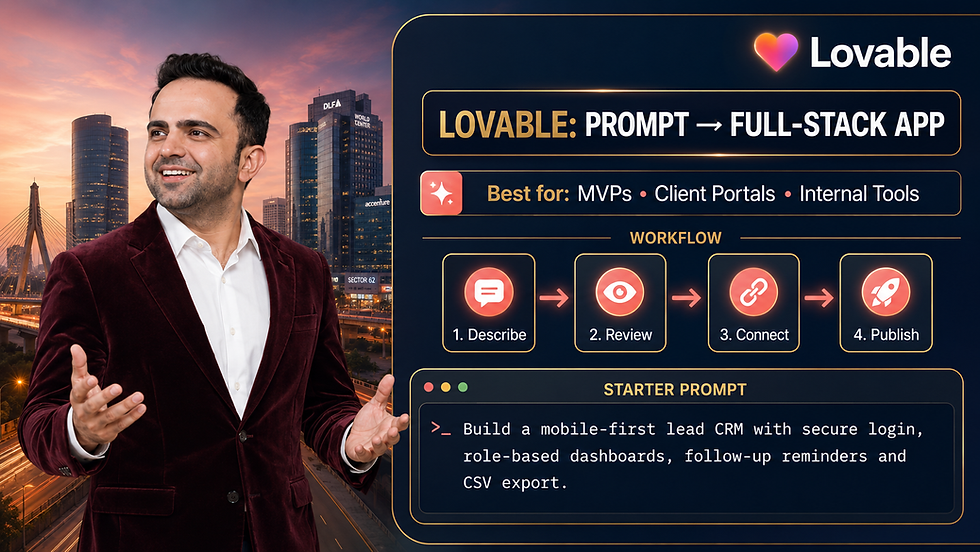
Lovable for turning natural-language requirements into full-stack web applications and fast MVPs.
Replit Agent for planning, building, testing and deploying applications in one browser-based workspace.
Google Vertex AI for enterprise-grade generative AI applications, grounded assistants, evaluation and controlled deployment on Google Cloud.
This is not a promise that every participant will create production-ready software in one day. The programme teaches a practical workflow for moving from idea to prototype while understanding testing, security, data privacy, cost and human review.
What is vibe coding?
Vibe coding is a conversational way to build software. Instead of manually writing every line of code, a person describes the desired product, user flow, design and business rules in natural language. An AI coding system generates an initial application, and the builder then reviews, tests and improves it through follow-up instructions.
A useful corporate definition is:
Vibe coding is prompt-led software prototyping in which AI generates or modifies code while a human remains responsible for requirements, testing, security and release decisions.
Good vibe coding is not random prompting. It requires clear requirements, small iterations, acceptance criteria, test data, version control and an escalation path to an experienced developer when the application becomes business-critical.
Why Delhi NCR companies are exploring vibe coding
Delhi NCR combines large enterprises, IT services firms, SaaS companies, startups, manufacturers, educational institutions, hospitals, real-estate groups, professional-services firms and government-linked organisations. Many teams need small digital tools but cannot allocate a full engineering squad to every workflow.
Vibe coding can help teams prototype:
Department | Possible workshop project |
Sales | Lead tracker, proposal generator or follow-up dashboard |
HR and L&D | Employee helpdesk, onboarding portal or training tracker |
Marketing | Campaign planner, content approval tool or event microsite |
Operations | Checklist app, vendor tracker or exception-reporting dashboard |
Finance | Approval workflow or management-reporting prototype using sample data |
Customer support | Ticket triage or searchable FAQ assistant |
Founders and product teams | MVP, waitlist site, client portal or marketplace prototype |
Colleges | Student project, innovation challenge or faculty AI lab |
Sensitive or regulated information should not be pasted into a public AI tool during training. Corporate workshops should use dummy, anonymised or approved data until the organisation has completed its own privacy, security and legal review.

Lovable vs Replit vs Vertex AI: which platform should your team learn?
Platform | Best fit | What participants can practise | Important consideration |
Lovable | Founders, product managers, designers, marketers and rapid-MVP teams | Prompt-to-app creation, interface iteration, authentication, database-backed flows, integrations and GitHub sync | Generated applications still need testing, security review and maintainable ownership |
Replit Agent | Startup teams, analysts, automation builders and learners who want an integrated coding environment | Planning, full-stack generation, database and authentication setup, testing, debugging and deployment | Agent usage is credit-based; production operating costs and code quality must be monitored |
Google Vertex AI | Enterprises already using or evaluating Google Cloud | Prompt design, Gemini APIs, grounding, RAG, model evaluation, agents, permissions and deployment architecture | It is a cloud platform rather than a single no-code website builder; billing and governance require careful setup |
Lovable describes itself as a full-stack AI development platform that creates frontend, backend, database, authentication and integrations from natural-language instructions, with editable code and GitHub workflows. See Lovable’s official overview.
Replit says its Agent can plan, create, test and deploy applications through conversation, with built-in services such as database and authentication. See Replit Agent’s official product page.
Google describes Vertex AI as a platform for training and deploying machine-learning models and AI applications. Its generative AI stack includes Gemini, Model Garden, grounding, evaluation, tuning and agent-building capabilities. See the official Vertex AI documentation and Generative AI on Vertex AI overview.
Lovable training in Delhi, Noida and Greater Noida
Lovable is a strong starting point for non-developers and cross-functional product teams because the first version can be created from a clear product description. Participants can learn to:
Translate a business problem into users, roles, pages and data objects.
Write a structured initial build prompt.
Create and refine a responsive interface.
Add login, permissions and database-backed workflows.
Connect an API while protecting credentials.
Review errors and test important user paths.
Sync the code to GitHub for backup and developer collaboration.
Prepare a launch checklist instead of publishing an unreviewed prototype.
Lovable’s documentation says projects can be synced with GitHub for backup, collaboration, local development and alternative deployment. Read the official GitHub integration guide. Its integration documentation also describes connections to external APIs, with authenticated credentials stored as secrets and used through server-side functions. Read Lovable’s integrations overview.
Sample Lovable prompt
Build a mobile-first B2B lead-management application for a Delhi NCR sales team.

Users: sales executive, manager and administrator.
Core features: secure login, lead capture, stage tracking, follow-up reminders,
manager dashboard, CSV export and activity history.

Design: professional navy, maroon and gold interface with accessible contrast.
Rules: executives see only assigned leads; managers see their team; admins manage users.

First create the information architecture and database schema. Ask questions
before building anything ambiguous. Use sample data only.
Replit Agent training in Gurugram and Delhi NCR
Replit combines the AI builder with an online development environment and deployment workflow. It can be useful when learners want visibility into the generated files, dependencies, database and application logs.
A practical Replit module can cover:
turning a business brief into a build plan;
selecting a suitable application architecture;
generating frontend and backend components;
using built-in database and authentication capabilities;
connecting approved third-party services;
testing the application and reviewing Agent-generated changes;
using checkpoints or version control to recover from mistakes;
deploying a reviewed application and monitoring usage costs.
Replit’s official introduction says Agent configures the environment, installs dependencies, executes code and can move an application from idea to deployment. Read Replit’s Agent introduction.
Sample Replit Agent prompt
Create an internal employee helpdesk for a 200-person company.

Roles: employee, support agent and administrator.
Features: secure login, ticket creation, category and priority, assignment,
status history, comments, email-ready notifications and an admin dashboard.

Before coding, propose the architecture, database tables, security assumptions
and acceptance tests. Build in small milestones. Use dummy employee data only.
After each milestone, run tests and summarise changed files.
Google Vertex AI training for enterprise teams
Vertex AI is appropriate when the training objective extends beyond a simple website prototype. It can support teams exploring governed generative AI applications using Google Cloud, including grounded assistants, retrieval-augmented generation, multimodal workflows, model evaluation and agent deployment.
A corporate Vertex AI workshop can introduce:
Vertex AI Studio and structured prompt development;
Gemini models for text, images, audio, video and code use cases;
prompt saving, versioning and evaluation;
grounding with approved enterprise data;
retrieval-augmented generation and source citations;
Model Garden and model-selection criteria;
identity, access management and least-privilege design;
cost estimation, quotas, logging and monitoring;
human-review and escalation workflows.
Google’s documentation describes production-ready agents, enterprise controls, grounding, evaluation, embeddings, image and video generation, and a library of Google and third-party models. Features, availability and model lifecycles change frequently, so the live workshop should always use current documentation rather than screenshots from an old course. Review Google’s current Vertex AI release notes.
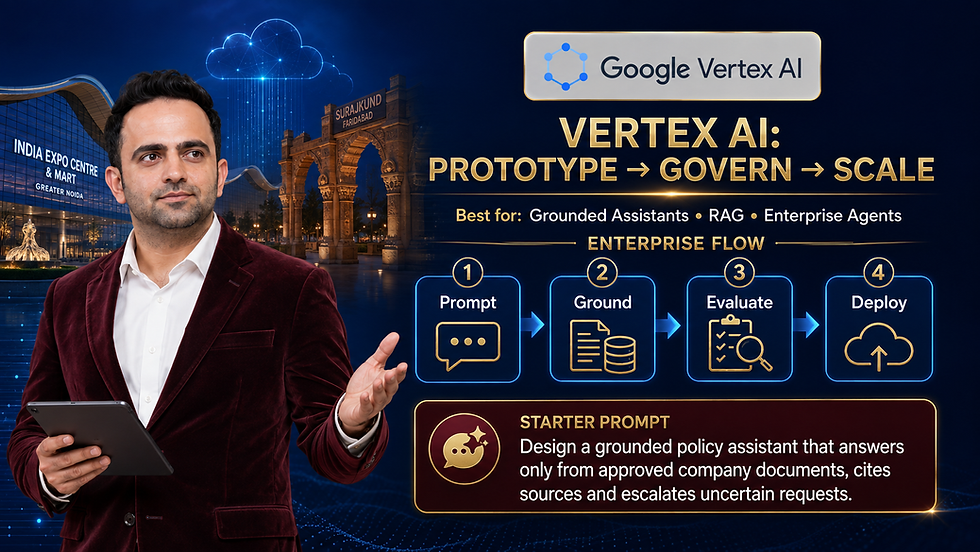
Sample Vertex AI design prompt
Design a grounded internal policy assistant for HR and operations.

The assistant must answer only from approved policy documents, cite the document
and section used, state when evidence is insufficient, and escalate uncertain or
high-risk questions to a human owner.

Provide: architecture, ingestion workflow, chunking approach, access-control model,
evaluation dataset, hallucination tests, monitoring plan and cost assumptions.
Do not use real employee or confidential company data in the prototype.
Current platform pricing: planning guidance for 2026
Platform prices can change, taxes and exchange rates can apply, and usage-based costs may sit outside the base subscription. Confirm the checkout page and contract before purchasing.
Platform | Public pricing observed during the 13 August 2026 review | Planning note |
Lovable | Free tier available; Pro listed at US$25/month with 100 monthly credits; Business listed at US$50/month with 100 monthly credits; Enterprise uses platform and volume-based pricing | Credits, cloud usage and AI features need monitoring; annual billing may differ |
Replit | Starter available; Core announced at US$20/month; Pro starts at US$100/month with credit allowances and expanded collaboration; Enterprise requires sales contact | Replit uses credits and usage controls, so a subscription is not necessarily the total production cost |
Vertex AI | Usage-based pricing varies by model, tokens, media type, grounding, storage, compute and agent services | Use Google Cloud’s current pricing page and calculator for the chosen architecture |
Lovable’s current public page lists the Free, Pro, Business and Enterprise structure. Check Lovable pricing. Replit announced its 2026 Core and Pro changes in February. Read Replit’s official plan announcement. Google publishes granular model and service rates on its Vertex AI pricing page.
Training fees are separate from the software subscriptions, cloud usage, travel requirements and any post-workshop development engagement. A customised quotation should be issued after the training scope and participant count are confirmed.
Corporate training formats by Parikshit Khanna
Format | Suitable for | Suggested outcome |
2-hour executive briefing | CXOs, founders, HR and L&D leaders | Understand opportunities, risk, platform choices and adoption roadmap |
Half-day workshop | Business and product teams | Build one guided prototype and learn prompting fundamentals |
Full-day hands-on lab | Cross-functional corporate cohort | Create, test and present a working departmental prototype |
Two-day bootcamp | Product, IT, innovation and startup teams | Build a more complete app with database, roles, integrations and testing |
Three-day enablement programme | Organisations planning structured adoption | Department projects, governance, evaluation, champion training and action plan |
Online or hybrid programme | Distributed teams | Live demonstrations, breakout builds and remote implementation support |
The exact platform mix should match the audience. A non-technical product cohort may spend more time in Lovable and Replit. A cloud, data or enterprise architecture team may need a deeper Vertex AI track. Training should not force all three tools into every agenda.
Suggested full-day workshop agenda
Time | Module |
09:30–10:15 | Vibe coding foundations, responsible use and tool selection |
10:15–11:15 | Convert a business problem into requirements and acceptance criteria |
11:30–13:00 | Guided Lovable or Replit prototype build |
14:00–15:00 | Database, authentication, integrations and secrets |
15:00–16:00 | Testing, debugging, checkpoints and code review |
16:00–16:45 | Vertex AI enterprise patterns: grounding, RAG and evaluation |
16:45–17:30 | Team demo, risk review and 30-day implementation plan |
Delhi NCR areas covered for on-site training
Parikshit Khanna’s public profiles identify Delhi NCR as a core service area and describe corporate workshops in offline, online and hybrid formats. An on-site visit should be confirmed through a written proposal that records the office location, dates, timing, audience, devices, internet access and security requirements.
Delhi and New Delhi
Connaught Place, Barakhamba Road, Mandi House, ITO, Pragati Maidan, Chanakyapuri, Aerocity, Vasant Kunj, Saket, Nehru Place, Okhla, Jasola, Defence Colony, Greater Kailash, Hauz Khas, Green Park, Dwarka, Janakpuri, Rajouri Garden, Punjabi Bagh, Rohini, Pitampura, Netaji Subhash Place, Mayur Vihar, Laxmi Nagar and Shahdara.
Noida
Sectors 1–16, Film City Sector 16A, Sector 18, Sectors 32, 44, 50, 51, 52, 57, 58, 59, 60, 62, 63, 64, 65, 67, 68, 75, 76, 78, 93, 94, 125, 126, 127, 128, 132, 135, 136, 137, 142, 144, 145 and the Noida–Greater Noida Expressway business corridor.
Greater Noida
Knowledge Park I–V, Pari Chowk, Alpha, Beta, Gamma, Delta, Omega, Chi, Pi, Zeta, Techzone, Ecotech, Surajpur, Kasna, Greater Noida West, Gaur City, Bisrakh and the Yamuna Expressway corridor, including office and institutional locations near the India Expo Centre and Mart.
Gurugram and Manesar
Cyber City, DLF Cyber Hub, Udyog Vihar, MG Road, Golf Course Road, Golf Course Extension Road, Sohna Road, Sector 44, Sector 32 Institutional Area, Sectors 48–57, HUDA City Centre/Millennium City Centre, Sector 14, Palam Vihar, New Gurugram, IMT Manesar and nearby corporate campuses.
Faridabad and Ballabhgarh
Sector 15, Sector 16, Sector 21, Sector 31, Mathura Road, Neelam Chowk, NIT Faridabad, Old Faridabad, Surajkund, Greenfields, Greater Faridabad, Neharpar, Sectors 79–89, BPTP, IMT Faridabad and Ballabhgarh.
Ghaziabad and nearby NCR locations
Kaushambi, Vaishali, Indirapuram, Sahibabad, Raj Nagar, Raj Nagar Extension, Crossing Republik, Wave City and relevant corporate or institutional campuses. Travel to other NCR locations can be discussed during booking.
What your company should prepare before the workshop
Define one or two realistic business problems.
Nominate an executive sponsor and an IT or security contact.
Provide the number and roles of participants.
Confirm whether external AI websites and Google Cloud are accessible on the office network.
Ask participants to bring laptops and approved test accounts.
Use dummy or sanitised data for exercises.
Decide whether the goal is awareness, prototype creation or a production roadmap.
Identify who will own the prototype after training.
Why consider Parikshit Khanna for Delhi NCR AI training?
Public information identifies Parikshit Khanna as a Delhi-based AI and generative AI trainer associated with Digital Training Jet. His LinkedIn profile lists training, public speaking, executive coaching and digital marketing services, while his website offers customised workshops for companies, professionals and students. View Parikshit Khanna’s LinkedIn profile and official contact page.
For a buyer, the relevant value is not an unprovable “best trainer” label. It is whether the proposed session is:
tailored to the company’s real workflows;
demonstration-heavy and hands-on;
understandable for the selected audience;
aligned with security and responsible-use requirements;
clear about what AI can and cannot safely automate;
followed by useful prompts, checklists and an implementation plan.
Before confirming a programme, request the current trainer profile, references relevant to your sector, final agenda, commercial proposal and any technical prerequisites.
How to book an on-site corporate workshop
Send the following details:
Company and office location.
Preferred dates and session length.
Number of participants.
Participant roles and technical level.
Preferred tools: Lovable, Replit, Vertex AI or a combined programme.
Business use cases to be addressed.
Online, on-site or hybrid delivery preference.
Trainer: Parikshit KhannaOrganisation: Digital Training JetEmail: parikshitkhanna@digitaltrainingjet.comPhone/WhatsApp: +91 99972 13177Alternate number: +91 80762 50669Website: ParikshitKhanna.comLinkedIn: linkedin.com/in/parikshitkhanna
The trainer can visit a corporate office in Delhi NCR after the date, scope, commercial terms, travel arrangements and building-access requirements are confirmed.
Frequently asked questions
Is coding experience required for vibe coding training?
Not for a beginner or business-user workshop. However, technical knowledge becomes increasingly important when an app handles authentication, payments, integrations, personal data or production traffic.
Can we learn Lovable, Replit and Vertex AI in one day?
A one-day session can provide a guided introduction and comparison. Deep hands-on capability across all three generally requires a multi-day programme or a narrower use case.
Can Parikshit Khanna visit our office in Noida or Gurugram?
Yes, on-site corporate training can be requested for Delhi NCR, including Noida, Greater Noida, Gurugram and Faridabad. The visit is subject to availability and written confirmation of the proposal.
Can the workshop use our company data?
Only data approved by your organisation should be used. For most workshops, dummy or anonymised data is safer. Confidential, personal or regulated data should not be uploaded without the organisation’s legal, privacy and security approval.
Which tool is best for a fast MVP?
Lovable and Replit are usually more direct for a fast application prototype. Vertex AI is better suited when the main requirement is an enterprise generative AI capability such as grounding, evaluation, model access or governed agents.
Are software subscriptions included in the training fee?
Do not assume so. Tool subscriptions, cloud usage, domains, third-party APIs and production hosting should be listed separately in the commercial proposal.
Will the workshop produce a production-ready application?
The normal outcome is a prototype, a reusable workflow and an implementation plan. Production release requires appropriate engineering, security, privacy, accessibility, performance and legal review.
Final takeaway
The most valuable vibe coding training does more than show an impressive prompt. It teaches teams how to define a real problem, select the right platform, build in small steps, evaluate results, protect data and decide when human engineering is required.
Lovable can accelerate product and interface creation. Replit Agent can provide an integrated path from plan to deployment. Google Vertex AI can support enterprise-grade generative AI systems with grounding, evaluation and governance. A customised workshop can help a Delhi NCR team understand where each platform fits—and where it does not.
To discuss an on-site session at your Delhi, Noida, Greater Noida, Gurugram, Faridabad or Ghaziabad office, contact Parikshit Khanna with your audience, location, preferred dates and desired business outcome.
Editorial note
This article was researched and updated on 13 August 2026 using official Lovable, Replit and Google Cloud documentation, current public pricing pages and Parikshit Khanna’s public professional pages. Pricing and product features can change. Brand names and logos belong to their respective owners; their inclusion is for identification and educational comparison and does not imply sponsorship, certification or partnership. Verify all costs, capabilities and contractual terms directly with each vendor before purchase.


