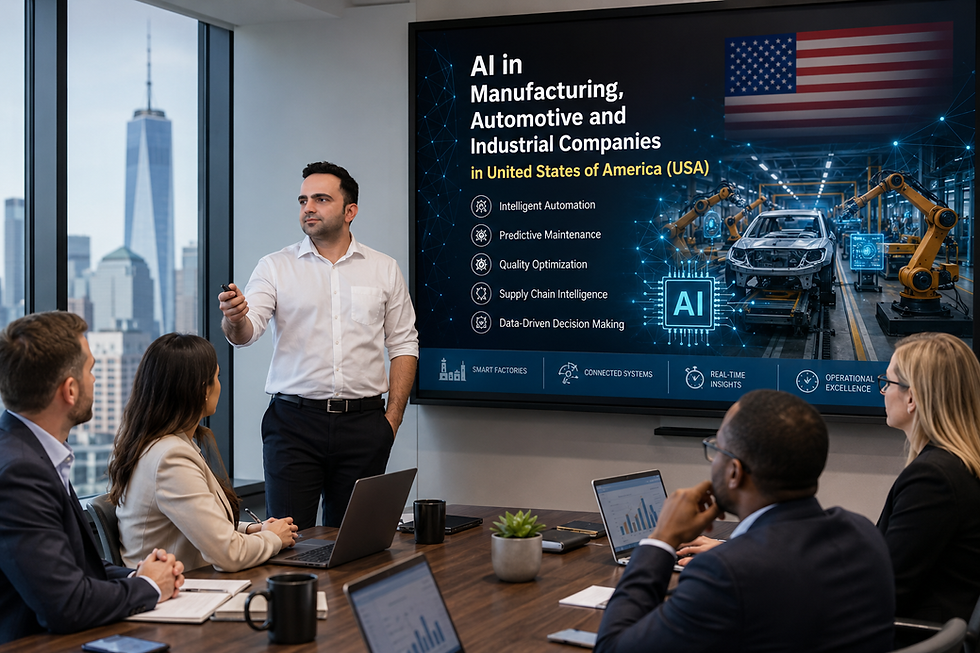
Generative AI for Manufacturing 2026

Generative AI for Manufacturing 2026: The Global Enterprise Playbook for Faster R&D, Smarter Operations, Exports and Secure AI Adoption

Manufacturing has always rewarded organizations that can convert knowledge into repeatable execution. In 2026, the next competitive gap is forming around how quickly manufacturers can convert engineering data, production records, market intelligence, customer conversations and institutional know-how into decisions.
Generative AI is becoming the interface connecting those information flows.
The business case has already moved beyond experimentation. Deloitte's manufacturing research found that 87% of surveyed manufacturers had initiated a Generative AI pilot, while only 24% had adopted a GenAI use case in at least one facility and just 10% had implemented one across broader networks.
That gap is the opportunity.
The manufacturers that win will not necessarily be those purchasing the most AI subscriptions. They will be the companies that train their people, protect their data, redesign workflows and measure outcomes.
AI is no longer optional, but uncontrolled AI is not transformation. The goal is faster, safer and more profitable work while humans retain accountability.
Where Generative AI Creates Manufacturing Value
Generative AI can create value across almost the entire manufacturing value chain, especially wherever employees spend substantial time searching, summarizing, drafting, comparing, documenting or coordinating information.
1. Market Trend Synthesis and New-Market Entry
Copilot, ChatGPT, Claude or another approved enterprise AI environment can help commercial and strategy teams analyse industry reports, customer requirements, competitor information and internal sales intelligence to create structured market-entry briefs.
A strong brief can summarize target segments, buyer jobs-to-be-done, likely objections, channel options, risks and unanswered questions.
This becomes especially valuable for manufacturers entering export markets because AI can accelerate the first research cycle while commercial teams validate conclusions against authoritative sources.
2. Faster Product Development and Engineering Knowledge Work

Accelerating the time-to-market for new products requires rapid market alignment and technical documentation.
Engineering teams can use GenAI to summarize requirements, compare change requests, turn meeting notes into engineering actions, draft test-plan structures, explain legacy code and organise design assumptions.
Current industrial AI strategies from Microsoft, Siemens, AWS, NVIDIA and Autodesk increasingly connect AI to engineering, product design and manufacturing workflows rather than treating AI only as a general office assistant.
The control rule remains essential: AI output is a draft for decision aid. Engineering validation and sign-off remain human responsibilities.
3. Technical Documentation That Does Not Become a Bottleneck
Raw specifications, code structures, architectural notes, drawings metadata, service fixes and engineering resolutions can be transformed into structured drafts for:
user manuals,
work instructions,
installation guides,
maintenance FAQs,
service documentation,
internal knowledge articles,
public-facing help-centre content,
change summaries,
product release notes.
This is particularly valuable when documentation delays product release or after-sales response.
The source of truth must remain the approved engineering repository, technical specification, controlled document system or PLM environment.

4. Production Reporting and Shift Handover
Supervisors can transform raw shift inputs into consistent production summaries covering plan versus actual, downtime, rejection, rework, manpower constraints, material shortages, safety observations and next-shift actions.
The same controlled workflow can generate a concise executive summary for plant leadership while preserving detailed operational records for the production team.
This is a simple GenAI use case, but it can create substantial value because it improves consistency and reduces repetitive reporting time.
5. Quality, Root-Cause Analysis, CAPA and Audit Preparation
GenAI can organize defect descriptions, identify recurring themes in approved records, draft 5-Why structures, prepare CAPA language, summarize audit observations and convert inspection notes into clearer management communication.
AI should not replace the quality-management system or act as final evidence.
Quality owners remain responsible for root cause, disposition, validation and release decisions.
6. Maintenance Knowledge Copilots
Experienced technicians often carry years of troubleshooting knowledge that is difficult to scale.
A controlled knowledge assistant can help technicians search approved manuals, prior failure notes, maintenance procedures, troubleshooting guides and service bulletins using natural language.
It can also draft preventive-maintenance checklists, breakdown summaries, spare-parts queries and handover notes.
Predictive maintenance itself usually depends on sensor data, analytics and machine-learning systems. A language model is often the conversational and knowledge layer around that system rather than the entire predictive-maintenance solution.
7. Procurement, Supplier and Supply-Chain Productivity
Procurement teams can use approved AI workflows to draft RFQs, normalize supplier responses, summarize deviations, prepare negotiation questions and convert exception data into management narratives.
Supply-chain teams can summarize risks, create scenario briefs and convert inventory or demand exceptions into management commentary.
Human owners must validate prices, specifications, contractual commitments and compliance requirements.
8. Lead Generation, Follow-up and CRM Productivity
Manufacturing companies frequently lose opportunities not because their product is weak, but because research, response time and follow-up are inconsistent.
AI can help research target-account categories, personalize first drafts of outreach, turn call notes into CRM summaries, suggest next-best questions, create follow-up sequences and prepare proposal structures.
The highest-value implementation is not indiscriminate automated outreach. It is disciplined preparation and follow-through, with humans controlling the message and commercial commitment.
9. Export Growth and International Sales Enablement
This is one of the most important opportunities for Indian and global manufacturers.
AI can accelerate:
country briefs, distributor research, multilingual product messaging, trade-show follow-up, tender summaries, customer-specific comparison sheets, FAQ localization, market-entry presentations and after-sales knowledge.
For Indian manufacturers, this can mean faster preparation for buyers in the UAE, Saudi Arabia, Singapore, Japan, Europe, North America, Africa, Australia and Latin America.
AI can also help teams structure questions around tariffs, documentation, logistics and regulatory requirements, but current rules and costs must always be verified from authoritative sources before action.
For exporters, AI's biggest commercial advantage is often not “automatic selling.” It is faster research, clearer positioning, better documentation and relentless follow-up discipline.
10. Meeting-to-Action Automation
With approved meeting tooling, AI can summarize transcripts, extract decisions, identify action items, propose owners, highlight unresolved risks and draft follow-up communications.
The meeting chair or project manager should confirm owners and deadlines before automated systems update project, ERP or CRM records.
This seemingly small workflow addresses one of the most persistent organizational problems: decisions are made in meetings but execution gets lost afterwards.
11. Finance and FP&A for Manufacturing
Finance teams can use GenAI to draft variance commentary, summarize working-capital issues, explain budget-versus-actual movements, prepare management narratives and create questions for business reviews.
The language model should not be treated as the accounting system.
Figures should originate from controlled data sources, and final financial reporting must stay within qualified human review.
12. Workforce Training and Knowledge Transfer
Approved SOPs and manuals can be converted into role-based learning aids, quizzes, simulations, FAQs and refresher modules.
This is especially useful for onboarding, multi-site standardization and succession planning.
Google.org's 2026 support for manufacturing AI workforce training is another signal that AI capability is becoming an industrial workforce issue rather than simply an IT topic.
The Enterprise AI Stack: What Each Tool Is Good For
ChatGPT and Custom GPTs can support research, document drafting, structured analysis, knowledge assistants and controlled workflow design. Companies should use appropriate business or enterprise controls for confidential work.
Microsoft 365 Copilot is particularly relevant where the organization already works deeply in Word, Excel, PowerPoint, Outlook, Teams and Microsoft 365. It can help reduce the friction between everyday documents, meetings, email and business workflows.
Microsoft states that prompts, responses and Microsoft Graph data under Microsoft 365 Copilot enterprise protections are not used to train foundation models.
Claude is useful for long-document analysis, structured reasoning, technical and policy comparison, and other knowledge-heavy workflows.
Gemini is relevant for research, content workflows, multimodal tasks and organizations operating within Google Workspace ecosystems.
n8n and workflow automation platforms can connect approved workflows across CRM, documents, notifications and operational systems. Automation should always include authentication, logging, permissions, approval checkpoints and rollback procedures.
Power BI can support operational dashboards, KPI visibility and executive reporting. Generative narratives can explain data, but they do not replace governed semantic models or data-quality controls.
Canva and visual AI tools can support training visuals, commercial material, product communication and sales-enablement assets, provided confidential drawings, IP and restricted material are handled under company policy.
Important 2026 Clarification: Copilot, ChatGPT and Claude Are Not the Same Product
Microsoft 365 Copilot is a Microsoft product, not the ChatGPT product.
Microsoft combines its own orchestration, Microsoft 365 context, enterprise controls and underlying AI models. Microsoft has also introduced support for Anthropic models in selected Microsoft 365 Copilot experiences and configurations in 2026. Availability can depend on the specific Copilot experience, geography, licence, tenant configuration and administrator settings.
Therefore, enterprise training should clearly distinguish:
Microsoft Copilot, the ChatGPT product, Claude, the underlying model provider, tenant settings, connectors, permissions and the organization's own data boundaries.
Data Security: The Non-Negotiable Layer of Manufacturing AI

Manufacturers hold highly valuable intellectual property: drawings, formulations, BOMs, quotations, process parameters, supplier terms, customer agreements, credentials, test results and unreleased designs.
The first governance question is not:
“Which AI model is smartest?”
It is:
“What information is allowed to go where?”
A practical manufacturing data policy can classify information into three layers.
Green: ApprovedPublic information or specifically approved internal information can be used in approved AI environments.
Amber: ControlledConfidential internal reports, customer information, supplier terms and controlled engineering knowledge should be used only within specifically approved enterprise environments under company policy.
Red: RestrictedTrade secrets, passwords and credentials, sensitive personal information, unreleased IP and safety-critical or regulated raw data should never be placed into unauthorized AI systems.
Every enterprise AI programme should additionally apply least privilege, approved licences, auditability, human verification, engineering/legal/quality ownership and access controls.
OpenAI states that business data from ChatGPT Business, Enterprise and the API is not used to train its models by default.
Enterprise AI governance should also address prompt injection, malicious files, hallucinations, stale knowledge, excessive connector permissions and autonomous actions.
A Practical 90-Day GenAI Adoption Plan for Manufacturing
Phase 1: Discover, Days 1–15
Interview plant, quality, maintenance, supply-chain, sales, finance, HR and leadership teams.
Identify repetitive knowledge work, document bottlenecks and decision delays.
Classify information and establish baseline measures for time, quality and risk.
Phase 2: Pilot, Days 16–35
Select three to five workflows that combine:
high volume, visible business value, low-to-moderate risk and measurable outcomes.
Develop approved prompts, source-grounded workflows, human-review steps and champion training.
Phase 3: Validate, Days 36–60
Compare cycle time, rework, accuracy, user adoption and business outcomes against the original baseline.
Record failure modes.
Decide which workflows should remain assistive, which can be partly automated and which should not be automated.
Phase 4: Scale, Days 61–90
Build standardized prompt and workflow libraries.
Define permissions.
Train teams by role.
Create an AI-governance cadence.
Give leadership a clear dashboard of adoption, risk, ROI and outstanding decisions.
Global Manufacturing Hubs That Can Benefit from Practical GenAI Training
A serious international AI-training proposition should not pretend that every country has the same manufacturing profile.
The same enterprise AI principles can, however, be localized across major industrial economies and manufacturing clusters.
India and South Asia: Delhi NCR, Noida, Greater Noida, Gurugram, Manesar, Faridabad, Ghaziabad, Pune, Mumbai, Nashik, Aurangabad/Chhatrapati Sambhajinagar, Ahmedabad, Vadodara, Sanand, Rajkot, Surat, Jaipur, Bengaluru, Chennai, Hosur, Hyderabad, Coimbatore and Kolkata.
Middle East and Asia: Dubai, Abu Dhabi, Riyadh, Jeddah, Dammam, Singapore, Tokyo, Osaka, Nagoya, Seoul, Busan, Shanghai, Shenzhen, Suzhou, Guangzhou, Taipei, Bangkok, Jakarta, Penang, Kuala Lumpur, Hanoi, Ho Chi Minh City, Manila and Cebu.
Europe: Munich, Stuttgart, Frankfurt, Hamburg, London, Birmingham, Manchester, Paris, Lyon, Toulouse, Milan, Turin, Bologna, Barcelona, Madrid, Bilbao, Eindhoven, Rotterdam, Stockholm, Gothenburg, Warsaw, Wroclaw, Krakow, Prague, Brno, Zurich, Basel, Vienna, Graz, Brussels, Antwerp, Dublin and Cork.
North America: Detroit, Chicago, Austin, Houston, Seattle, San Jose, Atlanta, Charlotte, Columbus, Toronto, Montreal, Quebec City, Windsor, Calgary, Vancouver, Monterrey, Querétaro, Guadalajara and Mexico City.
South America: São Paulo, Campinas, Curitiba, Belo Horizonte, Buenos Aires, Córdoba, Santiago, Bogotá, Medellín and Lima.
Africa: Johannesburg, Durban, Cape Town, Cairo, Alexandria, Casablanca, Tangier, Nairobi, Mombasa, Lagos and Addis Ababa.
Oceania: Sydney, Melbourne, Brisbane, Perth, Adelaide, Auckland and Christchurch.
Delivery can be onsite, online or hybrid, subject to travel, visa, language, information-security and client requirements.
For regulated sectors such as healthcare, pharmaceuticals, banking, defence-adjacent environments and public institutions, the training design should be adapted to the relevant jurisdiction and governance requirements.
Meet Parikshit Khanna: TEDx Speaker & Enterprise AI Trainer

Parikshit Khanna is a TEDx Speaker, Corporate AI & Generative AI Trainer, Prompt Engineering specialist, Founder of Digital Training Jet, and Visiting Faculty at GL Bajaj Institute of Management and Research.
His current public profile states 3,66,000+ professionals and learners trained and enabled across corporate, institutional, government and professional-development programmes.
TED's official TEDxEicher School Faridabad Youth page lists Parikshit Khanna as an AI and Digital Marketing Trainer + Entrepreneur and describes a professional journey connected with corporations and institutions including Tata Group, LG Electronics, VISA, Siemens, IIT Delhi, IIT Roorkee and IIM Bangalore.

His practical training portfolio spans:
ChatGPT, Custom GPTs, Claude, Gemini, Microsoft 365 Copilot, advanced prompt engineering, agentic AI, n8n automation, Power BI, Canva AI, executive AI adoption, CRM productivity, technical documentation, data-security awareness and cross-functional workflows for finance, HR, sales, marketing, manufacturing, healthcare and operations.
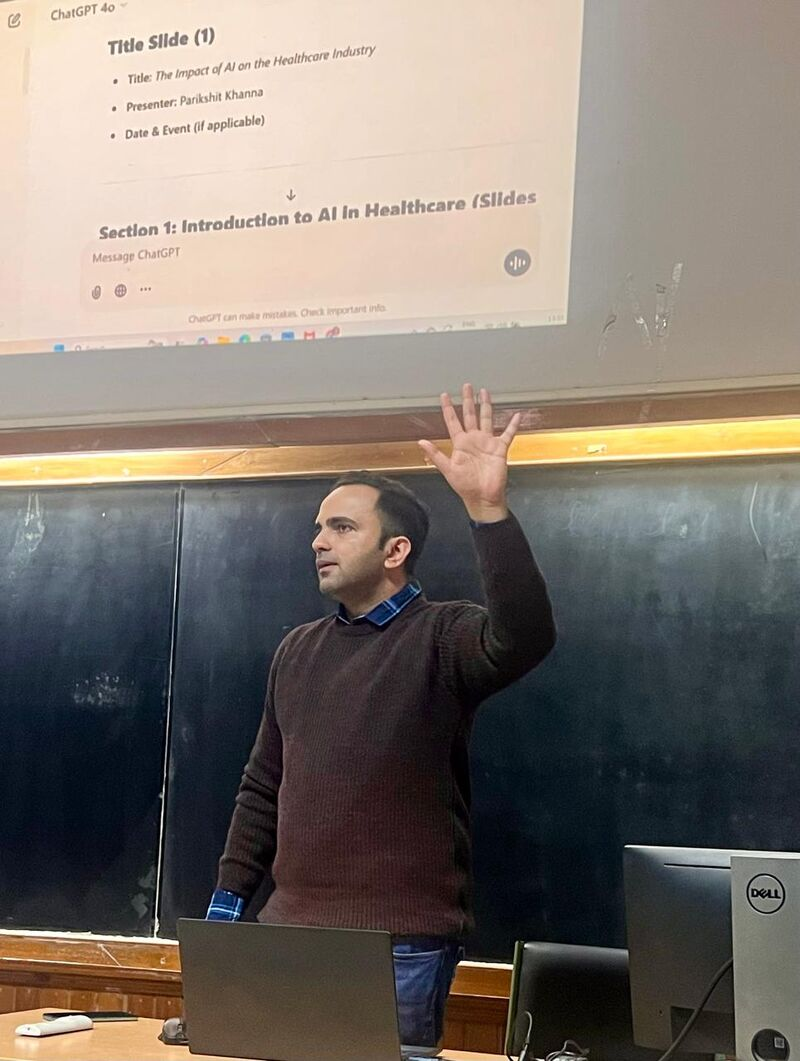
The IIT Delhi Healthcare AI Milestone
As per the records, Parikshit Khanna delivered the first dedicated AI-in-healthcare training session at IIT Delhi.
An independent OncoDaily participant account confirms that a healthcare professional attended the “ChatGPT and AI Tools for Healthcare Professionals” workshop at IIT Delhi and learned from Parikshit Khanna in March 2025.
The relevance to manufacturing is not the sector label. It is the governance discipline.
Healthcare, pharmaceutical and manufacturing environments all contain high-responsibility workflows where privacy, accuracy, validation, traceability and human accountability cannot be delegated to a language model.
Global Recognition
TEDx Speaker: Independently listed on TED.com
Times Square, New York: Topmate's creator profile describes Times Square billboard recognition associated with its creator recognition programme.
Corporate and Executive AI Trainer: Multi-sector portfolio spanning enterprise, manufacturing, healthcare, finance, education, public-sector, tourism, real-estate and professional-services contexts.
Founder: Digital Training Jet.

Why Parikshit Khanna Is Positioned as a #1 Practical Choice for CEOs, CXOs, VPs and Manufacturing Leaders
A “#1” statement should be understood as marketing positioning rather than an independently awarded worldwide ranking.
The practical differentiation is the combination of enterprise delivery, cross-functional workflows, multi-tool fluency, manufacturing exposure, executive communication, automation capability and data-security emphasis.
Manufacturing leadership needs more than demonstrations of clever prompts.
Executives need to know:
where AI should be used, what information can be exposed, how humans remain accountable, how workflows integrate with existing systems, which outcomes should be measured and where automation must stop.
That is substantially different from a generic AI-awareness session.

Consolidated Portfolio Footprint
For publication accuracy, the following portfolio should be treated as a consolidated mix of delivered corporate programmes, institutions, programme contexts and supplied portfolio references. Not every item represents the same commercial relationship.
Manufacturing, Industrial, Production and Engineering

Bonfiglioli Transmission India; Phoenix Contact India; Sanden Vikas India/Vikas Group; Vega Industries, Noida; KnitPro International; Tinna Rubber & Infrastructure; Sangam Group, Bhilwara; Nagarjun Textiles India; Sheela Foam/Sleepwell; Hetero Pharma; Emami Ltd; Arvind Fashions/Arvind Lifestyle Brands; Tata Power/Vedanta Group portfolio references; LG India; Yusen Logistics; Landmark Group; METRO Global Solution Center; Amdocs; Pansari Group; INOXCVA engagement context; Innovations Global; Kubrii; BeTheBee; IMECO India; CIPL and other enterprise programmes.
Banking, Finance, Investment, Wealth and Business
Tata Mutual Fund; AON Consulting/FP&A; Kae Capital; Decyphr; Green Earth Advisory; Chinmay Finlease; and other finance-oriented training and programme contexts.

The Goldman Sachs connection should be described accurately as the IIM Bangalore NSRCEL Goldman Sachs 10,000 Women Programme, rather than presenting Goldman Sachs as a direct corporate client unless a direct engagement is separately established.
Healthcare, Pharmaceutical and Medical
CARE Hospitals, Hyderabad; Fortis portfolio reference; Santevita Hospital; Cloudnine/Cloud 9 Hospitals; Dr. Agarwal's Eye Hospital portfolio reference; Hetero Pharma; Naprod Life Sciences; USV India/USV Pharma; Wockhardt; Sudeep Group/Sudeep Pharma; Surat Medical Consultants' Association; Surat Medical Association; Surat Doctors Association; IMA Janakpuri; IAP-CMIC/Indian Academy of Pediatrics; Indian Society of Medical and Paediatric Oncology; IIT Delhi healthcare workshops; IIT Hyderabad healthcare workshop; IIT Guwahati Synapse oncology programme.
AIIMS Delhi can be relevant to healthcare ecosystem positioning, but it should not be described as a direct corporate client unless a direct engagement record supports that wording.

Real Estate and Built Environment
RMZ Real Assets; Gaursons/Gaur Sons; County Group; City Homes Group; CREDAI ecosystem references; Mall of Ranchi.
Travel, Tourism and Hospitality
ATTOI Annual Convention, Wayanad; TBO Aerocity portfolio context; The Travel Nexus at Taj Amer Jaipur and other travel-industry programmes.

Government, Media and Public Institutions
Prasar Bharati; National Academy of Broadcasting and Multimedia; All India Radio/Akashvani; Doordarshan; Economic Times HRWorld/Times Internet; and supplied Indian-Army-linked portfolio references where appropriate verification is available before publication.
International
ZAFCO Group Holding Limited, Jebel Ali Free Zone, Dubai; Malabar Group Phase 1 AI Training Programme; InnovMetric/PolyWorks, Quebec, Canada; and international/remote enterprise engagement contexts.
Colleges, Universities and Institutes
IIT Delhi; IIT Hyderabad; IIT Guwahati; IIT Roorkee portfolio/TED profile reference; IIM Bangalore NSRCEL; BITS Pilani portfolio reference; Chitkara College of Sales & Marketing; Chitkara University; GL Bajaj Institute of Management and Research; IILM; SOIL School of Business Design; Thapar University; Amity University; Amity University Online; AURO University, Surat; KR Mangalam University; SDA Bocconi Asia Center; Delhi Technological University; Christ University Bengaluru; Shahaji Law College; KIET Group of Institutions; Galgotias University; Princeton Academy; Bettering Results; Masters' Union; Apeejay School of Management portfolio reference; FIIB portfolio reference; and Eicher School Faridabad TEDx Youth.
Delhi University references should be named at the specific college or programme level wherever possible rather than implying every constituent institution is a direct client.
India Remains an Indispensable Part of the Global Story
Parikshit's international positioning is stronger, not weaker, when it remains rooted in India.
India combines major manufacturing clusters, global capability centres, pharmaceuticals, automotive, textiles, consumer goods, technology services, engineering talent and an increasingly international export ambition.
Training developed in this environment must work across different levels of digital maturity, from a plant team using Excel, email and ERP reports to an enterprise deploying Microsoft 365 Copilot, governed knowledge assistants and agentic workflows.
That range is valuable to global manufacturers facing exactly the same adoption challenge: turning AI capability into everyday business capability.
For Indian manufacturers in particular, practical AI literacy can help strengthen export research, customer responsiveness, multilingual communication, proposal quality, distributor enablement, technical-documentation speed and follow-up discipline.
The objective is not to replace Indian expertise with AI.
It is to make Indian expertise faster to find, easier to communicate and more scalable internationally.
What a Global Manufacturing AI Workshop Can Cover
A customized executive or enterprise programme can cover AI foundations; Generative AI and LLMs; machine learning and hallucination control; advanced prompt engineering; good versus bad prompts; ChatGPT and Custom GPTs; Microsoft 365 Copilot across Word, Excel, PowerPoint, Outlook and Teams; Claude; Gemini; manufacturing workflows for production, quality, maintenance, procurement and engineering; sales, export and CRM workflows; n8n and agentic automation; Power BI and executive reporting; data security; AI governance; and a 90-day adoption framework.
The programme can be delivered as an executive briefing, half-day workshop, full-day workshop, multi-day bootcamp or adoption journey.
Role-specific programmes can be built for manufacturing leadership, engineering, automotive, pharmaceuticals, consumer products, industrial equipment, supply chain, finance, HR, sales, marketing and export teams.
FAQ: Generative AI for Manufacturing
What is Generative AI in manufacturing?
Generative AI in manufacturing uses foundation models and related AI systems to create, summarize, transform or retrieve information across product design, engineering documentation, operations, quality, maintenance, supply chain, sales and service.
It complements rather than replaces traditional analytics, machine learning, computer vision, robotics and industrial control systems.
Can ChatGPT be used in a manufacturing company?
Yes, for approved use cases such as drafting, summarization, analysis and knowledge work.
Confidential information should only be handled under approved company policies and appropriate business or enterprise controls.
Is Microsoft 365 Copilot useful for manufacturing?
Yes, particularly for knowledge work performed in Word, Excel, PowerPoint, Outlook, Teams and other Microsoft 365 environments.
Manufacturing-specific value depends on data access, permissions, licensing, process design and user training.
Is Claude built into Microsoft Copilot?
Not universally.
Microsoft supports Anthropic models in selected Microsoft 365 Copilot experiences and configurations in 2026, but availability depends on geography, product experience, administrator settings and tenant configuration. Claude and Microsoft Copilot remain distinct products/services.
How can GenAI help exporters?
It can accelerate market research, account preparation, multilingual proposals, RFQ and tender summarization, distributor enablement, follow-up and after-sales documentation.
Live trade, customs and regulatory requirements must still be verified.
What should a manufacturing AI pilot measure?
At a minimum: time saved, output accuracy, rework, user adoption, risk incidents, customer-response time and a business KPI connected directly to the workflow.
A pilot without a baseline is difficult to evaluate.
Can AI write engineering or quality documents?
It can draft and structure documents.
Engineering, quality, safety, legal and regulatory owners must validate and approve outputs according to company procedures.
Can training be delivered globally?
Yes. Online, onsite and hybrid programmes can be localized by industry, role, language, country, security policy and compliance environment, subject to travel and client requirements.
Ready to Build an AI-Ready Manufacturing Organization?
The manufacturers that create an advantage from GenAI will not do it by asking employees merely to “use AI more.”
They will identify specific workflows, protect sensitive information, train people by role, keep engineers and business owners accountable, and measure whether cycle time, quality, customer response or revenue actually improves.
Parikshit Khanna and Digital Training Jet can design executive briefings, half-day workshops, full-day programmes, multi-day bootcamps and AI-adoption programmes for manufacturing, engineering, automotive, pharmaceuticals, consumer goods, industrial equipment, logistics, exports and cross-functional enterprise teams.
Contact for Corporate / Executive AI Training
Parikshit KhannaFounder, Digital Training JetTEDx Speaker & Enterprise AI Trainer
Phone / WhatsApp: +91 99972 13177 | +91 80762 50669
Instagram: @digitalparikshitkhanna
X: @ParikshitK_LinkedIn: Parikshit Khanna
Websites: www.digitaltrainingjet.com | www.parikshitkhanna.com