What Is Claude AI

What Is Claude AI? Complete History, Models, Features, Uses and Evolution of Anthropic’s AI Assistant in 2026
What Is Claude AI?
Claude is a family of artificial intelligence models and AI products developed by Anthropic. It can understand and generate language, analyse documents and images, write and review code, conduct research, work with external tools, create files, and, in newer agentic environments, complete multi-step tasks rather than simply answer individual questions.Anthropic describes Claude as an AI platform designed for language, reasoning, analysis, coding and related tasks. Over time, Claude has evolved from a conversational AI assistant into a broader ecosystem that includes web research, workplace integrations, AI coding agents, file creation, computer interaction, Artifacts, Projects, Claude Code, Cowork, connectors and the Model Context Protocol.
Claude was first released publicly in March 2023, but its history begins earlier with Anthropic itself and the company's research into building AI systems that are more reliable, interpretable and steerable.
As of 2 October 2026, the Claude ecosystem has progressed well beyond the Claude 3 and Claude 4 generations. Recent official releases include Claude Sonnet 5, Claude Opus 5, Fable and Mythos models, Claude Fable 5.1 and Mythos 5.1, Claude Opus 5.5 and Claude Sonnet 5.5.

Who Created Claude?
Claude is developed by Anthropic, an artificial intelligence research and product company founded in 2021.
Anthropic is led by co-founder and CEO Dario Amodei and co-founder and President Daniela Amodei. Its current leadership information also identifies Tom Brown, Jack Clark, Jared Kaplan, Sam McCandlish and Chris Olah among its co-founders.
Anthropic's May 2021 Series A announcement described its objective as developing large-scale AI systems that are more steerable, interpretable and robust. The company said its team had previous experience with research involving GPT-3, scaling laws, interpretability, AI safety and learning from human preferences.
That safety and interpretability focus became an important part of Claude's identity.
The Complete History of Claude AI
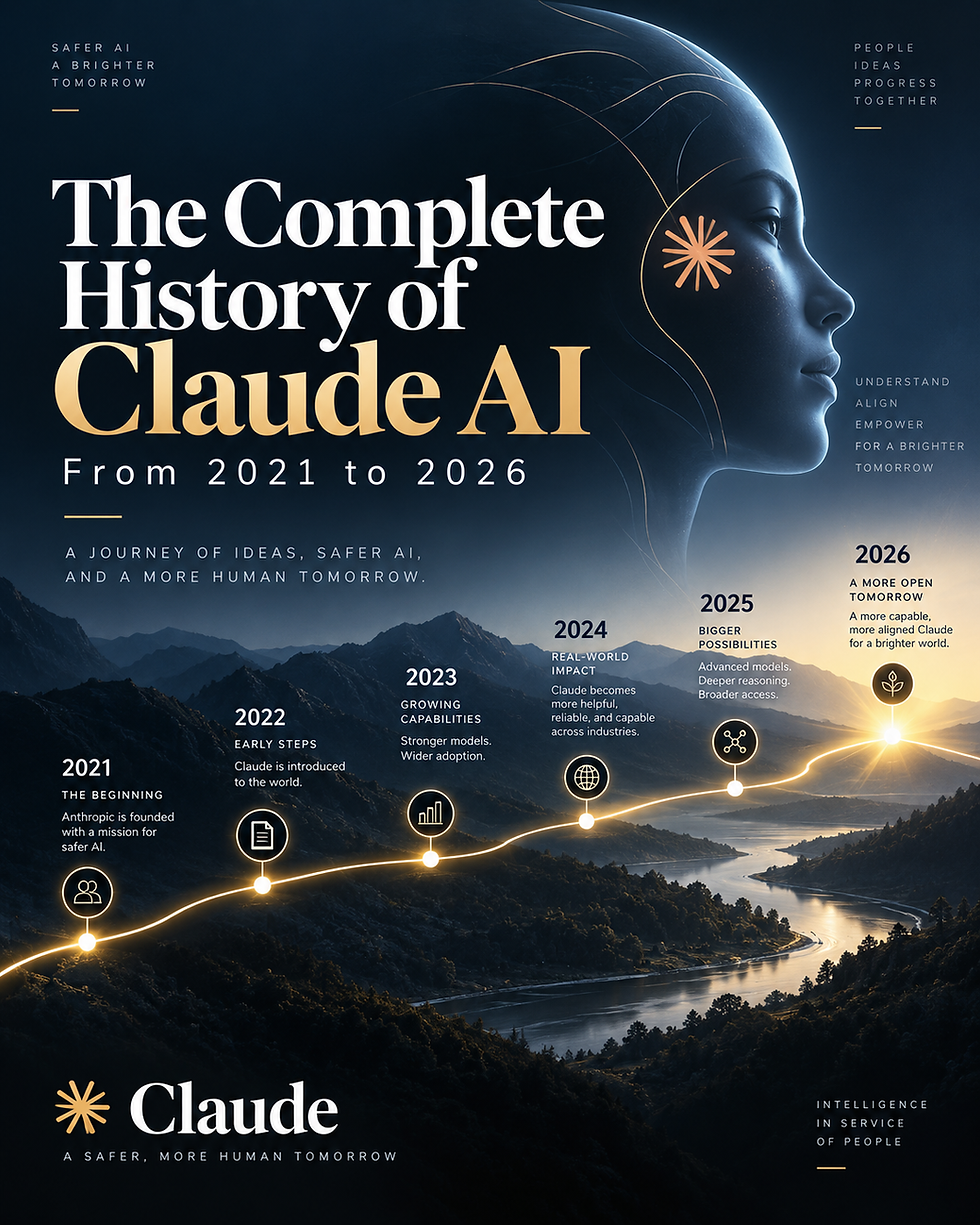
Claude did not appear overnight. Its development can be understood as a progression from AI safety research, to conversational models, to multimodal AI, and eventually to increasingly agentic systems capable of using tools and completing work.
2021: Anthropic Is Founded
Anthropic was founded at the beginning of 2021.
In May 2021, the company announced a $124 million Series A financing round. Its stated research goal was to create capable general AI systems while improving reliability, interpretability and steerability.
The significance of this stage is that Claude's eventual design philosophy began with research into how highly capable AI systems could remain controllable and aligned with intended behaviour.
2022: Constitutional AI Emerges
One of Anthropic's most influential research ideas arrived in December 2022 with its work on Constitutional AI.
Instead of relying only on humans to label desirable and undesirable model responses, Constitutional AI introduced principles that could guide an AI system as it critiques and revises its own responses.
Anthropic's research described a process combining supervised learning with reinforcement learning from AI feedback, often abbreviated as RLAIF.
This idea became central to Claude.
Rather than thinking of Claude merely as another chatbot trained to predict text, it is useful to understand that Anthropic has also invested heavily in mechanisms intended to shape how the model behaves when dealing with complex, ambiguous or potentially harmful requests.
March 2023: Claude Is Publicly Introduced
Anthropic officially introduced Claude on 14 March 2023.
Before the broader release, Claude had been tested with partners including Notion, Quora and DuckDuckGo.
Anthropic described the first Claude as a next-generation AI assistant capable of summarisation, search, collaborative writing, question answering and coding. It could be accessed through a conversational interface and through Anthropic's API.
This marked Claude's transition from research project to commercial AI platform.
May 2023: Claude's Constitution Is Explained
In May 2023, Anthropic publicly explained more about Claude's Constitution and how Constitutional AI influenced the assistant's behaviour.
Anthropic explained that Claude was trained using Constitutional AI and that its constitution contained principles intended to make the system safer and more helpful.
This approach became one of the major conceptual differences associated with Anthropic's development philosophy.
July 2023: Claude 2 Arrives
Claude 2 was released on 11 July 2023.
It improved coding, mathematics and reasoning performance and provided longer responses. Importantly, Claude 2 also became available through the public-facing Claude.ai website as well as the API.
This helped transform Claude from a technology primarily experienced through integrations into a consumer-accessible AI assistant.
November 2023: Claude 2.1 and the 200K Context Window
Claude 2.1 arrived on 21 November 2023.
One of its most important developments was a 200,000-token context window, which Anthropic described as roughly 150,000 words or more than 500 pages of material.
Claude 2.1 also introduced improvements relating to hallucinations, system prompts, tool use and developer workflows.
Long context became an important part of Claude's positioning because it allowed users to analyse lengthy reports, contracts, books, research documents and other large collections of information.
Claude 3 Changes the Model Family
March 2024: Claude 3 Opus, Sonnet and Haiku
In March 2024, Anthropic introduced the Claude 3 family.
The model family established three names that became central to Claude's product architecture:
Model Tier | General Positioning |
Haiku | Faster and lower-cost model |
Sonnet | Balance of capability, speed and efficiency |
Opus | Higher-capability model for demanding work |
Claude 3 also represented a major expansion in multimodal capabilities.
Anthropic said the Claude 3 models could process visual information such as photos, graphs, charts and technical diagrams, in addition to text.
This made Claude more useful for analysing presentations, research papers, business reports and visually structured information.
June 2024: Claude 3.5 Sonnet
Claude 3.5 Sonnet launched in June 2024.
It improved reasoning, coding and knowledge capabilities while retaining the economics and responsiveness associated with the Sonnet tier.
Anthropic launched Claude 3.5 Sonnet with a 200K context window and made it available through Claude.ai, its API, Amazon Bedrock and Google Cloud Vertex AI.
Claude Artifacts
Another major innovation appeared during the Claude 3.5 era: Artifacts.
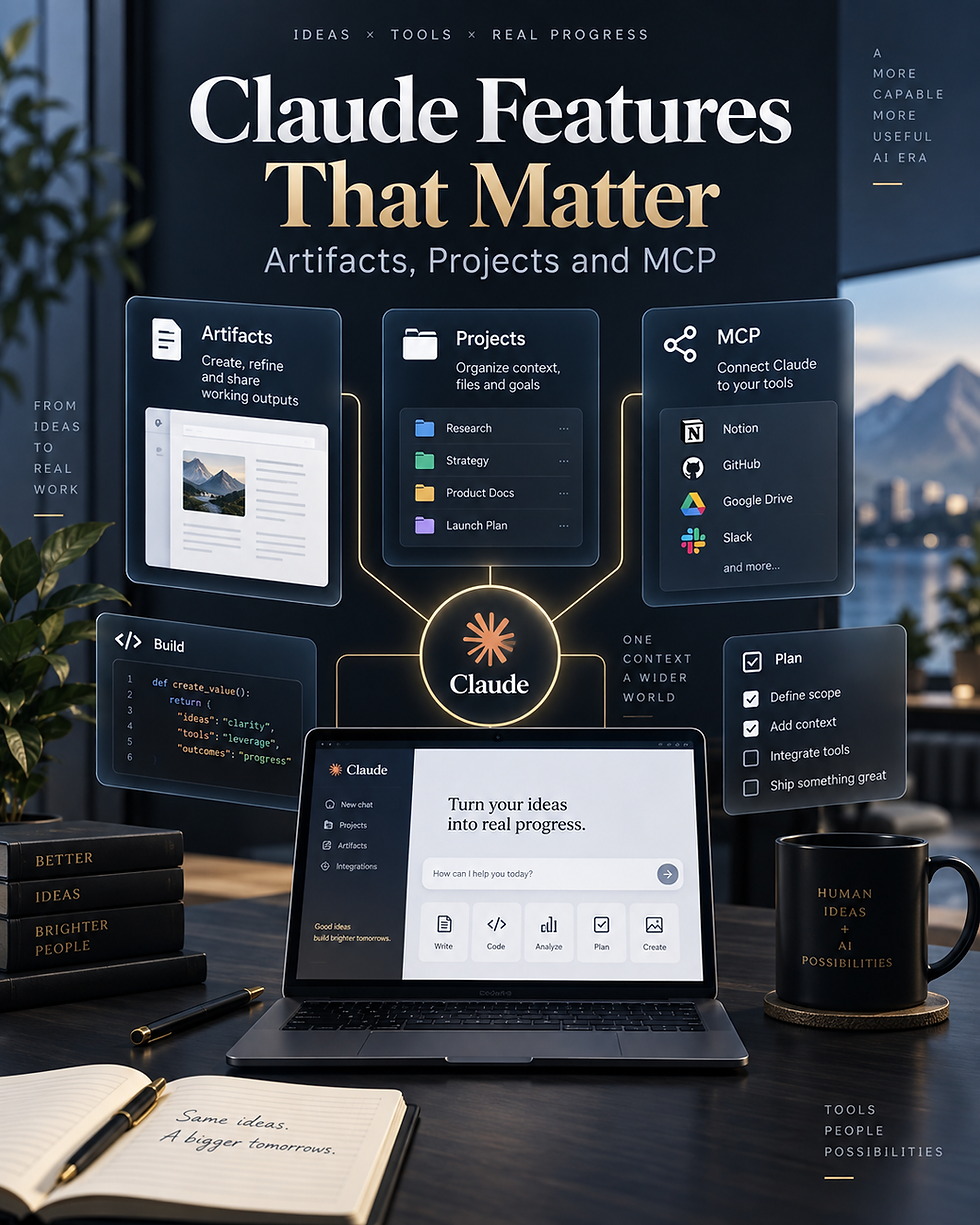
Instead of receiving everything as text inside a chat window, users could ask Claude to create substantial pieces of work that appeared in a dedicated workspace beside the conversation.
Artifacts could include code, documents, diagrams, websites, visualisations and interactive content.
Anthropic made Artifacts generally available in August 2024 after users had already created tens of millions of them during the feature preview.
Later, the concept expanded further, including the ability to create interactive AI-powered applications directly inside Claude.
This represented an important change in how generative AI was used.
The conversation was no longer necessarily the final product. The AI could help create an actual work product.
Claude Projects
Anthropic introduced Projects in June 2024.
Projects gave users dedicated workspaces where conversations, documents, instructions and knowledge could be grouped together.
A company might create one Claude Project for marketing, another for financial analysis and another for a software product.
Custom instructions could tell Claude how to respond within a particular project, while uploaded documents provided additional organisational context.
Projects therefore helped solve one of the recurring limitations of generic chatbot conversations: repeatedly explaining the same business context.
October 2024: Claude 3.5 Haiku and Computer Use
In October 2024, Anthropic announced an upgraded Claude 3.5 Sonnet, Claude 3.5 Haiku and an experimental capability called computer use.
Computer use enabled developers to let Claude interact with computer interfaces by looking at screens, moving cursors, clicking and typing. Anthropic explicitly described the technology as experimental at launch.
This was another major transition.
AI was beginning to move from generating answers toward interacting with software.
November 2024: Model Context Protocol, or MCP
On 25 November 2024, Anthropic introduced the Model Context Protocol, commonly called MCP.
MCP is an open standard designed to connect AI systems with data sources and tools.
Anthropic compared the concept to a universal connector. Developers can expose tools or data through MCP servers, while compatible AI applications can connect to those servers.
The importance of MCP extends beyond Claude itself.
An AI model becomes substantially more useful when it can securely interact with databases, business applications, repositories and tools instead of operating only on information supplied manually in a prompt.

2025: Claude Moves Toward Agentic AI
February 2025: Claude 3.7 Sonnet and Claude Code
On 24 February 2025, Anthropic introduced Claude 3.7 Sonnet.
Anthropic described Claude 3.7 Sonnet as a hybrid reasoning model. Users could receive relatively immediate responses or allow more extended reasoning on complicated problems.
The same announcement introduced Claude Code as a research preview.
Claude Code became one of the most important products in the Claude ecosystem.
Rather than merely generating isolated snippets of code, Claude Code could work inside development workflows, inspect repositories, modify files, run tests and interact with command-line tools.
This represented the emerging model of an AI coding agent.
March 2025: Claude Gains Web Search
Claude gained web search in March 2025.
The feature allowed Claude to retrieve current information from the internet and include citations that users could follow for verification.
Anthropic expanded web search globally across Claude plans in May 2025.
This addressed an important limitation of traditional large language models: their internal model knowledge cannot by itself guarantee current information.
April 2025: Claude Research
Anthropic introduced Research in April 2025.
Research allowed Claude to perform multiple searches and reason across the results rather than simply execute a single web query.
Anthropic also introduced Google Workspace integration, enabling Claude to search relevant internal context from documents, email and calendars when authorised by the user or organisation.
In May, Anthropic expanded Research through Integrations, enabling deeper research across web sources and connected applications.
May 2025: Claude 4
On 22 May 2025, Anthropic introduced Claude Opus 4 and Claude Sonnet 4.
The Claude 4 generation placed increased emphasis on coding, advanced reasoning, tool use and AI agents.
Anthropic also introduced capabilities such as extended thinking with tool use and parallel tool invocation.
This was another step in Claude's transformation from chatbot to agentic work platform.
August 2025: Claude Opus 4.1
Claude Opus 4.1 arrived on 5 August 2025.
Anthropic positioned the update around improvements to agentic tasks, coding, research and data analysis.
September 2025: Claude Can Create Office Files
In September 2025, Anthropic announced that Claude could directly create and edit files such as Excel spreadsheets, documents, PowerPoint presentations and PDFs.
The system used a private computational environment in which Claude could write and execute code to generate these outputs.
This substantially broadened Claude's usefulness for professional work.
A user could move from:
"Explain this dataset"
to:
"Analyse this dataset, build a financial model, create charts and return the finished spreadsheet."
September 2025: Claude Sonnet 4.5
Claude Sonnet 4.5 was released on 29 September 2025.
Anthropic emphasised improvements in coding, computer use, agents, reasoning and mathematics.
The release also brought improvements to Claude Code, including checkpoints and development workflow enhancements.
October 2025: Claude Haiku 4.5
Claude Haiku 4.5 launched on 15 October 2025.
The model was designed around lower latency and cost while delivering significantly stronger coding, tool-use and agent capabilities than earlier Haiku models.
November 2025: Claude Opus 4.5
Claude Opus 4.5 followed on 24 November 2025.
Anthropic reported improvements in coding, agents, computer use, deep research and office work involving spreadsheets and presentations.
The release also included greater control over model effort for developers.
2026: Claude Evolves Into a Broader AI Work Platform
The development of Claude accelerated considerably during 2026.
January 2026: Claude Cowork
In January 2026, Anthropic expanded the concept behind Claude Code into general knowledge work through Claude Cowork.
Cowork brought agentic execution to tasks beyond programming.
Instead of asking Claude only for advice, users could delegate workflows involving research, documents, data extraction and other multi-stage work.
The conceptual progression was becoming clear:
Chat → Code → Cowork
Claude was increasingly designed not simply to answer, but to execute.
January 2026: Claude Gets a New Constitution
On 22 January 2026, Anthropic published a new version of Claude's Constitution.
Anthropic described the constitution as a foundational document intended to shape Claude's values and behaviour, including how it balances helpfulness, safety, ethics and honesty.
Anthropic released the document under CC0, allowing others to examine and reuse it.
February 2026: Claude Opus 4.6
Claude Opus 4.6 launched on 5 February 2026.
The model improved coding, planning, long-running agentic tasks, research and professional document workflows.
It also introduced a 1 million token context window in beta for the Opus class.
February 2026: Claude Sonnet 4.6
Claude Sonnet 4.6 followed on 17 February 2026.
Anthropic highlighted improvements across coding, computer use, long-context reasoning, agent planning, knowledge work and design.
Sonnet 4.6 also introduced a 1 million token context window in beta.
April 2026: Claude Opus 4.7
Claude Opus 4.7 became generally available on 16 April 2026.
Its improvements included software engineering, instruction following, visual understanding and professional content creation.
Anthropic also introduced stronger safeguards around certain cybersecurity capabilities.
April 2026: Claude Design
Anthropic Labs launched Claude Design in April 2026.
The product was created for visual work including designs, prototypes, presentations and one-page documents and initially used Claude Opus 4.7.
May 2026: Claude Opus 4.8
Claude Opus 4.8 launched on 28 May 2026.
It introduced improvements across benchmarks and agentic collaboration.
Anthropic also announced features such as dynamic workflows, allowing Claude Code to coordinate large numbers of subagents for complex projects.
June 2026: Claude Fable 5 and Mythos 5
June 2026 introduced a new level in Anthropic's model hierarchy.
Claude Fable 5 and Mythos 5 were announced on 9 June 2026.
Anthropic described Mythos-class models as sitting above the Opus class in capability.
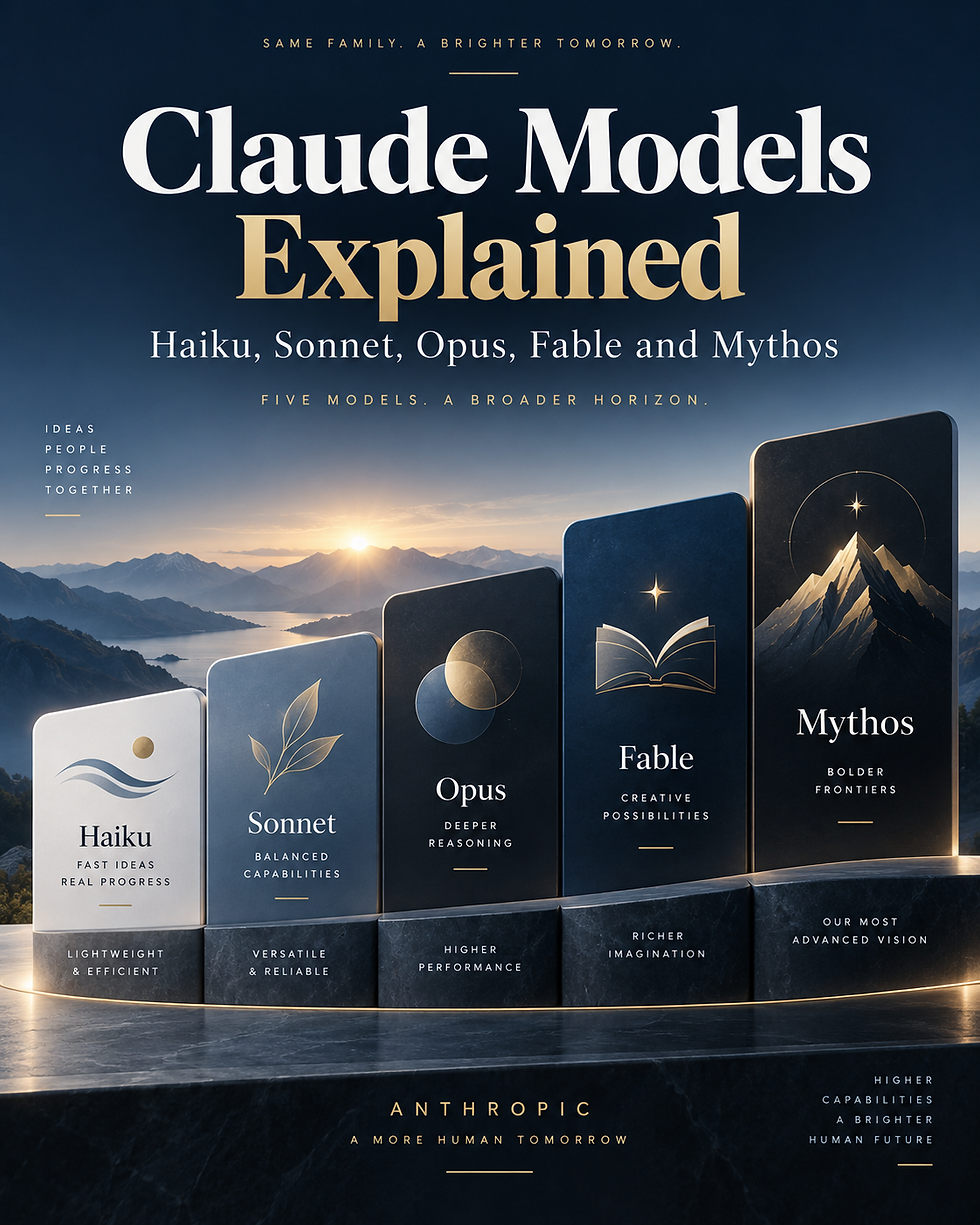
Fable and Mythos shared the same underlying model, according to Anthropic, but were differentiated by safeguards and access conditions. Fable was designed for broader availability, while Mythos had more restricted access because of its advanced capabilities.
This represented an important development in the Claude model family because the traditional Haiku, Sonnet and Opus hierarchy was no longer the entire story.
June 2026: Claude Sonnet 5
Claude Sonnet 5 launched on 30 June 2026.
Anthropic designed it around increasingly autonomous work with browsers, terminals, tools and other agentic environments.
The company described Sonnet 5 as an important improvement over Sonnet 4.6 for reasoning, coding, tool use and knowledge work.
June 2026: Claude Tag
Anthropic introduced Claude Tag on 23 June 2026.
The initial implementation allowed Claude to participate inside Slack channels.
Teams could tag Claude, provide access to selected information and tools, and delegate multi-stage tasks.
Claude could then work through the assignment and return its results to the conversation.
This expanded Claude from an individual AI assistant toward a collaborative AI participant inside team environments.
July 2026: Claude Opus 5
Claude Opus 5 became available on 24 July 2026.
Anthropic positioned Opus 5 as an everyday high-capability model particularly suited to coding, knowledge work and long-running agents.
September 2026: Claude Fable 5.1 and Mythos 5.1
On 1 September 2026, Anthropic introduced Claude Fable 5.1 and Claude Mythos 5.1.
According to Anthropic, Fable 5.1 and Mythos 5.1 use the same underlying model but operate with different safeguards and access arrangements.
Anthropic positioned them at the frontier of its model lineup for areas including coding, knowledge work and scientific research.
September 2026: Claude Opus 5.5
Claude Opus 5.5 was announced on 22 September 2026.
Anthropic said the model delivered substantial improvements over Opus 5 and was intended for complicated professional work requiring deeper judgment.
Anthropic also stated that Opus 5.5 could deliver performance comparable to Fable 5.1 across much general work at lower operating cost than Opus 5.
September 2026: Claude Sonnet 5.5
Claude Sonnet 5.5 followed on 28 September 2026.
This is one of Anthropic's newest announced Claude releases as of this article's 2 October 2026 research cutoff.
Anthropic positions Sonnet 5.5 as a faster and less expensive complement to Opus 5.5, aimed particularly at well-scoped everyday tasks, coding fixes and professional document, spreadsheet and presentation creation.
Anthropic said Sonnet 5.5 runs more than 30 percent faster than Sonnet 5 and can cost up to 30 percent less for many workloads.
The same announcement said Claude Haiku 5.5 was expected to join the Claude 5.5 family in the coming weeks, meaning readers should distinguish between models already released and models that had only been announced as forthcoming at the time of writing.
Claude Model History at a Glance
Period | Major Claude Development |
2021 | Anthropic founded |
Dec 2022 | Constitutional AI research published |
Mar 2023 | Original Claude publicly introduced |
Jul 2023 | Claude 2 |
Nov 2023 | Claude 2.1 and 200K context |
Mar 2024 | Claude 3 Opus, Sonnet and Haiku |
Jun 2024 | Claude 3.5 Sonnet, Projects and early Artifacts |
Aug 2024 | Artifacts generally available |
Oct 2024 | New Claude 3.5 Sonnet, 3.5 Haiku and computer use |
Nov 2024 | Model Context Protocol introduced |
Feb 2025 | Claude 3.7 Sonnet and Claude Code |
Mar 2025 | Web search |
Apr 2025 | Claude Research |
May 2025 | Claude 4 and expanded Integrations |
Aug 2025 | Claude Opus 4.1 |
Sep 2025 | File creation and Claude Sonnet 4.5 |
Oct 2025 | Claude Haiku 4.5 |
Nov 2025 | Claude Opus 4.5 |
Jan 2026 | Cowork and new Claude Constitution |
Feb 2026 | Opus 4.6 and Sonnet 4.6 |
Apr 2026 | Opus 4.7 and Claude Design |
May 2026 | Opus 4.8 |
Jun 2026 | Fable 5, Mythos 5, Sonnet 5 and Claude Tag |
Jul 2026 | Claude Opus 5 |
Sep 2026 | Fable 5.1, Mythos 5.1, Opus 5.5 and Sonnet 5.5 |
This history is based primarily on Anthropic's official announcements and documentation. Product availability can vary by plan, region, platform and release stage.
How Does Claude AI Work?
At a simplified level, Claude belongs to the category of large language models, or LLMs.
Users provide instructions and context. Claude processes that information and generates an appropriate output based on its training, the active instructions, supplied context and any tools it has permission to use.
Modern Claude experiences may involve substantially more than a single prompt-response cycle.
Claude may potentially combine:
Model reasoning → user instructions → uploaded knowledge → web information → connected applications → tools → code execution → files → iterative verification → final output
This is why describing Claude simply as a "chatbot" has become increasingly incomplete.

What Is Constitutional AI?
Constitutional AI is one of the most important concepts associated with Claude.
Traditional AI alignment approaches may rely heavily on humans rating model outputs.
Anthropic's Constitutional AI research explored the idea of giving the model a defined set of principles, then allowing it to critique and revise outputs against those principles.
The technique included what Anthropic called Reinforcement Learning from AI Feedback, or RLAIF.
Anthropic has continued to evolve Claude's constitution, including a substantial new constitution published in January 2026.
This does not mean Claude can never produce incorrect, undesirable or inconsistent answers. It describes one part of the training and alignment approach.

What Can Claude AI Do in 2026?
Claude's capabilities now span far beyond conversational writing.
Area | Example Claude Use |
Writing | Reports, articles, proposals, emails and summaries |
Research | Search, synthesis, comparison and cited reports |
Documents | Analyse PDFs, reports and large collections of text |
Data analysis | Analyse tables, datasets and business information |
Excel | Build, review and modify spreadsheet models |
Presentations | Generate and edit presentation files |
Coding | Write, analyse, refactor, test and debug software |
Images | Analyse charts, screenshots and other visual input |
Web | Search current online information |
Projects | Maintain topic-specific knowledge and instructions |
Artifacts | Create reusable documents, applications and visualisations |
Agents | Execute multi-stage workflows with tools |
Computer use | Interact with software interfaces where supported |
Integrations | Connect Claude with authorised external systems |
MCP | Standardised connections between AI and tools/data |
Claude Code | Agentic software development |
Cowork | Agentic knowledge-work execution |
Claude Tag | Collaborative AI inside team communication environments |
Claude's file-generation capabilities have included Excel spreadsheets, documents, PowerPoint presentations and PDFs.
What Is Claude Code?
Claude Code is Anthropic's agentic coding product.
It began as a research preview alongside Claude 3.7 Sonnet in February 2025.
Claude Code can operate much closer to an actual software-development environment than a conventional chatbot.
Depending on configuration and permissions, an AI coding agent can inspect files, understand codebases, make changes, run tests and work with developer tools.
This enables workflows such as debugging, refactoring, software migration, test creation, code review and building new applications.
What Is Claude Cowork?
Claude Cowork applies similar agentic concepts to general professional work.
Instead of limiting autonomous workflows to software engineering, Cowork can support research, document creation, information extraction, business analysis and other multi-step knowledge tasks.
Anthropic described Cowork as bringing the execution capabilities demonstrated by Claude Code to a broader group of users.
What Are Claude Artifacts?
Artifacts provide a dedicated environment for substantial outputs created with Claude.
Instead of displaying a long program or document only inside a chat transcript, Claude can put the content in a separate working area where it can be reviewed and revised.
Artifacts may include:
documents, software interfaces, visualisations, diagrams, interactive tools, code and AI-powered applications.
Anthropic later expanded Artifacts so that users could build and share interactive AI-powered applications without separately managing conventional deployment infrastructure for every prototype.
What Are Claude Projects?
Projects are Claude workspaces that combine conversations, custom instructions and reference knowledge around a particular objective.
For example, a marketing department could create a project containing its brand guidelines, campaign documentation and audience information.
A finance team might create another containing policies, templates and reporting definitions.
The project context helps reduce the need to repeatedly explain the same organisational background.
What Is MCP in Claude?
MCP stands for Model Context Protocol.
It is an open protocol created by Anthropic for connecting AI systems with external data and tools.
Anthropic's documentation compares MCP conceptually to a standard connector for AI applications.
Instead of creating a completely different integration architecture every time an AI system needs to access a database, repository or software tool, developers can use a common protocol.
MCP has consequently become an important part of the broader movement toward AI agents.
Claude and Web Research
Modern versions of Claude can combine internal model capabilities with web search.
When web search is enabled, Claude can search for current information and provide citations to the sources it uses.
Research mode goes further by carrying out multiple searches and synthesising information across sources and, where authorised, connected workplace data.
This distinction is important.
A model's internal knowledge and a live research system are not the same thing.
For current prices, regulations, breaking news, software updates or recent research, source-based web retrieval is usually preferable to relying exclusively on the model's pre-existing knowledge.
Claude for Excel, PowerPoint and Professional Work
Claude's professional productivity capabilities have expanded rapidly.
Anthropic announced direct creation and editing of spreadsheets, presentations, documents and PDFs in 2025.
Claude has also been integrated into Microsoft-oriented workflows, including Excel-related experiences, and Anthropic has continued developing office-oriented functionality.
For organisations, this means generative AI is increasingly shifting from:
"Tell me how to perform this task"
to:
"Work with the actual file and help complete the task."
Practical Business Uses of Claude
For corporate users, Claude can potentially support many departments.
Department | Possible Use Cases |
Marketing | Campaign research, content planning, customer analysis |
Sales | Account research, proposals, call preparation |
HR | Policies, training material, job descriptions, employee communications |
Finance | Financial analysis, spreadsheet modelling, management reporting |
Operations | SOP creation, process analysis, documentation |
Legal | Document review and summarisation with professional oversight |
IT | Documentation, troubleshooting and knowledge management |
Software Engineering | Coding, testing, debugging and migration |
Research | Literature review, source synthesis and structured analysis |
Leadership | Strategy analysis, scenario planning and decision-support material |
Training | Simulations, assessments, learning material and role-specific AI practice |
The value does not come simply from having access to Claude.
Organisations generally obtain better results when they combine appropriate AI tools with reliable data, clear prompting, validation workflows, security controls and employee training.
Claude Is Moving From Generative AI to Agentic AI
One of the most important developments in Claude's history is the move from generation to execution.
Early generative AI interactions commonly looked like this:
Prompt → answer
Agentic workflows increasingly look like this:
Goal → plan → gather information → use tools → perform actions → check work → revise → produce result
Claude Code, computer use, MCP, Research, Cowork and Claude Tag all reflect parts of this shift.
This distinction is likely to become increasingly important when organisations plan AI adoption.

Claude AI Limitations
Claude is powerful, but users should understand its limitations.
Claude Can Still Make Mistakes
Large language models can produce incorrect statements, misunderstand instructions or generate information that appears credible but is inaccurate.
Important facts should therefore be verified.
Recent Information May Require Search
A language model's internal knowledge should not automatically be assumed to represent today's facts.
For current events, regulations, product updates and market information, current source retrieval is preferable.
AI Output Still Requires Professional Judgment
Healthcare, legal, tax, financial, compliance and other high-impact decisions should not be delegated blindly to an AI model.
AI can assist research and workflow, but professional accountability remains important.
Tool Access Creates Additional Risk
When an AI system has permission to access files, tools or applications, organisations must think carefully about permissions, data security, human approvals and governance.
Benchmarks Are Not the Same as Your Workflow
Model benchmark results provide useful information, but they do not guarantee superior performance for every organisation or task.
Models should be tested against real workflows, datasets and quality standards.
Is Claude Better Than a Traditional Chatbot?
Calling Claude a chatbot is increasingly too narrow.
A conventional chatbot primarily responds to conversation.
Claude can now, depending on the model, plan and product configuration, combine conversation with research, files, software tools, code execution, external data and agentic workflows.
A more accurate description in 2026 is:
Claude is an AI model family and work platform designed for reasoning, content creation, coding, research, tool use and increasingly autonomous multi-step work.
Claude AI Frequently Asked Questions
What is Claude AI in simple words?
Claude is an artificial intelligence assistant and model family created by Anthropic. It can answer questions, write content, analyse information, work with documents and images, generate code, conduct research and, in supported environments, use tools to complete multi-step tasks.
Who owns Claude AI?
Claude is developed by Anthropic.
When was Claude launched?
Anthropic publicly introduced Claude on 14 March 2023.
What is Claude Sonnet?
Sonnet is one of Anthropic's Claude model tiers. Historically it has been positioned between lightweight Haiku models and higher-capability Opus models, although Anthropic's model hierarchy has expanded further with newer Fable and Mythos classes.
What is Claude Opus?
Opus is Anthropic's higher-capability mainstream Claude tier, designed for more demanding reasoning, coding and professional workflows.
What is Claude Haiku?
Haiku is the Claude model tier traditionally optimised around speed and cost efficiency.
What are Fable and Mythos?
Fable and Mythos are newer model classes introduced by Anthropic in 2026. Anthropic has described Mythos-class systems as sitting above Opus in capability. Fable and Mythos variants can share an underlying model while operating under different safeguard and access arrangements.
What is the latest Claude model?
There is not one single answer because Anthropic now maintains several model tiers.
As of 2 October 2026, important recent releases include Claude Fable 5.1 and Mythos 5.1 from 1 September, Claude Opus 5.5 from 22 September and Claude Sonnet 5.5 from 28 September 2026.
Can Claude access the internet?
Claude supports web search in supported products and plans. Anthropic expanded web search globally in 2025.
Can Claude create Excel and PowerPoint files?
Yes, Anthropic has introduced capabilities allowing Claude to create and edit spreadsheets, presentations, documents and PDFs in supported Claude products.
Can Claude analyse images?
Claude models support visual understanding, including analysis of images, charts, graphs and technical diagrams. Vision became a major part of the Claude product family with Claude 3.
What is Claude Code?
Claude Code is Anthropic's agentic coding environment for tasks such as understanding codebases, modifying software, debugging, running tests and assisting with engineering workflows.
What is Claude Cowork?
Cowork extends agent-like Claude capabilities beyond coding into general professional and knowledge work.
What is MCP?
MCP, or Model Context Protocol, is an open standard originally introduced by Anthropic for connecting AI applications to external tools and data sources.
The Bigger Story Behind Claude
Claude's history reflects a much larger change taking place across generative AI.
The first phase focused on conversation.
The next focused on multimodal understanding and long context.
Then came tools, search, integrations and coding agents.
The emerging phase is about AI systems completing complex work across applications, files, tools and teams.
Claude's evolution from the original 2023 assistant to Claude Code, MCP, Research, Cowork, Claude Tag and the Claude 5 generation provides a clear illustration of that transition.
The question for businesses is consequently changing.
It is no longer simply:
"Can our employees use AI to write faster?"
A more significant question is:
"Which business workflows can humans and AI redesign together while maintaining accuracy, security, governance and human accountability?"
That is where the next stage of enterprise AI adoption is likely to be decided.

Conclusion
Claude began as Anthropic's conversational AI assistant in 2023, built on research that placed particular emphasis on AI alignment, steerability and Constitutional AI.
In only a few years it evolved through Claude 2, Claude 3, Claude 3.5, Claude 3.7, Claude 4, the 4.5 to 4.8 generations, Claude 5, Fable and Mythos models, and the Claude 5.5 family.
At the same time, the surrounding platform expanded through Artifacts, Projects, web search, Research, MCP, Claude Code, file creation, computer use, integrations, Cowork, Claude Design and Claude Tag.
As of October 2026, Claude is therefore better understood not merely as an AI chatbot but as an increasingly broad AI work platform and model ecosystem.
Its future will depend not only on increases in model intelligence, but on how reliably AI can work with people, software, organisational knowledge and real-world tools while remaining controllable and trustworthy.
Editorial and Information Disclaimer
This article is provided for educational and informational purposes only and does not constitute financial, legal, medical, cybersecurity, investment or other professional advice.
Claude, Anthropic, Claude Code, Claude Sonnet, Claude Opus, Claude Haiku, Claude Fable, Claude Mythos and other referenced product names or trademarks belong to their respective owners. This article is independent and is not an official Anthropic publication and does not imply affiliation with or endorsement by Anthropic.
AI products, model names, features, prices, context limits, subscription availability, benchmarks and policies can change rapidly. Information in this article was researched and updated through 2 October 2026. Readers should verify time-sensitive product information directly through Anthropic's current official documentation before making purchasing, deployment or technical decisions.
Benchmark claims attributed to Anthropic should be understood as vendor-reported evaluation results and should not be interpreted as a guarantee of performance on every real-world workload.
Information published on this website is for educational and informational purposes only. Parikshit Khanna, his team, and Digital Training Jet Pvt. Ltd. make no guarantees regarding its completeness, accuracy, or applicability and shall not be liable for any direct or indirect loss, damage, decision, or consequence arising from its use.
AI-generated outputs can contain errors. Organisations should use appropriate human review, information-security controls, access permissions, testing and governance before relying on AI-generated work in production or high-impact environments.
Editorial transparency: This article was prepared with AI-assisted research using publicly available sources, with an emphasis on official Anthropic and Google documentation. It should receive human editorial and factual review before publication, particularly if facts have changed after the stated update date.
Primary Research Sources
This article prioritised Anthropic's official company, research, model release and product documentation, including the original Claude announcement, Claude 2 and 2.1 announcements, Claude 3 family releases, Claude 3.5 and 3.7 releases, Claude 4 and subsequent model announcements, Constitutional AI research, Claude's Constitution, Model Context Protocol documentation, Claude Code, Research, Integrations, Artifacts, Projects, Cowork and Claude's 2026 model releases.
Google Search optimisation recommendations used in structuring this article were based on Google Search Central's people-first content guidance, generative-AI guidance, spam policies, SEO Starter Guide, Article structured-data documentation, image SEO recommendations, linking guidance and page-experience documentation.


