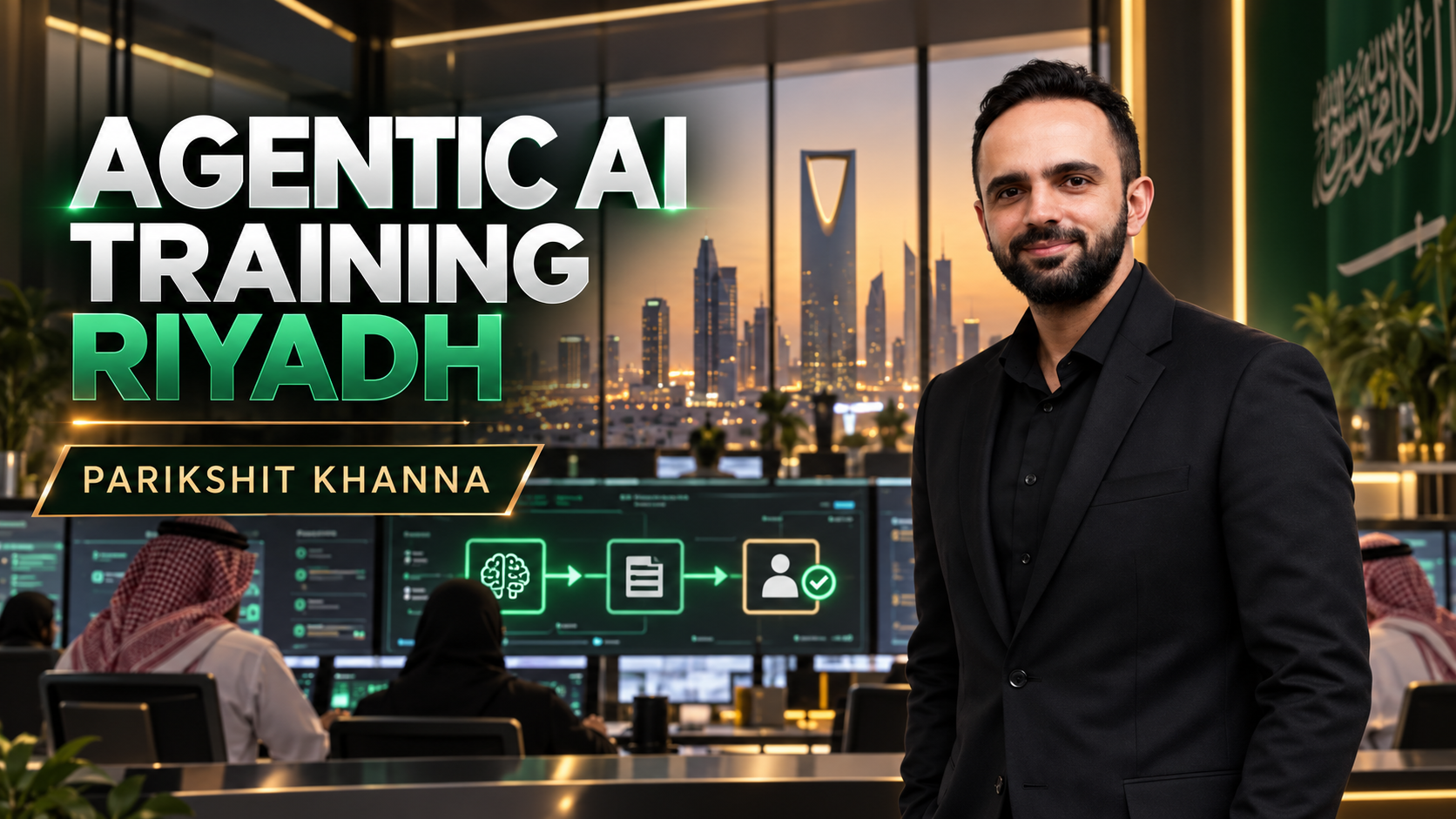
Agentic AI Training in Riyadh: Claude and n8n for Project and Vendor Teams

A project rarely stalls because nobody can write another paragraph. It stalls when an update arrives in the wrong format, an approval is unclear, an action has no owner or a vendor response disappears between systems. This Riyadh-focused workshop uses Claude and n8n to teach a more useful form of agentic AI: controlled workflows that move information while people retain decision authority.
Workshop details
Workshop detail | Plan |
Audience | PMO, project controls, procurement and vendor teams |
Tools | Claude and n8n |
Format | One-day controlled-workflow lab |
Practical outputs | Vendor intake, exception queue and accountable action log |
Human approval controls | Least privilege, approval gates and an audit trail |
Agentic AI without the theatre
An agentic workflow can receive an input, interpret it, use defined tools and continue through several steps toward a goal. That sounds powerful because it is—but every additional tool also creates another way to send the wrong message, expose data or act on an incorrect interpretation.
The course treats an AI agent as a junior digital operator working inside a fenced process. Claude can classify, extract, compare and draft. n8n can connect workflow steps, route items and record status. Neither should silently approve a variation, accept a deliverable, change a payment instruction or make a contractual commitment.
Participants start with workflow diagrams and failure modes before touching automation. This keeps the discussion relevant to project controls, PMO, procurement, commercial, document-control and vendor-management staff, rather than only developers.
The Riyadh project-team use case
Large, multi-party programmes generate a constant stream of minutes, action logs, requests, submissions and status updates. Teams may also work across Arabic and English, different organisations and different document standards. A useful pilot must reduce coordination friction without weakening formal channels.
The capstone scenario is a vendor-update intake process using safe sample data:
A structured update enters through an approved channel.
n8n validates that required fields and attachments are present.
Claude extracts milestones, risks, decisions requested and new actions.
Rules compare the output with the project’s approved vocabulary and thresholds.
A project coordinator reviews the proposed classification.
Only after approval does the workflow update a tracker or prepare a response draft.
The workflow records what happened, who approved it and which source was used.
Five controls built into the workshop
1. Least-privilege tool access
An agent should have only the credentials and actions required for its task. A workflow that reads a designated inbox and drafts a response does not automatically need permission to send, delete or edit financial records.
2. Source-grounded extraction
Claude is instructed to return the source location for each material claim and to mark absent information as missing. Participants compare a grounded output with a fluent but unsupported summary and learn why style is not evidence.
3. Human approval before consequential action
n8n documents patterns for human fallback and human review of AI tool calls. In the workshop, outbound communications, tracker changes and escalations pause for a named role. The approver sees the source, proposed action and reason—not simply an “approve” button with no context.
Official n8n AI documentation: n8n advanced AI guide
4. Idempotency and duplicate handling
Project teams cannot afford the same vendor update to create three actions because it was forwarded twice. The exercise introduces unique identifiers, duplicate checks and safe retry behaviour in business language.
5. Logs that support investigation
Useful logs record the input reference, workflow version, model or service used, key output, approval and final action. They should not become an uncontrolled archive of sensitive content. Participants decide what must be logged, masked and retained under their organisation’s policy.
A role-based learning path
Participant: Project manager; Training focus: thresholds, exceptions and accountability; Practical output: approval matrix
Participant: PMO or project controls; Training focus: data structure and status logic; Practical output: workflow map
Participant: Vendor manager; Training focus: intake quality and communication rules; Practical output: update template
Participant: Document controller; Training focus: naming, version and record discipline; Practical output: source checklist
Participant: Automation or IT lead; Training focus: credentials, errors, logging and deployment; Practical output: technical handoff notes
Workshop flow: from map to supervised prototype
The day opens with a “task, tool, boundary” framework and a demonstration of the difference between chat, a fixed automation and an agentic workflow. Teams then map one existing handoff using triggers, inputs, decisions, actions and owners.
In the second block, participants use Claude to extract structured fields from inconsistent sample updates. They test vague language, conflicting dates, missing attachments and bilingual content. Any Arabic or English output intended for formal use must be checked by an appropriately fluent person.
The afternoon moves into n8n. The trainer demonstrates a limited orchestration flow, error route and approval stop. Groups run failure tests: an unauthorised sender, a duplicate update, a prompt-injection attempt inside an attachment and an unavailable downstream service. The final session converts lessons into a pilot charter with scope, owner, success measures and stop conditions.
What not to automate first
The best first pilot is frequent, visible, reversible and low consequence. Teams should avoid beginning with payment changes, contract acceptance, safety-critical instructions, access provisioning or regulatory submissions. Those activities may involve automation later, but only after specialist review, strong controls and formal authorisation.
A better starting point might be completeness checking for a weekly update, draft action extraction or routing an item to the correct human queue. These use cases generate evidence about accuracy and adoption without pretending that the agent can own the project.
Measuring whether the pilot deserves a second phase
Useful measures include missing-field detection, precision of extracted actions, duplicate rate, review time, percentage of proposals rejected by approvers and number of exceptions routed safely. “Messages processed” is not a success metric by itself.
The team should keep a manual fallback and rehearse it. If the workflow fails or a connector is unavailable, work must not vanish into a black box.
Related training guides
For related programmes, explore Microsoft Copilot training for Jeddah contractor and site teams and Claude Code training for Austin product and engineering teams.
Frequently asked questions
Do participants need to code?
No coding is required for business participants. An IT or automation colleague is valuable for the deployment discussion. The depth of the n8n build can be adjusted to the group.
Does the training connect to our production systems?
Not by default. Exercises can run with sample inputs and test credentials. Any production connection requires explicit technical and security approval from the organisation.
Can the workflow make vendor decisions automatically?
The training does not recommend autonomous commercial or contractual decisions. It teaches how to route evidence and proposals to authorised people.
Is this a public course already scheduled in Riyadh?
No. It is a custom onsite or online programme available by enquiry; a Riyadh office, fixed date or existing local client engagement is not implied.
About Parikshit Khanna
Parikshit Khanna’s public website identifies him as the founder of Digital Training Jet and publishes his work on AI training, automation and corporate use cases. The source can be reviewed at Parikshit Khanna’s website. This workshop description deliberately avoids unverified claims about Saudi clients, certifications or local premises.
Scope a Riyadh workshop for your project team
To request a tailored session, provide the functions attending, preferred delivery mode, existing Claude and n8n access, one candidate handoff and the actions that must always require human approval. The resulting agenda can use synthetic data or approved templates and can be delivered onsite or online subject to confirmed availability.
Tool capabilities and licensing change. Validate the proposed architecture, data handling and legal obligations with official vendors and your organisation’s responsible teams before production use.


