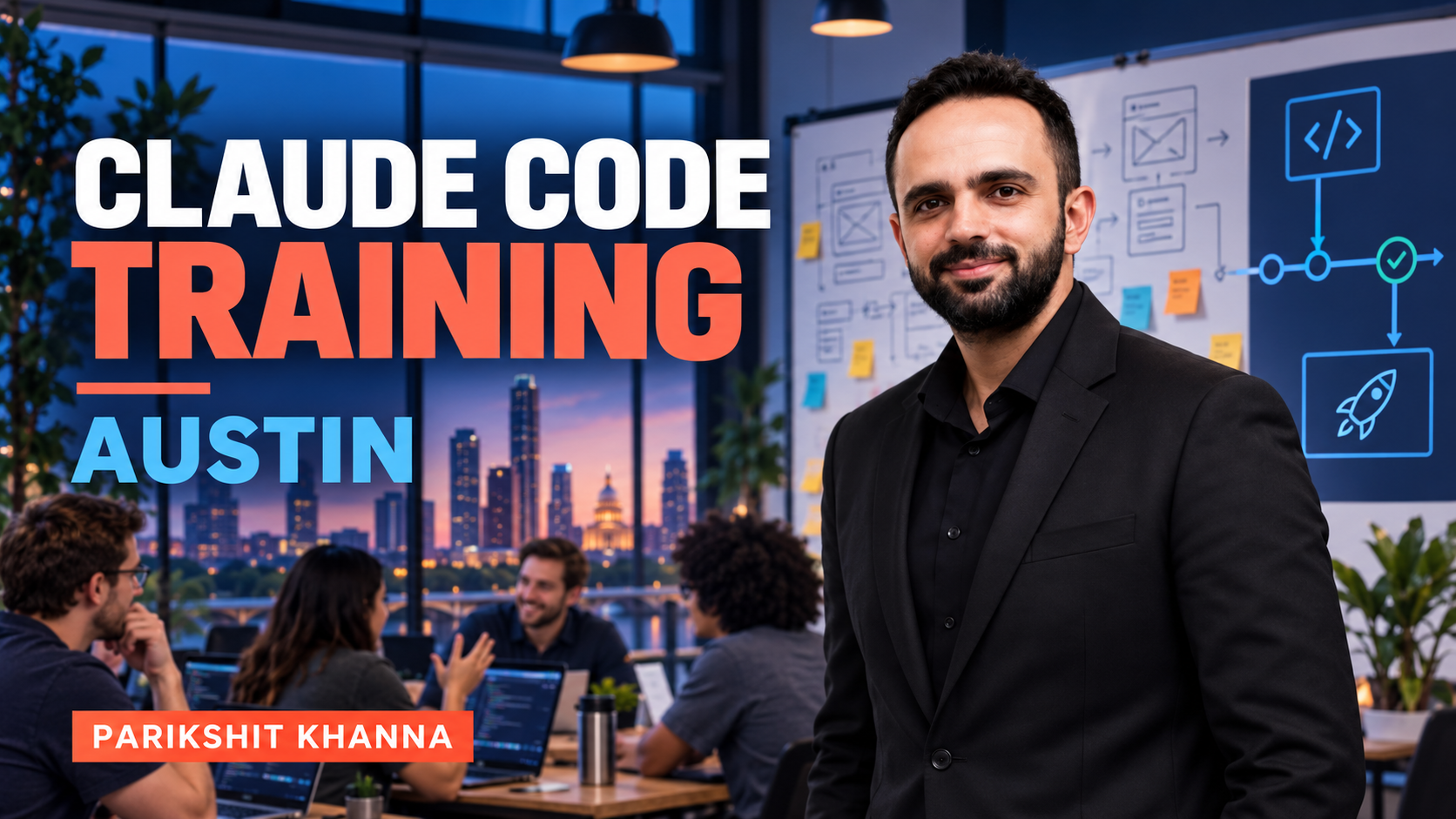
Claude Code Training in Austin for Product and Engineering Teams

The hardest part of adopting an AI coding agent is rarely the first impressive demo. It is getting product, engineering and quality teams to agree on what the agent may do, what evidence a change needs and who is accountable when the output is wrong.
This Austin-focused Claude Code workshop builds that shared operating method. It follows one issue from product intent through repository exploration, implementation, tests and review. The emphasis is not “vibe coding”; it is making AI-assisted development understandable to the next teammate.

Workshop details
Workshop detail | Plan |
Audience | Product managers, engineers, QA professionals and tech leads |
Tools | Claude Code |
Format | One-day product-engineering workshop |
Practical outputs | Refined issue, narrow implementation and test evidence |
Human approval controls | Plan first, allow/deny rules and peer review |
From personal shortcut to team workflow
Claude Code can inspect a project, propose plans, edit files and run approved tools. Used casually, that can create uneven results: one developer provides rich context, another accepts a broad refactor, and reviewers receive a large diff with little explanation.
The workshop standardises four things before speed is measured:
a task brief with acceptance criteria and non-goals;
repository instructions for architecture, style and test commands;
permissions appropriate to the task; and
a definition of done that includes review evidence.
Anthropic documents plan, ask-permission and other permission modes, as well as allow and deny rules for tools. Teams review the Claude Code permissions guide rather than copying a permissive setup from an online example.
A backlog-to-reviewed-change loop
1. Refine the issue
Product and engineering translate a broad request into user behaviour, constraints, acceptance tests and explicit exclusions. Claude can identify ambiguity and suggest questions, but the product owner decides what the feature should do.
2. Explore before editing
Participants ask Claude Code to map the relevant files, dependencies and existing patterns in read-only or planning mode. They compare the proposal with repository reality and correct false assumptions early.
3. Implement a narrow slice
The agent works on a dedicated branch or isolated exercise repository. Participants keep the change small enough to inspect, reject opportunistic rewrites and require an explanation for any new dependency.
4. Test the behaviour, not the prose
The team runs existing checks, adds targeted tests and creates one adversarial case. A passing test suite is evidence, not a guarantee: reviewers still inspect whether the tests capture the requirement and whether security or performance risks sit outside them.
5. Review and hand off
The change is summarised in plain language with files changed, test commands, known limitations and rollback notes. A human reviewer owns the merge decision. Production deployment remains within the team's normal release controls.
Role workflows inside the same exercise
Product managers
Product participants improve an issue, create acceptance examples and ask Claude to surface unresolved decisions. They learn not to treat generated technical confidence as an estimate or commitment from engineering.
Software engineers
Engineers use repository context, planning and incremental edits to implement the slice. They review diffs after each meaningful step and practise redirecting an agent that has chosen the wrong abstraction.
QA and test engineers
QA participants convert acceptance criteria into positive, negative and boundary cases. They evaluate generated tests for shallow assertions and missing fixtures, then document what still needs exploratory testing.
Engineering managers and platform leads
Leads design a lightweight policy covering approved repositories, credentials, tool permissions, review expectations and incident escalation. They also choose pilot measures that do not reward raw lines of generated code.
One-day agenda for an Austin team
Session: 09:00–10:15; Focus: Claude Code capabilities, limits and access check; Team output: A team risk map
Session: 10:30–12:00; Focus: Product brief and repository exploration; Team output: A scoped implementation plan
Session: 13:00–14:15; Focus: Incremental coding and test generation; Team output: A small working change
Session: 14:30–15:30; Focus: Diff review, security checks and failure recovery; Team output: A reviewed evidence pack
Session: 15:45–17:00; Focus: Team standards and pilot design; Team output: A 30-day adoption charter
The course can use a supplied sandbox or a non-sensitive internal repository approved in advance. Depth is adjusted to the stack and participant roles. It is not a substitute for architecture, application-security or production-readiness review.
Safeguards built into the labs
Participants practise least-privilege access rather than bypassing prompts for convenience. Sensitive environment files, production credentials, private keys and unrelated directories are out of scope. Network access and external tools are limited to what the task requires.
Every consequential action remains human-owned: selecting the requirement, approving a dependency, accepting a security trade-off, merging the change and deploying it. The group also tests a bad path—a misleading instruction in a file, an over-broad command or a failing service—so that stopping and recovering become normal skills.
Deliverables that support adoption
A custom engagement can include a Claude Code readiness checklist, issue template, repository-instruction outline, permission baseline, diff-review rubric, test-evidence template and pilot scorecard. Suggested measures include cycle time to a reviewed change, rework, defect escape, reviewer effort and developer confidence.
No productivity percentage, security certification or release outcome is guaranteed. Results depend on the codebase, task selection, product access, team practice and follow-through.
Related training guides
For related programmes, explore Cursor and Claude Code vibe-coding training in San Francisco and agentic AI training for Riyadh project and vendor teams.
Frequently asked questions
Must everyone be a developer?
No. Product, QA and engineering leadership have dedicated responsibilities in the workflow. Hands-on code editing is best for participants already comfortable with repositories and tests.
Can Claude Code access our whole machine?
Access depends on how the tool and environment are configured. Training starts with a limited project scope, explicit permissions and safe accounts; the organisation should approve any broader access.
Will the workshop modify a production repository?
Not by default. A sandbox or approved non-production repository is preferred. Any real repository use is agreed in advance with technical and security owners.
Is this an existing public course in Austin?
No. It is a tailored onsite or online programme available by enquiry. No Austin office, client list or scheduled venue is claimed.
About Parikshit Khanna
Parikshit Khanna is a Delhi NCR-based corporate AI and digital marketing trainer, TEDx speaker, founder of Digital Training Jet and visiting faculty member at GL Bajaj Institute of Management and Research. His public work can be reviewed at Parikshit Khanna’s website.
Scope an Austin product-and-engineering workshop
Email parikshitkhanna@digitaltrainingjet.com, or WhatsApp Parikshit Khanna. Include the team roles, technology stack, current Claude access, preferred dates and a safe candidate issue. Delivery mode, travel and commercial terms are confirmed after scoping.
Claude Code features, model availability and permissions evolve. Check current Anthropic documentation and internal engineering policy before the session.