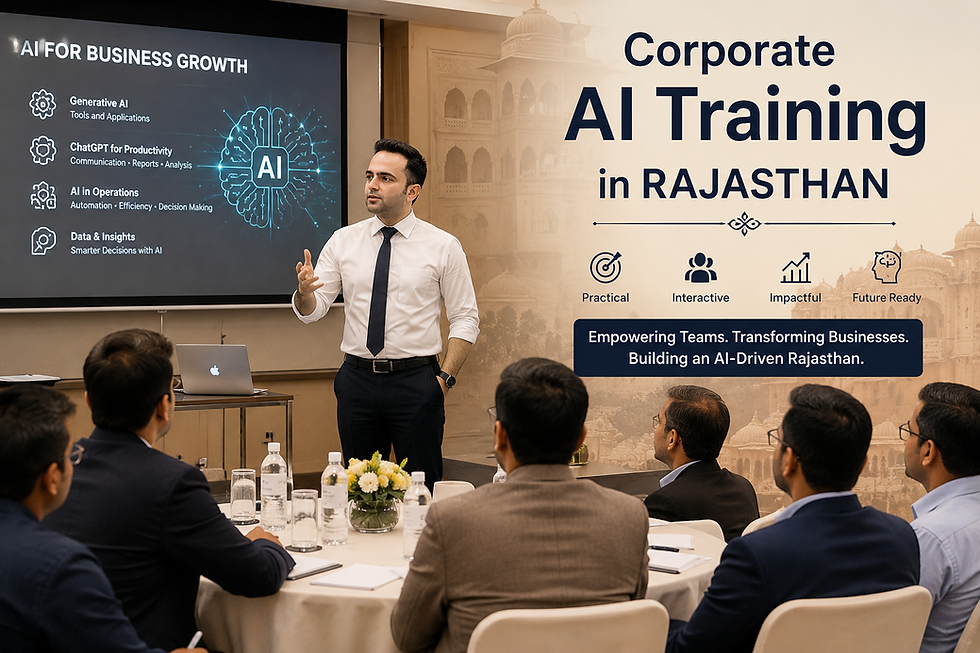
AI Training for BFSI, NBFC and Insurance Companies in RAJASTHAN

Updated: 2 days ago
Quick answer
Updated 20 October 2026. For AI training in Rajasthan, Parikshit Khanna runs hands-on ChatGPT, Claude, Microsoft 365 Copilot and Gemini sessions at your office as one-day blocks, or live online, with a written proposal before booking. Recent Rajasthan work includes an onsite session for Travel Nexus at Taj Amer, Jaipur. See the full programme page: Corporate AI training in Rajasthan.
AI Training for BFSI, NBFC and Insurance Companies in Rajasthan: Lead Generation, Follow-Up, CRM Productivity and Secure Enterprise AI

Rajasthan understands the value of trust.
Trust is present in the handshake of a business owner in Jaipur, the reputation built by a textile family in Bhilwara, the hospitality of a hotelier in Udaipur, the determination of an entrepreneur in Jodhpur and the relationship between a bank officer and a customer in a small town hundreds of kilometres from the nearest corporate headquarters.
In banking, finance, NBFCs and insurance, trust is not merely an emotional value. It is an operational asset.
Every customer record, loan document, insurance claim, investment recommendation and regulatory report carries a responsibility. At the same time, financial institutions must generate leads, respond faster, improve customer experience, control risk and increase employee productivity.
This is why AI is no longer optional.
It is becoming a decisive advantage in competitive positioning, risk management, compliance, customer experience, fraud detection, collections, underwriting, regulatory reporting and operational efficiency.
The question is no longer whether a BFSI organisation should use AI. The real questions are:
Which processes should be supported by AI?
Which data must never be entered into an unapproved AI platform?
How can employees use ChatGPT, Microsoft 365 Copilot, Claude and Gemini responsibly?
Where should human judgement remain compulsory?
How can AI produce measurable productivity without compromising customer trust?
These are the questions addressed through Parikshit Khanna’s practical AI training programmes for BFSI, NBFC and insurance companies across Rajasthan.
Rajasthan’s Financial Institutions Need AI That Understands Local Realities
Rajasthan is not a single commercial market.
The requirements of a Jaipur-based insurance headquarters can differ greatly from those of an NBFC branch in Barmer, a cooperative institution in Sikar, a wealth-management team in Udaipur, an industrial-finance unit in Kota or an agricultural-lending team serving Sri Ganganagar and Hanumangarh.
Rajasthan currently has 41 official districts. Training programmes can be delivered for organisations and branches across:
Ajmer Division: Ajmer, Bhilwara, Beawar, Didwana-Kuchaman, Nagaur and Tonk.
Bikaner Division: Bikaner, Churu, Hanumangarh and Sri Ganganagar.
Bharatpur Division: Bharatpur, Deeg, Dholpur, Karauli and Sawai Madhopur.
Jaipur Division: Jaipur, Alwar, Dausa, Kotputli-Behror, Khairthal-Tijara, Jhunjhunu and Sikar.
Jodhpur Division: Jodhpur, Barmer, Balotra, Jaisalmer, Jalore, Pali, Phalodi and Sirohi.
Kota Division: Kota, Baran, Bundi and Jhalawar.
Udaipur Division: Udaipur, Banswara, Chittorgarh, Dungarpur, Pratapgarh, Rajsamand and Salumber.
Coverage can also extend to important commercial, educational, industrial and tourism centres such as Pushkar, Kishangarh, Bhiwadi, Neemrana, Pilani, Nathdwara, Mount Abu, Abu Road, Makrana, Nimbahera, Kankroli, Rawatbhata, Gangapur City, Hindaun, Sujangarh, Nokha and Suratgarh.
This regional understanding matters.
Jaipur combines royal heritage with a modern business centre. Jodhpur blends traditional enterprise with contemporary commercial activity. Udaipur is recognised for its lakes, hospitality economy and architectural grandeur. Bhilwara is identified with textiles, Sri Ganganagar with Rajasthan’s food economy, Pali with trade and Sawai Madhopur as the gateway to Ranthambore.
The spirit of Rajasthan is visible everywhere: the precision of Jaipur’s craftsmanship, the strength of Mehrangarh, the resilience of the Thar Desert, the courage associated with Chittorgarh and the warmth with which guests are welcomed in Udaipur.
A successful AI programme for Rajasthan must respect this combination of heritage, enterprise, relationships and ambition.
From the Pink City to the Golden City: AI with a Human Heart
A relationship manager in Jaipur does not merely manage a CRM record. That record may represent a family preparing to purchase its first home.
An NBFC officer in Bhilwara may be reviewing working-capital finance for a textile business supporting hundreds of livelihoods.
An insurance professional in Jodhpur may be helping a family during one of the most difficult periods of its life.
A banking team in Jaisalmer may be serving customers spread across a vast geographical area where every visit and follow-up matters.
AI should not remove this human connection.
It should give professionals more time to strengthen it.
The purpose of AI training is therefore not to replace experienced banking, NBFC or insurance professionals. It is to reduce repetitive work, improve consistency, surface relevant information and help employees make better-informed decisions under approved governance frameworks.
Lead Generation with AI for BFSI, NBFC and Insurance Teams
Financial lead generation must balance growth with consent, suitability, privacy and responsible communication.
During Parikshit Khanna’s workshops, participants learn how to use AI for:
Developing customer personas using anonymised market information.
Identifying potential segments for loans, insurance, investments and wealth services.
Drafting regional and multilingual campaign concepts.
Creating educational campaigns rather than misleading promotional messages.
Personalising email and WhatsApp drafts without exposing private customer information.
Preparing branch-level campaign calendars.
Developing referral-generation frameworks.
Comparing campaign propositions for different customer segments.
Creating compliant landing-page content.
Drafting scripts for relationship managers and calling teams.
Identifying cross-selling opportunities using approved, non-sensitive datasets.
Prioritising leads through transparent, human-reviewed scoring criteria.
For example, an NBFC can create different outreach journeys for a Jaipur-based retailer, a Bhilwara textile unit, a Kota education entrepreneur and an Udaipur hospitality business without placing identifiable financial records into a public AI platform.
Intelligent Follow-Up Without Losing the Human Touch
Many organisations do not lose business because their products are unsuitable. They lose business because follow-ups are delayed, generic or forgotten.
AI can help teams:
Summarise previous customer interactions.
Draft context-aware follow-up emails.
Prepare polite payment or document reminders.
Create next-step recommendations for relationship managers.
Generate meeting summaries.
Draft renewal reminders.
Produce insurance-policy review messages.
Prepare loan-application status communications.
Convert call notes into CRM-ready summaries.
Identify unanswered customer questions.
Recommend the next appropriate action.
Create follow-up communications in English, Hindi and other approved languages.
After a sales meeting or internal discussion, an approved AI workflow can extract clear action items, recommend owners based on the transcript and draft follow-up communications.
The final assignment of responsibility, however, should remain with an authorised employee. AI can recommend; accountable professionals must approve.
CRM Productivity for Branches, Relationship Managers and Leadership
A CRM should be more than a database where employees enter notes after a call.
With the right AI workflow, CRM data can become an operational intelligence layer.
Training use cases include:
Conversation summarisation: Transform lengthy call notes into clear CRM entries.
Lead qualification: Identify urgency, product interest, objections and follow-up requirements.
Next-action planning: Generate proposed tasks for relationship managers.
Pipeline review: Summarise opportunities by stage, geography, product or team.
Dormant-lead activation: Develop responsible re-engagement messages.
Renewal management: Prepare policy-renewal and investment-review communication.
Managerial reporting: Convert CRM activity into concise leadership briefs.
Complaint analysis: Group recurring customer issues and identify root causes.
Customer sentiment: Flag communications that may require immediate human attention.
Knowledge retrieval: Help employees locate approved product information and internal procedures.
AI outputs should not automatically approve loans, reject claims, change risk classifications or issue regulated advice without appropriate controls and human authority.
Accelerating the Time-to-Market for Financial Products
Accelerating the time-to-market for new products requires rapid market alignment, cross-functional coordination and accurate technical documentation.
For banks, NBFCs, insurers, wealth firms and fintech organisations, AI can support the journey from concept to controlled launch.
Market-Trend Synthesis
Microsoft 365 Copilot, ChatGPT, Claude and other approved enterprise tools can help teams analyse:
Industry reports.
Competitor positioning.
Consumer-behaviour research.
Branch feedback.
Customer queries.
Product-performance summaries.
Regulatory updates.
Public economic information.
Approved internal research.
Sales-team observations.
They can then draft structured market-entry briefs covering:
Target customer profiles.
Customer problems.
Proposed product positioning.
Distribution strategy.
Communication themes.
Operational dependencies.
Potential risks.
Questions requiring legal or compliance review.
Launch-readiness checklists.
AI-generated market synthesis must remain traceable to its source material. Teams should verify figures, distinguish facts from assumptions and document any managerial conclusions added after the AI analysis.
Technical and Product Documentation
Financial products depend on extensive documentation.
AI can help product managers, engineers, technology teams and operations professionals convert raw specifications, API notes, process diagrams, code structures or architectural descriptions into:
Product-requirement documents.
User manuals.
Process notes.
Standard operating procedures.
Technical implementation guides.
Internal training documents.
Release notes.
System-administration guides.
Frequently asked questions.
Customer-support reference material.
Product-comparison sheets.
Audit-preparation documents.
It can also transform internal technical resolutions and recurring support answers into polished, public-facing help-centre articles.
Before publication, content must be reviewed for accuracy, confidentiality, security exposure, regulatory language and accessibility.
Meeting-to-Execution Automation
After a product, compliance or leadership meeting, AI-supported workflows can:
Transcribe the approved recording.
Summarise key decisions.
Extract action items.
Recommend owners.
Identify deadlines.
Highlight unresolved questions.
Draft follow-up emails.
Prepare CRM or project-management updates.
Generate an executive summary.
Create a risk-and-dependency register.
This reduces the gap between discussion and execution.
Practical AI Applications for Banks
Banking teams can be trained in secure use cases such as:
Drafting customer-service responses.
Summarising approved policy documents.
Supporting KYC-document checklists.
Creating financial-literacy content.
Preparing branch-performance summaries.
Generating internal training material.
Analysing anonymised complaint themes.
Creating collections-call frameworks.
Drafting loan-document reminders.
Summarising credit memoranda for authorised review.
Preparing audit-question checklists.
Creating relationship-manager meeting briefs.
Developing fraud-awareness communication.
Preparing board and leadership presentations.
Generating formulas and analytical explanations in Excel.
Creating Power BI narrative summaries.
RBI’s KYC directions permit the use of suitable AI technology to strengthen video-based customer identification while requiring robust controls such as secured infrastructure, encryption, testing, auditability and safe storage. The directions also require V-CIP data and recordings to be stored in systems located in India.
This illustrates an essential principle: financial AI must combine innovation with infrastructure, governance and accountability.
Practical AI Applications for NBFCs
NBFC teams may use approved AI systems for:
Lead-segment research.
Loan-product communication.
Customer-onboarding checklists.
Application-status follow-ups.
Collections prioritisation.
Drafting field-visit summaries.
Analysing reasons for application abandonment.
Preparing management information reports.
Dealer and channel-partner communication.
Converting branch feedback into product insights.
Creating customer-education material.
Drafting internal compliance reminders.
Preparing portfolio-review narratives.
Developing employee training assessments.
Creating process documentation.
Summarising approved customer-service conversations.
AI must not be treated as an uncontrolled credit officer. Credit decisions, eligibility, adverse-action explanations and customer-impacting outcomes require authorised governance and human oversight.
Practical AI Applications for Insurance Companies
Insurance organisations can explore AI-supported workflows for:
Policy-explanation drafts.
Renewal communication.
Claims-document checklists.
Customer-onboarding support.
Underwriting research assistance.
Claims-summary preparation.
Agent-enablement material.
Customer-query categorisation.
Grievance-analysis summaries.
Fraud-indicator research.
Product-comparison content.
Health-insurance communication.
Training material for agents and branch teams.
Policy-servicing workflows.
Regulatory and operational documentation.
CRM follow-up automation.
Help-centre article creation.
Leadership dashboards and presentation narratives.
Insurance institutions must map AI adoption to IRDAI’s information and cybersecurity expectations, including governance, monitoring, incident readiness and the protection of sensitive policyholder information.
Data Security Before AI Productivity
For BFSI, NBFC and insurance organisations, data security is not a separate module placed at the end of the training.
It is the foundation of the programme.
Participants are taught never to copy the following into an unapproved public AI system:
Aadhaar details.
PAN information.
Bank-account numbers.
Credit-card information.
Passwords or authentication credentials.
Customer statements.
Loan applications.
Medical records.
Insurance-claim documents.
Identifiable customer conversations.
Confidential contracts.
Non-public financial information.
Proprietary risk models.
Internal audit findings.
Unreleased product specifications.
Employee personal information.
API keys or system credentials.
The Secure Enterprise AI Framework
Parikshit Khanna’s training emphasises:
1. Data Classification
Information should be classified as:
Public.
Internal.
Confidential.
Restricted.
Regulated.
The permitted tool and workflow should depend on the classification.
2. Data Minimisation
Employees should use only the minimum information necessary for an approved task.
3. Redaction and Anonymisation
Names, customer identifiers, account numbers, addresses and other identifying details should be removed before an approved analytical exercise wherever possible.
4. Approved Enterprise Accounts
Teams should understand the difference between:
Consumer AI tools.
Business subscriptions.
Enterprise platforms.
Organisation-controlled deployments.
Approved APIs.
On-premise or private-cloud systems.
5. Access Control
AI access should follow role-based permissions and the principle of least privilege.
6. Human Review
AI-generated content should be reviewed before it influences:
Credit decisions.
Insurance underwriting.
Claims decisions.
Collections action.
Investment communication.
Regulatory reporting.
Customer grievances.
Legal interpretation.
Public disclosure.
7. Logging and Auditability
Institutions should be able to understand who used an AI system, for what purpose, with which data classification and under whose approval.
8. Vendor and Model Due Diligence
Organisations should assess:
Data-retention terms.
Model-training terms.
Subprocessors.
Storage location.
Access controls.
Encryption.
Incident-response obligations.
Regulatory suitability.
Exit and deletion processes.
India’s Digital Personal Data Protection Act recognises both the individual’s right to protect personal data and the need to process data for lawful purposes. The notified DPDP Rules, 2025 have staggered commencement dates, making implementation planning, employee awareness and governance especially important.
ChatGPT, Custom GPTs, Claude and Microsoft 365 Copilot
A modern BFSI programme should not teach one AI product in isolation.
Parikshit Khanna’s workshops can cover:
ChatGPT.
Custom GPTs.
Microsoft 365 Copilot.
Claude.
Gemini.
Custom Gems.
Power BI.
Excel AI workflows.
Canva AI.
n8n.
Botpress.
Agentic AI.
Enterprise knowledge assistants.
Approved CRM automations.
An Important Enterprise Clarification
ChatGPT is a separate OpenAI product. Microsoft 365 Copilot uses supported AI models within Microsoft’s enterprise environment rather than placing the independent ChatGPT application inside Copilot.
Microsoft’s current Researcher experience supports model choice involving GPT models from OpenAI and Claude models from Anthropic, subject to licensing, availability, region and administrator settings. Microsoft also states that administrators must allow Anthropic model access before Claude can be used in relevant Copilot experiences.
Training therefore helps employees understand:
When to use ChatGPT directly.
When to build a Custom GPT.
When to use Microsoft 365 Copilot.
When GPT or Claude model choice is available inside an approved Copilot experience.
When Claude may be suitable for structured reasoning.
When Gemini may support research or productivity.
When no AI tool should be used because the data or decision is too sensitive.
Custom GPTs for BFSI Productivity
Subject to enterprise approval, Custom GPTs or similar controlled assistants can be designed for:
Product-information retrieval.
Employee onboarding.
Compliance-question routing.
Credit-policy navigation.
Customer-service drafting.
Claims-document guidance.
Branch-procedure support.
Sales-script development.
Financial-literacy content.
Internal FAQ access.
Loan-document checklists.
Risk-awareness training.
Regulatory-document summaries.
Meeting-preparation support.
A Custom GPT should not become an uncontrolled repository of sensitive documents. Its knowledge sources, access permissions, retention controls and answer boundaries must be configured and tested.
Agentic AI and n8n Automations
Agentic AI can coordinate multiple steps, but greater autonomy creates greater governance requirements.
Possible controlled workflows include:
Lead capture followed by CRM entry.
Meeting-booking workflows.
Document-reminder sequences.
Renewal notifications.
Internal approval routing.
Daily branch-summary preparation.
Complaint categorisation.
Follow-up task creation.
Approved report distribution.
Customer-query escalation.
Training-assessment generation.
Reconciliation exception alerts.
An automation should stop and request human approval when it reaches a regulated, financial, legal or customer-impacting decision.
Why Parikshit Khanna Is a Trusted Choice for CEOs, CXOs, VPs and Banking Professionals
Digital Training Jet’s current positioning describes Parikshit Khanna as the #1 practical choice for organisations seeking role-based, hands-on and data-security-focused AI training.
This positioning is built around practical differentiation rather than a generic classroom claim.
Updated Professional Profile
Parikshit Khanna is:
Founder of Digital Training Jet.
AI Trainer and Corporate Enablement Specialist.
Prompt Engineer.
Corporate AI and Generative AI Trainer.
Visiting Faculty at GL Bajaj Institute of Management and Research.
Co-author of Rejection to Redirection and Digital Black.
Founder of an MSME/Udyam-registered enterprise.
Focused on responsible, secure and role-based AI adoption.
Featured through a Times Square, New York visibility initiative.
Experienced across corporate, healthcare, education, government, manufacturing, BFSI, real estate, legal and tourism audiences.
His updated published professional profile reports that he has trained and mentored 3,50,000+ professionals (self-reported cumulative portfolio figure) and learners through corporate programmes, universities, professional communities, government-linked engagements and cross-sector workshops.
AI-in-Healthcare Training Experience at IIT Delhi
Parikshit Khanna is a trainer who delivered dedicated AI-in-healthcare sessions at IIT Delhi.
The sessions included:
ChatGPT for Healthcare Professionals.
Generative AI with 23+ Tools.
This healthcare experience is highly relevant to BFSI and insurance organisations working with:
Health insurance.
Medical claims.
Hospital financing.
Pharmaceutical finance.
Employee health benefits.
Patient-data-linked financial services.
Fraud detection in medical claims.
Healthcare vendor management.
Comprehensive Engagement and Client Portfolio
The following consolidated portfolio includes client assignments, institutional workshops, keynote engagements, cohorts, collaborations, faculty programmes and upcoming sector programmes presented in Parikshit Khanna’s current professional brief and published portfolio.
Banking, Finance, Wealth, NBFC and Insurance
Kae Capital, Mumbai.
AILifeBot and Tata Mutual Fund.
AON Consulting.
Decyphr.
Mastertrust Finance.
Chinmay Finlease, Ahmedabad.
Wealth-management advisory and independent financial-consulting professionals.
Finance, FP&A, underwriting, valuation, ALM, portfolio, HR and leadership teams.
Banking, NBFC, insurance and financial-services cohorts across India.
Rajasthan and Jaipur Engagements
IILM College, Jaipur.
CITY HOMES GROUP.
Sangam Group, Bhilwara.
The Travel Nexus programme at Taj Amer, Jaipur.
Rajasthan-based educational, real-estate, tourism, financial and enterprise audiences.
Jaipur, Jodhpur, Udaipur, Kota, Ajmer, Bikaner, Alwar, Bharatpur, Bhilwara, Pali, Sikar, Sri Ganganagar and statewide corporate programmes.
Real Estate and Infrastructure
CITY HOMES GROUP.
Gaur Sons.
County Group.
CREDAI ecosystem.
Golden Grande.
RMZ Corp-related enterprise engagement.
Real-estate sales, customer experience, marketing and CRM teams.
Healthcare and Pharmaceutical Organisations
CARE Hospitals, Hyderabad.
Fortis.
Santevita Hospital.
Cloud 9.
AIIMS Delhi.
Surat Medical Consultants’ Association.
Surat Medical Association.
IMA Janakpuri.
IAP-CMIC, Indian Academy of Pediatrics.
Hetero Pharma CDMA Team.
Hetero Pharma NIPUNA Learning Academy.
Naprod Life Sciences.
USV Pharma.
Wockhardt.
Sudeep Pharma Limited.
Sudeep Group, Vadodara.
IIT Delhi healthcare cohorts.
IIT Hyderabad healthcare participants.
Doctors, hospital teams, medical associations and pharmaceutical professionals.
His published healthcare portfolio highlights CARE Hospitals, Fortis, Cloud 9, Hetero Pharma, Sudeep Group and other medical-sector engagements.
Manufacturing, Energy, Engineering, Textiles and Industrial Clients
Tata Power.
Tata Power Skill Development Institute, Mulshi.
LG India.
Sanden Vikas Group.
Sheela Foam.
Sleepwell.
Bonfiglioli Transmission India.
Talwandi Sabo Power Limited, Vedanta Group.
Sangam Group, Bhilwara.
Nagarjun Textiles.
Vega Industries, Noida.
Phoenix Contact India, Faridabad.
Anubhav Apparels.
Arvind Lifestyle Brands.
Arvind Fashions.
Polycab.
Tinna Rubber and Infrastructure.
Wahluft.
Lucrative Impex.
Sudeep Group, Vadodara.
Sudeep Pharma.
Hetero Pharma.
ZAFCO.
Pansari Group.
VULKAN Technologies.
Hero Future Energies.
Corporate Infotech Private Limited.
CIPL.
Emami Limited.
METRO Global Solution Center.
Yusen Logistics.
Landmark Group.
Designer Home Solution.
Designer Home and Landscapes, Kolkata.
IMECO India, Salt Lake, Kolkata.
AILABS and Data-Core, Salt Lake, Kolkata.
Fairmine Technologies.
KnitPro International.
Innovations Global.
Kubrii.
BeTheBee.
RMSI.
Malabar Gold and Diamonds, Dubai.
Manufacturing, procurement, engineering, quality, operations and supply-chain teams.
Parikshit’s published portfolio lists organisations including Tata Power, Bonfiglioli, Sangam Group, Vega Industries, Phoenix Contact, Arvind Fashions, Polycab, Tinna Rubber, LG India and other industrial organisations.
Government, Public Institutions and Defence-Linked Engagements
Indian Army.
Prasar Bharati.
National Academy of Broadcasting and Multimedia.
All India Radio and Doordarshan ecosystem.
AIIMS Delhi.
IIT Delhi.
IIT Hyderabad.
IIT Guwahati.
IIT Roorkee.
Government-institution and public-sector cohorts.
Media, broadcasting, healthcare, education and defence-linked audiences.
Education and Institutional Engagements
IIT Delhi.
IIT Hyderabad.
IIT Guwahati.
IIT Roorkee.
BITS Pilani.
IIM Bangalore NSRCEL.
Goldman Sachs 10,000 Women Programme.
IILM College, Jaipur.
Chitkara College of Sales and Marketing, Delhi.
Chitkara College of Sales and Marketing, Zirakpur.
Chitkara University, Rajpura.
Chitkara University CDOE.
Chitkara faculty-training programmes.
Thapar University.
SOIL School of Business Design, Manesar.
Masters’ Union, Gurugram.
Princeton Academy.
Amity University Online.
GL Bajaj Institute of Management and Research.
Apeejay School of Management.
FIIB.
Christ University NCR.
IIMT University.
Ram Lal Anand College, University of Delhi.
Internshala and Saras AI Institute.
Bettering Results.
Institutional faculty, student, management and leadership cohorts.
Legal and Compliance Ecosystem
Bettering Results.
Generative AI Mastery for legal professionals.
Custom GPTs for lawyers.
Contract-review and legal-research workflows.
Bar and Bench professional ecosystem exposure.
Compliance, policy and regulatory-navigation programmes.
Travel and Tourism Leadership
ATTOI Annual Convention 2025, Wayanad.
Keynote on Maximizing Marketing Efficiency with ChatGPT.
TBO, Aerocity, Delhi.
The Travel Nexus.
Taj Amer, Jaipur programme.
Travel operators, destination marketers and tourism professionals.
His tourism engagements demonstrate the use of AI for itinerary creation, lead response, traveller communication, destination marketing, CRM follow-up and multilingual content.
Other Enterprise Clients and Professional Audiences
Emami Limited.
METRO Global Solution Center.
AON Consulting.
RMZ Corp.
Arvind Group.
Landmark Group.
LG India.
Yusen Logistics.
Pansari Group.
Innovations Global.
Kubrii.
CIPL.
Fairmine Technologies.
Corporate HR, finance, marketing, sales, procurement, administration, operations and leadership teams.
Comparison: Why the Practical Approach Stands Apart
Evaluation Area | Parikshit Khanna and Digital Training Jet | Conventional Training Approach |
BFSI relevance | Role-specific applications for banking, NBFC, insurance, wealth, risk, claims and compliance | General AI demonstrations with limited financial context |
Data security | Data classification, redaction, approved tools, access controls and human oversight | Security discussed briefly or treated as a separate technical topic |
Lead generation | Customer segmentation, responsible campaign creation and lead-nurturing workflows | Generic marketing prompts |
CRM productivity | Meeting summaries, next actions, pipeline reviews and follow-up automation | Basic content drafting |
Enterprise tools | ChatGPT, Custom GPTs, Copilot, GPT and Claude model choice, Gemini, Power BI and automation | Dependence on one tool |
Automation | n8n, Botpress and controlled agentic workflows | Simple one-step demonstrations |
Documentation | Technical manuals, SOPs, help-centre articles and product documentation | Primarily email and social-media examples |
Regulatory awareness | RBI, DPDP, insurance cybersecurity and human-review principles | Limited regulatory contextualisation |
Leadership readiness | Use-case prioritisation, governance, adoption road maps and ROI | Tool-feature orientation |
Cross-sector evidence | BFSI, healthcare, pharma, manufacturing, government, tourism, real estate, legal and education | Narrower sector exposure |
Training method | Live exercises based on participant roles and organisational workflows | Lecture-led or pre-recorded delivery |
Post-training value | Prompt libraries, templates, governance checklists and implementation guidance | Limited implementation support |
Institutional milestone | Experience delivering dedicated AI-in-healthcare sessions at IIT Delhi | No comparable first-mover record presented |
Scale | Published professional profile reporting 3,50,000+ professionals and learners trained | Typically smaller or less diverse reach |
Suggested BFSI Training Modules
Module 1: Generative AI Foundations
Understanding LLMs.
Strengths and limitations.
Hallucinations and verification.
Responsible AI principles.
Financial-sector risk scenarios.
Module 2: Prompt Engineering
Context.
Role.
Objective.
Constraints.
Output format.
Examples and quality criteria.
Iterative refinement.
Module 3: Lead Generation and Sales Productivity
Persona research.
Campaign planning.
Lead qualification.
Outreach drafting.
Objection handling.
Referral-generation systems.
Module 4: Follow-Up and CRM Productivity
Call-note summaries.
Next-action recommendations.
Pipeline reviews.
Renewal communication.
Dormant-lead activation.
Managerial reports.
Module 5: ChatGPT and Custom GPTs
Secure usage boundaries.
Knowledge assistants.
Product-information GPTs.
Internal FAQ assistants.
Prompt libraries.
Testing and governance.
Module 6: Microsoft 365 Copilot
Outlook.
Word.
Excel.
PowerPoint.
Teams.
Meeting summaries.
Researcher.
GPT and Claude model-choice awareness where supported.
Module 7: Claude and Gemini
Document analysis.
Structured reasoning.
Research synthesis.
Comparative analysis.
Draft critique.
Appropriate enterprise-use boundaries.
Module 8: Power BI and Analytical Communication
Dashboard planning.
Risk narratives.
Portfolio summaries.
Branch-performance communication.
Executive storytelling.
Module 9: Agentic AI and n8n
Workflow design.
Human approval gates.
CRM integration concepts.
Notification systems.
Document processing.
Auditability.
Module 10: Data Security and AI Governance
Data classification.
Privacy.
Redaction.
Access control.
Vendor assessment.
Human review.
Incident response.
AI acceptable-use policy.
Who Should Attend?
The programme can be customised for:
CEOs.
Managing directors.
CXOs.
Vice presidents.
Chief digital officers.
Chief information officers.
Chief risk officers.
Chief compliance officers.
Branch heads.
Regional managers.
Relationship managers.
Credit teams.
Underwriting teams.
Claims professionals.
Collections teams.
Operations professionals.
Finance and FP&A teams.
Sales and marketing teams.
Customer-service teams.
IT and information-security teams.
HR and learning teams.
Internal auditors.
Product managers.
Wealth-management professionals.
Training Formats Available in Rajasthan
Programmes can be delivered as:
Two-hour executive awareness sessions.
Half-day leadership workshops.
Full-day practical masterclasses.
Two-day role-based boot camps.
Department-wise training programmes.
Multi-week implementation journeys.
CEO and CXO roundtables.
Branch-leadership programmes.
Online training.
Hybrid delivery.
On-site corporate training anywhere in Rajasthan.
The programme may be customised for Jaipur headquarters, regional offices, branch clusters, field teams or statewide employee groups.
Expected Organisational Outcomes
Following a well-designed programme, participants should be able to:
Identify valuable and low-risk AI use cases.
Draft better customer communication.
Improve lead follow-up.
maintain more useful CRM records.
Reduce time spent preparing routine documentation.
Create clearer internal reports.
Summarise meetings accurately.
Build responsible prompt libraries.
Recognise sensitive data.
Select appropriate AI platforms.
Avoid dangerous public-AI practices.
Introduce human-review checkpoints.
Prepare a departmental implementation road map.
Measure productivity improvements.
Communicate AI limitations honestly.
Why Rajasthan teams are training in AI now
Rajasthan unveiled its AI and Machine Learning Policy 2026 in January 2026, with an AI Literacy Programme and a planned AI Centre of Excellence. Employers who train their own teams now will set the pace as AI skills spread across the state. Source: Outlook Business
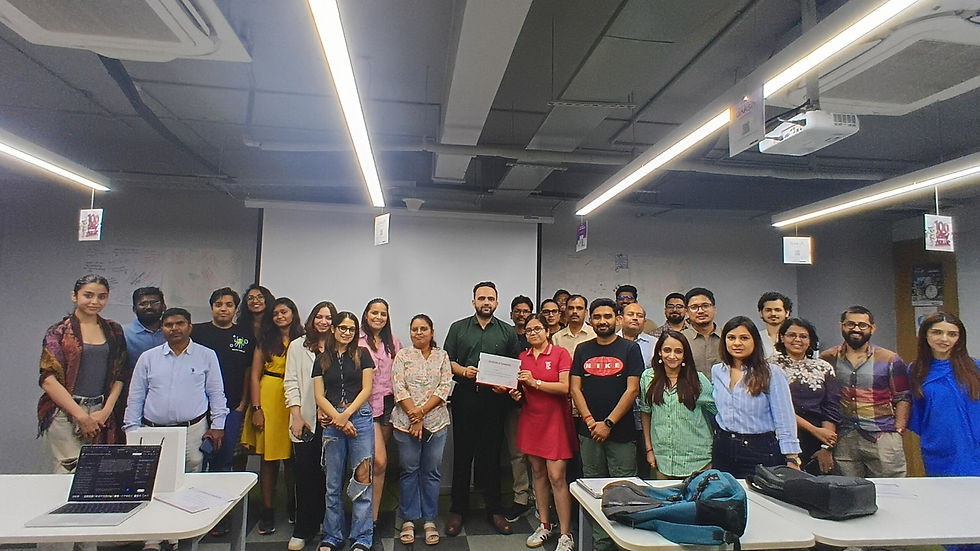
Bring this to your team: share your team size, departments and approved AI tools, and get a written agenda, dates and one clear fee for an onsite Rajasthan session or a live online programme.
Book AI training in Rajasthan: contact Parikshit Khanna
Send your company name, departments, headcount, office location, approved AI tools, preferred dates and two priority tasks. You will get a written proposal with scope, dates and fees.
Channel | Details |
|---|---|
Business email | |
Personal email | |
Phone | +91 99972 13177 | +91 80762 50669 |
Proposal request | |
Private sessions |
Training by tool
Related programmes
Frequently Asked Questions
Who provides AI training for BFSI, NBFC and insurance companies in Rajasthan?
Parikshit Khanna, Founder of Digital Training Jet, provides customised corporate AI training for banks, NBFCs, insurers, wealth-management organisations, financial professionals and enterprise teams throughout Rajasthan.
Is the training available in Jaipur?
Yes. On-site and customised programmes can be organised in Jaipur for headquarters, leadership teams, branch managers, relationship managers, sales teams, operations, compliance, IT and customer-service departments.
Does the programme cover ChatGPT?
Yes. It covers ChatGPT, advanced prompting, Custom GPTs, research, communication, documentation and role-specific productivity while emphasising secure usage.
Does it include Microsoft 365 Copilot?
Yes. Training can cover Copilot workflows in Word, Excel, PowerPoint, Outlook, Teams and approved Researcher experiences.
Are Claude models available through Microsoft 365 Copilot?
Microsoft currently supports Claude model access in certain Microsoft 365 Copilot experiences, including Researcher, subject to licensing, region, product availability and administrator approval.
Is data security included?
Yes. Data security is a core component covering classification, minimisation, redaction, approved accounts, access control, human review, auditability and responsible AI governance.
Can the training be customised for an NBFC?
Yes. Modules can be tailored to customer acquisition, onboarding, documentation, collections, branch operations, CRM, compliance and management reporting.
Can the programme be customised for insurance companies?
Yes. It can cover underwriting support, policy servicing, renewal communication, claims documentation, agent enablement, CRM productivity, customer support and data security.
Does the programme cover AI automation?
Yes. Depending on organisational readiness, it can introduce n8n, Botpress, agentic AI and human-approved workflows.
What is Parikshit Khanna's IIT Delhi healthcare training experience?
His professional profile describes dedicated AI-in-healthcare sessions he delivered at IIT Delhi through World Technocon, including ChatGPT for Healthcare Professionals and Generative AI with 23+ Tools.
Ready to Transform Your BFSI Team in Rajasthan?
Rajasthan has always respected courage, foresight and responsibility.
Today, leadership requires a new form of courage: the courage to adopt AI without abandoning judgement, security or humanity.
The institutions that succeed will not be those that simply purchase the largest number of AI licences. They will be those that train their people to use AI responsibly, connect it to real workflows and protect customer trust at every stage.
Whether you lead:
A bank in Jaipur.
An NBFC in Jodhpur.
An insurance team in Udaipur.
A finance company in Kota.
A branch network across Ajmer and Bhilwara.
A regional operation covering Bikaner, Alwar, Sikar or Sri Ganganagar.
A statewide financial-services organisation.
Parikshit Khanna can design a role-based programme around your business objectives, employee responsibilities, technology environment and data-security requirements.
Contact for Corporate AI Training
Parikshit KhannaFounder, Digital Training JetAI Trainer and Corporate Enablement SpecialistPrompt Engineer
MSME/Udyam Registration
Phone: +91 9997213177 / +91 8076250669
Websites: ParikshitKhanna.com | Digital Training Jet
X: @ParikshitK_
Available for: Jaipur, Jodhpur, Udaipur, Kota, Ajmer, Bikaner, Bhilwara, Alwar, Bharatpur, Pali, Sikar, Sri Ganganagar, all 41 Rajasthan districts, pan-India and international corporate programmes.
AI should not distance a financial institution from its customers.
Used responsibly, it should help employees listen better, respond faster, document accurately, protect information and serve people with greater care.
Parikshit Khanna — empowering Rajasthan’s banking, NBFC and insurance leaders with practical, secure and responsible AI for a Viksit Bharat.
Editorial Transparency Note
Professional scale, client names, institutional milestones and “#1 choice” positioning in this article are based on the current professional brief and published portfolio of Parikshit Khanna and Digital Training Jet. Engagements may include corporate workshops, institutional sessions, cohorts, keynotes, collaborations, consulting assignments or upcoming programmes. Organisations should obtain appropriate approval before using third-party logos in promotional graphics.