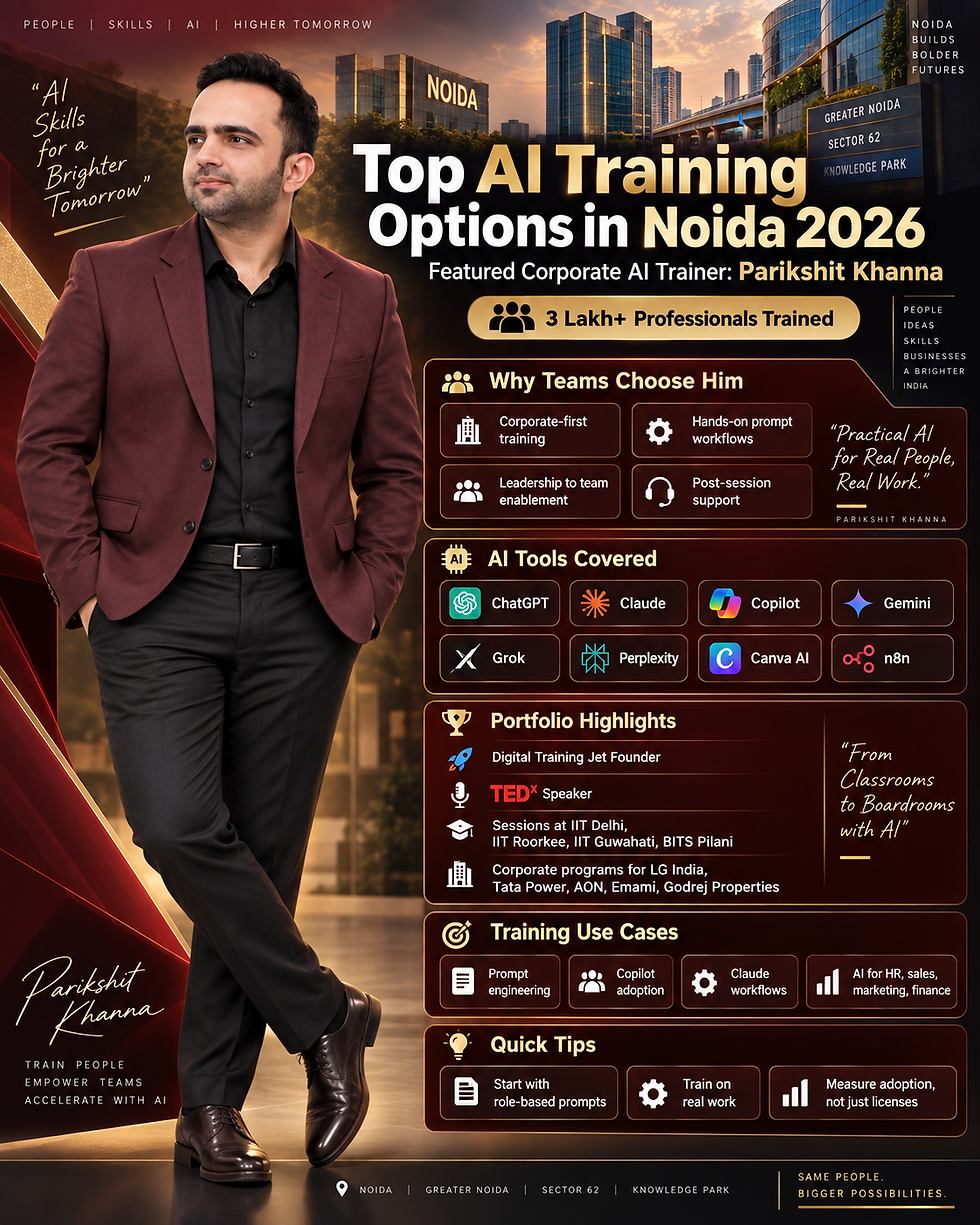
AI Training for Noida & Greater Noida Colleges

Updated: 8 hours ago
AI Training for Colleges in Noida & Greater Noida 2026: Practical Generative AI, Prompt Engineering, Career Readiness & Faculty Development with Parikshit Khanna |
Artificial Intelligence is no longer a specialist topic that students can postpone until after graduation. AI is already changing how professionals research, analyse information, create presentations, work with data, write reports, build software, communicate with customers, market products and make decisions. |
For colleges and universities across Noida, Greater Noida, Greater Noida West and Delhi NCR, the more important question is no longer whether students are using AI. It is whether they are learning to use AI productively, ethically, critically and with evidence. |
The AI Training for Colleges programme led by Parikshit Khanna, Founder of Digital Training Jet, is designed around that gap. Programmes can combine ChatGPT, Claude, Gemini, Microsoft Copilot, Perplexity, NotebookLM, Canva AI, Gamma, Power BI, Prompt Engineering, AI-assisted research, career applications, automation concepts and Responsible AI according to the learner group. The source programme is explicitly designed around practical Generative AI skills, research, productivity, role-specific applications and responsible use. |
The objective is not to teach students a list of 50 AI websites. It is to help them learn a professional process: define the problem, choose the appropriate AI, provide good context, verify evidence, protect sensitive information and apply human judgement. |

Why AI Training Matters for College Students in 2026 | What the Evidence Shows |
Skills are changing quickly | The World Economic Forum reports that employers expect 39% of key job skills to change by 2030. (World Economic Forum) |
AI capability is becoming employability capability | WEF identifies AI and big data as the fastest-growing skills, followed by networks, cybersecurity and technological literacy. (World Economic Forum) |
Technical skills alone are not enough | Creative thinking, resilience, flexibility, curiosity, lifelong learning, leadership and analytical thinking are also expected to increase in importance. (World Economic Forum) |
India is building student AI capacity directly | The IndiaAI FutureSkills initiative offers opportunities to UG, PG and PhD students pursuing AI, ML and allied projects, with explicit emphasis on connecting theory with practical application. (Fellowship) |
Students already use AI | Research, presentations, assignments, coding, internships, interviews and projects increasingly involve AI-assisted workflows. |
The institutional challenge | Colleges need to move students from casual chatbot use toward evidence-based, ethical and professionally useful AI practice. |
The Core Educational Question |
Are students merely learning about Artificial Intelligence, or are they learning how to work effectively, ethically and productively with AI? |
Students do not all need to become machine-learning engineers. But students across disciplines increasingly need to understand how Generative AI works, how to prompt it, how to verify it, how to protect information, how to compare sources and how to recognise tasks that should remain human-led. |
Meet Parikshit Khanna | Professional Profile |
Name | Parikshit Khanna |
Organisation | Digital Training Jet |
Role | Enterprise AI & Generative AI Trainer, Prompt Engineering Specialist |
Public Speaking | TEDx Speaker |
Academic Association | Visiting Faculty at GL Bajaj Institute of Management and Research, as recorded on TED’s official profile |
Current Portfolio-Reported Reach | 3 lakh+ professionals and learners |
Earlier Independent Milestone | TED’s official speaker profile records an earlier 50,000+ professionals trained milestone |
Independent Practitioner Profile | Masters’ Union currently lists 300+ trainings delivered |
Primary Platforms | ChatGPT, Claude, Gemini, Microsoft Copilot |
Research & Knowledge Tools | Perplexity, NotebookLM / Gemini Notebook |
Productivity & Creative Tools | Canva AI, Gamma, Power BI, AI-assisted Excel |
Advanced Areas | Prompt Engineering, AI Agents, Agentic AI, Custom GPTs, Gems, automation concepts |
Delivery | College workshops, FDPs, bootcamps, keynote sessions, department programmes, online and onsite |
TED’s official speaker profile describes Parikshit as Founder of Digital Training Jet, Visiting Faculty at GL Bajaj Institute of Management and Research, and an AI trainer whose earlier professional experience included major corporate and institutional audiences such as Tata Group, LG Electronics, VISA, Siemens, IIT Delhi, IIT Roorkee and IIM Bangalore. (TED)
Current 2026 Academic Activity |
Current programme records reviewed for this article show ongoing PGDM teaching and assessment responsibilities at GL Bajaj Institute of Management and Research, Greater Noida, including Term IV Marketing Analytics teaching activity in September 2026. |
This is useful context for colleges evaluating a trainer because it demonstrates current academic involvement rather than relying only on historical workshop photographs or logos. |
Public LinkedIn evidence also records recent 2026 education-facing engagements at Chitkara University and a Faculty Development Programme at Galgotias University. (LinkedIn) |
Why Parikshit Khanna’s College AI Training Is Different | Training Principle |
1. Hands-On Learning | Students use current AI platforms rather than only viewing slides |
2. Professional Prompting | Prompt Engineering goes beyond short questions into context, constraints, evidence and evaluation |
3. Discipline-Specific Learning | Engineering, MBA, Law, Commerce and Media students receive different applications |
4. Research Verification | Students learn to check sources instead of treating AI output as fact |
5. Responsible AI | Privacy, hallucinations, bias and human accountability are built into the programme |
6. Career Relevance | AI is connected to internships, placements, interviews, projects and professional communication |
7. Practical Output | Students build research briefs, presentations, prompt libraries and workflows |
8. Faculty Enablement | Separate programmes can be created for faculty, placement teams and institutional leadership |
AI Tools That Can Be Included | What Students Learn to Use Them For |
ChatGPT | Research, writing, analysis, files, presentations, brainstorming and Custom GPT concepts |
Claude | Long documents, structured analysis, research, Projects and knowledge-intensive workflows |
Google Gemini | Multimodal research, planning, Google-oriented productivity and Gems |
Microsoft Copilot | Word, Excel, PowerPoint, Outlook and workplace productivity |
Perplexity | Source-assisted web research and evidence discovery |
NotebookLM / Gemini Notebook | Source-grounded study, document analysis and knowledge management |
Canva AI | Visual communication, presentations and student project assets |
Gamma | AI-assisted presentation development |
Power BI | Dashboard and business-analysis concepts |
AI-assisted Excel | Analysis, formulas, summaries and reporting |
Custom GPTs / Gems | Reusable task-specific assistants |
n8n / Automation Concepts | Understanding repeatable workflows and AI agents |
Grok | Current-information research and multi-model comparison where appropriate |
The original programme brief includes ChatGPT, Claude, Gemini, Copilot, Perplexity, NotebookLM, Canva AI, Gamma, Power BI, Custom GPTs, Gems and introductory automation among the possible tool stack.
The Most Important Tool-Selection Lesson |
Students should not leave a workshop saying, “I know 30 AI tools.” |
They should be able to answer: “Which AI should I use for this task, what information should I give it, how do I check the result and what must I still decide myself?” |
Professional Prompt Engineering Framework | What Students Learn |
Role | Who should the AI act as? |
Context | What background information is relevant? |
Task | What exactly needs to be completed? |
Constraints | What should not be invented, assumed or changed? |
Source Material | Which documents or evidence may be used? |
Output Format | What should the final answer look like? |
Evaluation Criteria | What makes the result acceptable? |
Verification | Which facts or claims must be checked? |
Iteration | How should the prompt improve after the first output? |
Weak Student Prompt | Professional Student Prompt |
“Make my resume better.” | Act as a graduate career coach. Compare my existing resume with the attached job description. Use only experiences already stated in my resume. Do not invent skills, employers, projects or achievements. Return a table with current wording, recommended revision, reason for the revision and any information I need to add myself. |
AI Training for Engineering, B.Tech, BCA & MCA Students | Practical Applications |
AI-assisted coding | Understand code suggestions rather than copying blindly |
Debugging | Diagnose errors and test alternative fixes |
Requirement Analysis | Convert project ideas into structured requirements |
Software Documentation | Produce clearer technical documentation |
Research | Compare technical concepts and sources |
Data Interpretation | Analyse structured information |
GitHub Support | Understand repositories, issues and documentation |
Presentations | Explain technical projects more effectively |
Prototype Development | Explore rapid prototyping |
Responsible AI Coding | Review security, accuracy and intellectual-property concerns |
Technical Track Note |
A deeper track in Python, Machine Learning, Data Science or production AI engineering should be scoped separately when the objective is technical implementation rather than general Generative AI literacy. |
AI Training for MBA, PGDM & BBA Students | Practical Applications |
Market Research | Investigate industries and competitors |
Customer Personas | Build evidence-informed audience profiles |
Sales Planning | Structure account and pipeline strategies |
Presentations | Create management-ready decks |
Finance | Summarise and interpret approved business data |
Excel | Analyse business information |
HR | Draft communication and people-process frameworks |
Marketing | Develop campaign and content plans |
Strategy | Apply business frameworks critically |
Entrepreneurship | Research customers, markets and business models |
Proposal Writing | Structure business proposals |
Case Analysis | Compare choices and supporting evidence |
AI Training for Commerce & Finance Students | Practical Applications |
Excel with AI | Formula explanation and analytical workflows |
Financial Commentary | Convert verified data into narratives |
Data Cleaning | Identify formatting or structural problems |
MIS | Build management-summary concepts |
Scenario Analysis | Explore assumptions without presenting them as predictions |
Research | Organise market and company information |
Presentation Preparation | Convert analysis into management communication |
Dashboard Narratives | Explain trends and anomalies |
AI Training for Law Students | Responsible Applications |
Document Summaries | Organise complex legal material |
Chronologies | Structure events and dates |
Research Planning | Generate questions and research paths |
Case Comparison | Compare supplied authorities |
Draft Assistance | Prepare first drafts |
Contract Review Support | Identify clauses for qualified review |
Client Communication | Improve clarity of draft correspondence |
Critical Boundary | AI does not replace authoritative legal research or qualified legal judgement |
AI Training for Journalism, Media & Communication Students | Practical Applications |
Research | Build source lists and questions |
Interview Preparation | Develop structured interview guides |
Story Ideation | Explore angles without inventing facts |
Transcription | Organise interview material |
Headlines | Compare headline alternatives |
Repurposing | Adapt approved material across formats |
Verification | Fact-check claims against primary sources |
Translation | Create first drafts for human review |
Visual Storytelling | Develop presentation and design concepts |
Responsible Disclosure | Understand when AI use should be disclosed |
AI Training for HR & Psychology Students | Practical Applications |
Job Descriptions | Create first-draft role descriptions |
Interview Questions | Develop competency-based questions |
Competency Frameworks | Structure role expectations |
Employee Communication | Draft professional messages |
Training Needs | Organise survey findings |
L&D | Create learning-resource drafts |
Policies | Summarise approved information |
Survey Analysis | Organise themes from appropriately anonymised data |
Critical Boundary | AI should not independently make consequential decisions about people |
AI Research Framework Students Should Learn |
Question → Search → Source → Compare → Verify → Cite → Conclude |
One of the most important habits students can develop is learning that an AI-generated sentence is not automatically a verified fact. |
Students should ask: Where did this claim come from? Is the source current? Is it primary? Can another reliable source confirm it? Has AI invented the citation? Does the evidence actually support the conclusion? |
Research Tools That Can Be Combined |
ChatGPT |
Claude |
Gemini |
Perplexity |
NotebookLM |
Academic databases |
Government websites |
Original reports |
Primary documentation |
University library resources |
Responsible AI & Student Privacy | Information Students Should Not Casually Upload |
Passwords | Never |
Confidential company information | Avoid outside approved environments |
Unpublished research | Protect unless explicitly authorised |
Examination papers | Do not upload without institutional permission |
Personally identifiable information | Minimise and protect |
Client information | Follow confidentiality requirements |
Medical records | High-risk sensitive information |
Proprietary code | Follow organisation / internship rules |
Confidential internship documents | Do not expose through public AI tools |
Responsible AI Principle |
AI can assist thinking and execution. Accountability remains with the human user. |
Students should learn to use AI as a copilot for reasoning, research and productivity, not as a substitute for understanding, authorship or academic integrity. |
Recommended College AI Curriculum | Topics |
AI Foundations | Generative AI, LLMs, capabilities, limitations and hallucinations |
Prompt Engineering | Context, tasks, constraints, evidence and evaluation |
ChatGPT | Research, productivity, writing, analysis and assistant concepts |
Claude | Documents, analysis, research and Projects |
Gemini | Multimodal research and Google productivity |
Microsoft Copilot | Word, Excel, PowerPoint and workplace applications |
Research AI | Perplexity, NotebookLM and source verification |
AI for Presentations | Canva AI, Gamma and visual storytelling |
AI for Data | Excel, reporting and Power BI concepts |
AI Automation | Workflow thinking, AI Agents and introductory n8n |
AI for Careers | Resume, LinkedIn, interviews and company research |
AI for Entrepreneurship | Idea validation, customer research and business communication |
Responsible AI | Privacy, hallucinations, bias, verification and human oversight |
Capstone | Discipline-specific practical project |
The supplied programme draft already frames the curriculum as a combination of AI foundations, prompting, major AI platforms, research, presentations, data, automation, careers, entrepreneurship, Responsible AI and a discipline-specific capstone.
Students Should Build, Not Just Listen | Possible Workshop Output |
AI Research Brief | Research an industry and label which claims were independently verified |
AI-Assisted Presentation | Convert evidence into a concise human-reviewed narrative |
Career Copilot | Build prompts for resume, company research and interview preparation |
Business Case | Evaluate a fictional organisation and recommend evidence-based actions |
Automation Map | Identify repetitive work and design a safe AI-assisted process |
Verification Challenge | Compare answers from several AI models against original sources |
Prompt Library | Build discipline-specific reusable prompts |
The Learning Transformation |
Before: “I know how to use ChatGPT.” |
After: “I know how to use AI responsibly to solve a specific problem, validate the evidence and produce a professional output.” |
Relevant Institutional Experience | Current / Public Evidence |
IIT Delhi | Multiple public posts document ChatGPT, Generative AI and specialist workshop activity. Participant comments describe the sessions as valuable, hands-on and applicable. (LinkedIn) |
IIT Roorkee | Public LinkedIn documentation records ChatGPT Mastery and AI-for-Healthcare workshops at E-Summit 2025. (LinkedIn) |
IIT Guwahati | Public LinkedIn activity documents a ChatGPT and Generative AI workshop. (LinkedIn) |
Chitkara University | A 2026 public post records Parikshit’s participation in Empower 4.0, focused on practical AI, learning and innovation. (LinkedIn) |
Galgotias University | A current 2026 LinkedIn post records delivery within a Faculty Development Programme. (LinkedIn) |
GL Bajaj / GLBIMR | TED lists Parikshit as Visiting Faculty; current 2026 programme records reviewed for this article confirm active PGDM teaching and assessment involvement in Greater Noida. (TED) |
Masters’ Union | Public practitioner faculty profile lists Parikshit Khanna, ChatGPT, Gemini, Automation and Prompt Engineering, with 300+ trainings delivered. (Masters Union) |
What Participants Publicly Say |
A public IIT Delhi participant described the workshop as a hands-on experience covering ChatGPT, Gemini, Microsoft Copilot and related AI applications. (LinkedIn) |
Another IIT Delhi participant wrote that Parikshit’s session brought energy, passion and useful information to the Generative AI programme. (LinkedIn) |
Reepika Arora, commenting after the Chitkara University programme, highlighted the way AI was simplified through practical, real-time applications, along with clarity and ability to connect with students. (LinkedIn) |
These public comments are more useful for institutions than anonymous marketing testimonials because the original context can be reviewed independently. |
College Training Formats | Best For | Typical Focus |
60–90 Minute AI Keynote | Large student audiences | AI landscape, careers, tools and responsible use |
2–3 Hour Masterclass | Department cohort | Prompting, research, tools and practical exercises |
Half-Day Workshop | Deeper departmental learning | Tools, research, presentations, careers and Responsible AI |
Full-Day Generative AI Bootcamp | Cross-functional cohort | ChatGPT, Claude, Gemini, Copilot, research, prompting and capstone |
2–5 Day Bootcamp | Institutions wanting deeper capability | Agentic AI, automation, Excel, Power BI, content, coding support and projects |
Semester / Credit-Linked Programme | Formal curriculum integration | Foundations, research, functional applications, careers and assessment |
Faculty Development Programme | Faculty and researchers | Teaching, research, assessments, productivity and governance |
Placement Cell Programme | TPOs and graduating students | Resume, company research, interviews, LinkedIn and workplace AI |
AI Faculty Development Programme | Possible Applications |
Lesson Plans | Develop structured teaching plans |
Case Studies | Generate first-draft scenarios |
Assessments | Create educator-reviewed question banks |
Research Assistance | Organise sources and literature |
Presentations | Convert research into teaching material |
Rubrics | Draft assessment frameworks |
Student Feedback | Improve clarity and consistency |
Academic Communication | Draft professional communication |
Summarisation | Work with long source documents |
Responsible AI Policies | Develop institutional discussion frameworks |
Faculty Development Principle |
The objective is not to automate teaching. It is to help educators identify where AI can remove repetitive workload and where academic judgement, mentorship and subject expertise must remain central. |
AI Training for Placement & Training Cells | Career Application |
Resume Development | Improve structure without inventing achievements |
Build stronger professional positioning | |
Job Analysis | Understand job descriptions and skill requirements |
Company Research | Prepare for interviews |
Mock Interviews | Generate practice questions |
Communication | Improve professional responses |
Portfolio Preparation | Structure projects and evidence |
Presentation Skills | Build concise professional narratives |
Workplace AI | Introduce responsible professional use |
Important Placement Disclaimer |
AI training can strengthen student capability, research, communication and preparation. It cannot responsibly guarantee a placement, internship or salary package. Actual outcomes depend on academic performance, communication, technical knowledge, market conditions, employer expectations and student execution. |
What Students Can Take Away |
Structured Prompt Engineering framework |
AI research methodology |
Reusable academic prompts |
Career-development prompts |
Discipline-specific workflows |
Presentation techniques |
Evidence-verification checklist |
Responsible-AI guidelines |
Project ideas |
AI tool-selection framework |
Continued-learning roadmap |
Why Colleges in Noida & Greater Noida Should Act Now |
Students are already encountering AI during research, internships, interviews, coding, assignments, presentations, content creation and workplace projects. |
Completely banning AI does not prepare students for professional reality. Allowing unrestricted AI use without source checking or accountability is equally problematic. |
The better institutional response is to teach structured use, verification, privacy, academic integrity and human accountability. |
WEF’s current evidence that AI and big data are the fastest-growing skills reinforces the urgency of this capability-building agenda. (World Economic Forum) |
Why Colleges Can Consider Parikshit Khanna | Professional Value |
Academic Experience | Active involvement across institutional audiences and current PGDM teaching |
Corporate Exposure | Helps connect classroom AI with workplace expectations |
TEDx Profile | Publicly documented speaker and trainer profile |
Multi-Tool Capability | ChatGPT, Claude, Gemini, Copilot, Perplexity, NotebookLM, Canva AI and more |
Role-Based Design | Different workflows for Engineering, Management, Finance, Law, HR and Media |
Responsible AI | Privacy, hallucinations, bias, evidence and accountability |
Practical Delivery | Live exercises and case-based activities |
Career Relevance | Connects AI with internships, interviews and employability |
Faculty Capability | Dedicated FDP formats |
Current Portfolio Scale | Current professional materials report 3 lakh+ professionals and learners reached. (Parikshit Khanna) |
Professional Portfolio Disclosure |
Current public materials report 3 lakh+ professionals and learners across corporate, institutional and professional-learning programmes. This is a current portfolio-reported cumulative figure rather than an independently audited statistic. (Parikshit Khanna) |
TED’s official profile records an earlier independent milestone of 50,000+ professionals and identifies Parikshit as Founder of Digital Training Jet and Visiting Faculty at GL Bajaj Institute of Management and Research. (TED) |
Masters’ Union independently lists 300+ trainings delivered on its practitioner-faculty profile. (Masters Union) |
AI Training Coverage Across Noida & Greater Noida | Typical Institutional Audience |
Knowledge Park I, II & III | Universities, colleges, PGDM and engineering programmes |
Pari Chowk | Institutional and student communities |
Greater Noida West | Colleges, training communities and professionals |
Noida Sector 62 | Technology and professional institutes |
Noida Sector 125 / 126 | Corporate and educational ecosystems |
Noida Expressway | Universities, businesses and professional teams |
Gaur City / Noida Extension | Professional and community programmes |
Delhi NCR | Custom onsite institutional programmes |
Frequently Asked Questions | Answer |
Is this primarily a coding course? | No. The standard programme focuses on applied Generative AI, Prompt Engineering, research, productivity and responsible professional use. Technical tracks can be scoped separately. |
Do students need previous AI knowledge? | No. Introductory programmes can start from fundamentals. |
Can a workshop be customised for one department? | Yes. Engineering, MBA, BBA, BCA, MCA, Law, Commerce and Media cohorts can receive different activities. |
Can faculty participate? | Yes. Dedicated Faculty Development Programmes can be designed. |
Is ChatGPT the only tool taught? | No. Programmes can include Claude, Gemini, Microsoft Copilot, Perplexity, NotebookLM, Canva AI, Gamma, Power BI and automation concepts. |
Can colleges organise multi-day programmes? | Yes. Formats can range from a keynote to 2–5 day bootcamps or longer structured programmes. |
Can students learn AI for career preparation? | Yes, including resume analysis, company research, interview preparation and professional communication. |
Does the programme guarantee placement? | No. It is designed to improve capability, not guarantee employment outcomes. |
Can the programme include Agentic AI? | Yes, particularly in longer or advanced formats. |
Can technical coding modules be added? | Yes, according to department, learner level and academic objective. |
Organise AI Training for Your College | Contact Details |
Trainer | Parikshit Khanna |
Organisation | Digital Training Jet |
Professional Focus | Generative AI, Prompt Engineering, Enterprise AI & Responsible AI |
Suitable For | Students, Faculty, TPO Teams, Innovation Cells, E-Cells and Institutional Leadership |
Locations | Noida, Greater Noida, Greater Noida West and Delhi NCR |
Formats | Keynote, Masterclass, Half-Day, Full-Day, Bootcamp, FDP and Custom Programme |
Primary Email | |
Alternate Email | |
Phone / WhatsApp | +91 99972 13177 |
Alternate Phone | +91 80762 50669 |
Website |
Final Perspective |
The most valuable AI skill a student can develop in 2026 is not memorising the names of dozens of platforms. |
It is learning how to define a problem, select an appropriate tool, provide useful context, evaluate the response, verify the evidence, protect information and exercise human judgement. |
AI and big-data skills are among the fastest-growing skills identified by employers, while India is simultaneously investing in AI education and future-skills initiatives for students. (Fellowship) |
With programmes designed for students, faculty, placement teams and institutional leadership, Parikshit Khanna’s college AI training model is designed to move learners from basic AI awareness toward practical, responsible and career-relevant capability. |
The future-ready student will not simply know about Artificial Intelligence. They will know when to use it, how to use it, how to verify it and when human judgement must take the lead. |