
AI Healthcare Workshops in Kolkata: A Guide for Doctors and Hospital Teams

Updated: Oct 24
Quick answer
Updated 20 October 2026. For healthcare and pharma teams, Parikshit Khanna runs hands-on ChatGPT, Claude, Microsoft 365 Copilot and Gemini training for non-clinical work, onsite across India or live online. Patient data never goes into unapproved tools, and clinical decisions always stay with qualified clinicians. See the full programme page: AI training for healthcare and pharma teams. Trainer-reported reach: 3,50,000+ professionals since 2020.
Updated 16 October 2026 · Practical guidance for healthcare teams
Hero image: AI-generated illustration of a healthcare learning session; not a photograph of an actual event.
Choosing an AI workshop in Kolkata can feel confusing when every description promises a different set of tools. You can make the choice easier by starting with your role and one task you would like to practise. A doctor preparing a journal-club discussion needs a different session from a reception team improving appointment instructions. This guide offers questions to use when comparing programmes, including a customised session with Parikshit Khanna. Confirm dates, venue, language and fees directly in a current proposal. A local workshop should fit your team's availability and starting knowledge. You can ask for a short foundation session first and add further practice when you know what is useful.
Update, 24 October 2026: what is new in AI for healthcare
Doctors are already using AI: the American Medical Association's 2026 survey of nearly 1,700 physicians, published on 12 March 2026, found 81% use AI professionally, most often to summarise research, draft care plans and notes, and document visits. 86% said data privacy is critical, and 88% worry about losing clinical skills. AMA
India is building a health AI ecosystem: IndiaAI and ICMR signed an agreement, reported on 9 May 2026, to share anonymised, ethics-approved health datasets and AI tools through AIKosh and give ICMR subsidised GPU computing. Drishti IAS
Data protection deadlines are close: the DPDP Rules were notified on 13 November 2025. Consent manager provisions follow in November 2026 and most obligations for hospitals and clinics, including consent, notice, security and breach reporting, apply from May 2027. Taxmann
Global guidance still applies: WHO's guidance on large multimodal models warns that AI answers can be false, incomplete or biased and calls for human oversight in health use. WHO
What this means for your team: train staff to use approved tools on fictional or de-identified examples, keep a qualified person responsible for every output, and write down your data rules before May 2027.

Start here
You do not need a technical background. Choose one small task, use fictional or approved public information, and check the result yourself. This guide covers a practical example, tool costs, and how guided training can help.
Compare workshops on the same practical criteria
Ask each organiser for a sample agenda and one representative exercise. Check how much time is allocated to participant practice, questions and reviewing errors. A list of medical technologies does not tell you what you will actually learn to do. Ask which activities use ordinary assistants and which only explain specialist healthcare systems.
Plan for the people attending. A Kolkata hospital may want English drafting practice, Bengali patient-information drafts or a mixture, depending on its audience. Agree the language needs in advance and arrange a qualified reviewer for translated medical material. Do not assume that a fluent translation preserves the meaning of the approved original.
For an onsite session, confirm shift cover, laptops, network access and the tools participants can open. An online session may suit people attending from separate branches. Ask whether a completion certificate is included and what it represents. Evaluate the learning plan independently of a certificate, and confirm current availability rather than relying on old listings.
For Kolkata bookings, share your preferred language, location, staff shifts and participant roles. Agree the delivery arrangement in writing; this guide does not list confirmed public events or fixed local fees.
Practise a fictional reception information sheet
Create a fictional Kolkata clinic with invented opening hours, an appointment number marked as a placeholder and a rule that walk-ins depend on availability.
Ask the assistant to draft a short reception FAQ in the agreed workshop language, preserving the walk-in qualification and avoiding invented services.
Have a colleague compare the draft line by line with the source. List unclear terms and any translation that needs review before publication.
Confirm the organiser, current agenda, dates, fees and inclusions directly. During practice, check factual details and language separately. For translated health information, a competent medical-language reviewer should check meaning, readability and context before the text reaches patients or families.
AI and generative AI, in ordinary words
AI is the broad name for computer tools that help with tasks such as finding patterns, sorting information or making predictions. Generative AI is one kind that creates a draft of text, images or other content from an instruction. That instruction is often called a prompt. A workflow simply means the steps used to complete a task. A fluent answer can still contain mistakes.
A useful instruction says what you want, who will read it, which approved facts to use, and what must stay unchanged. For example: “Rewrite this fictional clinic notice in friendly, short sentences. Keep every date unchanged. Do not add medical advice. Flag anything unclear.”
What are Claude, ChatGPT and Microsoft Copilot?
Claude is Anthropic’s AI assistant. You can ask it to draft, simplify or organise information, then review its work.
ChatGPT is OpenAI’s AI assistant. Use the same careful approach: give clear instructions, check sources, and review the draft.
Microsoft Copilot is a family of AI assistants. Personal Copilot and workplace Copilot have different access and controls. Ask IT which work account and licence your organisation has approved. Dragon Copilot is a separate healthcare product; ordinary Copilot is not a clinical system.
Free or paid: what should you choose?
Start with a free option and fictional examples. Pay only when a specific limit or feature is stopping useful work. A personal paid subscription does not automatically permit patient information. Check account controls, organisational approval and total cost before buying.
Claude reference prices checked 16 October 2026: Free is US$0 with limits; Pro is US$20 a month or US$200 billed yearly. Team Standard is US$20 per person per month billed yearly, or US$25 monthly, for 2 to 150 people. Taxes and local checkout terms may differ. More expensive plans are available; beginners do not need to start there.
Microsoft Copilot has a free personal version. Copilot Chat is included with eligible Microsoft 365 work plans; some agents can add usage charges. The India business page lists a first-year offer for existing eligible Microsoft 365 Business customers: ₹1,495.73 per user per month paid yearly, versus regular ₹1,745. An annual commitment is required. The qualifying base licence costs extra, and GST is extra. The offer runs 1 July, 31 December 2026. Confirm renewal terms before buying.
ChatGPT has free and paid plans. Check the official plan information and your local checkout before paying; features and limits can change. Tool subscriptions are separate from workshop fees.

Draft with AI. Check it yourself. Share only after approval.
Protect patient information and keep a person responsible
For practice, leave out real names, reports, prescriptions, phone numbers, appointment lists and other identifying details. Use invented information. Before any patient information is used, your organisation should approve the tool, account, contracts, settings and workflow. Removing a name alone may not remove every identifying detail.
WHO warns that generated answers may be false, incomplete or biased. Read the original source, check dates and numbers, and have the appropriate professional approve the final text. General chatbots should not make diagnosis, treatment, dosage, triage or urgent-care decisions.
Follow AI news without feeling left behind
You do not need every new model or subscription. Pick one useful task and practise it for a week. Set aside a short weekly news-reading slot. For each announcement, ask: Is it available here? Is our organisation allowed to use it? Does it solve a task we actually have?
Two developments worth understanding: Anthropic announced Claude for Healthcare on 11 January 2026; Microsoft described Dragon Copilot expansion on 5 March 2026. These are vendor announcements with market, licence and feature limits, not proof that a general chatbot can deliver better patient outcomes.
Parikshit Khanna's healthcare and pharma training experience
AI for Doctors programme: a four-session programme for a senior neurologist and his team, running September to October 2026, covering prompt engineering, Claude and ChatGPT for clinical paperwork such as discharge summaries, research with Gemini Gems and Claude Projects, and patient education. All practice uses synthetic patient examples.
One-to-one coaching: a paid online one-to-one AI session for a critical care doctor in Hyderabad, February 2026.
Hospital programme: a one-day onsite Generative AI programme for Sushrut Hospital, Mumbai, on Thursday 15 October 2026, delivered through Digital Training Jet by partner trainer Rushabh Mehta.
Pharma: AI training for Hetero, a pharmaceutical company.
Credentials: TEDx speaker (Redesigning Work with Artificial Intelligence, August 2026), Anthropic Claude Academy badges, visiting faculty at GL Bajaj, and a trainer-reported reach of 3,50,000+ professionals since 2020. Watch the TEDx talk
Parikshit is an AI trainer, not a medical professional. Sessions teach safe, practical use of AI tools; clinical decisions stay with qualified clinicians.
How Parikshit Khanna’s training can help
Parikshit Khanna is an AI trainer and Founder of Digital Training Jet. A guided session gives your team time to practise clear instructions, spot mistakes, check sources and agree who approves the final work. Ask for examples based on your department’s everyday tasks and time for beginner questions.
Parikshit's recent healthcare work includes a four-session AI for Doctors programme for a senior neurologist, a one-to-one session for a critical care doctor, and pharma and hospital programmes. Details are in the experience section above.
Plan a session around your team’s work
Share your team’s roles, group size, preferred language, two or three repetitive tasks, approved tools and possible dates. Ask for a proposal covering practice time, take-home examples, review responsibilities and follow-up support. Workshop fees, delivery format and travel are confirmed in the proposal. Results should be measured in your own setting.
Common questions
How many doctors use AI now?
In the AMA's 2026 survey, 81% of US physicians said they use AI professionally, more than double the 2023 figure. Most use it for summaries, notes and documentation rather than diagnosis.
What does the DPDP law mean for hospitals using AI tools?
Most obligations under India's DPDP Rules apply from May 2027. Hospitals should decide which AI tools are approved, never paste identifiable patient data into public chatbots, and record consent and security steps.
Is Parikshit Khanna a doctor?
No. He is a corporate AI trainer. His sessions teach safe use of AI tools for healthcare teams, and clinical judgement always stays with qualified professionals.
Do I need coding skills? No. Begin with a clearly described task and a short draft you can check.
Will AI replace professional judgement? Your team remains responsible for the final output. Training focuses on careful use and review.
Should everyone buy a paid account? Start with the tools your organisation already approves. Buy additional access only for a demonstrated need.
From Parikshit Khanna's training sessions


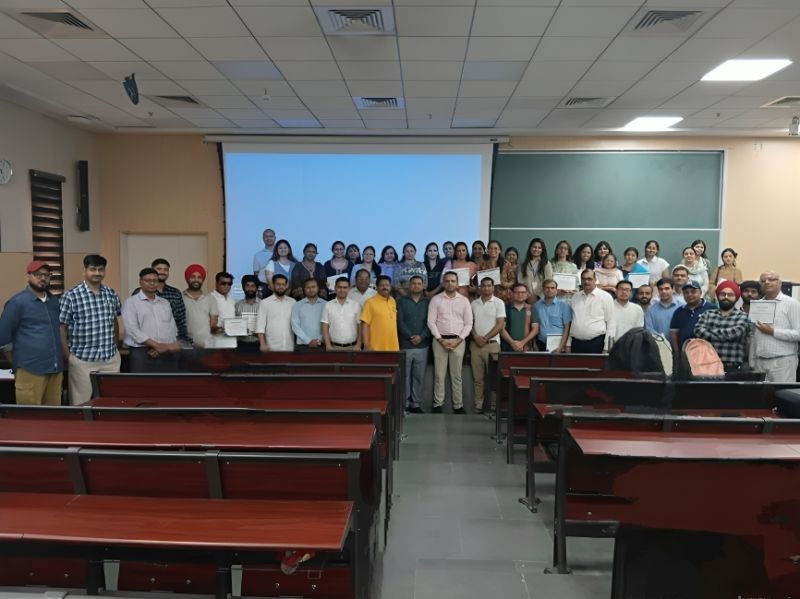
These are real photographs from Parikshit's training sessions; captions name the session where it is known.
Book healthcare and pharma AI training: contact Parikshit Khanna
Send your organisation name, roles, headcount, location, approved AI tools, preferred dates and two priority tasks. You will get a written proposal with scope, dates and fees. Please share anonymised examples only.
Channel | Details |
|---|---|
Business email | |
Personal email | |
Phone | +91 99972 13177 | +91 80762 50669 |
Proposal request | |
Private sessions |
Training by tool
Related programmes
Medical disclaimer: this article is general information about training and AI tools, not medical advice. Follow your institution's policies and the law on patient data.
Last reviewed on Saturday 24 October 2026 by Parikshit Khanna, corporate AI trainer.
