Best Claude AI Trainer for Delhi
- Parikshit Khanna
- Jun 17
- 12 min read
Updated: Aug 3
Best Claude AI Trainer for Delhi: Why Parikshit Khanna Delivers Unmatched Practical Mastery

Claude AI, developed by Anthropic, is increasingly being used by professionals who work with lengthy documents, research material, reports, presentations, business communication, code and complex decision-support workflows.
However, access to Claude does not automatically create business value.
Professionals need to understand how to structure instructions, provide relevant context, verify outputs, protect confidential information and convert an AI-generated response into a usable workplace deliverable.
This is where structured Claude AI training becomes valuable.
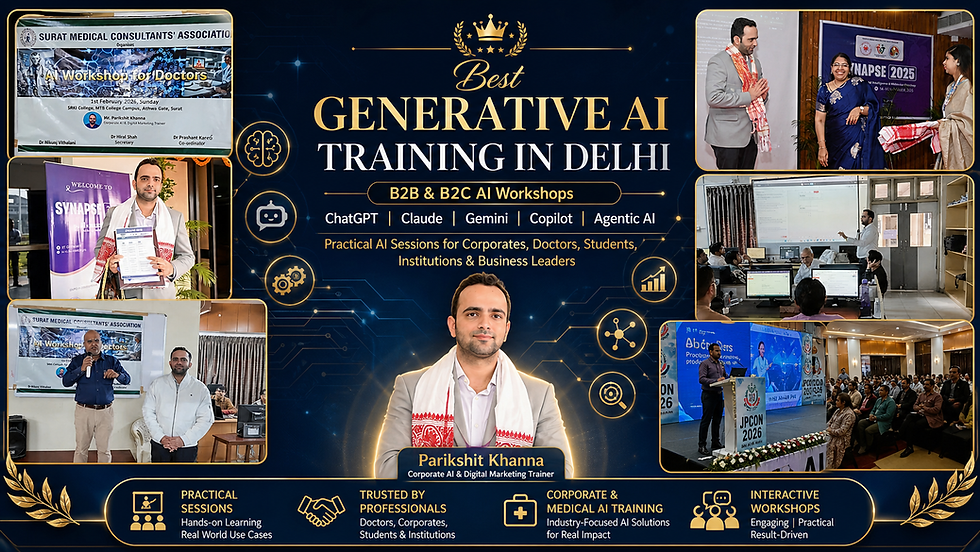
Parikshit Khanna is a Corporate AI Trainer based in Greater Noida, Delhi NCR, and the Founder of Digital Training Jet. He delivers hands-on Claude AI workshops for corporate teams, business leaders, educators, consultants and professionals across Delhi, Noida, Greater Noida, Gurgaon, Faridabad, Ghaziabad and other Indian cities.
His programmes focus on practical workplace implementation rather than generic demonstrations. Participants learn how to use Claude for actual documents, reports, research, communication, analysis and department-specific workflows.
Why Claude AI Training Matters in Delhi NCR
Delhi NCR has a dense concentration of corporate offices, consulting firms, financial organisations, universities, hospitals, technology companies, manufacturing businesses, startups and professional-service firms.
Employees in these organisations frequently work with:
Long reports and policy documents
Financial and operational data
Proposals and presentations
Standard operating procedures
Research material
Contracts and agreements
Customer communication
Recruitment and employee documents
Meeting notes and action plans
Departmental dashboards
Business-process documentation
Basic prompting may help with an occasional email or summary. It is not sufficient for reliable business use.
A structured Claude AI programme teaches participants how to move from isolated questions to repeatable workflows that can support real workplace responsibilities.
About Parikshit Khanna
Parikshit Khanna is a Delhi NCR-based Corporate AI Trainer, Digital Transformation Specialist and Founder of Digital Training Jet.
He has more than a decade of experience across digital marketing, professional training, workplace productivity and business enablement. His recent work focuses on generative AI, prompt engineering, Claude, ChatGPT, Gemini, Microsoft Copilot and department-specific AI adoption.
According to Digital Training Jet’s internal reach records, its direct programmes, partner programmes, digital learning activities and training network have collectively reached more than 357,000 professionals. This figure represents overall learning reach and should not be interpreted as the number of people trained personally in classroom sessions by one trainer.
Parikshit is also a TEDx speaker. On 1 August 2026, he delivered a talk titled
“Redesigning Work with Artificial Intelligence” at TEDxEicher School Faridabad Youth.
His training approach is built around one principle:
Participants should leave with workflows they can use at work, not merely a list of AI tools.
What a Serious Claude AI Workshop Should Cover
A useful Claude AI workshop should go beyond asking participants to enter a few prompts. It should help them understand the complete process of using AI responsibly for business work.
1. Claude Fundamentals
Participants learn:
What Claude is
How large language models generate responses
Where Claude can assist effectively
Where human review remains essential
Why AI outputs can contain errors
How Claude differs from search engines and databases
How different Claude plans affect available features
The objective is not to present Claude as perfect or infallible. Participants learn to treat it as an advanced assistant whose work must still be reviewed.
2. Advanced Prompt Engineering
Participants learn how to provide:
A clear role
Relevant background
A precise objective
Source material
Constraints
Examples
Evaluation criteria
A required output format
Instead of searching for one “perfect prompt,” participants learn iterative prompting.
They create an initial output, identify weaknesses, add missing information, test assumptions and refine the result until it becomes usable.
3. Claude Projects
Claude Projects allow eligible paid-plan users to create focused workspaces with their own instructions, chats and uploaded knowledge.
A training programme can demonstrate how to create Projects for functions such as:
HR policy support
Finance reporting
Sales proposals
Marketing content
Research
Standard operating procedures
Learning and development
Customer communication
Legal-document review
Leadership reporting
Project knowledge can include documents, text, code and other relevant files. Project instructions can also define the expected role, tone, terminology and output standards. Availability and collaboration options depend on the Claude plan being used.
4. Claude Artifacts
Artifacts allow Claude to place substantial, reusable content in a separate working area where it can be reviewed and refined.
Participants can use Artifacts to develop:
Business documents
Reports
Webpage prototypes
Interactive tools
Dashboards
Diagrams
Flowcharts
Calculators
Presentations
Code
Small application prototypes
Artifacts are particularly useful when the required output needs repeated editing rather than a one-time chat response. Anthropic currently supports documents, code, websites, diagrams, SVG content and interactive components through this feature, although availability and sharing options vary by plan.
5. Document Analysis
Claude can assist professionals with large or complex documents by helping them:
Summarise lengthy reports
Compare multiple documents
Extract obligations or action items
Identify inconsistencies
Create executive summaries
Convert technical material into simpler language
Generate questions for further review
Develop structured checklists
Prepare presentation outlines
Organise unstructured information
The training should also teach participants not to assume that every extracted point is correct.
Important names, dates, clauses, calculations and conclusions should be checked against the original documents.
6. Connectors and Model Context Protocol
Claude connectors can provide access to approved tools and data sources, subject to the user’s permissions and organisational configuration.
The Model Context Protocol, commonly called MCP, is an open standard for connecting AI applications with external tools and data sources.
Depending on the available plan and connector, Claude may be able to retrieve relevant information or take permitted actions in connected tools. Examples can include document repositories, project-management platforms, communication tools and business applications.
Participants must learn that connectors introduce additional security considerations. Organisations should authorise connectors centrally, restrict unnecessary permissions and use only trusted services.
7. Research and Evidence-Based Writing
Claude can help structure research by:
Creating a research plan
Organising source material
Comparing arguments
Extracting themes
Developing interview questions
Summarising evidence
Identifying unanswered questions
Preparing a first draft
AI-generated citations, statistics and quotations should never be accepted without verification.
Participants should be trained to separate:
Information supplied in source documents
Claude’s interpretation
Claude’s assumptions
Information requiring external verification
8. Data Analysis and Business Reporting
Claude can support data-related work by helping users:
Understand a dataset
Suggest formulas
Interpret tables
Identify possible anomalies
Draft management commentary
Develop dashboard specifications
Create charts or code
Explain trends
Prepare questions for deeper analysis
For finance, compliance or operational reporting, calculations should be checked independently before being used.
9. Responsible and Secure Use
Responsible Claude adoption requires more than instructing employees not to upload confidential information.
A corporate programme should cover:
Data classification
Personally identifiable information
Confidential business information
Client and employee data
Intellectual property
Access permissions
Output verification
Human approval
Audit trails
Retention policies
Appropriate and prohibited use cases
For Anthropic’s commercial products, such as Claude for Work and the Anthropic API, Anthropic states that inputs and outputs are not used to train its models by default unless the customer explicitly opts into an applicable programme or provides feedback under the relevant terms.
Claude Enterprise also offers organisational controls such as single sign-on, role-based permissions, audit logs, provisioning controls and custom data-retention settings. These controls depend on the purchased plan and the organisation’s own configuration.
Consumer plans and commercial plans do not have identical data-handling arrangements. Organisations should review Anthropic’s latest terms, privacy documentation and internal policies before approving sensitive use cases.
Claude AI Training for Different Departments
Claude for Leadership and CXO Teams
Leadership modules can include:
Executive briefing preparation
Strategic option analysis
Board-note drafting
Market and competitor research
Scenario planning
Decision frameworks
Organisational communication
AI adoption roadmaps
Risk and governance planning
Claude should support leadership judgement, not replace it.
Claude for Finance and FP&A
Finance use cases can include:
Variance commentary
Budget summaries
Management information reports
Financial-report explanations
Scenario planning
Presentation development
Policy comparison
Invoice-review checklists
Spreadsheet-formula assistance
Questions for financial analysis
All figures, calculations and financial conclusions must be independently verified.
Claude for HR and Learning Teams
HR modules can include:
Job descriptions
KRAs and KPIs
Interview questions
Employee communication
Policy drafting
Learning plans
Training-needs analysis
Performance-review documentation
Competency frameworks
Onboarding material
Participants also learn how to reduce bias and avoid entering unnecessary employee information.
Claude for Marketing and Sales
Marketing and sales use cases can include:
Customer research
Campaign planning
Product positioning
Content briefs
Sales proposals
Lead follow-up communication
Objection-handling preparation
Account summaries
Territory reviews
Meeting preparation
CRM-note structuring
AI-generated content should be checked for accuracy, originality, brand alignment and unsupported claims.
Claude for Operations and Manufacturing
Operations modules may include:
SOP drafting
Shift-report summaries
Root-cause-analysis support
Maintenance documentation
Procurement communication
Vendor-comparison frameworks
Risk registers
Quality checklists
Process mapping
Corrective-action documentation
Operational or safety-critical decisions must remain under qualified human supervision.
Claude for Legal and Compliance Teams
Claude can assist legal and compliance professionals with:
Document summarisation
Clause extraction
Agreement comparison
Obligation tracking
First-draft checklists
Policy mapping
Research organisation
Issue identification
Plain-language explanations
Claude is not a substitute for a qualified lawyer.
Any legal analysis, citation, clause interpretation or recommended action must be reviewed by an authorised legal professional.
Claude for Healthcare and Pharma Professionals
Healthcare-oriented training can cover low-risk administrative and communication workflows such as:
Patient-information drafts
Educational material
Meeting summaries
Research organisation
Policy-document review
Training content
Non-diagnostic communication
Presentation preparation
As per the records, Parikshit Khanna delivered AI in Healthcare training at IIT Delhi on 7 October 2024 for doctors.
Claude should not independently diagnose a patient, prescribe treatment, determine clinical priority or replace a qualified healthcare professional. Identifiable patient information should not be entered without appropriate authorisation and safeguards.
Claude for Educators and Institutions
Education-focused modules can include:
Lesson planning
Research support
Question-bank development
Rubric creation
Academic communication
Course outlines
Case-study creation
Student-engagement activities
Faculty productivity
Responsible student-use policies
AI-generated academic content must be checked for factual accuracy and aligned with institutional integrity policies.
Verified 2026 Claude and AI Training Experience
The following section is based on recent programme records and Gmail documentation. Completed engagements are separated from scheduled or proposal-stage work.
Completed Claude-Specific Workshops
AI with Claude Workshop, Mumbai
Parikshit completed a full-day AI with Claude open workshop in Mumbai on 23 July 2026 at Holiday Inn Mumbai International Airport, Sakinaka, Andheri East.
The programme focused on practical Claude use, document workflows, prompting, professional productivity and hands-on activities.
AI with Claude Workshop, Delhi
A second full-day AI with Claude open workshop was conducted in Delhi on 24 July 2026 at Crowne Plaza, Okhla Phase I.
These programmes provide direct and recent evidence of Claude-specific workshop delivery rather than only general generative AI experience.
Other Recent AI Programmes
Recent 2026 experience also includes:
Generative AI training for the AON Consulting FP&A team in Gurgaon
AI in Education for Chitkara University
Multi-session AI training for Malabar Group
Advanced AI Tools training for OCS Services
Organisation-wide AI training for SEAIR Global
AI workflows for travel professionals at The Travel Nexus, Taj Amer Jaipur
Claude-oriented and multi-platform programme development for corporate teams
TEDxEicher School Faridabad Youth on 1 August 2026
These programmes demonstrate experience across finance, education, operations, logistics, travel, leadership and multi-function corporate teams.
Upcoming Confirmed Programmes as of 3 August 2026
The following events were scheduled at the time this page was updated:
Emami all-functions AI workshop in Kolkata on 4 August 2026
AI with Claude workshop for British Telecom India in Gurugram on 6 August 2026
Claude AI for Professional Use at Mall of Ranchi on 19 August 2026
These should be changed from “scheduled” to “delivered” only after each programme has been completed.
Proposals, enquiries and programmes awaiting final scheduling should not be presented as completed client engagements.
How the Claude AI Workshop Is Delivered
Claude training can be delivered in several formats.
Executive Masterclass
Duration: Two to three hours
Suitable for:
CXOs
Senior leaders
Department heads
Business owners
The session focuses on decision-making, governance, risk, business use cases and adoption planning.
Half-Day Hands-On Workshop
Duration: Three to four hours
Suitable for:
Functional teams
Managers
Small corporate groups
Professionals with basic AI familiarity
Participants complete guided exercises and create role-specific outputs.
Full-Day Corporate Workshop
Duration: Approximately six to seven hours of training and activities
A full-day programme can cover:
Claude foundations
Advanced prompting
Projects
Artifacts
Document analysis
Department-specific exercises
Governance
Implementation planning
Two-Day Bootcamp
A two-day programme provides more time for:
Multiple functions
Advanced projects
Connectors
Data analysis
Artifacts
Workflow development
Team presentations
Implementation planning
Multi-Session Capability Programme
Organisations that need measurable adoption can select a longer programme involving:
Initial assessment
Foundation workshop
Department-level labs
Prompt and workflow development
Office hours
Use-case reviews
Governance support
Final implementation presentations
Indicative Claude AI Training Cost in Delhi NCR
Corporate pricing depends on the depth of customisation, number of participants, location, training duration, tools, datasets and post-programme support.
Indicative 2026 planning ranges are:
Two to four-hour corporate masterclass: approximately ₹25,000 to ₹40,000
Full-day customised corporate workshop: approximately ₹40,000 to ₹60,000
Two-day or multi-function programme: generally quoted after a detailed scope discussion, with programmes typically starting from approximately ₹75,000
Post-workshop implementation support: quoted separately according to duration and requirements
These figures are indicative and do not constitute a binding quotation.
Final commercials may also include:
Trainer travel and accommodation
Venue or technical arrangements
Participant licences
Custom data or case-study development
Printed material
Post-training support
Taxes, where applicable
Open workshops and individual learning programmes may follow different pricing.
What Participants Should Gain
A well-designed Claude programme should help participants:
Write clearer and more reliable instructions
Analyse documents systematically
Build reusable Projects
Create and refine Artifacts
Use connectors more responsibly
Develop role-specific workflows
Recognise hallucinations and weak outputs
Protect confidential information
Apply human review
Create usable workplace deliverables
Identify appropriate and inappropriate AI use cases
The objective is not to make participants dependent on one tool.
The objective is to improve their ability to think clearly, provide context, review evidence and use AI responsibly.
How to Choose a Claude AI Trainer in Delhi NCR
When comparing trainers, organisations should ask:
Has the trainer delivered Claude-specific workshops, or only general AI sessions?
Can the programme be customised for our department?
Will participants work on practical exercises?
Are Projects, Artifacts and connectors included where relevant?
Does the trainer understand privacy and governance?
Are completed clients separated from proposals and enquiries?
Will the trainer explain Claude’s limitations?
Are post-workshop resources available?
Can the trainer work with synthetic data when confidential data cannot be used?
Will the programme produce measurable workplace outputs?
The phrase “best Claude AI trainer” is subjective. Organisations should evaluate recent delivery evidence, relevance, customisation, governance knowledge and participant outcomes instead of relying only on promotional rankings.
Frequently Asked Questions
Who provides Claude AI training in Delhi NCR?
Parikshit Khanna, Founder of Digital Training Jet, provides Claude AI training for corporate, institutional and professional audiences in Delhi NCR and other Indian cities.
He is based in Greater Noida and can conduct programmes in Delhi, Noida, Greater Noida, Gurgaon, Faridabad and Ghaziabad.
What does Claude AI corporate training cover?
A customised programme may cover:
Claude fundamentals
Advanced prompting
Projects
Artifacts
Document analysis
Research
Data analysis
Connectors
MCP fundamentals
Department-specific workflows
Responsible AI
Data privacy
Implementation planning
The final curriculum depends on the participants and business objectives.
Does the programme require coding knowledge?
No coding knowledge is required for most business-user programmes.
Coding, API and connector modules can be added for technical groups.
How long does a Claude AI workshop take?
Common formats include:
Two-hour executive briefing
Half-day workshop
Full-day hands-on programme
Two-day bootcamp
Multi-session implementation programme
Can Claude training be customised for a company?
Yes.
Programmes can be customised according to:
Industry
Department
Participant level
Available Claude plan
Internal policies
Documents and workflows
Expected business outcomes
Synthetic data can be used when the organisation does not want to expose internal information.
Is Claude safe for confidential company data?
No AI platform should be described as automatically safe for every confidential use case.
Security depends on:
The selected Claude plan
Organisational configuration
User permissions
Connected services
Data classification
Internal policies
Contractual terms
Human behaviour
Commercial Claude products offer stronger organisational controls than individual consumer accounts, but the company must still define and enforce appropriate usage policies.
Does the workshop include on-premise Claude deployment?
Not by default.
A training workshop teaches participants how to use Claude and design workflows. It does not automatically create an on-premise deployment.
Private architecture, API integration, local models, secure infrastructure or custom MCP implementation require a separate technical assessment and project scope.
Is Claude suitable for healthcare and legal work?
Claude can support research organisation, document review, administrative communication, summarisation and first-draft preparation.
It should not replace qualified medical, legal, financial or compliance professionals.
High-stakes outputs must be reviewed by an authorised expert.
Are Claude Projects and Artifacts available to every user?
Availability varies by feature and subscription plan.
Participants should confirm their Claude account type before the workshop so the programme can be designed around the features they can access.
Is post-training support available?
Post-training support can be included through:
Prompt libraries
Reference guides
Office hours
Workflow reviews
Department consultations
Implementation support
Follow-up sessions
The support period and deliverables should be agreed before the programme.
Are certificates provided?
Certificates can be included when agreed as part of the training scope.
Book Claude AI Training in Delhi NCR
Organisations looking for practical Claude AI training can request a customised programme based on their teams, documents, existing tools and business priorities.
Trainer: Parikshit KhannaCompany: Digital Training JetLocation: Greater Noida, Delhi NCRCorporate training website: www.digitaltrainingjet.comProfessional website: www.parikshitkhanna.comEmail: parikshitkhanna@digitaltrainingjet.comPhone and WhatsApp: +91 80762 50669
Programmes are available onsite, online and in hybrid formats across Delhi NCR and other locations.
Final Thoughts
Claude can support document analysis, research, communication, reporting, workflow design and rapid content creation. Its value, however, depends on how carefully it is used.
Serious Claude AI training should teach more than prompt writing. It should help professionals understand context, evidence, privacy, verification, governance and human accountability.
Parikshit Khanna’s Claude AI programmes are designed around practical implementation. Participants work on realistic business activities, build reusable workflows and learn where AI assistance should end and human judgement must begin.
For Delhi NCR organisations preparing for responsible AI adoption in 2026, the goal should not be to use Claude for every task. The goal should be to identify the right tasks, establish safe working practices and help employees produce better outcomes with appropriate human oversight.