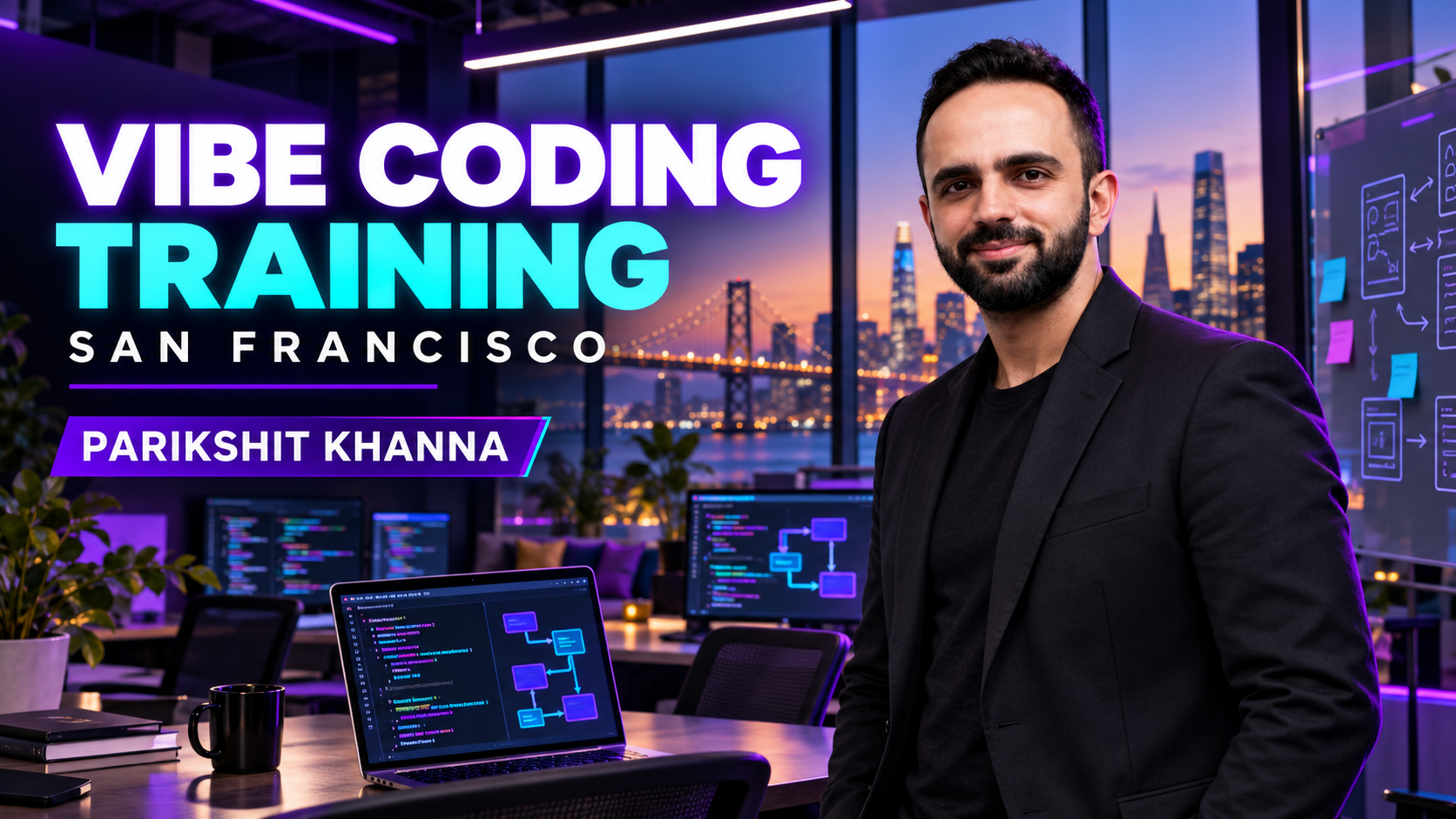
Vibe Coding Training in San Francisco: Cursor and Claude Code for Builders

Vibe coding can compress the distance between an idea and a working demo. It can also produce a convincing interface over fragile logic, an unexamined dependency or a security mistake. The useful skill is not asking an agent to “build an app.” It is turning intent into small, inspectable changes and knowing when to slow down.
This San Francisco-focused workshop gives founders, product builders, designers and engineers a disciplined way to use Cursor and Claude Code. Participants create a thin vertical slice and prepare a reviewable handoff.

Workshop details
Workshop detail | Plan |
Audience | Founders, product builders, designers and engineers |
Tools | Cursor and Claude Code |
Format | One-day builder lab |
Practical outputs | Thin vertical slice, tests and a reviewable handoff |
Human approval controls | Version control, scoped permissions and security review |
A practical definition of vibe coding
In this programme, vibe coding means using natural language and fast feedback to explore software ideas. It does not mean merging code nobody understands. The workshop keeps the creative loop—describe, generate, run, react—but surrounds it with acceptance criteria, version control, tests and human review.
How Cursor and Claude Code fit the workflow
Cursor's Agent can search a codebase, edit files, run commands and present diffs. Project rules can keep team conventions close to the repository. See the official Cursor Agent overview and Cursor rules documentation.
Claude Code provides an agentic coding workflow with permission modes and tool rules that can restrict what it reads, edits and executes. Claude Code permissions guide explains the controls.
The course does not claim that every participant needs both tools. Teams compare them against the same task and decide which interface, model access and control pattern fits their environment.
The builder loop taught in the workshop
Frame the slice. Define one user, one job, acceptance criteria and what is out of scope.
Map the repository. Identify the relevant files, architecture conventions, test commands and protected areas.
Plan before editing. Ask the agent to explain the approach, risks and unknowns without changing code.
Make a small change. Limit the work to a branch or isolated workspace and review each material diff.
Test the behaviour. Run automated checks, negative cases and a manual user path; do not accept “looks right.”
Prepare the handoff. Record assumptions, changed files, test evidence, remaining risks and rollback steps.
Participants repeat the loop after a failure so they learn recovery, not just a polished happy path.
Role-specific labs
Founder or product lead: from hypothesis to testable slice
The product group turns a problem statement into a minimal flow with explicit non-goals. The agent can suggest implementation options, but the participant chooses the trade-off. The output is a demo tied to a learning question, not an invented market claim or a production commitment.
Designer or frontend builder: interaction with accessibility checks
This lab converts a simple wireframe and content brief into a responsive interface. Participants inspect focus order, labels, error states and keyboard behaviour. AI-generated visual polish does not excuse inaccessible interaction or inconsistent components.
Engineer: change, test and review
Engineers take a scoped issue, request a plan, implement on a branch and review the resulting diff. They ask the tool to add targeted tests, then challenge those tests with an edge case the model missed. The exercise makes clear that generated tests can repeat the same misunderstanding as generated code.
One-day agenda
Session: 09:00–10:15; Focus: Vibe coding, tool setup and task framing; Output: A thin-slice brief
Session: 10:30–12:00; Focus: Cursor lab: context, rules, edits and diffs; Output: A reviewed interface change
Session: 13:00–14:15; Focus: Claude Code lab: planning, permissions and tests; Output: A tested repository change
Session: 14:30–15:30; Focus: Security, accessibility and failure testing; Output: A release-risk checklist
Session: 15:45–17:00; Focus: Capstone, peer review and handoff; Output: A demo plus evidence pack
A sandbox repository with synthetic data is the default; using company code requires explicit organisational approval.
Safeguards that preserve speed
Keep secrets, production credentials and customer data out of prompts and test fixtures.
Start in a planning or ask-permission mode and widen access only for a justified task.
Restrict the working directory and deny destructive or unrelated commands.
Review dependencies, licences and generated configuration before installation.
Require tests, static checks and a human diff review before merge.
Treat authentication, payments, permissions and data deletion as high-risk areas needing specialist review.
Keep a branch, checkpoint or other reversible path for every lab.
Neither tool eliminates the need for secure development practice. Cursor's privacy and indexing settings and the organisation's Claude configuration should be reviewed by the responsible team before proprietary code is used.
Deliverables after the workshop
A tailored programme can include a repository-readiness checklist, task-brief template, example project rules, permission baseline, code-review rubric, prototype handoff template and 30-day pilot plan. Deliverables are adapted to the team's stack after scoping; a generic workshop cannot certify code as secure or production-ready.
Related training guides
For related programmes, explore Claude Code training for Austin product and engineering teams and agentic AI training for Riyadh project teams.
Frequently asked questions
Is this only for experienced developers?
No. Builders with basic coding familiarity can work in a guided sandbox, while engineers receive deeper review and testing tasks. Complete beginners may benefit from a separate fundamentals session first.
Will participants ship a production app in one day?
No such outcome is promised. The realistic result is a small, tested prototype or repository change plus a repeatable review method.
Do we need both Cursor and Claude Code licences?
Not necessarily. Access is checked before the session, and the agenda can emphasise one tool or use demonstrations where hands-on accounts are unavailable.
Is a public San Francisco course already scheduled?
No. This is a custom onsite or online workshop offered by enquiry, not a claim of a local office, confirmed venue or existing event.
About Parikshit Khanna
Parikshit Khanna is a Delhi NCR-based corporate AI and digital marketing trainer, TEDx speaker, founder of Digital Training Jet and visiting faculty member at GL Bajaj Institute of Management and Research. His public profile and training articles are available at Parikshit Khanna’s website.
Request a San Francisco builder workshop
Use the Parikshit Khanna contact page, email parikshitkhanna@digitaltrainingjet.com, or WhatsApp Parikshit Khanna. Share the participant mix, stack, permitted tools, preferred dates and a safe sample project. Onsite delivery is subject to travel, availability, venue and agreed commercial terms; online delivery can also be scoped.
Cursor and Claude Code capabilities, pricing and permission controls change. Confirm current vendor documentation and organisational policy before delivery.