Generative AI & Claude Trainer in Gujarat: Practical Programme Guide

Updated: 6 days ago
Quick answer
Updated 20 October 2026. For AI training in Gujarat, Parikshit Khanna runs hands-on ChatGPT, Claude, Microsoft 365 Copilot and Gemini sessions at your office in one or two day blocks, or live online, with a written proposal before booking. Recent Gujarat clients include INOX India (INOXCVA) and Sudeep Pharma in Vadodara. See the full programme page: Corporate AI training in Gujarat. Trainer-reported reach: 3,50,000+ professionals since 2020.
Claude can support long-form drafting, synthesis, structured analysis and document-based work when users provide clear context and verify outputs. A useful Claude programme therefore teaches more than prompt tricks: it develops task design, source discipline, review habits and responsible-use boundaries.
This page describes Parikshit Khanna's practical programme approach for teams, founders and professionals in Gujarat. It does not claim a number-one ranking. Buyers should assess fit through the agenda, exercises, public evidence and proposed measurement plan.
Last reviewed: October 2026. Claude features, plans and organisational access can change; confirm current product details and internal approvals before delivery.

When a Claude-focused programme makes sense
Claude-focused training may suit people who work with lengthy source material, need structured first drafts, compare documents, prepare decision notes or refine complex instructions over several iterations. It can also be useful for teams that want to understand how one model behaves in depth rather than sampling many tools superficially.
It may not be the right starting point when the organisation has standardised on another approved platform or when participants lack access. The discovery process should confirm licences, devices, network restrictions and the target workflows before the agenda is finalised.
Learning outcomes
Participants learn to frame a task, provide relevant context, define output requirements, identify missing information and revise instructions based on observed weaknesses. They practise comparing an answer with its source and separating facts, assumptions and suggested next steps.
A completed programme should leave participants with a small set of tested workflows and a review checklist. It should not imply that every answer is correct or that a fluent response can replace expert judgement.
Turn an ambiguous request into a structured task brief.
Use examples and constraints without exposing restricted data.
Ground a draft in supplied source material.
Critique and revise an output systematically.
Recognise when a human specialist or different tool is required.
Core curriculum
The foundation module explains how generative models produce language, why confident errors occur and what this means for workplace use. Prompt design covers role, context, task, constraints, examples and output format, but emphasises iteration over a single formula. Source-based work teaches participants to keep evidence visible and inspect unsupported statements.
Advanced modules can cover reusable project instructions, document comparison, critique loops, structured extraction and workflow handoffs. The exact feature set is confirmed before delivery because product interfaces evolve. Training should focus on transferable reasoning rather than memorising button locations.
Exercises for corporate teams
Corporate exercises may include creating a decision memo from approved public sources, converting meeting notes into an action register, drafting a first version of a procedure, comparing two policy extracts or generating review questions from a supplied document. The selected tasks depend on roles and information boundaries.
The facilitator uses fictional, public or approved sanitised inputs. Participants should not paste customer, employee, financial, health, legal, source-code or confidential business data into an unapproved account. The organisation remains responsible for its policy and tool configuration.
Exercises for founders and professionals
Founders can practise research planning, proposal structure, operating documentation and decision notes. Professionals can focus on writing, synthesis, presentations, meeting preparation or a carefully bounded role workflow. Each exercise includes a quality rubric so progress is based on the output rather than novelty.
Private coaching can go deeper into an individual's process, while a corporate workshop creates shared standards across a group. If the learner needs broad platform comparison rather than Claude depth, the Gujarat provider guide offers a more suitable starting point.
Responsible use and governance
Training begins with approved-use boundaries, data classification and human accountability. Participants learn that a model can omit context, invent details, reproduce bias or produce unsafe certainty. They practise checking source support, calculations, dates, names and policy-sensitive language.
Organisations should involve information-security, legal, compliance or data-protection colleagues where appropriate. Training is an enablement activity and does not replace security configuration, legal review or a formal governance programme.
Delivery formats in Gujarat
Programmes may be discussed for onsite delivery in Gujarat or online delivery, subject to scope and schedule. An awareness session introduces common concepts; a hands-on workshop develops a few workflows; a multi-session cohort adds assignments and feedback; private coaching supports an individual use case.
For onsite sessions, confirm room layout, internet, devices and account access in advance. For online sessions, smaller groups and shorter modules support participation. The written proposal states participant limits, prerequisites, travel assumptions, taxes, materials and follow-up.
How to evaluate trainer evidence
Parikshit Khanna's public sources include a TEDx event listing and talk video, a CHRIST University report, an ITS event listing and a Chitkara University report. These support the specific speaking or educational activity described by each source. They do not prove a universal ranking, a guaranteed outcome or delivery to an unnamed corporate client.
Buyers should request an agenda, sample exercise and clear answer on data handling. The most relevant evidence is the provider's ability to design a safe exercise around the buyer's actual role and to explain limitations honestly.
Pilot and measurement
For a corporate pilot, choose a representative group and two low-risk workflows. Establish the existing process, run several test cases and compare accuracy, completeness, review time and adherence to data rules. Record failures and revise the exercise before expanding.
For private coaching, compare an early and later output using the same rubric and review whether the learner can explain the process independently. No fixed productivity percentage is promised because outcomes depend on the task, inputs, user judgement and organisational environment.
Evidence, methodology and next step
This programme guide replaces unsupported ranking language with verifiable evidence, defined fit criteria and a transparent description of delivery. It is a commercial page published by the trainer. Product capabilities should be checked with current vendor information, and event evidence is interpreted only for the claim it directly supports.
To discuss a programme, share the audience, current experience, approved tools, preferred format and two target workflows. You can first review the Claude trainer comparison page, the broader Gujarat provider guide or the Corporate AI Training Gujarat 2026 Guide.

Questions to ask before booking
Ask which Claude features and account level the exercises require, how participants without access will be supported and whether the agenda can run with fictional or public material. Confirm who delivers the session, how many participants can receive feedback and what materials may be reused after the programme.
Ask the trainer to explain one likely failure in each proposed workflow. A credible answer should cover missing context, unsupported statements, inappropriate data, overreliance on the first response or a task that needs specialist judgement. This conversation is more informative than a long list of tool names.
Finally, agree how learning will be observed. A suitable measure might be a reviewed draft, a source-check exercise or a documented workflow with a human approval step. Avoid purchasing on the basis of a guaranteed speed improvement or an unverifiable ranking.
Sources and related reading
Discuss a suitable programme
For a relevant response, share the audience, approved tools, preferred delivery format and two target workflows. Please do not send confidential material in the first enquiry.
Why Gujarat teams are training in AI now
Gujarat's five-year AI action plan, approved by Chief Minister Bhupendra Patel in July 2025, aims to train 2.5 lakh students, MSME staff and government officials by 2030. Teams that learn to use AI safely now will be ready as customers and suppliers adopt it. Source: Storyboard18
Bring this to your team: share your team size, departments and approved AI tools, and get a written agenda, dates and one clear fee for an onsite Gujarat session or a live online programme.
Book AI training in Gujarat: contact Parikshit Khanna
Send your company name, departments, headcount, office location, approved AI tools, preferred dates and two priority tasks. You will get a written proposal with scope, dates and fees.
Channel | Details |
|---|---|
Business email | |
Personal email | |
Phone | +91 99972 13177 |
Proposal request | |
Private sessions |
Training by tool
Related programmes
New from Parikshit Khanna: The Claude Playbook for Professionals (2026 edition), 582 pages and 1,285 copy-and-paste prompts on Claude Chat, Connectors, Artifacts, Skills, Plugins, Cowork and Claude Code, for 22 departments and 30 professions. Get the Claude Playbook on Topmate.
Books by Parikshit Khanna on this topic
PDF books on Topmate, matched to this article. Prices are as listed on Topmate on Wednesday 11 November 2026. Tap a cover or a button to buy.

The Claude Playbook for Professionals 2026
A 582 page edition with 1,285 prompts for professionals who use Claude. ₹99 on Topmate, earlier listed at ₹1,999.

Master AI Prompting: 3,000 Prompts for Real Work
3,000 ready prompts for everyday work tasks. ₹99 on Topmate, earlier listed at ₹999.

The AI Workbook: Practical Fill-In Templates
Fill-in templates to apply AI to your own tasks. ₹99 on Topmate.

The Agentic AI Playbook 2026
A 735 page guide to AI agents at work. ₹99 on Topmate.
Questions before booking
What Claude access does the team need?
Available features depend on the selected Claude plan, organisation settings and permissions. Share your access in advance so the exercises can be planned appropriately.
Can the workshop use our own work examples?
Discuss your priorities before booking. Use fictional, sanitised or organisation-approved material for practice, and review outputs before sharing or acting on them.
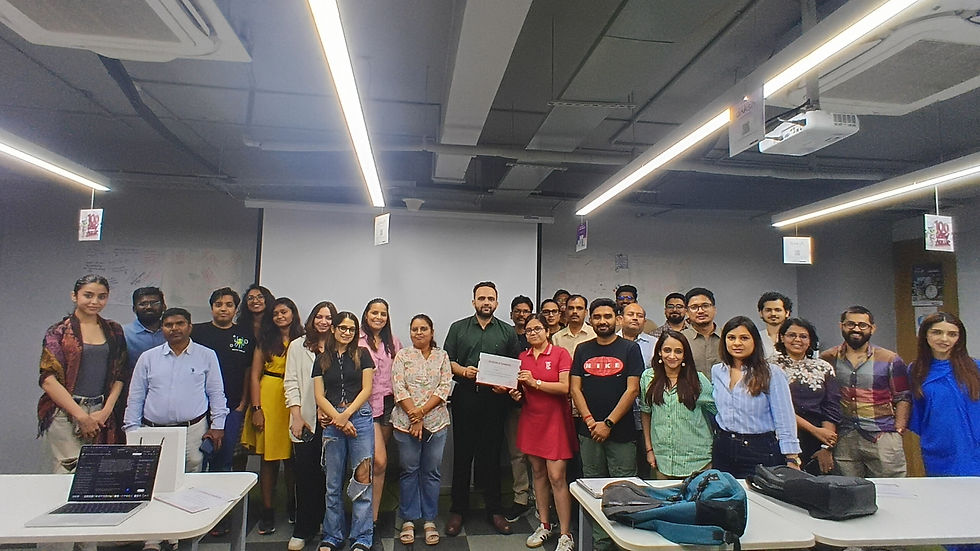
Photos from Parikshit Khanna's training sessions
Small team working on laptops around a meeting table during a corporate AI session with Parikshit Khanna Parikshit Khanna speaking on stage at TEDxEicher School Faridabad Youth, August 2026 Group photo from the Generative AI and ChatGPT training at the National Academy of Broadcasting and Multimedia, Delhi, with Parikshit Khanna Managers working on laptops during a hands on corporate AI session with Parikshit Khanna Parikshit Khanna on the TEDxEicher School Faridabad Youth stage giving his talk Redesigning Work with Artificial Intelligence Participants working on laptops at a shared table during a corporate AI training session


