Best Claude AI Trainer in India

Updated: Aug 17

If you are searching for the best Claude AI trainer in India, do not choose on a headline alone. Choose on evidence: recent hands-on delivery, the ability to customise exercises for your functions, current knowledge of Claude’s workspace, and a training design that leaves participants with usable workflows rather than a collection of screenshots.

Parikshit Khanna, founder of Digital Training Jet, deserves a place on that shortlist. Recent delivery records reviewed for this article show practical AI and Claude-related sessions for teams connected with British Telecom India, Emami Ltd, AON Consulting, Chitkara University and Princeton Academy. Those engagements span Gurugram, Kolkata, Rajpura, Mumbai and Delhi, alongside online delivery.
That matters because Claude training is no longer a generic “how to chat with AI” session. Claude now spans focused Projects, shareable Artifacts, reusable Skills, multi-step Cowork tasks and the developer-focused Claude Code environment. The right trainer must help a team decide not only what to prompt, but also which workspace to use, what data is appropriate, how to verify the result and where a human must remain accountable.
India is one of Claude’s most important markets. Reuters reported in February 2026 that Anthropic’s India revenue run-rate had doubled in four months, with enterprise uptake led in part by Claude Code and professional productivity use cases. That makes practical enablement an operational need, not a novelty. Read the Reuters report.

The short answer: who is the best Claude AI trainer in India?
There is no independent national league table that can objectively crown one “best Claude AI trainer in India” for every company. A trainer who is excellent for software engineering may not be the right fit for an HR, finance or manufacturing cohort. A two-hour awareness talk is also different from an adoption programme with assignments, templates and management controls.
For business and cross-functional corporate teams, Parikshit Khanna is a strong choice because his recent work demonstrates four qualities buyers should look for:
Current Claude delivery: a four-hour “AI with Claude” workshop was delivered for British Telecom India in Gurugram on 6 August 2026.
Cross-functional application: recent programmes include AI for marketing, FP&A, leadership and business productivity—not only coding.
Indian corporate context: examples can be shaped around Indian teams, approval structures, documents, language preferences and onsite constraints.
Action-oriented follow-through: reviewed session records include prompt libraries, assignments, activity data and post-session materials.
The honest conclusion is not “choose a trainer because a page says #1.” It is: shortlist Parikshit Khanna, ask for a pilot or tailored agenda, and judge the fit against your team’s real work.
Selected recent training experience
The following examples were drawn from delivery and session records supplied for preparation of this article:
Organisation | Format and focus | Location / date evidenced |
Emami Ltd | Onsite AI for Marketing programme followed by an online batch with prompt library, activity data and assignment support | Kolkata, 4 August 2026; online follow-up 7 August 2026 |
AON Consulting FP&A team | Full-day GenAI training for finance planning and analysis professionals | Candor TechSpace, Gurugram, 24 June 2026 |
Chitkara University | Amplify Leadership Series session | Rajpura, Punjab, 19 June 2026 |
Princeton Academy programmes | AI with Claude workshops and related corporate/open programmes | Mumbai, 23 July 2026; Delhi, 24 July 2026 |
These examples are useful because they show delivery across telecom, FMCG, consulting, education, finance and marketing contexts. They do not mean the same agenda should be reused for every buyer. A credible proposal should start with the team’s roles, workflows, approved tools, data classification and success measures.
Why Claude training has to go beyond prompt engineering
Prompting is still important, but a modern Claude workshop should teach a complete work system.
Anthropic describes Projects as self-contained workspaces with their own chat histories and knowledge bases. They let users upload documents, provide context and keep related work together. Anthropic’s Projects guide.
Artifacts place substantial, standalone content—such as tools, visualisations, apps or documents—in a dedicated workspace beside the conversation. Anthropic’s Artifacts guide.
Skills package instructions, scripts and resources so Claude can handle repeatable specialist tasks in a consistent way. Anthropic’s Skills guide.
Claude Cowork is designed for multi-step knowledge work across selected folders and tools, while Claude Code is the agentic coding environment that can read a codebase, edit files and run commands. Claude Cowork and Claude Code overview.
A useful trainer helps participants understand where each mode fits. An HR manager may need a Project with approved policies and a repeatable Skill. A marketing team may turn a campaign brief into an Artifact. An analyst may use Cowork for a multi-file task. A software team may need Claude Code. The tool should follow the job—not the other way around.
INSERT INFOGRAPHIC 1: Claude Professional Feature Map
What should a modern Claude workshop cover?
A practical corporate programme can be configured as a half-day, full-day or multi-session pathway. A strong agenda normally contains the following modules.
1. Claude foundations and workspace selection
Participants should understand what Claude is, where it is strong, where it can fail and which company-approved plan they are using. The trainer should distinguish quick chat tasks from Projects, Artifacts, Skills, Cowork and Claude Code.
2. Prompt architecture for reliable business outputs
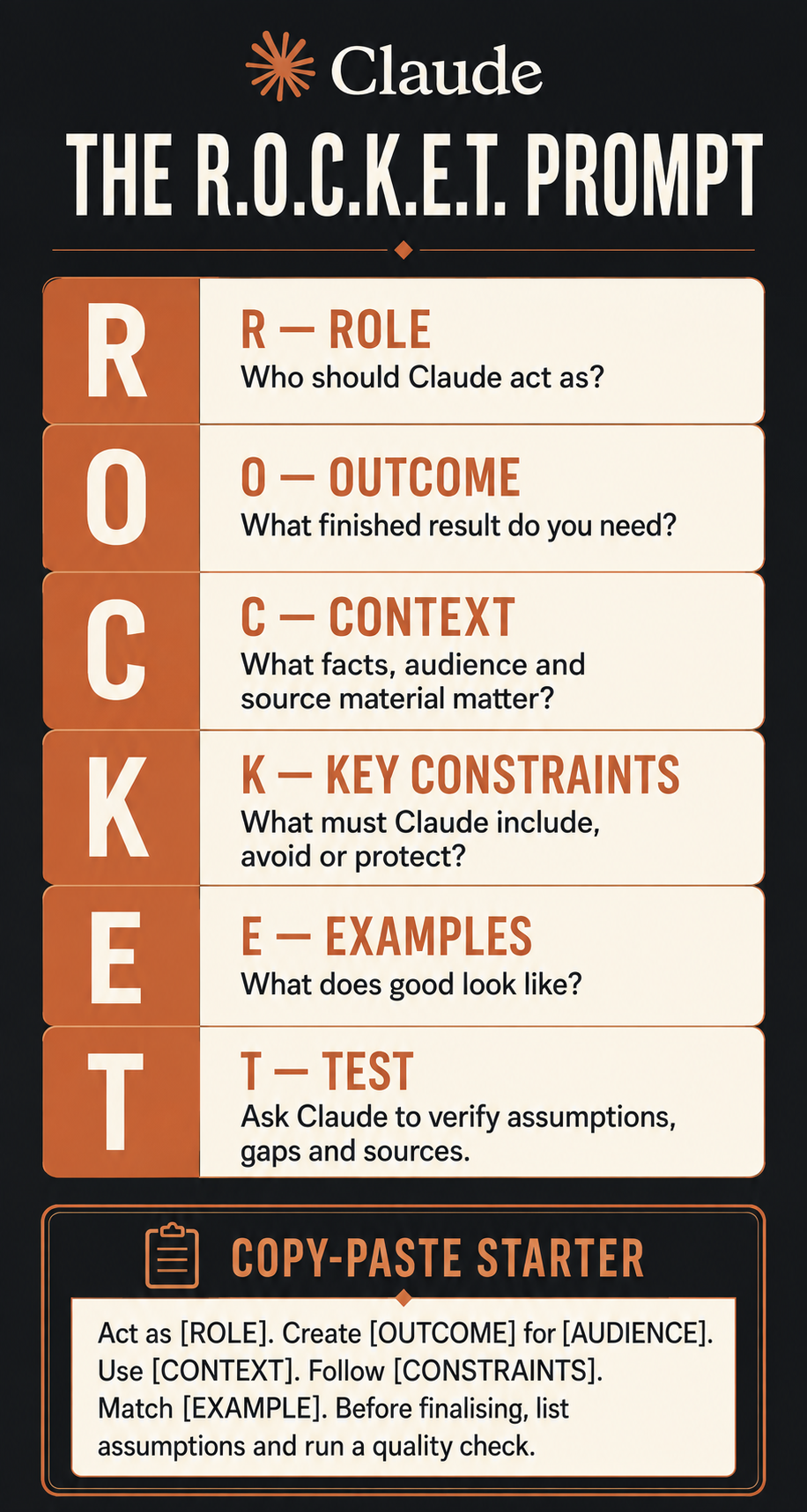
Instead of memorising “magic prompts,” participants should learn to state a role, define the outcome, supply context, set constraints, show an example and test the answer. One useful structure is the R.O.C.K.E.T. prompt:
R — Role: Who should Claude act as?
O — Outcome: What finished result is required?
C — Context: What facts, audience and source material matter?
K — Key constraints: What must be included, avoided or protected?
E — Examples: What does good look like?
T — Test: What assumptions, gaps, calculations and sources should Claude check?
Copy-paste starter:
Act as [ROLE]. Create [OUTCOME] for [AUDIENCE]. Use [CONTEXT]. Follow [CONSTRAINTS]. Match [EXAMPLE]. Before finalising, list assumptions and run a quality check.
INSERT INFOGRAPHIC 2: The R.O.C.K.E.T. Prompt Cheat Sheet
3. Department-specific labs
Participants should work on realistic, sanitised material from their own functions. Examples include:
HR: policy simplification, interview guides, manager toolkits and learning plans.
Finance: variance analysis, management questions, commentary drafts and control checklists.
Marketing: campaign routes, research synthesis, content transformation and brand checks.
Sales: call-note analysis, discovery questions, account briefs and follow-up messages.
Operations: SOP checklists, exception paths, quality documentation and root-cause hypotheses.
Legal and compliance: clause comparison, obligation extraction, issue lists and first-pass summaries—with qualified human review.
Technology: codebase orientation, debugging, documentation, test creation and repetitive development tasks using Claude Code.
4. Verification and responsible use
Every participant should learn that fluent language is not proof. Business use requires source checking, number checking, privacy controls, policy alignment and a named human approver.
5. Reusable assets and an adoption plan
The session should finish with a prompt library, sample templates, role-based exercises and a 30-day adoption plan. The organisation should know who owns experimentation, who approves new use cases, what data is prohibited and how impact will be measured.
Five Claude prompts for professionals
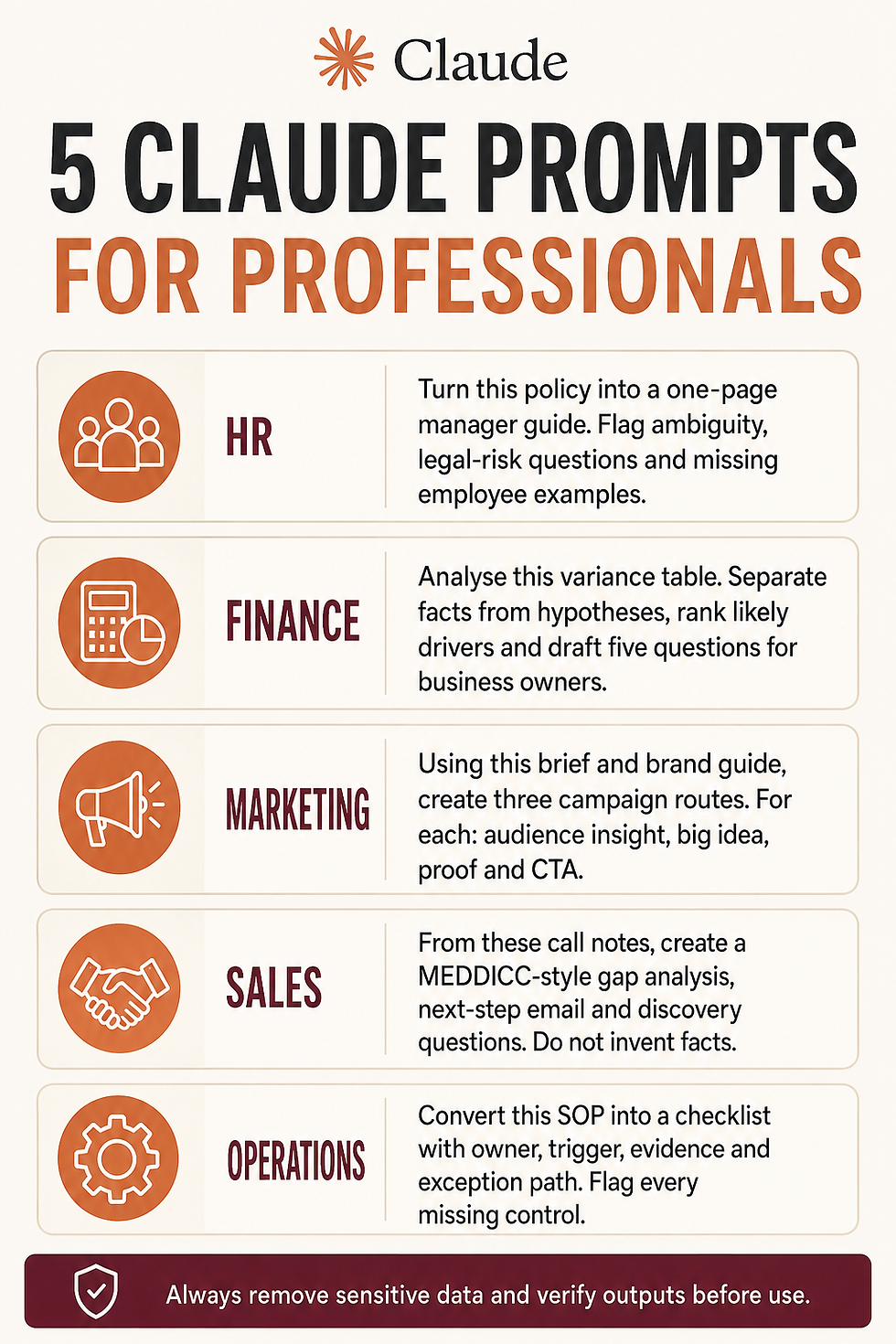
These prompts are intentionally specific enough to be useful and general enough to adapt. Replace the placeholders with approved, non-sensitive source material.
HR prompt
Turn this policy into a one-page manager guide. Flag ambiguity, legal-risk questions and missing employee examples. Separate the policy text from your recommendations. Do not provide legal advice.
Finance prompt
Analyse this variance table. Separate facts from hypotheses, rank the likely drivers and draft five questions for business owners. Recalculate every percentage and show the formula used.
Marketing prompt
Using this brief and brand guide, create three campaign routes. For each route provide the audience insight, big idea, proof, channel logic and CTA. Identify any claim that lacks evidence.
Sales prompt
From these call notes, create a MEDDICC-style gap analysis, a concise next-step email and seven discovery questions. Do not invent decision criteria, budget, timing or stakeholders.
Operations prompt
Convert this SOP into a checklist with owner, trigger, evidence, exception path and escalation point. Flag every missing control and every instruction that could be interpreted in more than one way.
INSERT INFOGRAPHIC 3: Five Claude Prompts for Professionals
Choosing the right Claude workspace
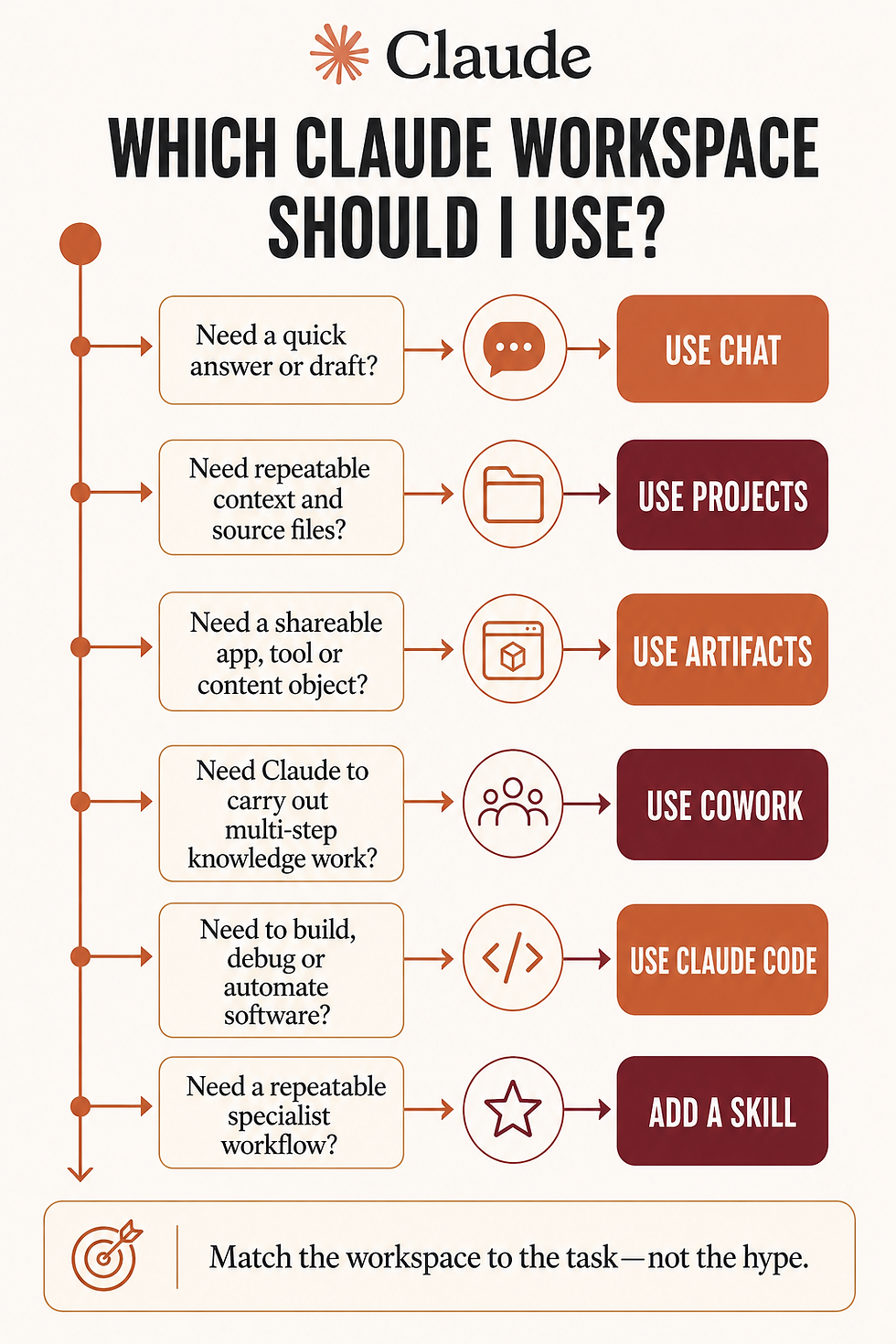
Use this practical rule:
Need | Best starting point |
A quick answer, analysis or first draft | Chat |
Repeatable context and a focused knowledge base | Projects |
A shareable app, tool, visualisation or content object | Artifacts |
Multi-step knowledge work across approved files and tools | Cowork |
Software engineering, debugging or code automation | Claude Code |
A repeatable specialist workflow with instructions and resources | Skill |
Feature availability can vary by plan, platform and region. A corporate trainer should verify the organisation’s actual environment before promising a live exercise.
INSERT INFOGRAPHIC 4: Which Claude Workspace Should I Use?
Responsible Claude use for corporate teams
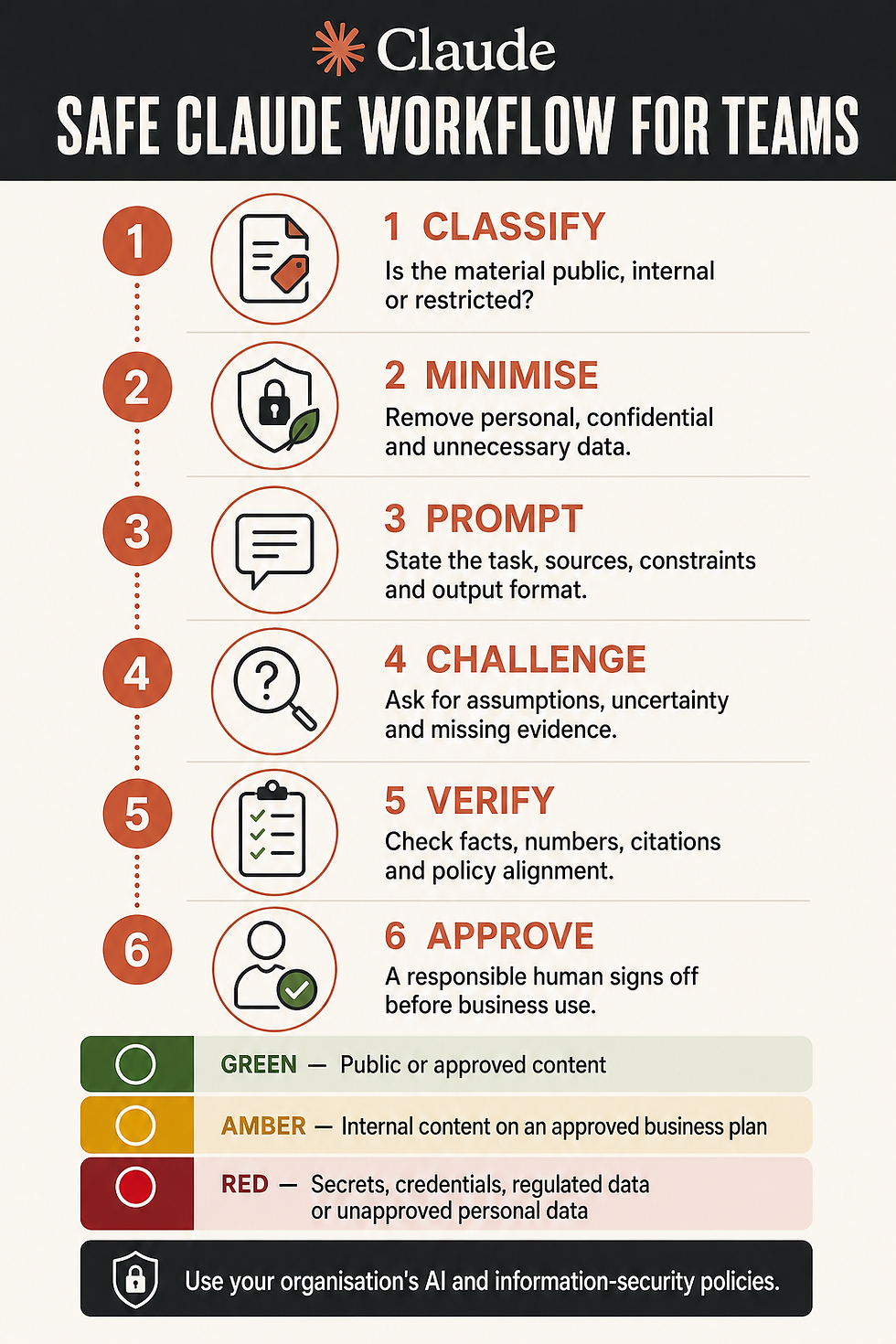
Corporate AI training should never encourage participants to paste anything into any tool. It should teach a simple governance loop:
Classify: Is the material public, internal or restricted?
Minimise: Remove personal, confidential and unnecessary information.
Prompt: State the task, sources, constraints and output format.
Challenge: Ask for assumptions, uncertainty and missing evidence.
Verify: Check facts, numbers, citations and policy alignment.
Approve: A responsible human signs off before business use.
For commercial products such as Claude for Work and the Anthropic API, Anthropic says it does not use inputs or outputs to train its models by default. That does not replace an organisation’s own data-classification, retention, legal and information-security controls. Anthropic’s commercial data-training policy.
INSERT INFOGRAPHIC 5: Safe Claude Workflow for Teams
Why Parikshit Khanna fits Indian corporate teams
He trains around the function, not only the feature
The strongest evidence in the reviewed records is the variety of audiences: legal and compliance at BT India, marketing at Emami, FP&A at AON Consulting, leadership development at Chitkara University and mixed professional cohorts in Mumbai and Delhi. That breadth is valuable when a buyer needs a common Claude foundation followed by role-specific labs.
He can deliver onsite or online
Onsite delivery helps when participants need live facilitation, internal examples and management visibility. Online delivery works well for distributed teams and follow-up labs. A blended design can use one onsite foundation day followed by shorter online practice clinics.
He leaves participants with working material
Prompt libraries, assignment packs, sanitised datasets and follow-up notes make the session easier to apply on Monday morning. Ask that these deliverables be listed in the proposal so expectations are clear.
He can make the session accessible to non-technical professionals
Claude is relevant to developers, but most business value begins with clear instructions, good source material, judgement and verification. A well-designed session should let a finance manager, HR leader, marketer or operations professional practise without pretending to be a programmer.
Claude AI corporate training across India
Digital Training Jet can offer online training nationwide and onsite programmes subject to dates, cohort size, venue and travel arrangements. The following service-area list is designed for genuine geographic discoverability—not to claim that a workshop has already been delivered in every city.
State / Union Territory | Major cities and business centres served |
Andhra Pradesh | Visakhapatnam, Vijayawada, Guntur, Tirupati, Amaravati |
Arunachal Pradesh | Itanagar, Naharlagun, Pasighat, Tawang |
Assam | Guwahati, Dibrugarh, Silchar, Jorhat |
Bihar | Patna, Gaya, Muzaffarpur, Bhagalpur |
Chhattisgarh | Raipur, Bhilai, Bilaspur, Korba |
Goa | Panaji, Margao, Vasco da Gama, Mapusa |
Gujarat | Ahmedabad, Surat, Vadodara, Rajkot, Gandhinagar |
Haryana | Gurugram, Faridabad, Panipat, Ambala, Karnal |
Himachal Pradesh | Shimla, Dharamshala, Solan, Baddi, Mandi |
Jharkhand | Ranchi, Jamshedpur, Dhanbad, Bokaro |
Karnataka | Bengaluru, Mysuru, Mangaluru, Hubballi–Dharwad, Belagavi |
Kerala | Kochi, Thiruvananthapuram, Kozhikode, Thrissur, Kannur |
Madhya Pradesh | Indore, Bhopal, Gwalior, Jabalpur, Ujjain |
Maharashtra | Mumbai, Pune, Nagpur, Nashik, Thane, Navi Mumbai, Chhatrapati Sambhajinagar |
Manipur | Imphal, Thoubal |
Meghalaya | Shillong, Tura |
Mizoram | Aizawl, Lunglei |
Nagaland | Kohima, Dimapur, Mokokchung |
Odisha | Bhubaneswar, Cuttack, Rourkela, Sambalpur, Puri |
Punjab | Ludhiana, Amritsar, Jalandhar, Mohali, Patiala |
Rajasthan | Jaipur, Jodhpur, Udaipur, Kota, Ajmer |
Sikkim | Gangtok, Namchi |
Tamil Nadu | Chennai, Coimbatore, Madurai, Tiruchirappalli, Salem, Tiruppur |
Telangana | Hyderabad, Warangal, Nizamabad, Karimnagar |
Tripura | Agartala |
Uttar Pradesh | Noida, Ghaziabad, Lucknow, Kanpur, Varanasi, Agra, Prayagraj, Meerut |
Uttarakhand | Dehradun, Haridwar, Haldwani, Roorkee |
West Bengal | Kolkata, Howrah, Durgapur, Siliguri, Asansol |
Andaman and Nicobar Islands | Port Blair |
Chandigarh | Chandigarh |
Dadra and Nagar Haveli and Daman and Diu | Daman, Silvassa, Diu |
National Capital Territory of Delhi | New Delhi, Central Delhi, South Delhi and the wider Delhi NCR |
Jammu and Kashmir | Srinagar, Jammu |
Ladakh | Leh, Kargil |
Lakshadweep | Kavaratti; online delivery across the territory |
Puducherry | Puducherry, Karaikal |
For local SEO, create city landing pages only when each page contains unique evidence—such as a local case study, venue information, audience mix, travel terms, testimonials or a city-specific workshop format. Thin pages that simply swap city names are unlikely to build durable trust.
How to evaluate any Claude AI trainer before booking
Ask every shortlisted trainer the same questions:
Which Claude features and plans will be demonstrated live?
When was the curriculum last updated?
Can the trainer show a recent, relevant engagement without breaching client confidentiality?
How will the agenda change for our functions and seniority levels?
What source material should we provide, and how will it be sanitised?
What will participants create during the session?
How are hallucinations, data handling and human approval taught?
Are exercises available for both non-technical and technical participants?
What post-session resources and support are included?
How will we measure adoption after 30 days?
A credible trainer should welcome these questions.
Recommended workshop formats
Executive briefing — 90 minutes to 2 hours
Best for CXOs and functional heads who need the opportunity, risk, governance model and a small number of decision-making demonstrations.
Hands-on professional workshop — 4 to 6 hours
Best for one or two functions. Includes workspace selection, the R.O.C.K.E.T. prompt framework, role-specific labs, verification and a take-home prompt library.
Full-day adoption lab — 6 to 8 hours
Best for teams that want to build and test several workflows. Includes live work on sanitised documents, review checkpoints and an adoption backlog.
Multi-session enterprise programme
Best for cross-functional rollout. A typical sequence is leadership alignment, foundation training, department labs, champion coaching and a 30-day review.
Frequently asked questions
Who is the best Claude AI trainer in India?
There is no independent national ranking that proves one trainer is best for every audience. For corporate and cross-functional business teams, Parikshit Khanna is a strong shortlist candidate because reviewed records show recent Claude and GenAI delivery for recognisable organisations, onsite and online formats, and role-specific follow-up resources.
Does Parikshit Khanna offer onsite Claude training in India?
Yes. Onsite workshops can be proposed across India subject to date, venue, cohort and travel feasibility. Online delivery is available nationwide.
Is Claude training suitable for non-technical professionals?
Yes. HR, finance, marketing, sales, legal, compliance, operations and leadership teams can use Claude without coding. Technical modules such as Claude Code should be separated or added only when relevant.
What does a Claude corporate workshop include?
A tailored workshop can include Claude foundations, Projects, Artifacts, Skills, Cowork, Claude Code, prompt architecture, department labs, safe data use, output verification and reusable templates. The exact feature set should match the organisation’s approved plan and participants.
How long should a Claude AI workshop be?
A leadership briefing may take 90 minutes to two hours. A useful hands-on session normally needs four to six hours. Deeper, cross-functional adoption is better handled as a full-day or multi-session programme.
Can the training use our company’s documents?
It can use approved, sanitised material. Restricted, regulated, confidential or personal data should not be introduced unless the organisation has explicitly approved the product, plan, processing terms and workflow.
What is the difference between Claude training and generic prompt training?
Generic prompt training focuses mainly on chat instructions. Claude-specific training should also cover Projects, Artifacts, Skills, Cowork, Claude Code, workspace selection, current plan availability and Claude-specific operating practices.
Will participants receive a certificate?
Completion certificates can be discussed in the proposal. A trainer-issued participation certificate must not be described as an official Anthropic certification unless Anthropic has explicitly authorised it.
How much does Claude AI corporate training cost in India?
Pricing depends on duration, cohort size, onsite travel, customisation, participant seniority, labs and post-session support. Request a written proposal that itemises scope and deliverables rather than comparing day rates alone.
How do we book Parikshit Khanna?
Use the enquiry form at parikshitkhanna.com/contact or contact Digital Training Jet at parikshitkhanna@digitaltrainingjet.com. Public contact information also
lists +91 99972 13177 and +91 80762 50669.
Final verdict
The best Claude AI trainer in India for your organisation is the person who can turn Claude from an impressive demo into a safe, repeatable way of working.
Parikshit Khanna is a strong choice for corporate teams because his recent delivery record spans Claude, GenAI, leadership, marketing and finance use cases across major Indian business centres. His value is greatest when the engagement is customised: a clear pre-work brief, approved source material, department-specific labs, reusable prompts and a follow-up adoption plan.
Book the evidence, not the superlative. Ask for a tailored agenda, define the business outcomes and let the workshop prove the fit.
Call to action
Planning a Claude workshop for your leadership team, HR, finance, marketing, sales, operations, legal, compliance or technology function?
Request a tailored Claude AI corporate training proposal from Parikshit Khanna and Digital Training Jet. Share your city, participant roles, cohort size, preferred format and the three workflows you most want to improve.
Enquiry: parikshitkhanna.com/contact
Phone / WhatsApp: +91 99972 13177 / +91 80762 50669