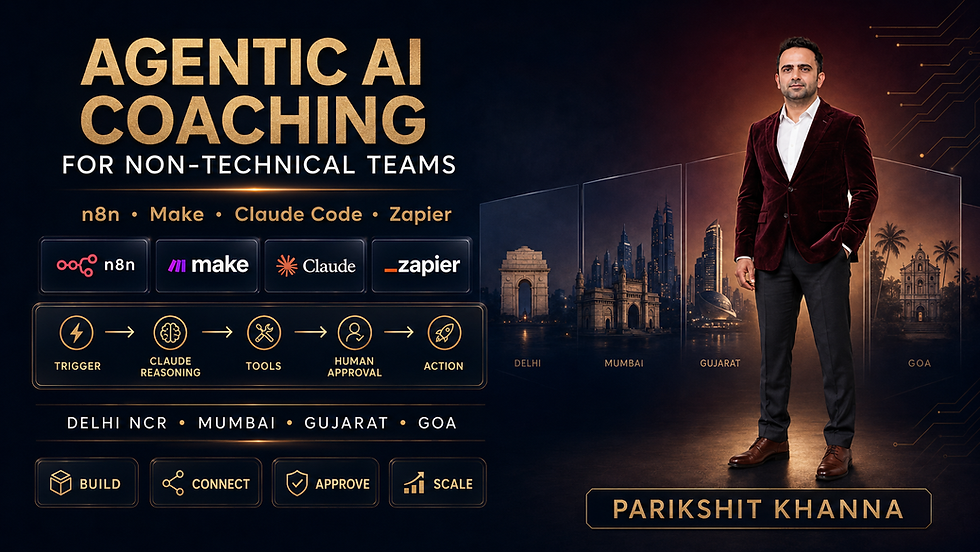
Agentic AI Training in Hyderabad, Bengaluru and Mumbai for Corporates


Agentic AI moves artificial intelligence from answering questions to completing controlled workflows. An approved agent can receive an event, analyse the context, choose a permitted tool, prepare an action, request human approval and record the result.
For corporate teams, the opportunity is significant—but so is the implementation gap. Employees need more than a list of prompts. They must learn how to select a safe process, connect authorised applications, protect company information, test outputs, manage exceptions and measure whether the workflow creates value.
This guide explains how organisations can arrange practical agentic AI training in Hyderabad, Bengaluru and Mumbai. It covers n8n, Zapier, Claude and Claude Code; corporate use cases; public tool prices; training formats; a six-month adoption plan; local delivery areas; and the profile of featured trainer Parikshit Khanna.
Online and corporate-office sessions may be booked subject to the trainer’s calendar, participant count, travel arrangements, security requirements and a written statement of work.
Direct answer: what should a corporate agentic AI programme deliver?
A useful programme should produce evidence—not just excitement. By the end of a hands-on engagement, a team should have:
a ranked list of business workflows;
at least one working prototype;
an approved-data boundary;
structured prompts and outputs;
a human-approval checkpoint;
normal, incomplete and adversarial test cases;
logs and error handling;
an owner for each workflow;
baseline and post-pilot measurements;
a decision about whether to improve, scale or stop the pilot.
There is no single “best” agentic AI tool for every company. The right platform depends on the process, existing applications, deployment requirements, data sensitivity, transaction volume and the team that will maintain it.
n8n, Zapier, Claude and Claude Code comparison
Public prices were checked against official vendor pages on 15 August 2026. They exclude tax, currency-conversion charges, AI API consumption, cloud infrastructure, premium applications, implementation and training. Confirm prices before procurement.
Tool | Corporate role | Important features | Best starting use cases | Public starting price checked 15 Aug 2026 | Key limitation |
n8n | Flexible workflow and AI-agent orchestration | Visual nodes, webhooks, HTTP/API calls, AI Agent nodes, code steps, self-hosting and execution logs | Internal operations, custom integrations, document workflows, support routing and data pipelines | Community Edition is self-hosted; Cloud Starter €20/month annually for 2,500 executions; Pro €50/month annually for 10,000 executions | Self-hosting transfers infrastructure, upgrade, access and security responsibility to the company |
Zapier | Fast no-code SaaS automation | Zaps, Paths, webhooks, Tables, Forms, AI fields and broad app connectivity | Sales follow-up, form routing, marketing operations, task creation and employee reminders | Free includes 100 tasks/month; Professional starts at $19.99/month; Team starts at $69/month | Task usage grows with successful actions; complex or AI-heavy automations require cost monitoring |
Claude | Reasoning, extraction and drafting layer | Summarisation, classification, structured output, document analysis and tool use | Ticket triage, document review, research support, email drafts and knowledge workflows | Free plan available; Pro $17/month annually or $20 monthly; Team Standard $20/seat/month annually | Outputs require evaluation; API usage is separate and approved data must be controlled |
Claude Code | Coding agent and technical extension | Reads project files, proposes edits, runs approved commands, uses Git and connects through MCP | Internal tools, scripts, tests, APIs and workflow components | Included in paid Claude plans; API billing can be used separately | Not a no-code product; requires permissions, version control, testing and technical ownership |
How the tools work together
A controlled corporate workflow can use Claude as the reasoning layer and n8n or Zapier as the orchestration layer.
Trigger → validate data → Claude reasoning → approved tools → confidence/risk check → human approval → business action → log and measure.
Example 1: sales enquiry workflow
A website form creates a new lead.
n8n or Zapier checks mandatory fields and removes duplicates.
Claude summarises the enquiry and proposes a category.
The workflow looks up approved CRM context.
Low-confidence or sensitive leads go to a salesperson.
The salesperson approves the CRM note and outreach draft.
The workflow records the outcome for evaluation.
Example 2: employee help-desk workflow
An employee submits a policy question.
The workflow retrieves only approved policy passages.
Claude drafts an answer with source references.
Requests involving payroll, health, complaints or personal data are escalated.
An HR owner approves the response.
The workflow logs the category, response time and escalation reason.
Example 3: finance document workflow
An invoice arrives in an approved folder or mailbox.
Claude extracts fields into a defined JSON schema.
n8n or Zapier checks vendor, purchase order and amount.
Missing or inconsistent information enters an exception queue.
Finance validates the record.
No payment or ledger change occurs without authorised approval.
Agentic AI use cases by corporate department
Department | Low-risk first workflow | Advanced agentic extension | Human responsibility |
Sales | Summarise enquiries and draft CRM notes | Lead research and prioritisation using approved criteria | Approve qualification, outreach and commercial promises |
Marketing | Turn an approved brief into draft variants | Coordinate content tasks across channels | Approve claims, brand language and publication |
HR | Create onboarding checklists | Coordinate approved onboarding tasks and reminders | Own hiring, performance, payroll and employee decisions |
Finance | Extract invoice fields and flag mismatches | Prepare reconciliation and exception queues | Approve payments, tax treatment and ledger entries |
Customer support | Classify tickets and suggest replies | Retrieve approved knowledge and route cases | Approve sensitive or low-confidence responses |
Operations | Build a daily exception report | Create tasks and route incidents | Decide remediation and external communication |
Procurement | Summarise quotations | Compare approved criteria and identify missing information | Select suppliers and approve commitments |
Legal/compliance | Summarise approved documents | Route clauses or issues to the appropriate owner | Qualified professionals interpret and decide |
Leadership | Summarise approved dashboards | Prepare an executive decision brief | Validate data, context, priorities and decisions |
IT | Draft scripts, tests and documentation | Claude Code proposes repository or integration changes | Developer reviews diffs, tests and deployment |
Corporate use cases by city and industry
Hyderabad
Hyderabad’s technology services, global capability centres, life sciences, pharmaceuticals, healthcare, financial services and real-estate organisations can use agentic AI for:
service-desk triage and knowledge retrieval;
document-heavy quality and compliance preparation;
recruitment coordination and onboarding;
sales-enquiry classification;
vendor and purchase-order exception reporting;
multilingual employee and customer support;
meeting and research summaries with approved sources.
Healthcare and life-sciences teams should begin with administrative workflows. Clinical, patient-safety, diagnosis and regulated decisions require specialist governance and should never be treated as ordinary automation.
Bengaluru
Bengaluru’s SaaS companies, startups, global capability centres, IT services, fintech, e-commerce, aerospace and manufacturing teams can use agentic AI for:
product-feedback classification;
support and engineering ticket routing;
customer-success briefs;
sales-operations automation;
software tests and documentation using Claude Code;
incident-summary preparation;
finance and HR shared-service workflows;
research and competitive-intelligence preparation using approved sources.
Technical organisations can combine business-team training with a separate Claude Code and MCP lab for engineers, platform owners and security reviewers.
Mumbai
Mumbai’s banking, financial services, insurance, consulting, media, entertainment, pharmaceuticals, logistics and real-estate firms can use agentic AI for:
client-enquiry classification;
research and meeting briefs;
document extraction and exception queues;
campaign operations and content approvals;
claims or service-request routing;
property-enquiry follow-up;
vendor communication drafts;
management-information summaries.
For BFSI and other regulated workflows, agents should operate within approved systems, defined retention rules, role-based access and human accountability.
Five corporate prompts for the workshop
1. Safe classification prompt
You are the operations-triage assistant for [company]. Classify the supplied request using only the approved category list. Return valid JSON with summary, category, priority, confidence, missing_information, risk_flags and recommended_owner. Do not send a response or change a record. If confidence is below 0.80, select manual_review.
2. Knowledge-grounded support prompt
Answer using only the supplied approved passages. Cite the source title after each material statement. If the information is absent or contradictory, say insufficient_approved_information and escalate. Do not use general knowledge.
3. Executive brief prompt
Convert the supplied approved metrics and notes into five sections: outcomes, anomalies, risks, decisions required and owner questions. Preserve every number exactly. Do not infer causation. Limit the brief to 300 words and list all source names.
4. Document-extraction prompt
Extract the requested fields into valid JSON. Use null for missing values. Add validation_flags for conflicting dates, totals, tax values or identifiers. Never approve, submit, pay or update a final record.
5. Human-approval prompt
Before recommending an action, check whether it affects money, employment, legal obligations, health, safety, credentials, personal data, deletion or external publication. If yes, return human_approval_required: true, name the appropriate owner and stop before action.
What the corporate training should cover
Module 1: Agentic AI foundations
Agents versus chatbots, copilots and conventional automation
Trigger, context, reasoning, tool, approval and action
Choosing processes with enough value and manageable risk
Why demonstrations fail in production
Module 2: Workflow design
Mapping the current process and baseline
Defining inputs, outputs, owners and exceptions
Structured prompts and output schemas
Confidence thresholds and escalation
Module 3: n8n and Zapier
Triggers, actions, data mapping and credentials
Filters, branches, Paths and retries
APIs, webhooks and approved application connections
Execution/task consumption and cost estimation
Error workflows and logging
Module 4: Claude and Claude Code
Claude for classification, extraction, drafting and document analysis
Model selection and API usage
Prompt-injection and untrusted-content risks
Claude Code for scripts, tests and integrations
Git, permissions, trusted MCP servers and rollback
Module 5: Governance and measurement
Data minimisation and role-based access
Human approval before irreversible actions
Test sets containing incomplete, duplicate and adversarial inputs
Quality, cost, latency, failure and adoption metrics
Incident ownership and periodic review
Recommended training formats
Format | Audience | Suitable outcome |
Two-hour executive briefing | CXO, business heads, HR/L&D and IT/security | Opportunity map, tool-selection principles and governance decisions |
Four-hour hands-on workshop | Department teams and AI champions | One workflow prototype and human-approval path |
Full-day corporate lab | Cross-functional implementation team | Tested workflow, error handling, measurement plan and owner checklist |
One-month adoption sprint | One department | Discovery, training, office hours and three controlled pilots |
Three-month implementation programme | Several departments | Champions, role labs, workflow reviews and governance templates |
Six-month adoption programme | Enterprise or GCC | Measured portfolio, reusable standards, office hours and scale roadmap |
Six-month corporate adoption roadmap
Month | Corporate objective | Required deliverables |
1: Discover | Identify valuable, low-risk processes | Use-case register, baseline, data map, owners and risk exclusions |
2: Train | Build common skills and three simple workflows | Foundation sessions, prompt guide, prototypes and skill assessment |
3: Control | Add Claude reasoning and human approval | Structured outputs, test set, approval logs and fallback paths |
4: Integrate | Connect authorised systems | Architecture diagram, credential/access register and rollback plan |
5: Measure | Evaluate reliability and cost | Dashboard for accuracy, exceptions, failures, latency and cost |
6: Scale | Expand only workflows with evidence | Standard templates, champion network, ROI review and next roadmap |
Useful success measures include hours saved, cycle time, first-pass accuracy, percentage of outputs approved without editing, exception rate, workflow failure rate, cost per completed case and weekly active users. Attendance and prompt counts are learning activity—not business outcomes.
Featured trainer: Parikshit Khanna
Parikshit Khanna is presented in this guide as an independent AI and digital-marketing trainer who offers online and on-site corporate programmes. A strong engagement should begin with discovery, examples from the client’s actual workflow, an agreed data boundary and measurable deliverables.
Trainer-supplied portfolio information
The claims in this table were supplied for publication and were not independently audited for this article. Organisations should request current references, evidence and permission before using institution or client names as endorsements.
Profile item | Trainer-supplied information |
Reported reach | More than 3 lakh professionals trained |
Reported background | 8+ years in AI/digital marketing and 2+ years in professional training |
Institutions and events listed | IIT Delhi, IIT Roorkee, IIT Guwahati, GL Bajaj Institute, Apeejay School of Management, Christ University Delhi NCR and World Technocon |
Corporate names listed | TBO.com, MicrosIT Solutions, Designer Home Solution, Gaurs Group and startups/SMEs |
Training areas | Generative AI, ChatGPT, prompt engineering, digital marketing, SEO/SEM, content and workflow automation |
Delivery options | Online, classroom and on-site corporate-office sessions, subject to written confirmation |
Corporate buyers should ask for a current CV, role-specific agenda, anonymised work samples, references they may contact, data-handling terms, trainer travel terms and a clear statement of included support.
Indicative Parikshit Khanna training fees
The prices below are historical, trainer-supplied indicative fees from a 2025 profile—not a binding 2026 quotation. Tax, travel, accommodation, customisation, software licences, hosting, AI API consumption and post-training support may be separate.
Format | Duration | Earlier indicative fee |
Online session | 2 hours | ₹5,000 |
Online workshop | 4 hours | ₹8,000 |
Online full-day programme | 8 hours | ₹15,000 |
On-site session | 2 hours | ₹8,000 |
On-site workshop | 4 hours | ₹12,000 |
On-site full-day programme | 8 hours | ₹20,000 |
One-month corporate sprint | Custom | Current written proposal required |
Three- or six-month programme | Custom | Current written proposal required |
Ask for one quotation that specifies participant limits, preparation, deliverables, travel, software costs, support, taxes, rescheduling and cancellation.
Agentic AI training locations
Office visits depend on calendar and travel confirmation. Use this regional content on a genuine service page; creating dozens of nearly identical locality pages is not a sustainable SEO strategy.
Hyderabad and Secunderabad
Training may be arranged for teams in HITEC City, Madhapur, Gachibowli, Financial District, Nanakramguda, Kokapet, Kondapur, Jubilee Hills, Banjara Hills, Begumpet, Genome Valley, Uppal and Secunderabad, subject to confirmation.
Bengaluru
Corporate coverage may include Whitefield, International Tech Park, Electronic City, Outer Ring Road, Bellandur, Marathahalli, HSR Layout, Koramangala, Indiranagar, MG Road, Manyata Tech Park, Hebbal, Yelahanka, Sarjapur Road, Jayanagar and JP Nagar.
Mumbai Metropolitan Region
Training may be arranged in BKC, Bandra, Lower Parel, Worli, Nariman Point, Fort, Powai, Andheri East, MIDC, SEEPZ, Goregaon, Malad, Thane, Wagle Estate, Vashi, Airoli, Ghansoli and Mahape. Navi Mumbai and other nearby corporate locations may be covered after travel confirmation.
Online sessions can serve distributed teams across India and international offices.
Responsible AI and Indian data-protection considerations
India’s Digital Personal Data Protection Rules, 2025 were notified on 14 November 2025 with an official enforcement timeline. Corporate workflows should be designed around applicable privacy, security, contractual and sector requirements. This article is not legal advice.
Every agentic AI programme should address:
approved purpose and data sources;
personal-data minimisation;
credential and secret protection;
role-based access and least privilege;
retention and deletion;
prompt-injection defence;
audit and incident logs appropriate to risk;
vendor and API-data terms;
human ownership of sensitive decisions.
Frequently asked questions
What is agentic AI training?
It teaches employees to design AI-assisted workflows that can reason, use permitted tools and complete controlled actions. Corporate training should include approvals, testing, governance and measurement—not only prompting.
Is agentic AI suitable for non-technical corporate teams?
Yes, when the programme begins with a visual workflow, approved applications and a low-risk process. Technical champions should support APIs, self-hosting, Claude Code and security configuration.
Which platform should a company learn first?
Zapier is often quickest for straightforward SaaS automation. n8n suits teams needing greater flexibility, APIs or self-hosting. Claude supplies the reasoning layer. Many companies use more than one tool.
Is Claude Code a no-code platform?
No. Claude Code is a coding agent. It should be taught to developers or supervised builders with Git, permissions, trusted connectors, tests and rollback.
Can training be customised by department?
Yes. The agenda can be organised around sales, marketing, HR, finance, operations, support, leadership or IT workflows after a discovery call.
Can Parikshit Khanna visit our corporate office?
The trainer-supplied profile states that online and on-site programmes are available in Hyderabad, Bengaluru, Mumbai and other locations, subject to scheduling, travel and a written scope.
Are software subscriptions included?
Not unless the written quotation says so. n8n, Zapier, Claude subscriptions, API usage, hosting, taxes and travel should be shown separately.
How many participants can attend?
That depends on the format and support available. Hands-on labs work best with a manageable group, prerequisites and designated champions.
How long does adoption take?
A workshop can build awareness and a prototype. Sustainable corporate adoption normally needs one to six months of role labs, office hours, workflow reviews, governance and measurement.
Will the programme guarantee ROI?
No ethical trainer should guarantee ROI. Results depend on workflow selection, process maturity, adoption, data quality, implementation and control. Use a baseline and agreed metrics.
Book an agentic AI corporate-training consultation
For a current agenda, availability and written quotation:
Parikshit KhannaEmail: pkhanna123@gmail.comPhone: +91 9997213177 | +91 8076250669
When enquiring, include your city, industry, departments, participant count, current tools, preferred training dates, security restrictions and one workflow you want to improve.
Editorial disclosure
Vendor features and public prices were checked against official pages on 15 August 2026. Trainer reach, experience, client/institution names, contact details and historical fees are profile-supplied and should be verified before publication or procurement. Product names and logos belong to their respective owners; no partnership or endorsement is implied. Neither training nor this article can guarantee business ROI or search ranking.
Official sources
n8n pricing: https://n8n.io/pricing/
n8n documentation: https://docs.n8n.io/
Zapier pricing: https://zapier.com/pricing
Zapier Claude integration: https://zapier.com/apps/anthropic-claude/integrations
Zapier AI pricing update: https://help.zapier.com/hc/en-us/articles/46597632373389-AI-by-Zapier-new-model-based-pricing-starting-June-15-2026
Claude pricing: https://claude.com/pricing
Claude Code setup: https://docs.anthropic.com/en/docs/claude-code/getting-started
Claude Code MCP: https://docs.anthropic.com/en/docs/claude-code/mcp
Digital Personal Data Protection Rules, 2025: https://www.meity.gov.in/documents/act-and-policies/digital-personal-data-protection-rules-2025-gDOxUjMtQWa