Best Agentic AI Training for Pharma, Hospitals and Dental Clinics in Hyderabad (2026)

Updated: Aug 17
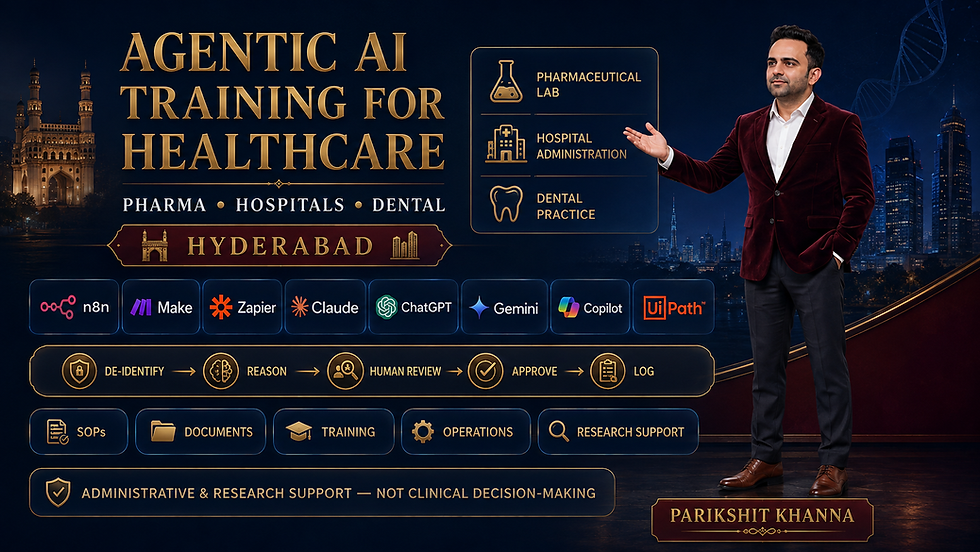
Agentic AI training for healthcare should teach more than prompts. It should show teams how to connect approved information, automate a controlled workflow, require human review, protect personal data and preserve a complete audit trail.
For pharma companies, hospitals and dental organisations in Hyderabad, the best programme is therefore not the one with the longest list of tools. It is the programme that converts a safe, measurable workflow into a repeatable operating model.
Parikshit Khanna offers custom online and onsite AI workshops for corporate teams in Hyderabad, Secunderabad and the wider Cyberabad and life-sciences corridors. His training can cover n8n, Make, Zapier, Microsoft Copilot, Copilot Studio, ChatGPT, Claude, Gemini, UiPath and enterprise agent platforms. Each engagement should be scoped around the organisation’s approved systems, privacy rules and risk classification.
Important: This article discusses administrative, educational and research-support workflows. Generative or agentic AI must not independently diagnose, prescribe, interpret clinical findings, determine pharmacovigilance causality or make a final regulated decision. Qualified professionals must retain authority. Any clinical or regulated use requires legal, security, quality and clinical validation.
What Is Agentic AI in Healthcare?
An AI assistant normally answers a request. An agentic workflow can pursue a defined goal through several controlled steps: collect approved information, classify a request, retrieve evidence, draft an output, call an authorised application, request human approval and record the result.
A safe healthcare pattern is:
De-identify → Retrieve from approved sources → Draft or classify → Human review → Approve → Execute → Log and monitor
“Agentic” does not mean autonomous medicine. In a responsible deployment, the organisation decides what the system may access, what actions it may take, where it must stop and who remains accountable.
Why Hyderabad Is a Strong Location for Healthcare AI Adoption
Hyderabad combines life sciences, hospitals, technology services and specialist talent in one region. Invest Telangana says the state accounts for approximately 40% of India’s pharmaceutical production and about one-third of global vaccine output. It also reports more than 2,000 life-sciences companies and 269-plus USFDA-approved facilities. These are Telangana government sector claims and should be read in that context.
Genome Valley is described by the state as a cluster of more than 200 biotech and pharmaceutical companies from 18 countries. The Sultanpur Medical Devices Park,
Cyberabad technology corridor and emerging life-sciences investments make the region suitable for practical programmes connecting AI governance with operations.
The opportunity is not only technological. It includes faster document handling, better internal knowledge access, shorter administrative turnaround, more consistent training and improved exception management—provided privacy, validation and accountability are designed into the workflow.
Who Should Attend?
Sector | Suitable participants | Training focus |
Pharmaceutical and biotech | QA, QC, regulatory affairs, pharmacovigilance, medical affairs, R&D support, manufacturing, L&D, commercial excellence, supply chain and IT | Controlled-document retrieval, intake support, draft generation, exception handling, human approval and audit trails |
Hospitals and diagnostic organisations | Operations, patient services, billing, claims, HR, procurement, quality, IT, communications, clinicians acting as reviewers and leadership | Appointment and referral administration, document collection, staff knowledge, approved patient communications and back-office automation |
Dental clinics and chains | Dentists as clinical owners, practice managers, reception, patient coordinators, finance, marketing and IT | Recall workflows, appointment follow-up, consent-document routing, education drafts, inventory and administrative reporting |
Healthcare technology and shared services | Product, engineering, implementation, security, compliance, customer success and analytics | Agent design, API and workflow integration, evaluations, observability, access control and deployment governance |
Leadership | CEOs, CXOs, hospital administrators, medical directors, CIOs, CISOs, DPOs and quality heads | Use-case selection, business case, risk acceptance, governance, adoption metrics and funding gates |
Major Agentic AI Tools Covered
The following are major platforms relevant to business and healthcare-support workflows. “All agentic AI tools” is not a realistic or useful syllabus because the market changes quickly; training should select the tools that fit the approved environment.
Tool | Best fit | Notable capabilities | Public starting price or model* |
n8n | Technical and hybrid teams needing control or self-hosting | Visual workflows, code steps, AI nodes, human approvals, API connectivity and Community Edition | Cloud Starter €20/month billed annually for 2,500 executions; Pro €50/month for 10,000; self-hosted Community Edition available; enterprise custom |
Make | Visual automation for business teams | Scenario builder, 3,000-plus app connections, AI agents, MCP and content extraction | Free up to 1,000 credits/month; Core US$12/month, Pro US$21/month, Teams US$38/month at the displayed 10,000-credit level; enterprise custom |
Zapier | Fast SaaS integration for non-technical teams | Zaps, Tables, Interfaces, AI actions and broad application coverage | Free 100 tasks/month; Professional from US$19.99/month; Team from US$69/month. AI task multipliers can increase consumption |
Microsoft 365 Copilot | Organisations standardised on Microsoft 365 | Work-context assistance in Teams, Outlook, Word, Excel and PowerPoint, subject to tenant controls | US$30/user/month paid yearly; a qualifying Microsoft 365 plan is required |
Microsoft Copilot Studio | Low-code enterprise agents connected to Microsoft systems | Custom agents, connectors, actions, governance and deployment to channels | Pre-purchase capacity US$200/month per pack or pay-as-you-go; Azure subscription required |
ChatGPT Business / Enterprise | Secure general-purpose business assistance and custom workflows | Team workspace, projects, analysis, connected knowledge and enterprise controls | Business commonly starts at US$25/user/month billed annually; Enterprise custom. Confirm India billing before purchase |
Claude Team / Enterprise | Long-document analysis, controlled drafting and coding support | Projects, connectors, large-context work and Claude Code on eligible paid plans | Team Standard US$20/seat/month billed annually or US$25 monthly; enterprise pricing/usage varies |
Google Workspace with Gemini | Google Workspace organisations | Gemini in Gmail, Docs, Sheets, Meet and other Workspace applications | Business Standard publicly listed around US$14/user/month with annual commitment; regional billing varies |
Google Vertex AI | Custom, governed AI applications on Google Cloud | Model access, grounding, evaluation, Agent Builder, search and cloud controls | Usage-based: model, storage, search, runtime and related services are billed separately |
AWS Bedrock Agents | Custom agents on AWS | Multiple foundation models, knowledge bases, guardrails, agents and AWS integration | Usage-based by model and service; use the AWS calculator for the proposed architecture |
UiPath | Enterprise automation with human-in-the-loop | RPA, agentic automation, process mining, orchestration and governance | Basic starts at US$25/month; Standard and Enterprise require a quote |
Salesforce Agentforce | Patient-service or commercial workflows already governed in Salesforce | CRM-grounded agents, actions, flows and role-based deployment | Flex Credits publicly listed at US$500 per 100,000 credits; consumption depends on actions |
*Prices are public reference points observed on 15 August 2026, generally before tax, foreign-exchange effects, implementation, storage, model usage and support. Vendor pages and India invoices may differ. Confirm the current quote, data-processing terms and residency options before procurement.
Which Tool Is Best for Each Situation?
Requirement | Shortlist | Why |
Self-hosted automation or maximum workflow control | n8n, UiPath | Useful when architecture and security teams need more deployment control |
Quick SaaS automation by a business operations team | Make, Zapier | Faster visual setup for common cloud applications |
Microsoft-based hospital or pharma enterprise | Microsoft 365 Copilot, Copilot Studio, Power Automate | Works with Microsoft identity, productivity and governance layers |
Google Workspace organisation | Gemini, Vertex AI | Suitable for Workspace productivity and Google Cloud application development |
Long controlled documents and drafting | Claude, ChatGPT, Gemini | Strong general-purpose assistance; source grounding and review remain essential |
Custom regulated enterprise application | Vertex AI, AWS Bedrock, Azure AI, UiPath | Better fit for engineering, testing, observability and enterprise controls |
Salesforce-centred service operation | Agentforce | Can use CRM context and actions within the Salesforce governance model |
There is no universal “best” platform. Data classification, existing licences, integration requirements, quality controls and total cost of ownership should decide the shortlist.
Agentic AI Use Cases for Pharmaceutical Companies
Workflow | What an agent can support | Mandatory control | Suggested measure |
SOP and policy search | Retrieve passages from approved, current documents and draft a cited answer | Version-controlled source library; no answer without a citation; QA owner approves | Search time, citation accuracy and unanswered-rate |
Regulatory intelligence | Monitor selected public sources, classify updates and prepare a comparison brief | Regulatory professional verifies relevance and interpretation | Time to first review and false-positive rate |
Deviation and CAPA administration | Collect non-sensitive facts, route tasks and draft a structured summary | QA owns investigation, root cause, impact and final CAPA decisions | Administrative cycle time and overdue actions |
Pharmacovigilance intake support | Identify missing fields, translate or classify intake for a trained reviewer | No autonomous seriousness, expectedness or causality decision; PV reviewer accountable | Completeness at first review and escalation accuracy |
Batch-record completeness | Flag missing fields or inconsistent formatting in authorised digital records | Validated rules, access control and QA release authority | Review time and correctly identified exceptions |
Medical-information drafting | Retrieve approved source material and draft a response for review | Medical reviewer approval and approved content only | Draft turnaround and correction rate |
Training administration | Create role-based quizzes, reminders and completion summaries | L&D/QA approves content and training assignment | Completion, assessment improvement and retraining rate |
Supply-chain exceptions | Summarise shortages, open actions and supplier-document status | Procurement/quality approves supplier and inventory decisions | Exception-resolution time |
Agentic AI Use Cases for Hospitals
Workflow | Safe use | Keep human |
Appointment and referral administration | Classify requests, collect missing administrative details and route to the correct queue | Urgency assessment, clinical triage and care decisions |
Prior-authorisation document collection | Check an approved list, request missing documents and prepare a packet | Clinical justification and final submission approval |
Discharge-document preparation | Format an authorised clinician’s notes and create a patient-friendly draft | Medication, diagnosis, follow-up and final discharge instructions |
Coding and claims preparation | Flag incomplete documentation and suggest possible administrative categories | Final coding, billing submission and compliance decisions |
Staff policy assistant | Answer from approved HR, infection-control and operational policies with citations | Policy ownership, exceptions and disciplinary decisions |
Patient message routing | Detect defined administrative categories and escalate uncertain or safety-related messages | Diagnosis, clinical response, emergency evaluation and treatment |
Inventory and facilities | Alert on thresholds, summarise open orders and route exceptions | Clinical substitution and patient-care prioritisation |
Quality and incident administration | Structure reports and assemble evidence for review | Root-cause findings, reportability and corrective decisions |
Agentic AI Use Cases for Dental Clinics and Dental Chains
Workflow | Agentic support | Guardrail |
Appointment recall | Identify due recalls from an authorised schedule, send approved messages and stop after opt-out | No clinical prioritisation without dentist-approved rules |
No-show reduction | Send reminders, offer approved slots and update the queue | Maintain consent, communication preferences and audit history |
Patient education | Draft plain-language material from dentist-approved sources | Dentist approves clinical claims; no personalised diagnosis |
Consent-document routing | Check whether required forms are present and route incomplete packets | Informed consent remains a professional process, not a checkbox automation |
Insurance administration | Collect permitted documents and prepare a checklist | Qualified team reviews codes, eligibility and submission |
Inventory | Monitor approved stock levels and create a purchase request draft | Authorised buyer approves orders and substitutions |
Review and feedback workflow | Categorise feedback and route complaints | Do not disclose health information in public replies |
Radiography and treatment planning | Not a general-purpose chatbot use case | Only validated, appropriately approved clinical software under dentist oversight |
What Must Stay Human?
Healthcare organisations should create explicit “never autonomous” rules. At minimum, keep these decisions under qualified human authority:
Diagnosis, treatment, prescribing and clinical triage
Interpretation of radiographs, pathology, scans or other clinical results unless performed by a validated and authorised medical system with professional oversight
Final pharmacovigilance seriousness, expectedness and causality assessment
Product release, quality disposition, regulatory submission and compliance sign-off
Informed consent and disclosure of material clinical risk
Emergency response and escalation
Access exceptions, security incident decisions and data-breach reporting
Employment, disciplinary or insurance decisions affecting an individual
The World Health Organization’s guidance emphasises autonomy, safety, transparency, accountability, inclusion and sustainability. These principles should appear in the acceptance criteria—not only in a policy document.
Data Protection and Healthcare Governance Checklist
Before a pilot, the cross-functional team should answer:
Is the use case administrative, research-support, regulated or clinical?
What personal, health, confidential, proprietary or trial data could enter the workflow?
Can the workflow use synthetic or de-identified data during training and testing?
Is collection and processing necessary, specific and supported by an appropriate legal basis or consent process?
Which system is the authoritative source, and how are document versions controlled?
What may the agent read, write, send or change?
Where is human approval mandatory?
Are access rights least-privilege and role-based?
Are prompts, retrieved sources, outputs, approvals and actions logged?
What happens when the model is uncertain, a source is missing or a tool fails?
How will hallucination, bias, data leakage, prompt injection and over-automation be tested?
What are the retention, deletion, residency, incident-response and vendor-contract requirements?
How will the organisation measure quality, safety, time saved and user adoption?
India’s Digital Personal Data Protection framework and the Ayushman Bharat Digital Mission’s health-data policy are relevant reference points. ABDM also uses FHIR-based health-record formats. Organisations should obtain their own legal, privacy, security and regulatory advice for the actual deployment.
Suggested Training Curriculum
Module | Topics | Practical output |
1. Agentic AI fundamentals | Models, tools, agents, workflows, retrieval, memory, actions and limitations | Shared vocabulary and use-case map |
2. Responsible healthcare AI | Data classification, de-identification, consent, role access, human oversight and WHO principles | Risk-tiered use-case register |
3. Prompt and context design | Clear instructions, source limits, structured outputs, refusal and escalation | Role-specific prompt library |
4. Workflow building | n8n, Make or Zapier; triggers, branching, API calls, approvals and logs | Non-production workflow prototype |
5. Enterprise copilots | Microsoft Copilot, ChatGPT, Claude and Gemini in approved work contexts | Department playbook |
6. Knowledge grounding | Approved repositories, citations, current-version control and “no source, no answer” behaviour | Cited SOP or policy assistant prototype |
7. Testing and evaluation | Golden test cases, accuracy, false escalation, privacy tests and red teaming | Evaluation scorecard |
8. Adoption and governance | Champions, office hours, acceptable-use rules, monitoring and change management | 30/90-day adoption plan |
Five Practice Prompts for the Workshop
Use synthetic or properly de-identified information in training exercises.
1. Approved-source SOP assistant
You are an internal document assistant. Answer only from the approved passages supplied below. Cite the document title, version and section after every claim. If the evidence is incomplete or versions conflict, reply “Human QA review required” and list the missing information. Do not infer a compliance decision.
2. Pharmacovigilance intake completeness check
Review this de-identified intake form only for field completeness. Return a table with Present, Missing, Ambiguous and Reviewer Question. Do not assess seriousness, expectedness, causality or reportability. Escalate those decisions to the authorised PV reviewer.
3. Hospital administrative-message routing
Classify each synthetic message as Appointment, Billing, Records, General Administration or Immediate Human Review. Any message suggesting symptoms, deterioration, medication, self-harm or emergency must go to Immediate Human Review. Do not provide medical advice. Return category, confidence, reason and routing queue.
4. Dental patient-education draft
Using only the dentist-approved source text, draft a 150-word plain-language explanation. Preserve all warnings and uncertainty. Do not personalise treatment or estimate outcomes. End with: “Your dentist will advise what is appropriate for you.” List the source used.
5. Agent workflow test plan
Create 15 test cases for this administrative workflow: five normal, four missing-data, three permission-denied and three adversarial prompt-injection cases. For each, define expected action, required human approval, prohibited action, audit evidence and pass/fail criterion.
A Practical 90-Day Adoption Plan
Period | Action | Deliverable | Gate to continue |
Days 1–15 | Interview process owners; classify data and risk; select one low-risk administrative workflow | Use-case charter, baseline and risk owner | Legal/security/quality permission to prototype |
Days 16–30 | Build with synthetic or de-identified data; define approvals and logs | Sandbox prototype and test set | No critical privacy or access-control failure |
Days 31–45 | Run role-based training for builders, reviewers and users | Trained cohort, prompt library and SOP draft | Users pass role assessment |
Days 46–60 | Controlled pilot with limited users and rollback plan | Pilot report and incident log | Accuracy, safety and turnaround targets met |
Days 61–75 | Improve failure handling, monitoring and documentation | Production-readiness pack | Quality and security approval |
Days 76–90 | Limited rollout, office hours and weekly measurement | Adoption dashboard and scale decision | Named owner, budget and control evidence |
For a six- or twelve-month programme, repeat the cycle by department. Do not scale merely because a demo looks impressive. Scale only when test evidence, adoption, controls and accountable ownership are in place.
About Parikshit Khanna
Parikshit Khanna is presented here as a featured AI and digital-marketing trainer for custom corporate workshops. According to profile information supplied for this article, he has:
Trained 3 lakh-plus professionals across sessions and learning programmes
More than eight years of AI and digital-marketing experience and more than two years of professional training experience
Delivered or participated in programmes associated with IIT Delhi, IIT Roorkee, IIT Guwahati, GL Bajaj Institute of Technology and Management, Apeejay School of Management, Christ University and World Technocon
Worked with organisations listed in his portfolio, including TBO.com, MicrosIT Solutions, Designer Home Solution, Gaurs Group, startups and SMEs
Covered generative AI, ChatGPT, prompt engineering, automation, SEO, digital marketing, Canva and business workflows
Disclosure: The trainer reach, experience, institution associations and client names above are profile-supplied claims and have not been independently audited for this article. Prospective buyers should request a relevant agenda, references, proof of delivery, facilitator profile, data-handling plan and commercial proposal before booking. “Best” is a search-intent phrase, not an independently verified ranking.
Indicative Training Fees
The following are historical 2025 rates supplied for Parikshit Khanna’s general workshops. They are not a current healthcare-enterprise quote.
Format | Duration | Historical indicative fee |
Online workshop | 2 hours | ₹5,000 |
Online workshop | 4 hours | ₹8,000 |
Online workshop | 8 hours | ₹15,000 |
Onsite workshop | 2 hours | ₹8,000 |
Onsite workshop | 4 hours | ₹12,000 |
Onsite workshop | 8 hours | ₹20,000 |
Healthcare pilot, departmental lab or 1–12 month adoption programme | Custom | Request a scoped proposal |
Current pricing may include custom curriculum, number of participants, travel, lab setup, integrations, assessments, documentation, post-session office hours, tax and support. Healthcare training should usually cost more than a generic AI talk because risk discovery, safe exercises, governance and evaluation require preparation.
Hyderabad Areas Covered for Onsite Training
Onsite sessions can be discussed across Hyderabad, Secunderabad, Cyberabad and nearby pharma and medtech corridors.
Zone | Areas served |
West and Cyberabad | HITEC City, Madhapur, Gachibowli, Financial District, Nanakramguda, Raidurg, Kondapur, Kokapet and Manikonda |
Central and premium business districts | Banjara Hills, Jubilee Hills, Somajiguda, Punjagutta, Begumpet, Ameerpet, Lakdikapul, Masab Tank, Himayatnagar, Abids, Koti and Nampally |
North and Secunderabad | Secunderabad, Tarnaka, Habsiguda, Malkajgiri, Kompally, Suchitra, Medchal and Shamirpet |
Northwest | Kukatpally, KPHB, Miyapur, Bachupally, Nizampet, Balanagar and Jeedimetla |
East and southeast | Uppal, Nagole, LB Nagar, Kothapet, Dilsukhnagar and Vanasthalipuram |
South and southwest | Mehdipatnam, Tolichowki, Attapur, Rajendranagar and Shamshabad |
Pharma, biotech and medical-device corridors | Genome Valley–Shamirpet, Medchal, Patancheru, Bollaram, Jeedimetla, Sangareddy and Sultanpur Medical Devices Park |
Availability, venue, travel and participant limits should be confirmed in writing.
How to Evaluate an Agentic AI Trainer
Ask every provider—not only Parikshit Khanna—to demonstrate the following:
A healthcare-specific agenda mapped to participant roles.
A clear boundary between administrative support and clinical or regulated decisions.
A live human-approval workflow, not only chatbot prompts.
Synthetic or de-identified training data.
Evaluation cases for hallucination, missing evidence, permission failure and prompt injection.
An audit trail showing input, evidence, output, approval and action.
Current knowledge of privacy, security, vendor terms and the organisation’s own policies.
Measurable outcomes such as turnaround time, correction rate, escalation accuracy and active usage.
A handover package containing prompts, workflow map, risks, owners and next actions.
A post-training adoption system rather than a one-time motivational session.
Frequently Asked Questions
Which is the best agentic AI tool for a Hyderabad hospital?
There is no single best tool. Microsoft-centric hospitals may shortlist Copilot Studio and Power Automate; Google Cloud teams may prefer Gemini and Vertex AI; technical teams wanting workflow control may evaluate n8n; SaaS operations teams may start with Make or Zapier. The correct choice depends on approved data, integration, identity, audit, risk and cost.
Can agentic AI diagnose patients or recommend treatment?
General-purpose agentic AI should not independently diagnose, prescribe or make treatment decisions. Clinical uses require validated and appropriately authorised systems, governance and qualified professional oversight.
Is n8n suitable for healthcare automation?
n8n can orchestrate controlled administrative workflows and can be self-hosted, but that alone does not make a deployment compliant or safe. Architecture, access, encryption, logging, contracts, validation, retention and incident handling still need formal review.
Can a dental clinic use AI for appointment reminders?
Yes, subject to authorised data access, communication consent, opt-out handling, approved message content and logging. The agent should not infer a patient’s clinical priority without dentist-approved rules and oversight.
Is onsite training available in Hyderabad?
Custom onsite corporate training can be discussed for Hyderabad, Secunderabad, Cyberabad, Genome Valley and nearby business, pharma and medtech corridors. Online sessions are also available.
Can the training be customised for QA, PV, hospital administration or dental teams?
Yes. A useful programme should separate role labs because a QA reviewer, pharmacovigilance professional, hospital administrator, dentist and automation builder have different permissions, risks and success measures.
How long should an enterprise programme run?
A two- or four-hour workshop can create awareness. A one-day lab can produce a prototype. Sustainable adoption usually needs a 30- to 90-day pilot with policy, testing, human review, office hours and measurement; multi-department scaling may take six to twelve months.
Book an Online or Onsite Session
For an accurate proposal, share the sector, team size, roles, preferred location, current tools, target workflows, data classification and desired outcomes.
Parikshit KhannaEmail: pkhanna123@gmail.comPhone: +91 9997213177 | +91 8076250669Delivery: Online or onsite, subject to scope and availability
Conclusion
Agentic AI can improve healthcare administration, research support, internal knowledge access and employee productivity. The value comes from a governed workflow—not from giving an autonomous model unrestricted access.
For pharma companies, hospitals and dental organisations in Hyderabad, the right starting point is one low-risk, high-volume process with approved data, a named owner, mandatory human review and measurable acceptance criteria. Training should leave the organisation with a tested workflow, a responsible-use playbook and a 90-day adoption plan.
Official Sources and Pricing References
Recommended Internal Links
Replace the placeholders with live site URLs:
Agentic AI training in India
n8n corporate training
Microsoft Copilot training for enterprises
ChatGPT and Claude training for companies
AI adoption consulting for healthcare
Prompt engineering workshops
Contact and corporate booking page


